Home » NewPages Blog » Page 73

NewPages Blog

At the NewPages Blog readers and writers can catch up with their favorite literary and alternative magazines, independent and university presses, creative writing programs, and writing and literary events. Find new books, new issue announcements, contest winners, and so much more!

May 2021 eLitPak :: CARVE Critiques and Editorial Services

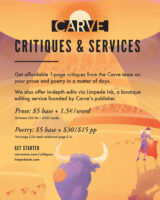
Screenshot of Carve Critiques & Services May 2021 NewPages eLitPak Flier
click image to open full-size flier

Carve offers critiques for prose on a per-word and for poetry on a per-page basis. Get a candid assessment of what’s working, what isn’t, and push your writing one step closer to publication. We also offer in-depth editorial services via Limpede Ink.

View the full NewPages May 2021 eLitPak Newsletter. Don’t forget to subscribe today to get it delivered to your inbox every month along with weekly updates on calls, contests, lit mag news, book news, and more.

May 2021 eLitPak :: 2021 Virtual Taos Writers Conference

screenshot of Taos Writers Conference March, April, May 2021 eLitPak flier
click image to view full-size flier

Join your fellow writers at the virtual 5th Annual Taos, New Mexico, Writers Conference on Zoom taking place Friday, July 23 through Sunday, July 25. Panel presentation on “Writing about Race, Class, Culture & Gender” plus over 20 workshops in all genres. Faculty include: Frank X Walker, CMarie Fuhrman, Levi Romero, Ari Honarvar, Stephanie Han, Jeremy Paden, Margaret Garcia and many more. Go to our website, call 575-758-0081, or email us.

View the full NewPages May 2021 eLitPak Newsletter. Don’t forget to subscribe today to get it delivered to your inbox every month along with weekly updates on calls, contests, lit mag news, book news, and more.

An Unquiet Mind

Guest Post by Diana De Jesus.

“I doubt sometimes whether
a quiet & unagitated life
would have suited me – yet I
sometimes long for it.” — Byron

This statement by Byron quoted in the text illustrates what life can be like for someone with mental illness.  An Unquiet Mind is a memoir by Kay Redfield Jamison, a Professor of Psychiatry, in which she candidly discusses her struggles with living with bipolar disorder (formally known as manic depression) from a variety of perspectives rather than just one lens.

Jamison references her journey from her adolescent to college years in which her manic depression illness slowly makes an appearance, altering her moods and performance unbeknownst to her at the time. However, as time progresses, so does the state of her illness. Jamison provides in vivid detail the many highs and lows she experiences because of her mental illness, and many incidences occur as a result; for example, extreme spending sprees, mood changes, violent episodes, engaging in uncharacteristic behavior towards her colleagues, and lastly a suicide attempt.

Soon after, she begins to see a psychiatrist at the age of 27, thus, eventually, learning her manic depression is hereditary since her father was dealing with the same affliction when she was a young adult. Moreover, her therapy sessions did not go without problems of course, as she confesses her reluctance to take medication more specifically Lithium.  In reality, she learns the hard way eventually realizing medication is a necessity rather than a hinderance; thereby, making peace with herself and her mental illness as she embraces her disease.

Through her writing, Jamison displays much resilience, and courage in spite of her illness. Her honesty and efforts in making sure people with depression and other psychiatric disorders do not feel ashamed nor stigmatized is quite commendable. In my view, she is a warrior and not a victim of her own mind. I recommend An Unquiet Mind to anyone; whereby, hopefully changing any preconceived notions regarding those who struggle with mental health issues.


An Unquiet Mind: A Memoir of Moods and Madness by Kay Redfield Jamison. Vintage, January 1997.

Reviewer bio: Diana De Jesus is an adjunct professor from Queens, NY, she is a fan of books, 80’s music to rock out too and old television shows. Additionally, she has a blog she is still very slowly and surely updating.

Buy this book from our affiliate Bookshop.org.

The Ways We Get By

Book Review by Katy Haas.

The characters in The Ways We Get By by Joe Dornich are doing their best, even if the things they’re doing aren’t necessarily good. Each one is struggling in their own way, many of them placed in interesting jobs like a professional cuddler working to care for his grandfather with dementia, a knock-off Aquaman struggling to connect with his father, an actor in a Bible-themed park, a man with a terminal illness manufacturing organs for fake dead bodies, and the list goes on.

These characters are far from perfect. They mess up, they have big egos, they abandon and hurt the people around them. But they’re utterly human with each of their flaws, and they all have heart. They seek companionship, aim to please their loved ones, and want to make friends and find love. The settings and situations they find themselves in aren’t quite ordinary, but they still feel real thanks to the raw humanness of the characters. Even characters one might normally deem unlikable still have a sympathetic light shown on them.

Dornich has created an enjoyable read that gives the reminder that plenty of us are out here trying our best as we do whatever we need to get by.


The Ways We Get By by Joe Dornich. Black Lawrence Press, January 2021.

Buy this book from our affiliate Bookshop.org.

Event :: the daphne review online mentorship for high school students

The Daphne Online Summer Mentorship 2021 bannerRegistration Deadline: May 31, 2021
Event Dates: June 14 – July 2, 2021
Event Location: Virtual
Love writing but need professional guidance to help you develop your voice? Apply to the 2021 Daphne Online Mentorship Program! We will be selecting 5-7 dedicated students to work with caring, accomplished professional writers on a one-on-one basis. Recent Daphne mentees have been accepted to Harvard, Princeton, Yale, Stanford, Columbia, and top creative writing programs, e.g., Iowa!

Session I: June 14 – July 2. Currently seeking online MENTORS! Please send resume to [email protected].

Students/program applicants, applications NOW OPEN. DEADLINE IS MAY 31, 2021. Any question, feel free to email us at [email protected].

The Main Street Rag – Spring 2021

The Spring 2021 issue features Postscript to a Postscript: an interview with Bill Glose, Winner of the 2020 Main Street Rag Poetry Book Award, interviewed by M. Scott Douglass. Fiction by Abe Aamidor, Allison Daniel, Tony Hozeny, Michele Lovell, Bob Moskowitz, Robert Stone and poetry by Bill Glose, Joan Bauer, Frederick W. Bassett, Joan Bernard, Burt Beckmann, Ace Boggess, Marion Starling Boyer, and more.

The Greensboro Review – Spring 2021

Featuring the Robert Watson Literary Prize-winning story, Casey Guerin’s “What Consumes You,” and the Prize-winning poem, Chelsea Harlan’s “Some Sunlight.” Issue 109 also includes an Editor’s Note by Terry L. Kennedy and new work from Rachel Abramowitz, Allyn Bernkopf, and more. Read more at The Greensboro Review website.

Carve Magazine – Spring 2021

The Spring 2021 issue features short stories by and interviews with Sydney Rende, Sam White, Kimm Brockett Stammen, and Caroline Kim. New poetry by Michael Quinn, Ruth Baumann, Will Thomas, and Mureall Hebert and nonfiction by Jory Pomeranz and Christie Tate. Prose & Poetry Contest winners: Mona’a Malik, Ryan Little, and Alisha Acquaye. Read more at the Carve website.

New Lit Mags added to the NewPages Guide to Literary Magazines in April 2021

Back from hiatus, Agave Magazine is a print publication showcasing contemporary art, literature, and photography for a modern readership. Ideal submissions develop subjects thoroughly giving us all the essentials—no more, no less. From editorial pieces to mixed genre, their contributors share insights on their creative processes alongside published pieces.

Founded in 2020, Coastal Shelf is a quarterly online literary magazine. Contemporary and eclectic, they crave close attention paid to language and a ‘larger takeaway’/analysis given to the events/themes. They love pieces with wittiness (but not light verse), quirkiness and layers. They also dig interesting uses of history and science.

The Lascaux Review, pronounced Las-coe, features fiction, poetry, and creative nonfiction of literary quality. Lascaux has published work by Philip Appleman, Hélène Cardona, Joseph Fasano, Tony Hoagland, Lee Martin, Maggie Smith, Robley Wilson, and many other poets and writers. Annual contests are conducted in poetry, flash fiction, creative nonfiction, and short fiction.

Founded in 2017, MoonPark Review is a quarterly online journal publishing compelling, imaginative short prose, including flash (fiction/nonfiction) and prose poetry. Thirteen prose pieces (or thirteen writers) are featured each quarter, accompanied with original illustrations.

Nixes Mate is unafraid of punctuation; semicolons don’t frighten them. Not even a little bit. Since 2016, they have been featuring small-batch artisanal literature, created by writers who use all 26 letters of the alphabet, and then some. There are many paths to poetry. Walk with them one line at a time.

Okay Donkey likes the odd, the off-kilter, and the just plain weird. They also like the surreal, experimental, and the genre-bending. They strive to uplift and amplify underrepresented voices and always strongly encourage BIPOC and LGBT+ folks to submit their work.

Also added are print literary magazine Bacopa Literary Review, Blue Collar Review, Deep Wild: Writing from the Backcountry, Walloon Writers Review, and Workers Write! and online journals Decolonial Passage, Flare Journal, and WhimsicalPoet/WhimsicalArt.

Don’t forget to stop by our Guide to Literary Magazines to see the newly updated listings and remember we also have our Big List with even more journals!

New Letters Award Winners

woman looking at a poster for a ballet performance

In the Winter/Spring 2021 issue of New Letters, there is a whole section dedicated to award winners.

Editor’s Choice Award
“Indigent” by Elizabeth Robinson

Patricia Cleary Miller Award for Poetry
“Late Song: Time” and “The Art of the Deal” by Mark Wagenaar

Robert Day Award for Fiction
“Lobu Hoteru” by Jacob R. Weber

Conger Beasley Jr. Award for Nonfiction
“Joan” by Rebecca Young

Visit New Letters‘ website to grab a copy of this issue and learn about each of these contests.

A Mystery that Only the Dead Can Solve

Guest Post by Heather McCardell.

Elatsoe (pronounced el-at-so-ay) by Darcie Little Badger follows Ellie Bride, a Lipan Apache teenager, as she, her ghost dog Kirby, mom, and best friend Jay seek to uncover the truth about the night her cousin was found in a single car crash. This hunt takes them to the little town of Willowbee, where Ellie discovers a town secret that haunts her more than the dead she can wake. In this riveting debut novel, Little Badger crafts a world where magic is the norm and passed down through family lines – Ellie can wake the dead, passed down through her Great-Six Grandmother, and Jay is a direct descendent from the fairy king Oberon – and weaves a tale about family, allies and advocacy, and the ongoing colonization of Indigenous peoples. Little Badger handles the topic of colonization with delicacy, approaching it through character dialogue and entwining it with the ending revelation.

One thing I adored about this book was the oral storytelling culture that appears throughout, especially in the tales of Great-Six. These act as teaching moments for both Ellie and the reader, and provide readers a deeper look into Ellie’s family history and relations. At the heart of this novel is a story about a young girl who will do what she can to get justice, and allies who believe and support her and her family when they rightfully claim that her cousin’s death was no accident. In between the detective work, Ellie continues to work on her skill of waking the dead, much to the concern of her mom, but there is one rule passed down with this magic that Ellie plans to abide by: never wake a human ghost. With Dr. Abe Allerton as a suspect, Ellie senses a conspiracy that involves her cousin’s murder, and this is one secret she won’t let stay buried.


Elatsoe by Darcie Little Badger. Levine Querido, August 2020.

Reviewer bio: Heather McCardell is a graduate student at the University of Windsor, studying English Literature and Creative Writing. When not writing essays, she enjoys writing poetry and hiking.

Buy this book from our affiliate Bookshop.org.

Event :: The Constellation, A Place for Writers Workshops Start This Week

yellow start with blue text on a white background saying The Constellation A Place for WritersDeadline: Year-round
Location: Virtual
The Constellation, A Place for Writers provides innovative, online creative writing workshops that inspire, instruct, nurture, and challenge. Our acclaimed instructors offer classes in short fiction, novel, essay, memoir, poetry, children and young adult, literary translation, publishing, and hybrid forms. We host sessions for writers at all levels. The brainchild of award-winning and bestselling author Connie May Fowler, The Constellation is a global community of writers who support and elevate each other as they engage in the important work of honing their art and craft. In addition to workshops, The Constellation mentors weekly free prompts, write-ins, and more.

An Everyday Cult

Guest Post by C. Jane Taylor.

An Everyday Cult invites the reader to ride the spiritual rapids of the Center for Transformational Learning, a cult whose leader hopes you will drown. Working under the guise of a trusted therapist, the cult’s aloof, captivating, even sexy leader—referred to only as ‘Doug’—gives weekly ‘homework’ assignments that use pathologies, psychological archetypes, and dream interpretation as the foundations for self-annihilation.

The author’s elegant use of language makes An Everyday Cult read like a literary work of fiction and yet her treatment of the subject matter makes the tale race like a horror film. We watch from behind reluctantly parted fingers as the dark reality of the cult unfolds.

The reader travels with Buglion as she falls—simultaneously in love with the cult’s charismatic leader and asleep to her own identity—drifts, sleeps, and then snaps awake to the eighteen-year nightmare she has endured. The narrative reminds us to open our own eyes and stay awake to the dangers of authoritarian leaders claiming to know us better than we know ourselves.


An Everyday Cult by Gerette Buglion. Rootstock Publishing, May 2021.

Reviewer bio: C. Jane Taylor is the author of Spirit Traffic, a woman’s motorcycle journey of family, fear, and fledging. She lives, writes, and rides in Hinesburg, Vermont.

Buy this book from our affiliate Bookshop.org.

Into the Void – #19

Issue #19 of Into the Void is by far our biggest issue yet! Containing 12 fiction pieces, 3 creative nonfiction pieces, 15 poems, and 11 beautiful art pieces, Issue #19 is vast, vivid and vibrant. Fiction by Sean Cunningham, Laurel Doud, Mark Foss, Jones Irwin, Chris Neilan, and more.

Hole In The Head Review – May 2021

We’re all masked up and ready to roll out our latest issue! Poetry, videos, music, a dog with a frisbee, Nobel Laureate, art work, photography. Poetry from Anne Pierson Wiese, Tim Suermondt, Samantha DeFlitch, Dawn Potter, Ralph Savarese. See what else is in this issue of Hole In The Head Review.

Creative Nonfiction – No. 75

This milestone issue features some of our favorite prizewinning essays. These curious, beautiful, nuanced stories about everything from surviving lightning strikes to the relief of solving medical mysteries consider the many perils, as well as the tremendous power, of living in a body. See what else the issue has in store for you at the Creative Nonfiction website.

The Adroit Journal – April 2021

With Issue #37 of The Adroit Journal, we celebrate the extraordinary work of our Gregory Djanikian Scholars—six poets with immense talent who have yet to publish a full-length collection (hello, poetry presses!): Jari Bradley, Donte Collins, Jane Huffman, L. A. Johnson, Nastasha Rao and Brandon Thurman.

Unique Upcycled Notebooks Made From Vintage Books

Photograph of upcycled notebooks handcrafted from vintage booksBookMark Books refashions discarded and unwanted vintage books into lovely, sturdy, unique, blank notebooks. Made with upcycled, vintage covers; recycled interior paper; and hand-waxed thread, they are excellent tools for writers, artists, musicians, teachers, or anyone who loves beautiful books and the act of making their mark. A notebook is an essential tool for writers and artists, and having something beautiful, handmade, and environmentally friendly to use when an idea strikes makes creating even more satisfying. Visit me on on Instagram @bookmark_books for pictures of what I’m working on and a link to my Etsy shop.

About Place Journal – May 2021

“Geographies of Justice,” edited by Alexis Lathem with Richard Cambridge and Charles Coe. An extraordinary testament to extraordinary times: includes poetry from Susan Deer Cloud, Tammy Melody Gomez, Richard Hoffmann, Jacqueline Johnson, Petra Kuppers, and Danielle Wolffe; nonfiction from Teow Lim Goh, Andréana Elise Lefton, David Mura, Nicole Walker, and Catherine Young. Find more contributors at the About Place Journal website.

The Necessity of Human Myth

Guest Post by Adrian Thomson.

Jesse Lee Kercheval’s “The Boy Who Drew Cats” speaks both to our current time and to the necessity of human myth. Confined to a house in Uruguay as her children face quarantine in Japan, Kercheval connects to the hero of a Japanese fable, the titular drawer of cats, in an attempt to find solace within herself through her own artistic ventures.

This connection to cultural myth—and Kercheval does cement her own tale very concretely to the modern as well as the mythical—inspires the author in its assertions of safety, balance, and a sense of stability. The myth helps her recapture her own love of art and facilitates a return to  the page where flowers transform into felines. Kercheval does not uphold the myth as a perfect guideline, either—she comments upon it, accepting the good she sees there while acknowledging elements she appears to dislike.

But her inclusion of the fable also speaks to the wider purpose of human myth—as a necessity of the imagination to allow us to “visit” faraway places and to inspire. Kercheval places both within the story to generate trust that the world will get better, as well as trust in her own abilities.


The Boy Who Drew Cats” by Jesse Lee Kercheval. Brevity, January 2021.

Reviewer bio: Adrian Thomson is a graduate student at Utah State University, currently working toward his MS by way of a thesis in poetry.

Explorations of Identity

Guest Post by Natalie Hess.

This was a really weird book, but in a good way. It follows a girl named Jenna Fox who was in a car accident and woke up from a coma with no memories at all. She has to build a new life for herself while also trying to find out about her past.

There are some sci-fi elements in the medical parts of this story as well which made for some really shocking plot twists, and the way that Jenna’s new life is shaped because of those things is so much different than normal people’s lives.

This book also brings up identity and what it means to be yourself and have your own personality and I really enjoyed that part of it. I also liked the whimsical way the story was told. There were parts where I felt like I was reading poetry because the writing is so pretty, but it was really easy to understand, even the more scientific parts.

If you really enjoy stories about medical miracles, or utopian stories, this is a great book to pick up.


The Adoration of Jenna Fox by Mary E. Pearson. Square Fish. 2009.

Reviewer bio: I’m Natalie Hess and I’m simply a high school student who LOVES reading everything from scifi to romance to nonfiction and everything in between. I also love sharing my thoughts and I hope you enjoy!

Buy this book from our affiliate Bookshop.org.
What It Means to Be an Underdog

Guest Post by Gabrielle Thurman.

Dog Boy by Eva Hornung is the harrowing tale of a young boy raised by wild dogs. Based on a true story, the novel follows Romochka, a four-year-old boy abandoned by his family, as he attempts to survive the Russian winters in the aftermath of perestroika. At its heart, this book is a story about what it means to be an underdog, both literally and metaphorically.

Every scene in this book had me gritting my teeth. I laughed. I cried. I walked away from it in horror and disgust, only to return to it again and again. It’s one of those books that even after you finish reading it, you still think about it. I can’t look at dogs the same way I used to. Hornung does a fantastic job of examining what it means to be a “person.”

The book isn’t perfect. There are parts where the plot gets a bit fuzzy and convenient. She stretched my suspension of disbelief a tad bit too far in places. Overall, though, this is one of my new favorites, and I’ll definitely be recommending it to others. If you love books about  dogs, survival, Russia, humanity, violence, family, and hope, then this book is for you.


Dog Boy by Eva Hornung. Viking, March 2010.

Reviewer bio: Gabrielle Thurman is a creative writer, professional editor, queer woman, native Arkansan, and aspiring novelist. Her creative nonfiction can be found in The Elephant Ladder and The Vortex Magazine of Literature and Fine Art.


New Letters Volume 87 Numbers 1 & 2

woman looking at a poster for a ballet performanceLiterary magazine New Letters publishes two double issues a year in print. Their Winter/Spring 2021 issue is now available for purchase and features fiction by Blair Hurley, Robert P. Kaye, Kirstin Scott, Anthony Varallo, and Leslie Blanco; essays by Carolina Avarado Molk, Emily Howorth, and Michaela Django Walsh; and poetry by Rebecca Foust, Jennifer Perrine, D.S. Waldman, Ted Kooser, Mihaela Moscaliuc, and Liane Strauss.

Also in this issue find the winners of their annual literary awards!

  • “Indigent” by Elizabeth Robinson, winner of the Editor’s Choice Award
  • Two poems by Mark Wagenaar, winner of the Patricia Clearly Miller Award for Poetry
  • “Lobu Hoteru” by Jacob R. Weber, winner of the Robert Day Award for Fiction
  • “Joan” by Rebecca Young, winner of the Beasley Jr. Award for Nonfiction

Their current awards in fiction, poetry, and nonfiction are open to entries through midnight CST on May 18! Check out the 2020 winners and don’t forget to pick up this issue and support the journal by subscribing!

‘Even the Saints Audition’

Guest Post by Sherrel McLafferty.

When we are asked to carry stories with us, fables and religion and family origins, we carry not just their words but their implications. Opening with a thoughtful exploration of Job, we witness the haunting impacts of “. . . the Devil asking / for permission to torment” and “God saying yes” on a vulnerable persona who ties these poems together. As a reader, the three acts serve as a pathway between childhood, where poems are playful including asking questions about sex in Sunday school, to the self doubt and self-harm of teenagehood, and ending with a young woman’s struggle with addiction.

In the background of this transformation, there is God and this story that haunts the beginning of each act, Job. God let him suffer. God lets our persona suffer. The commitment to the theme is astonishing; Jackson uses erasure of hymns, references to Jonah, and the anticipated language of sin. However, the redemption arc is not quite there. Jackson keeps us hungering for relief that only appears in the occasional rhetorical line or question, “Who am I /to go against God & the saints?”

I arrived at this book in need of fellowship about midway through this hellscape of a year. What a welcome 75 pages of commiseration. An open hand to anyone, regardless of religion, despite its theme because at its heart, it builds a story of abandonment, of melancholy, of needing someone to witness one’s pain.


Even the Saints Audition by Raych Jackson. Button Poetry, September 2019.

Reviewer bio: Sherrel McLafferty is a Pushcart nominated writer residing in Bowling Green, Ohio. For more information, visit her website at sherrelmclafferty.com or her Twitter @AwesomeSherrel.

Buy this book from our affiliate Bookshop.org.
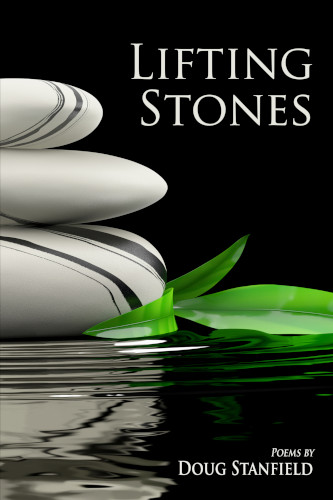
Magazine Stand :: Wordrunner eChapbooks – 2021

Our theme for this issue is LOVE in all its painful, confusing, passionate, and joyous diversity. Featuring fiction by Louise Blalock, Margaret Emma Brandl, Ed Davis, Stefan Kiesbye, and Nick Sweeney; memoir by Jane Boch, Ruth Askew Brelsford, Laura Foxworthy, and Carmela Delia Lanza; and poetry and prose poems by Leonore Hildebrandt, Robert Murray, and Jacalyn Shelley.

Raleigh Review – Spring 2021

This issue features the winners of the Flash Fiction & Geri Digiorno Contests. New flash fiction from Frank X. Christmas, Andrea Eberly, Amina Gautier, Katherine Hubbard, Alana Reynolds, and Nicholas A. White. New poetry by Julia C. Alter, Melissa Boston, Jessica Dionne, Chelsea Harlan, and more. Find more contributors at the Raleigh Review website.

The MacGuffin – Winter 2021

The MacGuffin’s Vol. 37.1 comes at you with an expanded selection of poetry and expanded coverage of our Poet Hunt contest(s) too! We start with Matthew Olzmann’s selections from Poet Hunt 25: Vivian Shipley’s grand prize winning “No Rehearsal” and honorable mention selections from Rita Schweiss and John Jeffire.

The Bitter Oleander – Spring 2021

Special to this issue of The Bitter Oleander: The Central New York poet Paul B. Roth in dialogue with John Taylor, with a selection of his poetry included. Also in this issue: fiction by William Nuth, Marilee Dahlman, and more; poetry by Andrea Inglese, Patty Pieczka, Lake Angela, Pedro Serrano, Silvia Scheibli, Fabio Pusterla, and more.

Apple Valley Review – Spring 2021

Featuring new fiction by Michael Beadle and Mary Gulino, an essay by Carl Schiffman, and poetry by Linda K. Sienkiewicz, Giovanni Raboni (translated from the Italian by Zack Rogow), Joseph Fasano, James P. Cooper, Katherine Fallon, Barbara Daniels, and Mark Belair. Cover painting by Dutch artist Johannes Vermeer. More info at the Apple Valley Review website.

At the Intersection of Religion & Generational Conflict

Guest Post by Madeline Thomas.

When a combination of a Catholic upbringing and the unforgettable viewing of a commercial for The Exorcist sends a young girl’s mind to the inevitability of a personal demon possession, the first steps are taken on a path to parental disappointment. Jessica Power Braun’s “Black Alpaca” places readers at the intersection of religion, generational conflict, and closet-Jesus nightmares with sharp humor and unflinching honesty.

The essay, published in Hippocampus Magazine, works through the realities of fear and guilt in the Catholic Church, the slow movement away from your family’s religious identity, and the discovery of a poignant black alpaca painting in the context of Braun’s identities as a mother, wife, and daughter. Humor forms the heart of the piece, but the essay makes no attempt to pull away from what is both painful and real—forming a balance that cultivates both emotional impact and investment for readers.

In a time where I feel the need for constant breaks from the mire of news and the world in general, the humor and tone present in “Black Alpaca” provides needed relief. Braun utilizes her power in storytelling to craft something worth connecting with.


Black Alpaca” by Jessica Power Braun. Hippocampus Magazine, January 2021.

Reviewer bio: Madeline Thomas is a graduate student and writer at Utah State University.

Join Poor Yorick for Their Monthly Reading Series

skull on black and pink backgroundPoor Yorick is continuing their monthly reading series with a virtual open mic and fireside chat! This event features a sneak preview of upcoming special issue in honor of National Poetry Month, “The Poet’s Mask.” Several contributors will present their work on the theme of masks and masking on April 29.

Contact Brianna Paris ([email protected]) for a Microsoft Teams invitation.

“The Poet’s Mask” will be published on Friday, April 30 on Poor Yorick‘s website.

This event is brought to you by the editorial team at Poor Yorick: A Journal of Rediscovery, which is the online literary publication of Western Connecticut State University’s M.F.A. Program. The journal publishes poems, stories, essays, photo essays, and other innovative works about rediscovery, the lost and the found—what we bury, and what we dig up. The editor will be on hand at the open mic to talk submissions, too; if this sounds like your kind of publication, contact us!

A Memoir of Two Illnesses

Guest Post by Kylie Smith.

In Every Last Breath: A Memoir of Two Illnesses, scholar and memoirist Joanne Jacobson strings twelve independently stunning essays together to create a lyrically compressed contemplation of the always frail body.

The essays detail Jacobson’s heart-wrenching experience of discovering her own chronic illness even as she was writing about her mother’s. Both memoir and biography, the book rejects the linear trajectory of conventional narrative to call the reader “out of time” and into the lives of two Jewish-American women as their diseases, one of blood and one of breath, force them to confront “end of life” together.

With the precision of a poet, Jacobson gracefully and honestly explores the ephemerality of time and breath and speaks deeply to the shared human experience of incremental loss. Every Last Breath is a hopeful and hurting reminder that the body is both singly inhabited and commonly shared.


Every Last Breath: A Memoir of Two Illnesses by Joanne Jacobson. The University of Utah Press, 2020.

Reviewer bio: Kylie Smith is a writer based out of Logan, Utah.

Buy this book from our affiliate Bookshop.org.

A Departure from the Everyday Love Story

Guest Post by Aramide Salako.

Love it. I reckon this to be the best Romance/Young Adult fiction ever. All love stories, fiction and nonfiction, are each unique manifestations unlike none other. But here, the story of love takes a clear departure from your everyday love story. What makes this book a brilliant read is the simple presentation of the power and shortcoming of love in the face of mortality.

Humans have a life to live, and the love to share wholeheartedly with another is the blessedness of being human. That humans will ultimately die, leaving the one bereaved of such felt assurance and aliveness that only the other half could provide, is the nemesis of being human.

Hazel Grace and Augustus Waters, bound with the affliction of cancer and then again bound by the Cupid arrow, grapple with the reality of their fate stoically, braving the odds stacked against them. They experience, enjoy, and embrace love, but death, that Grim Reaper, of course, has the final say.

The Fault In Our Stars is a fictitious narration of a story of our lives. Life is transient—a mere finite number within infinity.

We shall not have all the time in the world to experience the profundity of companionship, mirth, eros, and all of the fine attributes accompanied by love. But in that brief expanse of time—cancer-ridden, poverty-ridden, crisis-ridden, virus-ridden—love endures and triumphs over all human vagaries and the finitude of time.


The Fault in Our Stars by John Green. Penguin Group, April 2014.

Reviewer bio: My name is Aramide Salako from Nigeria. I enjoy reading classics and bestsellers. I’ve read some classics that linger in memory, both fiction and nonfiction. I self-published my first book this year: Thoughts in Traffic; 243 Quick-fire Notes to Aid Your Outlook on Self, Life and the Afterlife.

Buy this book from our affiliate Bookshop.org.
Sponsor Spotlight :: Neon: A Literary Magazine

black and white photograph looking up at a wind turbineNeon: A Literary Magazine is a tiny biannual journal and chapbook press. It is one of the longest-running independent literary magazines in the UK which focuses on slipstream fiction, poetry, and artwork. They publish work that is fantastical, surreal, and which crosses the boundaries between science fiction, horror, and literary fiction.

Neon publishes in print and a range of digital formats. They allow you to set your own price for a digital copy. When you purchase a print subscription (they ship to anywhere in the world!), you can addon on of their chapbooks, too. Subscribe today!

Plus, if you’re a writer, Neon is currently open to submissions. The theme of the next issue will be “Cities.” They are a paying market.

Drop by their listing on NewPages to learn more.

NewPages Book Stand – April 2021

If you’re always on the look-out for new books, be sure to check out our monthly updated Book Stand. This month, we featured the five titles below.

Christopher Citro in If We Had a Lemon We’d Throw It and Call That the Sun “makes wildly inventive, exciting, vital poems.”

The Last Unkillable Thing by Emily Pittinos is a journey across landscapes of mourning.

In More Enduring for Having Been Broken by Gwendolyn Paradice, readers can expect stories of children abandoned, forgotten, and ignored as they survive the trauma they experience.
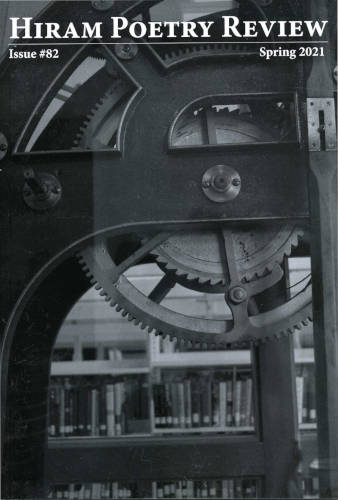
Saturation Project by Christine Hume is genre-defying as it “brings memoir and essay to the land of myth.”

The poems in Aaron Caycedo- Kimura’s Ubasute are detailed, elegiac meditations within a particular American family.

You can learn more about each of these New & Noteworthy books at our websiteClick here to see how to place your book in our New & Noteworthy section.

West Trade Review Volume 12 Available for Preorder

West Trade Review Volume 12 cover

West Trade Review, formerly Encore Literary Arts Magazine, is accepting preorders for its 12th print issue due out in May of this year.

This issue features fiction by Sophie Nau, Reshmi Hebbar, Lex Chilson; poetry by Mercury-Marvin Sunderland, Tesa Flores, Hunter Boone, Stephanie Dickinson; plus art, interviews, and reviews. Check out their preview and don’t forget to order a copy today.

Plus, don’t forget to swing by their listing on NewPages to learn more about them.

World Literature Today – Spring 2021

World Literature Today’s spring issue, “Redreaming Dreamland,” gathers the work of 21 writers and artists reflecting on the centennial of the 1921 Tulsa Race Massacre, including Patricia Smith, Joy Harjo, Jewell Parker Rhodes, and Tracy K. Smith. Additional highlights in the issue include a special section on Chinese migrant workers’ literature; an essay on how Giannina Braschi’s work keeps “popping up” in pop culture; fiction from Belarus and Iraq; plus reviews of new books by Najwan Darwish, Cixin Liu, Olga Tokarczuk, and dozens more.

Sky Island Journal – Spring 2021

Sky Island Journal’s stunning 16th issue features poetry, flash fiction, and creative nonfiction from contributors around the globe. Accomplished, well-established authors are published—side by side—with fresh, emerging voices. Readers are provided with a powerful, focused literary experience that transports them: one that challenges them intellectually and moves them emotionally. Always free to access, and always free from advertising, discover what over 80,000 readers in 145 countries already know; the finest new writing is here, at your fingertips.

Chinese Literature Today – Vol 9 No 2

In this issue of Chinese Literature Today: a selection Coronavirus Poems, “On Being Elsewhere” a feature by Lu Min, “Travel with the Wild Wind” by Xue Yiwei, and paintings by Wang Mansheng. Plus, poetry by Haobo Shen, Bai Lin, Zheng Min, and more, and a short story by Zhang Ning.

Chestnut Review – Spring 2021

The springtime brings a sense of renewal: feeling the sun beginning to heat up and shedding the cocoon of cold winter nights. Spring offers the opportunity to get out and discover something new. At Chestnut Review, we are also experiencing a turn, a closing of our second volume and anticipating our third. This issue features work by Cutter Streeby, Gretchen Rockwell, Rebecca Poynor, Zackary Medlin, Lorette C. Luzajic, Satya Dash, Fatima Malik, and more. See what else can be found in this issue at the Chestnut Review website.

Beloit Fiction Journal – Spring 2021

A new issue of Beloit Fiction Journal is out. Contributors to this issue include Sean Williamson, J. T. Townley, Casey McConahay, Andrew Bertaina, Paige Powell, Kathryn Henion, Maura Stanton, Caryn Cardello, Sara Heise Graybeal, Sam Gridley, and more. Read more at the Beloit Fiction Journal website.