This morning I took the boys out for a walk before the heat and humidity had a chance to settle in, and there at the edge of the driveway, I found them again—pale trumpet-shaped blooms, white with the faintest pinkish tints and deeper-colored markings at the throat. They’ve come back every summer for years now. I have no idea where they came from originally, but they reminded me immediately of the morning glories we used to grow around the old well pump. Google, ever the authority, informs me it’s a weed—though it belongs to the very same family as morning glories. And that got me thinking—who gets to decide?
Continue reading “Out of Place: A Prompt on Beauty, Belonging, and the Things We Pull”NewPages Blog :: Writing Prompts
Looking for a spark of inspiration? Our biweekly writing prompts are designed to challenge your creativity, deepen your storytelling, and help you reconnect with your writing practice. Whether you’re journaling, drafting fiction, or just trying to get words on the page, these prompts offer a fresh starting point every Monday—straight from our newsletter and every Friday with our Where to Submit Roundups.
The Postcard Challenge
Being a collector of postcards and discovering a cache of old ones while cleaning out my grandparents’ house sent me straight back to my undergraduate days and it seemed too good not to share.
Continue reading “The Postcard Challenge”Haunting the Halls: A Prompt on Love Built in Silence
Weekly Creative Prompt
Sanctuary of Silence
“And still, you chose to sleep beside the ghost of me.”
— Ashes of Eden, “Sanctuary of Silence” (2026)
There are songs that find you in a particular kind of ache, the kind you didn’t know had a name until the music gave it one. Ashes of Eden’s “Sanctuary of Silence” is one of those songs for me. It explores something most love stories skip past entirely: not the dramatic ending, not the confrontation, but the quiet architecture of a love that was never spoken aloud. A devotion that built its own temple in the dark and kept the lights on even after the person it was built for walked away.
The line that won’t let me go: “And still, you chose to sleep beside the ghost of me.”
Continue reading “Haunting the Halls: A Prompt on Love Built in Silence”A note before we begin: I came to this song one way and found it held something else entirely. If you’ve lost someone—recently, or not so recently—this prompt has a room for that too. The sanctuary doesn’t care how the person left. Only that they’re gone, and that something of them still echoes, just like I cannot escape from the echo of my grandfather who would have turned ninety today.
Weekly Creative Prompt
Sanctuary of Silence
“And still, you chose to sleep beside the ghost of me.”
— Ashes of Eden, “Sanctuary of Silence” (2026)
There are songs that find you in a particular kind of ache, the kind you didn’t know had a name until the music gave it one. Ashes of Eden’s “Sanctuary of Silence” is one of those songs for me. It explores something most love stories skip past entirely: not the dramatic ending, not the confrontation, but the quiet architecture of a love that was never spoken aloud. A devotion that built its own temple in the dark and kept the lights on even after the person it was built for walked away.
The line that won’t let me go: “And still, you chose to sleep beside the ghost of me.”
Continue reading “Haunting the Halls: A Prompt on Love Built in Silence”The Things We Thought Would Last
Weekly Creative Prompt
Dynasties
“I like the stars. It’s the illusion of permanence, I think… I can pretend that things last. I can pretend that lives last longer than moments.”
Neil Gaiman, The Sandman, Vol. 7: Brief Lives
For a long time, Miia’s Dynasty was everywhere—YouTube Shorts, fan-made MVs for the dramas I was watching, layered under scenes of characters loving each other badly or beautifully or both at once. When you hear it in that context enough times, it gets under your skin. It adds a bittersweet poignancy to everything it touches.
Then the other day, just streaming music, Miia’s own video came on—and I was transported. Back through all those clips, all those stories, and then further, into thinking about the different kinds of dynasties we build in our own lives. The ones we were born into. The ones we chose. The ones we were so sure would last.
It’s a little like what Adele did with Rolling in the Deep—that gut-punch of we could have had it all. The belief was real. The loss was real. And somewhere in the space between those two truths is where the song lives.
This time of year, when we’re thinking about what endures and what doesn’t—the things handed down, the things lost, the names we still speak and the ones that quietly faded—Dynasty feels like exactly the right spark.
What we build. What we believed about it. What falls. What remains.
This Week’s Challenge
Choose the moment that pulls you in and create from there.
The Belief
Write or create from inside the certainty. Before the cracks, before the signs. What does it feel like to be sure something will last? A relationship, a family, a way of life, a legacy built across generations. Let your work hold that conviction without irony, the reader should feel how real it was.
The Fall
Collapse isn’t always loud. Sometimes a dynasty ends in a single quiet decision, a silence where there should have been a word, a door closing softly on something enormous. Write or create from inside the unraveling. What does it look like, feel like, sound like from where your character is standing?
The Gap
That specific, suspended moment of realizing it’s over. Not the aftermath, the instant. The breath between what you thought you had and the truth of what remains. This is the hardest territory to write and the most resonant when you get it right.
The Aftermath
What survives a dynasty’s end? A photograph. A last name. A habit. A scar. A song someone still hums without remembering where they learned it. Write or create from what’s left behind—what gets carried forward and what gets buried.
Three Craft Notes
Let scale be flexible.
A dynasty doesn’t have to be a kingdom. The most powerful versions of this prompt will probably be intimate—a family, a relationship, a self-concept that once felt unshakeable. Don’t reach for the grand when the small is closer to the truth.
Resist explaining the loss.
The temptation in collapse narratives is to account for everything—to make the fall make sense. But the most haunting work leaves something unnamed. Trust the gap. One unexplained detail held with confidence will do more than a paragraph of analysis.
For visual artists and collage makers:
Think about what a dynasty looks like at each stage—the gold of the belief, the fracture lines, the ruins, the single artifact that outlasts everything else. Juxtaposition between grandeur and intimacy can carry the whole emotional arc without a single word.
Enjoy prompts like this?
Get fresh inspiration delivered to your inbox every Monday by subscribing to our weekly newsletter. You’ll also find new issues of great lit mags, new and forthcoming titles, recommended readings, bookstore updates, and submission opportunities.
Subscribe NowCut the Rot, Keep the Roots: A Writing Prompt on Pruning What No Longer Serves
A line from a novel-in-progress inspired by gardening? Why not? Can you imagine what a simple phrase can morph into when you are writing? Shall we “cut the rot and keep the roots” together?
Weekly Creative Prompt
Cut the Rot, Keep the Roots
“The most important thing is to prune well. And to prune well, you must know why you are cutting.”
— Unknown
There is a particular kind of grief that comes from watching something you tended carefully go wrong anyway.
My chives used to be a dense, thriving cluster — the kind of herb patch that made you feel like you knew what you were doing. Then, gradually, they didn’t. Early blooming, sparse growth, a tangle so enmeshed the whole clump had forgotten how to be healthy. Meanwhile, the garlic chives spread with complete indifference to anything resembling restraint, colonizing every nearby inch of soil.
The solution, it turns out, is almost brutal in its simplicity. Cut the flowers before they seed. Divide the clumps. Pull the whole thing apart and give each smaller section room to breathe again. The plant doesn’t die from this — it comes back stronger. But you have to be willing to do something that looks, from the outside, a lot like destruction.
Gardeners know this. Writers and artists often need to be reminded of it.
This Week’s Challenge
Think about something in your creative life—or your interior life—that has become overgrown, entangled, or choked by its own abundance. A project that kept accumulating until the original idea disappeared somewhere in the middle. A habit, a relationship, a way of working, a belief you’ve held so long it’s started to crowd everything else out. A voice in your writing that used to serve you and now just fills space.
What would it mean to cut the flowers—to remove what’s seeding more chaos—and separate what remains back into something smaller, cleaner, and capable of growing again?
Create from that threshold. The moment of decision. The act itself. Or the quiet afterward, when the bed looks almost bare and you have to trust that what you kept is enough.
Write, draw, photograph, collage, or compose something that lives in the tension between loss and renewal—where pruning is not abandonment, and division is not the same thing as destruction.
A Way In
If you’re not sure where to begin, start with a specific thing rather than a concept. A paragraph you’ve been carrying in a draft for two years that no longer belongs. A friendship that once felt essential and now feels like obligation. A creative practice you’ve outgrown but haven’t yet let go of. The more concrete and particular your entry point, the more the larger emotional truth will take care of itself.
Three Craft Tips
Not sure where to begin or how to go deeper once you’ve started? These three practices work especially well when the subject matter is loss, necessity, and the things we can’t fully explain.
Let the act speak—resist the explanation
The temptation with a prompt this close to the bone is to explain what it means while you’re writing it. But the most resonant work about necessary loss doesn’t announce itself. It shows hands in dirt. It shows the pause before the cut. It trusts the reader to feel the weight of what’s being separated without being told what to feel.
Write the physical reality of the thing—the tangled roots, the overgrown manuscript, the drawer you finally cleared out—and let the emotional meaning arrive on its own.
Honor what was healthy before it wasn’t
The pitfall of any “letting go” piece is that it can flatten what came before into a problem to be solved. But chives don’t go wrong out of failure—they go wrong out of abundance, out of too much of a good thing left unattended. The more honest and specific you are about what the thing was at its best, the more your piece will carry genuine grief rather than tidy resolution.
Don’t skip the eulogy for what worked. That’s where the real texture lives.
Resist the clean ending
Pruning in a garden looks decisive. On the page, the aftermath is messier and more truthful—what you kept isn’t guaranteed to thrive, and you won’t know for a while. If your piece arrives too neatly at peace with what was cut, push back on that draft.
The most honest version probably ends in uncertainty: the bed looks bare, and you’re not sure yet if you did the right thing, and you water it anyway.
Enjoy prompts like this?
Get fresh inspiration delivered to your inbox every Monday by subscribing to our weekly newsletter. You’ll also find new issues of great lit mags, new and forthcoming titles, recommended readings, bookstore updates, and submission opportunities.
Subscribe NowThe Mirror You Didn’t Plan: Using Reflected Structure in Writing and Art
Weekly Creative Prompt
The Mirror You Didn’t Plan
“Perhaps all the dragons in our lives are princesses who are only waiting to see us act, just once, with beauty and courage.”
— Rainer Maria Rilke
I have a confession to make. Working through a draft recently, I noticed something I hadn’t engineered. Two scenes—separated by chapters, featuring different characters—were quietly answering each other. Same emotional stakes, different outcomes. Same unspoken question, different silences. I hadn’t planned it. The mirror was already there.
That’s the thing about mirroring in creative work. We often reach for it instinctively before we understand why.
A mirror in writing or art isn’t just visual symmetry. It’s a structural echo—a repeated event, a parallel relationship, a second image that reframes the first simply by existing. A poem where the closing lines reverse the opening. A story where two characters make the same choice under different circumstances and one of them breaks. A diptych—and yes, the diptych isn’t only for visual artists; two poems placed side by side, two flash essays in conversation, two panels of a comic—where the meaning lives in the gap between the halves, not in either half alone.
The instinct toward mirroring is natural. The challenge is learning when to trust it and when to get out of its way.
This Week’s Challenge
Create something that uses mirroring as a structural device—but don’t force it. Start with one image, one scene, one voice. Then let the second half arrive on its own terms. What answers it? What reverses it? What stands across the glass and means something different depending on which side you’re reading from?
Craft Lesson
The most common pitfall with mirrored structures is engineering the symmetry too early. When a mirror is built before the material has found its own shape, it tends to flatten both halves — each one bending toward the other instead of standing on its own. Write the first half as if there is no second. Let it be complete. The mirror, if it belongs, will reveal itself in revision.
A mirror doesn’t have to be exact to work. The most resonant parallels are the ones that are almost symmetrical but not quite — two scenes that rhyme without matching, a repeated phrase that shifts meaning because the speaker has changed. Imperfect mirrors carry more emotional weight than perfect ones. They create the sensation of recognition without the neatness of resolution.
Enjoy prompts like this?
Get fresh inspiration delivered to your inbox every Monday by subscribing to our weekly newsletter. You’ll also find new issues of great lit mags, new and forthcoming titles, recommended readings, bookstore updates, and submission opportunities.
Subscribe NowDefenestration and Other Things My Brain Refused to Forget
Weekly Creative Prompt
Stuck in the Brain
“The mind is not a vessel to be filled, but a fire to be kindled.”
— Plutarch
I studied semantics and grammar in high school. I took German. And somehow, of all the vocabulary, root words, and linguistic rules I was supposed to carry forward, what lodged itself most firmly in my brain was this: das Fenster—the window. And therefore, defenestration: to throw out the window.
That’s it. That’s the piece of trivia my brain decided was worth keeping.
Which got me thinking: why that one? And what does it mean that our minds file away these oddly specific scraps—a word, a formula, a fact about a plant or a battle or a geometric shape—often at the expense of things we were actually trying to remember?
This Week’s Challenge
What seemingly trivial piece of data has taken up permanent residence in your brain? The kind of thing that surfaces unbidden, that you could recite at 3 a.m. without trying, that you have no practical use for and yet cannot seem to lose?
Got it? Now turn it into something.
Maybe the fact itself is the spark—what kind of story lives inside defenestration, or inside whatever your brain’s inexplicable tenant happens to be? Maybe the more interesting territory is the why: what does it mean that this particular thing stayed? What was happening in your life when it arrived? What did it quietly replace?
A Few Directions to Consider
For writers, you might write a piece in which a character is defined by the one useless thing they know—and what that reveals about who they actually are. Or write the memory itself: the classroom, the book, the moment the fact arrived and refused to leave.
For visual artists, consider what it looks like to map a brain’s arbitrary filing system—the grand and the absurd shelved side by side, the important and the trivial given equal real estate. What does that look like as a collage, an illustration, a diagram?
For anyone: the stuck fact doesn’t have to be the subject. Let it be the door.
Craft Tip: Don’t Get Hung Up on Explaining
Resist the urge to explain why the detail matters. The most interesting version of this prompt is the one where the writer trusts the strangeness without justifying it—where the odd little fact simply arrives in the piece and does its work quietly. The reader will feel the significance. You don’t have to name it.
Enjoy prompts like this?
Get fresh inspiration delivered to your inbox every Monday by subscribing to our weekly newsletter. You’ll also find new issues of great lit mags, new and forthcoming titles, recommended readings, bookstore updates, and submission opportunities.
Subscribe NowThe Fine Line Between Lonely and Lost
Weekly Creative Prompt
A Lost Boy and a Lonely Boy Are Not the Same
Not all wandering boys are lost. Some are simply alone.
Something that’s been echoing in my mind while drafting my serialized novel is the idea of “lonely boys.” Boys who grow up isolated inside their own families. Boys who move through the world unseen. Boys who learn to carry silence like a second spine.
Loneliness shapes them—but it shapes each one differently. Some boys turn inward. Some turn feral. Some turn numb. Some turn bright, because no one else will hold the light for them.
And yes—loneliness can make a boy lost, but it doesn’t make him a lost boy. Those two states look similar from the outside, but they are not the same.
This Week’s Challenge
Today we ask you to explore the fine line between being lost and being lonely and what happens in the thin margin between both states.
A lost boy wanders because he has no map. A lonely boy wanders because no one walks beside him. Your job tonight is to explore the space between.
💡 Consider: What does each boy take from his loneliness? What does each boy fear? And what happens when the world mistakes one for the other?
Ways to Enter the Prompt
For Writers: Craft a moment where two boys (or two characters of any gender) appear equally adrift, yet the root of their drifting is different. One is lonely. One is lost. Let the reader feel the distinction before you reveal it.
For Artists & Visual Creators: Illustrate or design a pair of images that mirror each other—same posture, same setting—but one radiates the ache of loneliness while the other radiates the disorientation of being lost.
For Musicians & Sound Designers: Compose two short motifs: one hollow, one searching. Let the emotional frequencies diverge.
For Multimedia Creators: Build a split-screen moment, a diptych, a mirrored sequence—two boys walking the same road for entirely different reasons.
Helpful Tip
If you want to feel the emotional gravity of this prompt, listen to “Neverland Farewell” by TXT. It captures that fragile space where longing, memory, and directionlessness blur together.
Try This:
Close your eyes during the instrumental break of “Neverland Farewell.” What color is the loneliness? What shape is the lostness? Sketch or describe what you see.
When Silence is the Answer
Some scenes don’t end when the screen goes dark. They settle in, lingering—quietly unfolding each time you return to them. Today’s prompt draws from one such moment in the film Dangerous Beauty, a scene I’ve revisited more times than I can count, and one that never quite says the same thing twice.
Weekly Creative Prompt
Those Who Stood
“I am standing”
— Minister Ramberti, Dangerous Beauty
There is a scene in the film Dangerous Beauty that I keep returning to—not because it is dramatic, but because it is so precisely, quietly true.
A celebrated courtesan is brought before the Inquisition. Plague has come to the city. Someone must be blamed. The man leading the charge against her is one she once refused gently—a scorned would-be lover who found the church before the church found him and arrived in holy robes still carrying a wound he has since dressed up as righteousness.
Her defense asks a question of the room. Those who have known her are invited to stand. Her very first patron rises. What does he want, the Inquisition asks. What is his defense of her?
“I am standing.”
Others follow, one by one, in silence. They do not confess. They do not argue the charges. They simply rise to be counted—until the room has to confront what it is actually looking at. Not witchcraft. Not enchantment. Just a woman surrounded by men willing to be seen standing next to her, without a single word of explanation.
The accuser pushes back—their standing is proof of her guilt, he says, evidence that she bewitched them. But you cannot argue with men who will not argue back.
Then the room turns to a Catholic churchman—a man of celibate vows who, by all private knowledge, should also stand. The silence waits for him. He does not rise. He speaks instead.
“Surely the Inquisition has better things to do than concern itself with a common courtesan.”
In trying to dismiss her, he confesses everything. His vows. His presence in that room of knowledge. His careful, self-serving calculation dressed as indifference. Actions, in the end, spoke. And the words that followed could not take it back.
This Week’s Challenge
Write, draw, collage, or create around the moment when what someone does, or refuses to do, speaks more clearly than anything they say. And what the words they choose instead give away about them.
It does not have to be a courtroom. It does not have to be historical. The shape of that scene—a question asked, a silence that accumulates, the words that rush in to fill it and expose the speaker—repeats in every era and every kind of room.
Some directions
- The First to Rise: Write the moment before the first person stands. Why are three words more than enough?
- The Churchman: Write from inside his reasoning, where every word he says sounds perfectly sensible to him.
- The Accuser: Explore a wound that found a warrant—a personal grievance given the full weight of authority.
- The Witness: Write a scene where someone is protected by presence rather than argument.
- The Cost of Sitting: Write the version where not enough people stand. What does that silence cost?
- Visual It: Create a visual piece—the standing figures, the seated ones, the person at the center of both.
Two Craft Practices
What this moment teaches beneath the surface.
Trust what the body does over what the mouth says
The standing men never declare their loyalty, their history, or their feelings. They stand. In your own writing, look for moments where action can carry what dialogue would flatten. A character who rises without speaking tells us something a confession never could—because it cannot be argued with, qualified, or taken back. Practice writing the physical choice and leaving the explanation out entirely. Trust your reader to feel the weight of it.
Let the words a character chooses indict them
The churchman’s sentence is a masterclass in self-exposure. He thinks he is being diplomatic. He thinks he is saying nothing. Instead he tells the room exactly who he is and exactly what he knows. When you write a character navigating a moral moment through language—deflecting, reframing, reaching for the reasonable-sounding exit—write it from inside their logic, where every word feels careful and safe. The reader will see what the character cannot. That gap is where the truth lives, and it is far more powerful than any narrator stepping in to name it.
The Rules of the Game: A Creative Prompt Inspired by Play, Chance, and Control
Something as simple as a drinking game has been cited as the inspiration behind “APT.,” a song that went on to circle the globe.
Games—love them or hate them—are woven into how we socialize, play, and take risks. Today, we’re looking at how these seemingly simple structures can become surprisingly rich sources of creative inspiration.
Weekly Creative Prompt
The Rules of the Game
Every game is an agreement: to follow the rules, to risk something, and to find out who we become when the stakes are real.
Games aren’t just something we play—they’re systems we step into. They come with rules we agree to (or ignore), rituals we repeat, and stakes that quietly escalate. Whether you’re holding cards, rolling dice, stacking pieces, or chanting along to a childhood rhyme, games ask us to perform, compete, collaborate, bluff, wait, risk, and surrender control.
For this prompt, take any non-sport game—a card game, board game, drinking game, dice game, party game, or made‑up rule set—and use it as the conceptual engine for a creative work. The game can appear literally, metaphorically, or abstractly. You don’t need to explain how it’s played. Instead, let its logic, pressure, rhythm, or symbolism guide what you make.
This is an invitation for writers, visual artists, and mixed‑media creatives alike: the “game” can shape narrative, image, form, texture, layout, sequence, performance, or interaction.
This Week’s Challenge
Create a piece inspired by a game where the mechanics of play reflect something human—emotion, power, memory, desire, fear, intimacy, loss, or survival.
You might:
- Translate a game into another medium (a poem that works like a hand of cards, a collage built in rounds, a sculpture assembled by chance)
- Use the rules of a game as a stand‑in for social or emotional rules
- Focus on a single moment of play: waiting, betting, folding, cheating, winning, refusing to play
- Alter the game—add a house rule, break a rule, let it dissolve entirely
The final work doesn’t need to depict the game clearly. The goal is not accuracy, but resonance. Let the game shape the experience, not explain itself.
Craft Lessons
Let the System Do the Work
Games are systems: structured, repetitive, and purposeful. Instead of starting with theme, try starting with structure.
Consider:
- Turns, rounds, or phases as a compositional framework
- Repetition or variation as a visual, verbal, or material motif
- Accumulation (chips, points, marks, layers) as meaning
Whether you’re writing a series of fragments, assembling a layered artwork, or creating a hybrid piece, allow the game’s structure to quietly guide form and flow.
Rules are About Power
Every game decides who has control: who starts, who decides, who enforces rules, who faces punishment.
Use this lens to explore:
- Authority and imbalance
- Consent, obligation, and pressure
- Fairness versus survival
- What it means to follow, bend, or refuse rules
Notice how the rules shape behavior—and how breaking them changes the outcome. This tension often becomes the emotional core of the work, across mediums.
Chances Create Meaning
Luck, randomness, and unpredictability are not empty gestures—they generate consequence.
Think about:
- Allowing chance to determine elements of the work (order, placement, language, materials)
- Treating randomness as a collaborator rather than a flaw
- Exploring how people respond to chance: superstition, control, blame, relief
In games and in art, chance reveals what we hope for, what we fear, and what we believe we deserve.
Enjoy prompts like this?
Get fresh inspiration delivered to your inbox every Monday by subscribing to our weekly newsletter. You’ll also find new issues of great lit mags, new and forthcoming titles, recommended readings, bookstore updates, and submission opportunities.
Subscribe NowWhat the Heck Is a Crumpet?! Writing Into Ritual, Restraint, and the Charged Ordinary
Since learning at the ripe old age of forty that I have GERD, LPR, and issues with fermentable sugars known as FODMAPs, navigating life, and food, has been an education in paying attention.
What came out of all that stress, anxiety, and the constant work of keeping things simple without losing the joy of them was something I didn’t expect: a ritual. A deliberate pause in the middle of the day. Homemade sourdough buns I’ve come to call Sakura Cloud Buns, soft and pillowy and made with care. The right tea chosen to echo whatever flavor the bun is carrying that week. Slow sips. A ceramic tea ware set my father brought back from Japan—delicate, hand-painted with sakura blossoms—pulled out and handled with intention instead of saved for some occasion that never comes.
Learning to be slow. Learning to be deliberate. Learning that a ritual doesn’t have to be inherited or traditional or performed for anyone else to matter.
This is what a tea-time ritual gave me, and it’s also what this week’s prompt is really asking you to explore—because this kind of ritual isn’t about tea. It’s about the pause we carve out when everything else is too much, and the ordinary objects we reach for when we need to remember that we’re still here.
It doesn’t have to be tea. It just has to be yours.
Weekly Creative Prompt
What the Heck is a Crumpet Anyways?!
“In nothing more is the English genius for domesticity more nobly expressed than in the institution of the tea-time ritual.”
— George Gissing, The Private Papers of Henry Ryecroft
There’s a reason the Boston Tea Party still haunts us—Americans have never quite forgiven themselves for what they threw overboard. We lost the kettle. We lost the ceremony. We lost the quiet, deliberate pause in the middle of the day when something as small as a cup could hold all of a relationship’s weight.
Teatime is not really about tea. It’s about what gathers around the table with it: restraint, inheritance, class, longing, the small economies of kindness. A crumpet is just bread—until it isn’t.
This Week’s Challenge
Write into a tea-time ritual.
Your narrator might encounter it for the first time, bewildered and curious — What the heck is a crumpet?! — or they might move through a ritual so ingrained it has become a private language, a thing passed between people the way only shared ceremony can. Let the ritual reveal something: about power or hospitality, longing or resistance, inheritance or the refusal of it.
Consider what happens when the ritual is interrupted. Refused. Misunderstood. Or weaponized.
Your piece might be fiction, nonfiction, poetry, scene fragments, dialogue, visual art, or hybrid work. You might work with teatime literally or metaphorically. But somewhere in the piece, let an ordinary object—a cup, a kettle, a small plate, a spoon—become charged with meaning. Let the ritual carry more than itself.
Ways In
Not sure where to begin? Choose the entry point that feels right for you.
- A character raised without ritual enters someone else’s home at tea time and doesn’t know what to do with their hands.
- Two people who have shared tea every day for years sit down together for the last time—or the first time without speaking of something that happened.
- Tea time as inheritance: a grandmother’s set, passed down with unspoken instructions.
- A character uses the ritual as control—hosting as a form of power, or refusing the cup as an act of defiance.
- Tea time in a country or context where it doesn’t belong: a diner, a war zone, a hospital waiting room. The wrong tea, the wrong cup, the wrong time—and everything it reveals.
Helpful Tips
On ritual and meaning: Rituals accumulate significance through repetition. The reader doesn’t need to be told the tea means something, they need to feel the weight of the familiar gesture. Let the detail do that work.
On the outsider lens: The narrator who doesn’t know the ritual is a tremendous narrative gift—confusion is a kind of revelation. What does “not knowing” allow them to see that the initiated can’t?
On restraint: What is not said over tea is often more important than what is. Silence, hesitation, the avoidance of a topic—these belong in the scene as much as dialogue.
Try This:
Before writing, spend five minutes with this question: What is the ritual actually protecting? Name it as specifically as you can—not “grief” but this specific grief, not “power” but whose power over whom. Let your answer live just beneath the surface of the piece, never stated, always felt.
Craft Lessons
If you’d like to go deeper—into craft, structure, and how ritual works on the page or in visual composition—the reflections below offer a few focused lenses.
The Object as Threshold
For Writers: In fiction and nonfiction alike, physical objects gain meaning through the weight we place on them in prose—through the way characters handle them, avoid them, misuse them, or inherit them. A cup of tea is just a cup until the narration slows down and notices how the character holds it. Think of the objects in your piece not as props, but as thresholds: things characters move through on their way to or from something else. Choose one object in your piece and write the scene around it—not the emotion, not the theme, but the object. Let the meaning arise from the handling.
For Visual Artists: Still life has always been more than arrangement—it is argument. What a painter or photographer chooses to include on the table (and what they leave out, or push to the edge) tells a story about value, abundance, absence, and care. Consider a composition centered on a tea service or a single cup: what is the table communicating? Who is expected? Who has already left? Work with placement, light, and omission to let the arrangement carry emotional weight without text.
Ritual and the Disruption That Reveals
For Writers: Ritual in narrative functions like music—the reader registers the pattern, and then the moment it breaks becomes charged with meaning. This is why the interrupted ritual is such a powerful scene: the deviation reveals what the repetition was protecting. In your piece, establish the ritual clearly enough for the reader to feel its shape, then introduce the break. The disruption doesn’t have to be dramatic. Someone sets the cup down wrong. The biscuits aren’t there. Someone doesn’t wait to be poured for. These small moments, in the right hands, can hold enormous pressure.
For Visual Artists: Consider the interrupted still life—the arrangement after something has happened. A knocked-over cup, a chair pulled back from the table, the absence where a place setting was. Disruption in visual work functions the same way it does in prose: the eye reads the break in pattern and understands that something has shifted. Use the imperfect, the unfinished, the displaced to suggest narrative without telling it.
Class, Culture, and the Hospitality Bargain
For Writers: Teatime is never purely personal—it carries the weight of its social history. Hospitality is never entirely benign: it is also a form of gatekeeping, an assertion of norms, a test. Who gets to offer? Who is expected to receive graciously? Who doesn’t know the rules? Writing that engages with ritual often finds its real subject in the power structures hiding inside familiar ceremony. You don’t have to announce the class dynamics or cultural tension—situate your characters clearly and let their actions and discomforts do the work.
For Visual Artists: Consider whose table this is, and whose it isn’t. Hospitality imagery in art has long coded belonging and exclusion through objects—the fine china versus the chipped mug, the abundance of the formal tea versus the sparse table of the working household. You might work with contrast, scale, or material to suggest the social stakes embedded in a single domestic scene.
Let There Be Light: A Writing Prompt on Illumination, Shadow, and What We Choose to See
There’s a reason “Let there be light” is how so many stories begin. Light doesn’t just illuminate—it creates. What we can see, we can name. What we can name, we can reckon with.
But light in fiction and poetry is never just light. It’s the angle of late afternoon sun that makes a kitchen feel like childhood. It’s the way a flashlight in the woods turns trees into something else entirely. It’s seasonal, emotional, spiritual, physical—and endlessly useful to a writer who knows how to work with it.
Weekly Newsletter Prompt
Let There Be Light
Every art form speaks in light and shadow first. The rest is detail.
Light is how we see. It bounces off everything around us, bends through water, disappears at dusk. It makes plants reach and moods shift. It’s the first thing called into existence in the oldest stories we have—and the last thing a character notices before everything changes.
This Week’s Challenge
Writing lives in the same creative family as every other art form—and light is the language they all share. Painters chase the golden hour. Photographers frame shadow as carefully as subject. Collagists layer translucence and opacity to build meaning. Even graphic novelists know that a single unlit panel can stop a reader cold.
This week, let that cross-art awareness into your writing practice.
For writers: Write a scene, poem, or flash piece in which light, or the absence of it, is doing more than one kind of work at once. Maybe the afternoon light in a room signals the end of something. Maybe a character is afraid of brightness. Maybe darkness is the only honest space left. Let the light (or its lack) carry both physical and emotional weight.
For visual artists & multimedia makers: Create a piece—drawing, photograph, collage, mixed media—in which light or shadow is the primary subject, not just the backdrop. Then write a short artist’s statement (3–5 sentences) describing one deliberate choice you made about light and what you wanted it to do.
For everyone: If you work across forms, try both. See what one teaches the other.
Ways In
Not sure where to start? Try one of these entry points:
- A room you know well — describe it in two different kinds of light. Morning vs. 2 a.m. Summer vs. January.
- A memory attached to light — a particular porch, a hospital hallway, a car ride at dusk. Let the light be the doorway in.
- Start with the science — light bounces, bends, scatters, fades. What if your character understood this literally? What if they thought about it too much?
- Write the darkness — begin the moment the lights go out, metaphorically or literally, and follow what emerges.
- A threshold moment — someone stepping into or out of light. What are they moving toward? What are they leaving?
💡 Tips Before You Begin
- Resist the obvious.
“She stepped into the light and felt hopeful” is a starting point, not a destination. Push past the first meaning your light carries. - Be specific about the quality.
Fluorescent, golden, blue-gray, filtered, blinding, absent—the type of light tells us where and when and who. - Let shadow do work too.
What light falls on matters. What it doesn’t fall on matters just as much. - Mood follows light — in real life and on the page.
If your scene feels flat, check what time of day it is and whether your light matches (or purposefully contradicts) the emotional register.
📚 Three Craft Lessons in Light
Painters study light for years. Photographers build entire practices around it. Writers often treat it as an afterthought—set dressing rather than structure. These three lessons are an invitation to change that.
Light as Emotional Weather
Skilled writers and artists use light the way filmmakers use it—not just to show us a scene, but to tell us how to feel about it before the feeling is ever named. This is sometimes called “objective correlative”: the external world reflecting interior states.
Notice how a writer or artist might give us a character sitting under a single bare bulb in a kitchen at 3 a.m.—we already know something is wrong before a word of interiority appears. Or how golden late-afternoon light in a childhood scene might do the work of nostalgia without ever naming it. Or how a photographer’s single shaft of light cutting across a cluttered room tells us everything about the life lived there.
The exercise: Write the same scene twice—once in harsh overhead light, once in soft lamplight. Same characters, same dialogue, same action. Notice how much changes without changing a word of what anyone says or does.
Specificity and the Physics of Light
Vague light is wasted light—in any medium. “The sun was bright” tells us almost nothing on the page, just as a flat, evenly lit photograph tells us almost nothing about mood or intention. The moment you get specific, everything sharpens.
Light has real properties: it slants, it filters, it reflects, it creates glare, it fades in gradients. Writers who understand this write better scenes. Photographers and visual artists who understand this make deliberate compositional choices rather than accidental ones. A collagist layering translucent tissue paper over a dark image is making the same kind of decision a novelist makes when they choose late afternoon over high noon.
Consider the specific worlds different light sources carry with them: fluorescent light hums and flattens—it’s institutional, exposing, relentless. Candlelight pools and trembles—it’s intimate, unstable, ancient. The light through hospital blinds creates a particular striped shadow that no other setting produces. Golden hour turns the ordinary luminous, which is exactly why it’s been painted, photographed, and described ten thousand times—and why it still works when handled with care.
The exercise: Pick three spaces—one intimate, one institutional, one natural. Writers: write one sentence of light for each, aiming for a level of specificity that makes the space and the mood inseparable. Visual artists: sketch, photograph, or collage the same three spaces using only light and shadow as your compositional tools—no color, no subject detail. See what the light alone communicates.
Structural Light — Beginning, Turning, Ending in Illumination
Some of the most powerful uses of light in writing and art are structural—light doesn’t just appear, it changes. And that change is the work’s emotional arc.
Think about how this plays out across forms. A short story might begin in darkness and move toward light, or vice versa, and that movement carries the reader’s feeling through the whole piece. A photographer might shoot a sequence in which the light shifts from harsh to soft, and the subject seems to transform without moving. A collagist might build layered opacity toward a single point of brightness that becomes the visual and emotional destination of the entire piece. The medium changes. The structural logic doesn’t.
The cliché version of this is the “dawning realization,” the moment a character finally sees. The craft version earns that dawn. It plants the darkness early, lets it mean something, and only then allows the light to arrive—or withholds it entirely, which can be just as powerful.
The exercise: Create a piece, in whatever medium is yours, in which the light changes once, and that single change marks the emotional turning point of the entire work. The change can be literal (the power goes out, the sun finally sets, the flash fires) or figurative—but try to make it both at once. Writers: let the light shift carry a scene from one emotional register to another without stating the shift outright. Visual artists: build a piece with two distinct light zones, before and after, and let the threshold between them be where the meaning lives.
Ready to write? Share your piece by tagging us on social or submit to one of the literary journals listed on NewPages—light-themed or otherwise. We’d love to see what you illuminate.
Enjoy prompts like this?
Get fresh inspiration delivered to your inbox every Monday by subscribing to our weekly newsletter. You’ll also find new issues of great lit mags, new and forthcoming titles, recommended readings, bookstore updates, and submission opportunities.
Subscribe NowWhat the Body Remembers
There’s a particular kind of beauty in a bruise at its worst—that deep, impossible purple, the color of something that has been through something. Then a few days later, the yellow. Sickly, almost strange. Easy to miss if you’re not paying attention. Some days you skip the purple. You find the bruise already fading, with no memory of the hurt that made it. And sometimes that’s not just the body—sometimes it’s the only way we survive certain things, noticing only when we’re already on the other side.
But that yellow means healing is already underway. The body has started the long, unspectacular work of reabsorbing what went wrong.
Weekly Creative Prompt
Bruises as Hurt and Healing
A writing prompt about bruises, survival, and the slow work of healing
Writers have always been drawn to the body as a record-keeper—skin that holds evidence, flesh that marks time. The bruise is one of the most honest images available to us: it doesn’t let you pretend nothing happened, but it also doesn’t let you stay stuck. It moves through its colors whether you want it to or not.
This week’s prompt asks you to sit with that image—the full arc of it, from the dark bloom of initial injury to the faded reminder of what your body quietly survived.
This Week’s Challenge
Write a piece, in any form, in which a bruise is the central image. Not just the wound, but the whole arc of it: the deep purple at its worst, the sickly yellow as it fades. Consider the bruise as paradox—proof that something hurt you, and proof that your body is already working to heal.
What does that color tell us about pain, survival, and the strange beauty of slowly becoming whole again?
You don’t have to have witnessed the wound at its worst. Some of the most honest writing begins with the yellow—with looking back and recognizing, only in the fading, that something must have happened.
Craft Lessons
The Paradox Image
A bruise is two things at once, and that doubleness is what makes it such powerful material for writers. It is evidence of damage, you can see exactly where something went wrong, and it is simultaneously a map of recovery in progress. The body did not ask for your consent before it began healing. That tension, between the hurt that happened and the healing that insists on happening, is where the richest writing lives.
This is the paradox image: a single object or detail that holds contradictory truths without resolving them. Think of Seamus Heaney’s bogs preserving bodies for centuries—death as a kind of keeping. Or James Baldwin’s use of light and fire as both destruction and illumination. The image doesn’t choose between its meanings. It holds both.
When you draft this prompt, resist the urge to explain the paradox. Let the image carry it. Trust the reader to feel the purple and the yellow without a narrator explaining what they mean.
Color as Emotional Time
The bruise moves through colors: red-black, deep purple, blue-green, the sickly yellow-brown of late healing. Each stage is not just a visual fact but an emotional one. Writers who understand this use color not as decoration but as a kind of clock—a way of marking where we are in a feeling.
In lyric poetry and personal essay especially, color can carry enormous weight when it’s anchored to specific, sensory observation rather than abstraction. “Sorrow” is abstract. “The yellow at the edge of the bruise, where it was almost done” is specific, and in its specificity it opens outward.
Notice how the yellow in a bruise is not a happy color, not a spring color. It’s the yellow of illness, of old paper, of something that has been through darkness and come out the other side looking strange. Give your piece permission to use the colors honestly—neither prettified nor sensationalized.
The Body’s Unapologetic Wisdom
One of the most striking things about the bruise as a subject is how indifferent the body is to what you want. It heals on its schedule. It announces your injury publicly, on the surface of you, whether you’re ready for that visibility or not. And it resolves without asking how you feel about it.
This is the body’s particular kind of wisdom: it is not interested in narrative, in meaning-making, in waiting for you to be ready. It simply proceeds. In writing about the body—injury, illness, recovery, change—one of the most radical moves a writer can make is to honor that indifference without either resenting it or sentimentalizing it.
There’s another kind of body wisdom worth considering: the bruise you didn’t notice at the time. The body sometimes withholds the full picture until you’re ready—or until enough time has passed that the wound is no longer dangerous to look at. Writers who work with trauma, grief, or long-held pain often describe this: you don’t write about the thing while it’s happening. You write about it from the yellow.
Consider writing from the perspective of the body itself, or in a voice that is close to the physical rather than the interpretive. What does the bruise know that the mind doesn’t?
A Way In
Think of something in your own life—a loss, a relationship, a period of time—that was both damaging and, in retrospect, something your body or self survived and integrated. You don’t have to write about the bruise itself. The bruise can be a lens.
Try This
Before you write, spend five minutes describing a bruise you remember—or imagine one—in only color terms, with no narrative. What stage is it? What does each color make you feel before you’ve thought about what it means? Use those raw responses as material.
A Way In
Try writing a short piece entirely in the present tense, anchored in the body’s sensory experience rather than the mind’s reflection on it. Stay as close to the physical facts as you can. See where the meaning comes from when you’re not reaching for it.
Enjoy prompts like this?
Get fresh inspiration delivered to your inbox every Monday by subscribing to our weekly newsletter. You’ll also find new issues of great lit mags, new and forthcoming titles, recommended readings, bookstore updates, and submission opportunities.
Subscribe NowWhat Hides Beneath the Melody: A Nursery Rhyme Writing Prompt
Weekly Newsletter Creative Prompt
Echoes Beneath the Nursery Rhyme
Sometimes, for seemingly no reason at all, nursery rhymes still crawl into your adult brain and linger. What seems innocent enough in youth can take a turn when you realize the undercurrents may not be as innocent as you thought.
Mary Had a Little Lamb. Ring‑around‑the‑Rosie. London Bridge. We grow up singing these without thinking much about them—simple melodies, easy to memorize, handed to us before we even remember learning them.
But many nursery rhymes carry shadows: plague histories, ruined cities, forgotten tragedies. Others simply feel eerie, even without a confirmed backstory, as though something older and heavier is woven into the tune.
This week, choose a children’s song or rhyme—whether it’s one whose proposed dark origins you know, or one you’ve never questioned—and create from the feeling it stirs in you now.
What lives under the melody? What memory, fear, tenderness, or myth does it unlock when you listen as an adult rather than as a child?
This Week’s Challenge
Let the rhyme be a doorway, not a subject.
Write, draw, collage, compose, choreograph, design, or otherwise craft a piece that responds to the emotional undercurrent of a nursery rhyme. Don’t retell the rhyme itself—follow the atmosphere it conjures. The sweetness, the dread, the nostalgia, the uncanny, the grief, the comfort.
A Way In
Not sure where to start?
Close your eyes and hum a nursery rhyme you knew as a child—one that surfaced without effort. Don’t choose; just notice which one appeared. Then sit with it for a moment before you look anything up. What does it feel like in your body? What image comes? What age do you become? That instinctive, pre-analytical response is your material. Start there.
Craft Lessons
The best use of the prompt is to not overexplain the perceived meaning behind the nursery rhymes, but to open up their hoods and see what you can find underneath.
Atmosphere is an Argument
The best responses to this prompt won’t explain what the rhyme “means”—they’ll make the reader feel something the rhyme already knows. Think of atmosphere not as decoration but as structure. Every sensory detail, every choice of pacing, is doing persuasive work. Ask yourself: what is the emotional claim I’m making, and is every line earning it?
The Familiar Made Strange (defamiliarization)
Nursery rhymes work because they’re already defamiliarized—adult experience compressed into child-sized language. Your job is a second defamiliarization: take the thing you know by heart and make it strange again. Try shifting scale (enormous, microscopic), time period, point of view, or medium. Strangeness creates attention, and attention creates meaning.
Restraint as Resonance
Resist the urge to explain the darkness. The most haunting pieces in this tradition—Into the Woods, Grimm originals, Angela Carter’s retellings—earn their power through what they withhold. Name the feeling; don’t narrate it. Trust the reader to feel what you felt. One unexplained detail, held with confidence, will do more than a paragraph of analysis.
Helpful Tip
On research and instinct: The proposed “dark origins” of many nursery rhymes—plague, beheadings, political satire—are often folklore themselves, not verified history. That’s not a problem; it’s a gift. You don’t need the backstory to be true for it to be emotionally true. If you want to research, go ahead—but don’t let the research become a substitute for your own felt response. The most powerful work here will come from what the rhyme does to you, not from what historians say it meant.
Try This:
Before you write, draw a line down a page. On the left, list everything you know about the rhyme—words, characters, any backstory. On the right, list everything you feel—images, body sensations, memories, associations. Then write from the right column only.
Enjoy prompts like this?
Get fresh inspiration delivered to your inbox every Monday by subscribing to our weekly newsletter. You’ll also find new issues of great lit mags, new and forthcoming titles, recommended readings, bookstore updates, and submission opportunities.
Subscribe NowBetween the Ramp and the Door: A Creative Prompt on Accessibility and Lived Reality
When my grandfather started using a wheelchair, we discovered fast that 1960s doorframes weren’t built with that in mind. The solution was straightforward: take the doors off their hinges. Problem solved—technically. But practical? Comfortable? Dignified? That’s a different question.
It shows up everywhere once you start looking. A strip mall might have two handicap access points and still leave someone stranded at a heavy door with no free hands and no automatic opener. My own GERD diagnosis taught me that standard kitchen design—counters at a certain height, the need to bend and lift—doesn’t account for bodies managing reflux every single day.
Accessibility often looks like a checkbox. Lived experience tells a different story.
Weekly Creative Prompt
Practical and Accessible Aren’t the Same Thing
A door taken off its hinges is still a door. It just asks more of you. That asking—the space between what was designed and what is lived—is where the story begins.
The Tension
Think about a space, system, or solution that technically met the definition of “accessible”—and still created unexpected barriers, workarounds, or moments of quiet adaptation. That gap between intention and reality is rich creative territory. It holds frustration, ingenuity, grief, humor, and resilience all at once.
This prompt isn’t only about disability or illness. It applies anywhere a designed solution falls short of a lived need—a school system built for one kind of learner, a workplace that accommodates but doesn’t include, a home that technically fits but never quite feels like it does.
A Way In
Not sure where to begin? Start small and specific.
A doorframe. A ramp. A counter. A form that doesn’t have a field for your situation. The most powerful entry point is usually a single physical detail that carries the weight of something larger. Ask yourself: Where did the workaround live? That’s often where the story does too.
Craft Ideas
Not a writer? Not only a writer? These entry points are for you.
Writing
Write a scene in which a character navigates a space that was designed with good intentions but fails them in a specific, concrete way. Resist the urge to editorialize—let the physical details carry the emotional weight. The character’s adaptation says more than any internal monologue could.
Visual Art & Photography
Create a piece that documents or imagines the workaround rather than the barrier. What does it look like when someone has made a system work for them despite its design? Consider negative space, threshold imagery, or the aesthetics of improvised solutions.
Mixed Media & Collage
Layer “official” accessibility language—signage, checklists, building code excerpts, medical guidelines—against imagery or text that reflects the lived reality. Let the tension between those two registers become the work itself.
This Week’s Challenge
Avoid abstraction. Be specific.
The real challenge here is avoiding abstraction. It’s easy to write about inaccessibility as a concept. It’s harder—and more powerful—to put a reader inside a specific body, in a specific space, in a specific moment, and let them feel the gap firsthand. The goal isn’t to make a point. It’s to make the reader understand something they may have never had to think about before.
Wherever this prompt takes you—a first draft, a finished piece, a photograph, a collage, a single sentence that finally says what you’ve been trying to say—that’s enough. The gap between design and lived experience has always been full of stories. Yours is one of them.
Before Anything Had a Name: A Prompt About Creation
What if before there was anything, there wasn’t darkness—not the deep, cinematic black of space—but a gray static, like a television tuned to nothing with the volume muted? And what if somewhere in all that silence, a whisper gathered itself and exploded into everything?
Creation is a question humans keep returning to. This week, we’re asking you to step inside that moment—the one before the first thing had a name.
This Week’s Newsletter Creative Prompt
Out of the Gray Silence
A writing prompt on emergence, creation, and the first impossible moment.
Every act of creation starts the same way—with nothing. A blank page. A held breath. A gray void waiting.
This week’s prompt asks you to reach into that void and pull something out. Not just anything—something that could only come from you.
This Week’s Challenge
Before anything had a name, there was only gray silence—lightless, soundless, waiting like a blank canvas. Then a whisper gathered force until it became a world-shaping boom that cracked open the nothingness.
What emerges in that first impossible moment?
Create what arrives with that sound: a world, a creature, a memory, a myth, a color, a mistake, a miracle. Write it, draw it, photograph it, collage it, or push two forms together into something new. Let the boom give birth to something only you could make.
Craft Lessons
Sometimes something abstract can seem tough to tackle. This prompt invites you to shake off the notion of abstraction to create something meaningful.
The Power of Sensory Grounding in Abstract Subjects
Creation mythology—the void, the boom, the emergence—is about as abstract as subject matter gets. The craft challenge is to make it felt rather than explained. The writer who tells us “and then the world began” loses us. The writer who tells us the first thing to exist was the smell of rain on concrete nobody had laid yet—that writer holds us.
Practice: For every abstract concept in your draft (silence, creation, nothingness), find one physical detail that embodies it. Not a metaphor—a thing. Concrete nouns are the anchor of all great lyric writing.
Scale as a Craft Tool
This prompt operates at cosmic scale—the birth of something from nothing. One of the most powerful moves a writer can make is to suddenly shift that scale: zoom from the universe to a single detail so small it shouldn’t matter.
Think of Annie Dillard watching a moth burn. Or Marilynne Robinson’s Gilead, which holds the entire weight of mortality in a description of light on a kitchen table. The cosmos-to-crumb move is a signature of the most memorable literary writing.
Practice: Write your piece at the grandest scale you can manage—and then, in the final paragraph or image, land on something impossibly small. One hair. One syllable. One mote of dust that didn’t know it had just become dust.
Form as Content—When Structure Tells the Story
The prompt explicitly invites hybrid and experimental forms—and this is intentional. When your subject is the birth of something new, your form can enact that birth. A piece that begins as prose and then fractures into white space and fragments. A visual piece that starts in gray and ends in color. A list that begins as noise and gradually becomes music.
Form is not just a container for content. Form is an argument. When you choose to write a field guide entry about the first creature that ever felt lonely, the bureaucratic structure of that form is saying something about how we catalogue and domesticate experience. Let that layer do some of the heavy lifting.
Practice: Before you draft, ask yourself: what form would this content be embarrassed to be put in? Then consider whether that tension could be exactly the point.
Three Ways to Enter the Void
Not sure where to begin? Choose the entry point that feels right for you:
- The Witness. Write in first person as someone—or something—that was present when the boom happened. Not God, not a narrator. A piece of gravel. A future word that didn’t exist yet. The color blue, before it was blue.
- The Artifact. Create something that exists because of the boom—a mythology fragment, a field guide entry for the first creature, a medical chart for the first wound, a recipe for the first meal. Let form carry meaning.
- The Visual. Draw, collage, or photograph the moment of emergence. Capture the gray just before and the something just after. You don’t have to be an artist—a torn magazine, a smudge of graphite, a double-exposed photo all count.
Helpful Tip
It’s tempting to jump straight to what emerges—the creature, the world, the image. But the most powerful responses to this prompt often start by dwelling in the sound itself.
Before you write a single noun, close your eyes and listen. What does this boom feel like? Is it low and geological, like tectonic plates grinding into existence? Is it sharp and electric, like a synapse firing for the first time? Is it somehow musical—or is it the very moment before music was invented?
That sonic quality will carry your piece. A boom that sounds like a cello breaking will birth something different than a boom that sounds like a word mispronounced in the dark. Let the sound lead, and the emergence will follow naturally.
Try this:
Set a timer for 3 minutes. Write only about the sound—its texture, temperature, weight, direction. Don’t describe what it creates yet. Just the sound. Then stop and read what you wrote. The shape of your piece is already there.
📬 Get Inspiration Delivered Weekly
Subscribe to the NewPages newsletter and never miss a spark. Each week you’ll receive:
✦ New issues of literary magazines
✦ New book releases worth your time
✦ Bookstore news and updates
✦ Recommended reading
✦ Submission opportunities and calls for work
✦ Weekly writing prompts like this one
Join thousands of readers and writers keeping the literary world close.
Begotten, Not Made: A Creative Prompt on Identity, Origin, and Authenticity
Being born Lutheran in a farming family in the Midwest meant that every Saturday night we got cleaned up and went to church. Over the years the language shifted a bit. “Quick and the dead” became “the living and the dead,” and many of the thys and thees softened into more modern speech.
But one phrase never really changed.
“Begotten, not made.”
And brains being what they are, you start to wonder what that phrase might mean outside its theological context. What does it really imply about lineage, identity, and authenticity? What happens when we take that ancient distinction and apply it to the world we live in now? And once you start thinking about it, the distinction between what is begotten and what is made begins to show up everywhere.
Weekly Creative Prompt
Begotten, Not Made
“begotten, not made, being of one substance with the Father, by whom all things were made”
— Nicene Creed
The distinction between begotten and made appears throughout theology and philosophy. To be begotten is to come from a direct lineage, sharing the essence of one’s progenitor. To be made is to be constructed, crafted, or engineered.
Even beyond religion, echoes of this belief run through society. The natural-born versus the manufactured. The organic versus the artificial. People formed through science, objects produced by hand or factory, and increasingly sophisticated technologies all challenge the idea that origin determines worth.
Now imagine a world where this divide is not subtle, but structural.
Those who are begotten inherit rights, privilege, and status.
Those who are made receive none.
But boundaries rarely stay fixed.
What happens when something made begins to resemble something begotten?
Or when the begotten rely on the made in ways that complicate the hierarchy?
Where does essence come from?
Who decides what counts as authentic?
What happens when those categories begin to collapse?
Write, draw, collage, sketch, or create your way into the space between what is begotten and what is made.
💡 Core Idea: Look for the Seam
Instead of examining the two categories separately, look at the place where they meet.
Where is the interface between the begotten and the made?
It might appear as:
- a surgical scar
- a serial number etched into bone
- a legal document defining personhood
- a memory that cannot be proven natural or artificial
- an heirloom whose origin is uncertain
The most compelling stories and artworks often live at the seam—the moment something made tries to pass as begotten, or something begotten begins to realize it has been shaped, modified, or constructed.
This Week’s Challenge
Explore the tension between begotten and made through any creative form—writing, drawing, collage, comics, photography, or multimedia work.
You might begin with one of these entry points:
- The Heirloom
An object treated as sacred within a family is revealed to have been mass-produced. - The Body
A character begins to lose track of which parts of themselves were inherited and which were engineered. - The Ritual
A culture develops a ceremony to determine who is truly “begotten.” - The Artifact
Something manufactured slowly gains emotional or cultural meaning until it is treated like a living legacy. - The Discovery
A person believed to be naturally born learns their origin was constructed—or vice versa.
Follow the tension wherever it leads.
Craft Practices to Deepen Your Work
Linguistic Coding
Language itself can reinforce hierarchy.
The Begotten might speak in organic, ancestral terms—bloodlines, roots, inheritance.
The Made might be described using mechanical or industrial language—assembly, calibration, circuitry.
Try reversing this expectation. What happens when the made begin to reclaim their origins through language?
The Ship of Theseus Question
A classic philosophical puzzle asks: if every plank of a ship is replaced, is it still the same ship?
Apply this idea to a character, object, or identity.
If a person gradually replaces parts of themselves with engineered components, at what point do they stop being begotten?
Or do they?
Structural Irony
Consider a society where the Made secretly maintain the world of the Begotten.
Perhaps the culture, history, or traditions that define the Begotten are actually preserved or manufactured by those who were never meant to belong.
If the Begotten depend on the Made to maintain their sense of authenticity, the hierarchy may already be collapsing.
Perhaps the real question is not whether something is begotten or made…
…but whether the difference still matters once both begin to resemble each other.
Try It As
This prompt may resonate with creators working in:
- speculative fiction
- poetry
- collage and mixed media
- visual art exploring authenticity and replication
- hybrid or experimental work about identity, origin, and artificial creation
This House Is Alive: A Writing Prompt on the Body as Architecture
Two unrelated phrases collided in my brain this week: “your body is a wonderland” and “a house with a room of its own.” They have no business being in the same thought — but once they were, I couldn’t shake the question underneath them: what happens when a home becomes a person, or a person becomes a house?
Weekly Creative Prompt
This House is Alive
On writing the body as architecture — and what it means to live inside yourself.
What if a house is not haunted, but breathing?
We spend so much time writing the interior life as though it were weather—storms of feeling, seasons of grief, fog at the edges of memory. But what if we tried a different architecture? What if the self had rooms, load-bearing walls, a foundation poured in childhood that still holds the whole structure up?
This week’s prompt asks you to think of a house as a body—and a body as a house. The roof is hair. The attic is the brain. The windows are eyes. The front door is a mouth. And from there, the metaphor opens into something stranger and more truthful than it first appears.
Whether you’re a poet, a memoirist, a fiction writer, or someone who just reached for a notebook during a difficult week—there’s an entry point here for you.
This Week’s Challenge
Select one option below to explore in writing, art, or collage. Or, if you’re feeling adventurous, try all four and see where they take you.
Option 1: Renovation
Your house-body needs repair. When the wallpaper-skin is peeled back, what forgotten history is revealed? What memory rises when the attic-brain is opened for light? Write or create from the moment something is exposed—or refused to be repaired.
Option 2: The Architect Arrives
A visitor appears claiming to be the architect of your house-body—your past self, future self, or a stranger with impossible knowledge. They walk room to room explaining their choices and pointing out one flaw they regret. What happens next?
Option 3: Structural Integrity Report
Your house-body is being inspected by an unexpected entity: a doctor, a ghost, an emotion, or a loved one. What do they find in the wiring, the foundation, the crawlspace? What truth does their report force you to confront?
Option 4: Guests
Your house-body fills with guests—memories, habits, ancestors, characters, or intrusive thoughts. Where do they stay? Who rearranges the furniture? Who leaves without saying goodbye? Create from the tension or tenderness of guesthood.
3 Craft Practices to Deepen Your Work
Not sure where to begin or how to go deeper once you’ve started? These three practices work especially well with extended metaphor prompts like this one.
Make the Metaphor Literal—Then Break It
Extended metaphors are strongest when they’re willing to test themselves. Start by committing fully to the conceit: if the windows are eyes, what does it mean when the glass fogs? What happens when one is broken and never replaced? Let yourself follow the logic wherever it goes. Then, deliberately find the moment the metaphor strains or fails, and write toward that edge. The crack in the analogy is often where the poem or essay truly lives. Don’t paper over the flaw, build the whole room around it.
Write the Mundane Detail First
When a prompt asks you to explore something vast—the self, the body, inherited memory—it’s tempting to start with large, resonant language. Resist that. Instead, anchor yourself in a single specific, even boring, detail: the particular squeak of a floorboard, a smudge on a baseboard, a draft from a window that was never quite sealed. Specificity does the work that abstraction can’t. The mundane detail creates trust between the writer and the reader, and it gives the larger emotional or thematic movement somewhere solid to push off from.
Let the Form Echo the Content
Houses have structure: rooms, thresholds, rooms within rooms. As you draft, consider how the shape of your piece might mirror the architecture you’re exploring. A piece about compartmentalization might use tight, separate sections. A piece about a house that’s falling apart might let the sentences fragment or the white space widen. A poem about a foundation might hold its form rigidly. The decisions you make about line breaks, paragraph length, and white space are structural decisions too. Don’t make them by default, make them deliberately, as if you’re the architect.
Get Fresh Inspiration, Every Week
If this prompt sparked something—a first line, a memory, an urge to rearrange your own furniture—imagine what a year of these could do.
Our newsletter is a weekly gathering place for writers and readers who want to stay close to the work. When you subscribe, you’ll receive:
- A new writing or creative prompt every week, like this one
- Literary magazine updates—new issues, themed calls, and editorial news from journals we love
- Recommended reading—essays, poems, stories, and interviews worth your time
- New book releases—debuts, collections, and titles from independent and small presses
- Bookstore updates—store openings, store closings, and new locations
- Submission opportunities—open calls, contests, and residencies for writers at every stage
We keep it warm, curated, and low-noise—no spam, no filler, just the kind of content that makes you want to sit down and write.
Whether you’ve been writing for decades or you’re just beginning to discover what you have to say, there’s a place for you here. Subscribe below and we’ll see you in your inbox—same time next week, with something new to make the house feel alive.
Already subscribed? Share this prompt with a writer who needs it.
Write What the Mouth Remembers
Weekly Creative Prompt
The Alliterati
“Verily, this vichyssoise of verbiage veers most verbose, so let me simply add that it’s my very good honor to meet you and you may call me V.”
— V for Vendetta, 2005
There is something ancient and almost physical about sound in language. Before the page, there was the mouth. Before the eye, there was the ear. When a writer repeats a sound — at the start of a word, buried in the middle, humming through the vowels — they are not merely decorating. They are building rhythm, momentum, and texture into the very bones of their work.
Hugo Weaving’s legendary “V” monologue is a masterclass in this: one repeated consonant transforms a speech into something incantatory, almost hypnotic. The technique is available to every writer, in every form — and when wielded with intention, it makes language demand to be spoken aloud.
Alliteration
Repeated initial consonant sounds—the oldest trick in the sonic arsenal
Consonance
Repeated consonant sounds anywhere within words—the murmur beneath the surface
Assonance
Repeated vowel sounds—the open throat of a line, its emotional color
This Week’s Challenge
Choose a single sound: a consonant, a vowel, a breath. Let it haunt your piece. Don’t just place it at the front of words; let it echo in the middle, slide between syllables, surface and submerge. Write something where the sound itself carries meaning, where the way it feels in the mouth mirrors what it says to the mind.
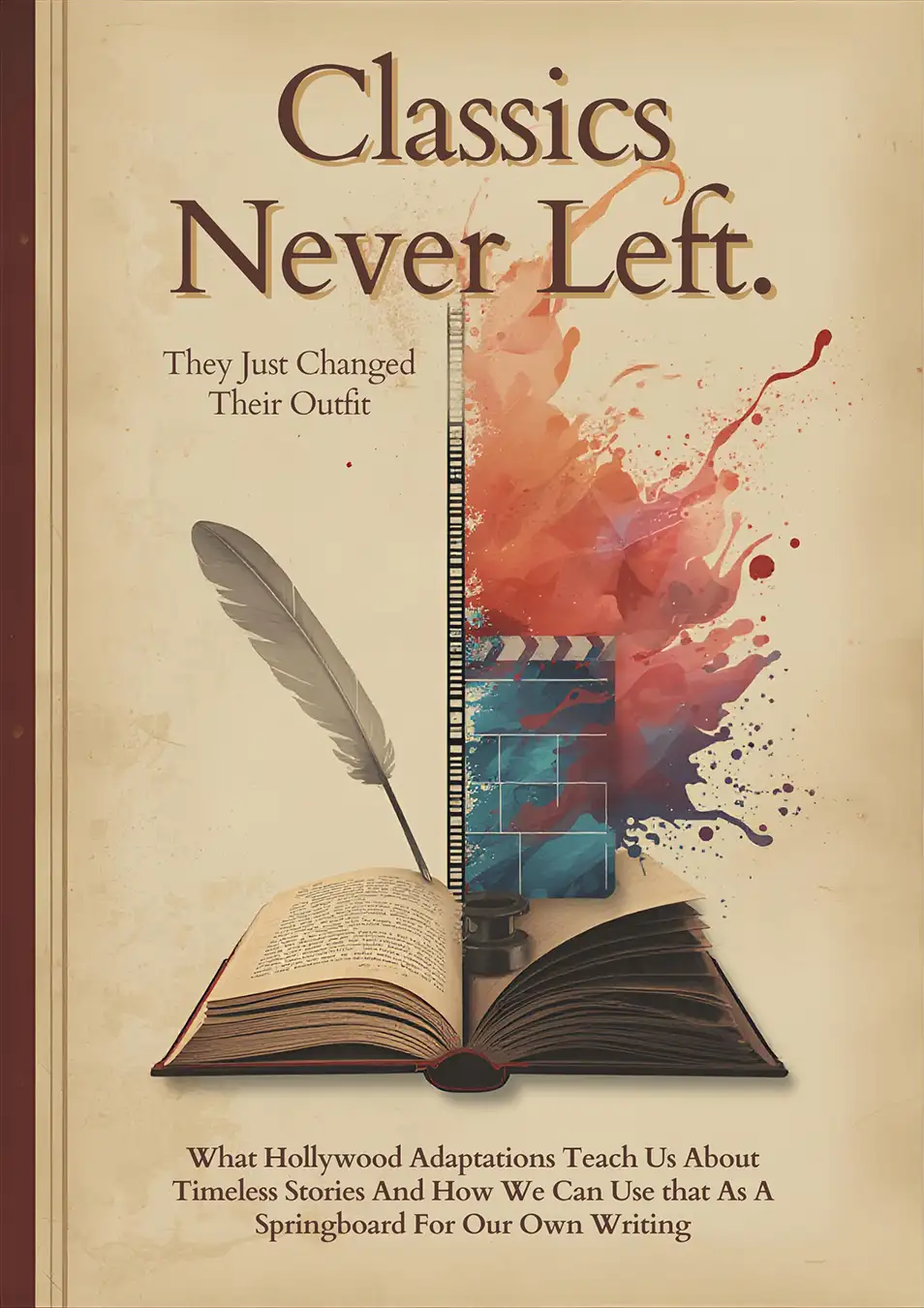
Reimagining the Classics: What Modern Retellings Can Teach Us
What Hollywood’s Best Adaptations Can Teach Us About Reimagining the Classics — Plus Creative Prompts to Try Yourself
I’ve always been an unabashed lover of novels, and an equally unabashed consumer of movie and miniseries adaptations. Some I adore (Colin Firth’s Pride and Prejudice supremacy forever), and some I’ll politely pretend never happened (looking at you, 2005). But what fascinates me most isn’t the faithful adaptations we debate endlessly; it’s the ones we never realized were adaptations at all.
There’s something delightful about discovering that a film you grew up quoting wasn’t just a clever screenplay, but a classic story in disguise. A story reshaped, modernized, re-dressed in contemporary anxieties and aesthetics… yet still unmistakably rooted in the original.
That little shock of recognition—Oh, wait… that’s Emma? That’s Shakespeare? That’s Les Liaisons Dangereuses?—is exactly what inspired this week’s prompt.
Inspiration Prompt: I Watched the Movie, Does That Count?
What do Clueless, 10 Things I Hate About You, and Cruel Intentions have in common? At first glance, it doesn’t feel like they really should have anything. One’s a pastel-drenched comedy about a Beverly Hills fashionista. One’s a high school rom-com with Heath Ledger at his most swoon-worthy. And one is… well, deliciously scandalous in a very 1990s way. And yet, these three iconic films are all modern retellings of classic literature—and the casual viewer probably had absolutely no idea.
Clueless translates Jane Austen’s Emma into the sunlit world of 1990s Los Angeles, where a pure-hearted but totally oblivious valley girl slowly grows into herself and, eventually, love. 10 Things I Hate About You lifts its entire plot from Shakespeare’s The Taming of the Shrew—trading Elizabethan suitors and arranged marriages for high school hallways and a brooding Patrick Verona. And Cruel Intentions? It’s Les Liaisons Dangereuses relocated from French aristocracy to Manhattan prep school culture, where manipulation and status games are just as ruthless, if slightly less corseted.
Were you already aware these were adaptations? Does knowing that change how you see them or how you feel about the originals?
Continue reading “Reimagining the Classics: What Modern Retellings Can Teach Us”Where to Submit Roundup: February 27, 2026
Happy Friday!
As we head into the final weekend of February, here’s hoping March eases in gently rather than roaring to life. Mother Nature is a fickle one, of course—so we’ll see what she has in mind.
Whether you’re feeling early spring energy or full-on cabin fever, NewPages is here to help you channel it into your writing and submitting. March brings a fresh wave of opportunities, and several deadlines are closing soon. Don’t miss your window.
Inspiration Prompt: Precious Children
We weren’t called precious because we were adorable and utterly lovable.
We were called precious because of what we looked like.
One child came with golden locks and golden eyes, skin kissed warm by some unseen sun—a living echo of the most coveted metal on earth. Another arrived silver-haired and metallic-eyed, with a cool bluish-grey undertone that made him look like something poured and set, something that belonged behind glass. The third had copper hair, coppery brown eyes, a warmth in her skin that glowed like something freshly forged.
Three children who reminded people of precious metals. Three children who had done nothing to earn that resemblance and nothing to deserve what came with it.
Here is what you get to decide: what does come with it?
Are they coveted, sought after, collected, kept close by people who want to own beautiful things? Are they feared, because what looks rare is also fragile, and fragile things make people nervous? Are they worshipped in ways that hollow a person out over time? Or are they cursed by a world that can’t see past the surface of them, that has decided their worth before they’ve spoken a single word?
Write the life of one, or all three. Write the moment someone first looked at them and wanted something. Write the moment they understood what they were to other people. Write the moment they decided whether to use it or fight it or flee it.
Precious is only a word until someone decides what it means. You be the one who decides.
Continue reading “Where to Submit Roundup: February 27, 2026”I’ll Carry You Home: The Pause Before the Answer
A writing prompt about last requests, the people who carry us, and the stories that find us before we’re ready for them.
Some songs find you at exactly the wrong moment — and stay forever.
James Blunt’s Carry You Home became that song for me while caring for the grandparents who raised me. It’s still capable of bringing me to my knees, carrying with it the weight of my grandmother’s passing and the particular ache of watching someone you love leave slowly. That line — “I’m watching you breathing for the last time” — hits different when you’ve lived it.
But the phrase that lodged itself deepest was the simplest one: I’ll carry you home.
Four words. A promise. A burden. A act of love that could mean so many different things depending on who’s asking and who’s being asked.
This week, let that phrase be your compass.
Maybe your character knows they’re dying. Maybe they don’t. Maybe the request comes out of nowhere — a sudden illness, an accident, a war that ends too quickly in all the wrong ways. They reach out to one specific person and ask them to carry them back to where their roots are, to where the family is, to wherever home still means something.
Or flip it. Write from the perspective of the person being asked. Do they even know this person well? Does the request feel like an honor or a burden — or both at once? Is there old betrayal tangled up in it? Do they go anyway?
And what does home even mean at the end? A place. A person. A moment of forgiveness. A family made whole again before it’s too late.
Create from wherever this lands for you. A short story or flash fiction. Dueling poems — one voice from each side of the request. A photo essay about the objects and places we carry people back to. A comic strip, a collage, a sketch. If you journal, write the conversation itself: the asking, the silence after, the answer.
The only rule is this: let it be real. The best work tends to come from the places that still make us cry.
Going Deeper: Three Writing Tips for “I’ll Carry You Home”
1. Anchor the Emotional Weight in a Single Object or Detail
The reason a line like “I’m watching you breathing for the last time” hits so hard is that it’s specific. When you write your piece, resist the urge to describe grief in the abstract. Instead, find the one detail that carries everything — a worn quilt, a particular smell, the sound of a name spoken in a certain way. That concrete anchor will do more emotional work than paragraphs of feeling ever could. Ask yourself: what is the one thing this character would notice that no one else would?
2. Let the Silence Speak
The most powerful moment in any “last request” story isn’t the asking — it’s the pause before the answer. Practice writing what your character doesn’t say. What do they swallow back? What do their hands do? Subtext is the difference between a scene that tells us someone is overwhelmed and one that makes the reader feel it. Try writing the scene twice: once with every emotion stated outright, then again with all of it removed and replaced only with action and dialogue. The truth usually lives somewhere between the two drafts.
3. Complicate the Person Being Asked
The richest version of this story lives in moral ambiguity. If the person being asked to “carry them home” feels purely duty-bound and willing, the story has only one note. But what if they have reason not to go? An old wound, a life they’ve built far away, a complicated history with the family waiting back home? Obligation and love and resentment can all occupy the same heart at the same time — and that tension is where your most honest writing will come from. Give your character a reason to say no, and then show us why they say yes anyway.
Enjoyed this? Our newsletter goes deeper every week — creative prompts, new lit mag issues, book releases, recommended reading, and bookstore updates. Subscribe below and join the conversation.
Subscribe to NewPages NewsletterWhere to Submit Roundup: February 20, 2026
Happy Friday!
Somehow we’re already staring down the last week of the month. The February eLitPak newsletter is out, and here in Michigan the warmer weather has arrived with its usual mix of rain and fog—but at least we’re getting a break from snow and ice.
With another major storm rolling across the country, I hope you’re staying safe and finding time to write. Here’s this week’s roundup of submission opportunities, plus a little spark to keep your creativity going.
Inspiration Prompt: Reading Between the Lines
Mark Twain once said, “A successful book is not made of what is in it, but what is left out of it.” He was talking about editing — but there’s a deeper implication worth sitting with. Omission isn’t just a tool for clarity. It’s where a story’s interior life lives.
Every piece of writing has an on-screen existence — the words the reader follows, the scenes they witness, the dialogue they hear. But surrounding that visible story is a larger, quieter one: the character history that never surfaces, the worldbuilding detail you wrote only for yourself, the emotional beat implied in a pause rather than stated in a speech, the off-screen choice that explains everything without ever being named.
The most resonant writing doesn’t fill in those gaps. It trusts them. It lets the unseen world press against the edges of the page — present, shaping, felt.
Your Challenge
Continue reading “Where to Submit Roundup: February 20, 2026”Never Answer the First Call: Writing Voices You Can’t Quite Trust
Growing up in a multigenerational household means inheriting more than hand‑me‑down furniture—you inherit stories. In my case, an aunt just eighteen years older filled the house with vampires, werewolves, and the witchy wolf lore of rural Michigan. One story always stuck:
If you’re lost in the woods and hear someone call your name, never respond to the first call. Unnatural things only call once.
I thought of that rule again while watching Sand Sea, where “black‑haired snakes” learn to mimic human voices. In earlier adaptations, they could only echo names. In this one, they’ve evolved—they can mimic entire sentences.
That evolution, from crude imitation to perfect replication, felt eerily familiar. Technology does it. Memories do it. Trauma does it. Even our own writing does it sometimes: a voice close enough to sound true, but not quite ours.
The Prompt: When the Devil Calls Your Name
That tension is your starting point. Write a piece—story, poem, essay, script fragment, comic, song, or hybrid—about a voice that sounds like it belongs to someone familiar… but doesn’t.
Some writers may want to explore a childhood rule about answering voices in the dark, or the mechanics of mimicry itself—an animal, an echo, an AI, a spell, a hallucination that almost convinces. Others might go toward grief: a voice that returns after loss, recognizable in every way except the one that matters. Or flip it entirely—what if the mimic is incompetent? The world’s worst supernatural impostor, who can copy words but not warmth, cadence, presence.
And then there’s the darkest version: a character who discovers their own voice has been replicated so perfectly that the people closest to them can no longer tell the difference. What do you do when the imitation becomes the record?
Where does the boundary lie between a voice you trust and a voice you only want to trust?
Write into that uncertainty.
Continue reading “Never Answer the First Call: Writing Voices You Can’t Quite Trust”Where to Submit Roundup: February 13, 2026
Happy Friday — or as happy as a Friday the thirteenth can be.
If you’re feeling superstitious and would rather avoid today’s bad‑luck vibes by staying home with a mug of something warm, we’ve got you covered. NewPages is back with our weekly roundup of submission opportunities, plus a little spark of inspiration to get those creative juices flowing.
Inspiration Prompt: It Just Takes Time…or A Jug of Moonshine
While reading the inaugural issue of Poetry Midwest, Paul Hostovsky’s poem “Flents” stopped me in my tracks. Perhaps it’s because my own grandfather passed away this past December, but the poem’s shift in perspective felt especially resonant.
In the poem, Paul Hostovsky recalls being fascinated as a boy by his father’s “Flents”—waxy, bite-sized lumps molded to the shape of his father’s ear canals. At thirteen and a half, they were novelties, curious mementos of the man himself. It wasn’t until Hostovsky reached the age his father was when he passed away that Hostovsky’s perspective changed. He realized those Flents weren’t just objects, but shields his father used to endure the very rock music Hostovsky once blasted through the house while his father lay in bed dying.
Perspective is a living thing—rarely objective, and always subject to change.
The Challenge:
Continue reading “Where to Submit Roundup: February 13, 2026”The Words Under the Words: Writing Through Auditory Illusions
For this week’s newsletter prompt, I opted not to dive into music, movies, dramas, or literature (in the fullest sense), but instead wanted to explore something I have experienced more often than I would like to admit: auditory illusions. Whether from caretaker trauma, the memory of a voice calling my name in the middle of the night, or those moments in crowded places when I swear someone has spoken to me—only to find no one nearby.
That got me thinking about a poem I loved in my college creative writing class, Naomi Shihab Nye’s ‘The Words Under the Words.’ I also found myself thinking about Jane Arden’s classic song ‘Insensitive,’ which explores a different—but related—kind of echo.
Inspiration Prompt: Auditory Illusions
Have you ever heard your name called in an empty house? Or listened to a cat cry and, for a split second, felt your body insist it sounded like a human infant? These uncanny moments aren’t just tricks of the ear—they’re invitations to listen for what else might be speaking.
Naomi Shihab Nye asks whether we can hear “the words under the words.” Auditory illusions—those misheard fragments, phantom echoes, or emotional reverberations—often point toward that deeper layer. They reveal the private logic of the mind, the meanings we continue to translate even when nothing external is making a sound.
And then there’s the kind of auditory haunting Jane Arden names in “Insensitive”: the voice you can’t stop hearing long after the relationship has ended. It lingers not because you want it back, but because your nervous system memorized it. The cadence remains long after the conversation is over. That too is an illusion of sorts—memory performing its own echo chamber—another version of “the words under the words,” the layer we continue to interpret long after the speaker has gone.
This week’s prompt asks you to explore that deeper space: the gap between what is heard and what is felt, between the literal sound and the emotional frequency beneath it. Writing into those gaps is an act of faith—faith that the surface layer isn’t the whole story, faith that something underneath is asking to be recognized.
Why We Hear What Isn’t There
Auditory illusions emerge where perception and emotion collide. We mishear because of:
Longing or Grief
The mind reaches for a familiar frequency—a lost loved one’s voice, a phrase that once meant safety.
Trauma
The world sharpens, and every sound becomes coded with urgency or threat.
Desire
We hear the “yes” in the static because part of us needs it to be there.
These “mis-hearings” aren’t errors; they’re insights. They reveal a character’s internal landscape more clearly than any literal description could.
3 Tips for Writing Sound, Silence, and the Unheard
1. Write the Subtext Literally
If your scene has two layers—a polite, surface-level exchange and a charged emotional undercurrent—try writing both. Put the spoken words on the page, and let the internal monologue or sensory interpretation run beneath it. The friction becomes the drama.
2. Use Onomatopoeia Sparingly—But Write the Physicality of Sound
Avoid the easy “Bang!” or “Clack!” Instead, describe how the sound lands in the body. Does it thud like a heartbeat? Buzz like anxiety? Vibrate in the teeth? The physical response is often more revealing than the noise itself.
3. Lean Into the Uncanny
The most compelling auditory illusions are almost right—but not quite. A voice that sounds like a familiar friend but lacks their usual warmth. Footsteps that mimic someone’s gait but drag just a little too long. Let your reader feel the uncanniness.
Listening for What’s Beneath
Each week, through prompts like this, we explore how perception—especially misperception—can reveal the deeper story. Whether you’re writing about phantom calls, remembered voices, or conversations with two layers, the goal remains the same:
Listen for the words under the words.
The message beneath the sound.
The truth beneath the illusion.
If you want prompts like this delivered each week—along with news about book releases, new lit mag issues, bookstore updates, and a carefully curated list of submission opportunities—consider subscribing to our weekly newsletter!
Where to Submit Roundup: February 6, 2026
Happy Friday and welcome to February!
We’ve officially made it through the first week of a new month. Here in Michigan, February arrived with an unexpected warm spell (20s after negative temperatures definitely counts as a heat wave, right?) after January delivered its fair share of subarctic drama. Winter, of course, isn’t finished with us yet.
If the weather outside your window isn’t especially inviting, NewPages has plenty to keep you inspired indoors. This week’s roundup features dozens of new and ongoing submission opportunities, along with a creative writing prompt designed to help you shake loose any lingering writer’s block.
Inspiration Prompt: A Penny for Your Thoughts
Writing exercises aren’t about perfection. They’re about momentum.
Think of them as rough drafts of the mind: fragments, sparks, half-formed ideas that exist simply to get words moving. Sometimes, it’s those unpolished scraps that become the pieces we return to later and think, Ah. There’s something here.
(If you’re anything like us, that explains the notebooks, documents, and folders full of unfinished starts and fragments from who knows where.)
This week, we’re trying something a little different with a response-based writing prompt.
The Spark
Read the following lines from a work-in-progress and let them sit with you for a moment. Don’t worry about original context. Let the words become something new in your hands.
Continue reading “Where to Submit Roundup: February 6, 2026”“Mercy, mercy,” quoth he. “Please have mercy on me!”
Why should I mercy show when you yourself have none?”
“Why, milady, to prove that you are the better one!”
“Aye and to prove that I am, a secret I shall let thee know… there is no mercy for the damned.”
And in one fell swoop she struck the killing blow.
Embracing the In-Between: Writing Beyond the Binary
Winter—especially in certain parts of the world—has a way of making everything feel stark and stripped down. Colors drain out of the landscape. Days shorten. The world contracts into muted tones: white skies, black branches, long shadows. In that kind of environment, it’s easy to start thinking in binaries. Some days, a life lived in clean lines—black or white—might even seem comforting.
But the world refuses to stay that simple. Even in winter, gray takes over: soft clouds, slushy streets, the blur where sunlight meets storm. Life, too, lives in these overlaps. Messy, chaotic, layered—not always in bad ways. And that’s where this week’s newsletter prompt was born.
Inspiration Prompt: It’s a Gray World After All
We often crave a binary world. We search for the “right” word, the clear hero or villain, the correct ending. It’s human nature to long for the neatness of black and white—a world of zeros and ones, where every choice is absolute.
But as every writer eventually discovers, the magic lives in the smudge.
The Beauty of the Blur
Strip away the extremes and you find gray. Visually, gray is where texture emerges. In stories, gray is where humanity resides. Think of the moment a character recognizes their enemy’s humanity, or when a perfect plan begins to fray.
That shift—from stark contrast to subtle gradation—isn’t just visual. It’s emotional. It marks the moment certainty dissolves.
Writing Exercise: The Gray World
Imagine a world governed strictly by absolutes. Then allow something to break it.
The Catalyst:
What sparks the first smudge? A confession? A discovery? A quiet internal shift?
The Sensation:
How does gray feel to someone who has only ever known black and white? Is it confusing? Liberating? Dangerous?
The Scene:
Write the moment certainty unravels. Use sensory detail—softening borders, deepening shadows, a voice that finally admits, “I don’t know.”
Let this be the space where your characters learn to live.
Pro Tips for the Blank Page
The Color-Coding Craft Tip (Practical + Insightful)
If you want to check whether your writing leans too heavily into “binary” thinking, try this visual exercise:
💡 The Gray-Scale Audit:
Take a page from your current draft and highlight moments that represent “black and white” thinking—clear good/bad, yes/no, confident/absolute—in one color.
Then highlight the “gray” moments—hesitation, mixed emotions, blurred boundaries—in another.
If the page is overwhelmingly one color, try finding a single line where you can introduce a smudge of complexity.
The Sensory Gray List (Expansive + Fun)
If you’re tired of using the word gray itself, expand your descriptive palette with adjacent textures and tones:
✨ Beyond “Gray”:
- Metals: pewter, gunmetal, tarnished silver
- Nature: flint, river stone, morning mist, woodsmoke, dove’s wing
- Abstract: static, shadows, graphite, slate, thumb‑smudged ink
These alternatives give you the nuance of “grayness” without repeating the word.
The Playlist Tip (Atmospheric + Immersive)
Music is an easy way to shift yourself into a more liminal creative space.
🎧 Soundboarding the Blur:
Try writing with lo-fi beats, ambient rain, or minimalist piano (think Erik Satie). These borderless, low-structure sounds keep the brain from snapping into rigid patterns and help you drift into a more exploratory, nuanced headspace.
Never Miss a Spark
If this prompt inspires you, there’s more where it came from. Writing may be a solitary craft, but you don’t have to navigate the gray areas alone.
➡️ Subscribe to our Weekly Newsletter
Every issue brings:
- New releases from emerging and established lit mags
- Fresh books to add to your radar
- Updates from indie bookstores and literary spaces
- Curated submission opportunities
Don’t wait for the blank page to stare back. Join our community and keep the creative momentum moving forward.
P.S. If you write something based on this prompt, tag us on social media or reply to our next newsletter—we’d love to see where the gray world takes you!

When Love Outgrows Its Banks: The Hydrology of the Heart
It’s no secret that I am particularly drawn to music and lyrics and can find myself being inspired by them. Whether it’s a particular turn of phrase that seems magical, a sung truth that cuts to the very core, or just an idea that gets me questioning or thinking—music stays with me. For a long time, the lyrics “That was a river / this is the ocean” seemed to haunt my mind.
What better fodder for inspiration than to consider bodies of water and compare them to emotional depths?
In the song by Colin Raye, these words offer a masterclass in emotional scale. Encountering an old flame, the singer reassures his wife that his past feelings were merely a river, while his current devotion is the ocean. It’s a striking image: a river has a beginning and an end; it follows a set path. But an ocean is an ecosystem. It is deep, immeasurable, and powerful enough to reshape the very coastline of our lives.
The World of Emotional Waterways
Imagine, for a moment, a world where our internal landscapes were literal. In this reality, emotions aren’t just felt—they are quantified by volume, flow, and depth.
- The Droplet: A fleeting moment of affection, easily evaporated.
- The Brook: A light infatuation, noisy and cheerful, but shallow enough to walk through.
- The River: A serious attachment. It has a strong current and a clear direction, but it is ultimately contained by its banks.
- The Ocean: True, transformative love. It is a vast expanse where you can no longer see the shore you left behind.
In such a world, how would we talk to one another? Would we warn friends of a “flash flood” of grief? Consider the tension that arises when someone offering an “ocean” of commitment meets someone experiencing an emotional “drought.”
Creative Prompt: Map Your Current
Whether you are a writer, painter, or digital artist, use this “Hydrology of the Heart” to create something new this week.
The Challenge: Write, draw, paint, or collage something that treats emotions as waterways—measurable, navigable, and capable of reshaping the land around them. What happens when your “ocean” meets someone else’s “river”?
Never Miss a Spark of Inspiration
If this prompt got your creative gears turning, you’ll love what we send out every week. Writing is a solitary journey, but you don’t have to scout the terrain alone.
Subscribe to our weekly newsletter to get inspiration prompts like this delivered straight to your inbox, along with:
- The Latest Literary News: Stay updated on new book releases and must-read literary magazines.
- Curated Bookstores: Discover independent gems to visit on your next trip.
- A Sampling of Submission Opportunities: All subscribers receive a small sampling of current submission opportunities from literary magazines, upcoming events, and indie publishers
🔓 Unlock 100+ Submission Opportunities
Ready to see your name in print? Paying subscribers receive exclusive early access to a curated database of 100+ submission opportunities. Every single lead is vetted by our team before posting, so you can spend less time researching and more time writing.
Where to Submit Roundup: January 16, 2026
Happy Friday!
Can you believe January is already halfway gone? This week we sent out our eLitPak newsletter—if you missed it, you can catch up online here.
The weather’s still doing its 2026 flip-flop—50s one day, teens the next. Some things never change! One thing you can count on, though, is NewPages bringing you a fresh roundup of submission opportunities and inspiration every week. Happy writing and submitting!
Inspiration Prompt: Negativity is All in the Head
We talk about “negative” temperatures, but what does that really mean? For some, cold means the 40s or 50s. For others, it’s subzero, where the air bites and the world freezes solid. Did you know that when it gets extremely cold, the atmosphere can become too dry for snow? The colder it gets, the less likely you’ll see those flakes…and the more likely you should be slathering yourself in moisturizer.
This week, imagine life in a world below zero. What would change for you? What new skills would you need to survive? Now take it further: what if your attitude controlled the temperature? The more negative your thoughts, the colder your surroundings become. Could your mindset freeze rivers, frost windows, or plunge a city into an endless winter?
Write, sketch, or create around the idea of negativity—how it shapes environments, relationships, and survival.
Now that you are perfectly inspired, and perfectly frigid, keep going to find a home for your work.
Continue reading “Where to Submit Roundup: January 16, 2026”The Sound of Silence: Finding Creative Meaning in the Dial Tone
Due to the passing of a loved one, I have been spending more and more time jumping through what feels like the “phone Olympics” whenever I need to handle affairs or set things up. Going through the often-frustrating phone menu systems, waiting on hold only to get cut off before ever reaching a person, or even dealing with people who just refuse to be kind and helpful—it got me thinking about that little old thing we know as the dial tone.
How can that hollow sound be used to inspire your writing and art?
Inspiration Prompt: A Dial Tone Conversation
In an era of instant messaging and constant connectivity, the act of making a phone call has become a strange, often frustrating ritual. We navigate endless automated menus, parley with digital “gatekeepers,” and endure hold music that feels like it’s looping into eternity.
But there is a specific, haunting moment in this process that we rarely stop to examine: the dial tone.
The Echo of Something Unfinished
What happens when the promise of a human voice falls through? You wait through the ringing, hoping for a “hello,” only to be met with that flat, rhythmic hum. In that moment, the connection is severed, leaving you in a digital limbo.
To some, that sound is the ultimate symbol of modern isolation—a reminder of the barriers between us and the help or companionship we seek. To others, it might be a moment of relief, a sudden exit from a conversation they weren’t ready to have.
Ask yourself:
- Is the dial tone the end of a conversation, or the start of one that never happened?
- Is it a lonely sound, or a blank canvas?
- What does the “machine gatekeeper” say about how we value each other’s time?
We want you to take this feeling—the frustration, the rhythm, or the silence—and turn it into art. Let the dial tone speak through your preferred medium:
- Fiction: Write a story that begins the moment the line goes dead.
- Poetry: Capture the cadence of the dial tone in your meter.
- Visual Art: Create a collage or photograph that represents “the machine gatekeeper.”
- Multimedia: Compose a short track or film centered around the drone of a disconnected line.
Creative Tip: Sometimes the best work comes from the most mundane frustrations. If you’re feeling stuck, try recording a dial tone and listening to it for three minutes. What images come to mind?
Never Miss a Spark of Creativity
If you found value in this prompt, there is plenty more where that came from. Our community thrives on the intersection of literature, art, and the tiny moments of daily life that inspire them.
Join our community by subscribing to our weekly newsletter. Get inspiration like this delivered straight to your inbox every week, along with:
- 📚 New Book Releases
- 📖 New Lit Mag Issues
- 📍 Bookstore Updates
- 📝 Submission Opportunities
Where to Submit Roundup: January 9, 2026
Happy Friday!
Welcome to the first submissions roundup of 2026! We hope you enjoyed a fun and relaxing winter holiday season. We’re back to help you keep your writing and submission goals going strong—and to spark your creativity with a weekly dose of inspiration.
Inspiration Prompt: What is a Living Wage?
“There is an apple in the world for everyone’s need, but not for everyone’s greed.”
— Rock My World
Minimum wage and living wage are not the same thing—and rarely even close. In the early 2000s, economists estimated that a true living wage for the average American would hover around $22 an hour. Two decades later, the gap between what people earn and what it costs to live has only widened.
We know the arguments: raise wages, cut jobs, hike prices. It feels like an endless cycle. But what does “enough” really look like?
Using your own experiences or observations, what do you think a true living wage is—and what would it take to achieve it?
- Explore what happens when the concept of “living wage” becomes literal: what if wages determined how long you live?
- Imagine a world where wages are tied to something other than money—time, health, happiness, or even art.
- Visualize the symbols of “need” versus “greed”: apples, scales, empty wallets, overflowing vaults.
- Tell the story of a character who earns their living in an unconventional way—or who fights for fairness in a system stacked against them.
Once you have finished your creation, keep going to find a home for your work.
Continue reading “Where to Submit Roundup: January 9, 2026”Starting Fresh in the New Year
Resolutions for the New Year? We’ve done that. Reviewing 2025? Covered. So how do we start 2026 off right? By chasing the concept of fresh.
One of my favorite moments in the Anne of Green Gables miniseries (with Megan Follows as Anne) is when her teacher reminds her that “tomorrow is always fresh, with no mistakes in it… yet.” Isn’t that the perfect spark for inspiration?
Inspiration Prompt: Fresh
Forget the resolutions destined to fizzle by February. Instead, picture this: a day that hasn’t asked anything of you yet. No mistakes—yet. No worn edges. Just possibility, bright and uncreased.
This week’s challenge is to capture that sense of renewal. Begin with something newly emerging—a scent, a bruise, a rumor, a memory resurfacing, a sprout breaking soil, a relationship resetting, a place you’ve returned to after too long away. Let “freshness” be more than newness: explore what is raw, recently touched, just‑changed, or changed again.
Ask yourself:
- How does something become fresh?
- How does it lose that quality?
- What happens in the moment the world feels washed clean—or when you wish it would?
Write, sketch, compose, or collage from that first spark of renewal or disruption. Let your work carry the bright sting of something just beginning.
💡 Want prompts like this delivered every week?
Subscribe to our newsletter for fresh inspiration, new lit mag issues, book recommendations, and submission opportunities for writers and artists across genres.
👉 Subscribe now
Where to Submit Roundup: December 26, 2025
Happy Friday!
Welcome to the final submissions roundup of 2025—say it isn’t so! With December wrapping up next week, now’s the moment to catch all those end‑of‑year deadlines before they slip away.
A quick scheduling note: NewPages will be on our annual winter break from December 24 through January 5. That means there will be no submissions roundup for the New Year. We’ll return with the first roundup of 2026 on January 9.
We hope you’ve had a wonderful, restful, and safe holiday season. Here’s wishing you all the best in the New Year—may your writing, reading, and submitting goals not only be met, but exceeded.
Inspiration Prompt: Resolutely Magic
New Year’s resolutions are made just to be broken… right? Carrying your best intentions forward for an entire year can feel like both a monumental effort and a monstrous challenge.
But imagine living in a world where your resolutions weren’t just hopeful lists—they were official contracts.
What happens if you break one?
What does that cost you?
Or picture a year when something unexpected happens: your resolutions are blessed with magic, guaranteeing that you’ll meet every expectation you set for yourself. How would that change you? Would the meaning of your accomplishments shift if you didn’t have to struggle for them? Would you create new resolutions? Bigger ones? Stranger ones? Would you use the power of “your” resolutions to reshape your community—or the world?
Write, draw, collage, sketch… create a world where resolutions carry power, consequence, and possibility. Let your imagination decide what becomes resolute—and what becomes magical.
Continue reading “Where to Submit Roundup: December 26, 2025”Writing Within Glass Walls: A Prompt for Winter Creativity
How do you use the season as inspiration without using the season as inspiration? It’s a tricky question.
The winter holiday season seems to elbow its way into our lives earlier every year—lights appearing before the leaves have even fallen, carols echoing long before snow arrives. But creative inspiration shouldn’t feel like a force‑feed. So how do we tap into the richness of this time of year without drowning in holiday spirit we never asked for?
Then it dawned on me: snow globes.
These little baubles come in every imaginable shape and size, and so many of them aren’t tied to holidays at all. They can be playful, eerie, nostalgic, surreal, or downright strange. When I was in elementary school, we made our own snow globes—baby food jars filled with glitter and miniature winter scenes. They were messy, handmade, and wildly charming. And honestly? What better raw material for creative work is there?
Plus, if you’re feeling adventurous, you can blend the literary with the literal and craft your own snow globe as part of your writing ritual. (Highly recommended.)
Inspiration Prompt: Snow Globe
Imagine a world small enough to hold, yet vast enough to transform you.
There’s something irresistibly enchanting about a snow globe. Glitter drifting like slow‑falling stars. Tiny houses and trees arranged just so. Whole towns frozen mid‑breath—every window aglow, every path untraveled. Turn the globe in your hands and time seems to pause. Shake it, and the sky erupts in a private blizzard. These little worlds invite us to wonder what it might feel like to live inside a universe bound by glass.
For this week’s creative experiment, sink into that magic—then unsettle it.
What if you woke one morning and found yourself inside a snow globe?
Outside forces—hands much larger than your own—disturb the ground whenever your world is tilted or rattled. Maybe you learn to read weather patterns based on someone else’s mood. Maybe tremors become a language; maybe glitter becomes prophecy.
What sounds fill such a place? What does warmth mean when it comes only from a hidden light under plastic snow?
Or picture your own city sealed inside an invisible dome.
Snow tumbles steadily from a cloudless sky. Year‑round drifts bury familiar landmarks. The ground gives small, frequent shudders. Daylight bends oddly, refracted against an unseen, curved boundary—enough to make shadows behave like strangers.
Do people adapt? Resist? Celebrate? How long before your community begins to wonder whether you’re being observed?
And consider this twist:
Someone from a place without winter—a desert, a humid coastline, a dry savanna—is suddenly thrust into this permanent blizzard.
What does cold mean to someone who has never felt it? What memories become useless? What new skills or survival instincts sharpen under pressure? How might such a climate, relentless and alien, reshape identity, relationships, or a sense of home?
Your invitation this week:
Write into the wonder. Sketch into the distortion. Collage into the beauty. Photograph the unease.
Your medium doesn’t matter—only your curiosity does. Explore how environments transform us, how confinement distorts perception, how a small world can become limitless when imagination cracks the glass.
What changes in this miniature world?
What becomes newly possible?
✨ If prompts like this ignite something in you, our weekly newsletter delivers fresh inspiration—along with curated submission opportunities, upcoming literary and writing events, indie bookstore news, new lit mag issues, book news, and more.
Subscribe and let your writing week begin with a spark.
Where to Submit Roundup: December 19, 2025
Happy Friday!
Yes, we’re back. I wish I could say our submission roundups took a two‑week break for something joyful or restorative, but unfortunately that wasn’t the case. A sudden death in my family meant stepping away for the funeral and all the difficult, unglamorous business that comes with losing someone you love.
But the weekly roundup has returned to help you close out your 2025 submission goals strong. Next week’s edition will be the final one of the year—already! Hard to believe we’re here again. Where has this year gone?
Inspiration Prompt: Miracles All Year
December likes to claim miracles for itself. Between the Hallmark plots, the snow‑globe aesthetics, and the songs on repeat everywhere you go, it’s easy to start believing that wonder is seasonal—that it shows up only when the calendar says it should.
But miracles don’t follow a schedule. They arrive in the ordinary months, the off‑season hours, the messy stretches when no one is expecting anything luminous at all.
For this week’s prompt, look beyond the holiday glow and write into a moment of unexpected grace from any point in your life. It can be grand or quiet, explainable or not:
- A job you got against all odds—after you’d already rehearsed the rejection.
- A scholarship that appeared exactly when the math said it shouldn’t.
- A near miss, a narrow escape, an outcome that still makes people tilt their heads and say, “How did that happen?”
- Or even something small: the right person showing up at the right moment, a door opening you didn’t know you were allowed to try.
Let the “miracle” be whatever you define it to be—an event, an insight, a turn, a survival, a shift. Then translate that moment into any medium you choose: a poem that holds its breath, a story that doesn’t fully explain itself, a lyric essay threading disbelief with gratitude, a comic, a collage, a script, a scene, a song.
Where did your miracle begin? What did it change? What trace of it remains?
Continue reading “Where to Submit Roundup: December 19, 2025”The Last Supper: Finding the Sacred in an Ordinary Meal
They say that in life there are only a few certainties: death and taxes. None of us truly knows when death will come knocking, though some people face its approach with more clarity because of illness. For most of us, though, the moment remains invisible until it has already passed.
This past Thanksgiving, my family experienced one of those invisible thresholds for the second time. The holiday dinner—familiar, warm, full of our usual stories—became a last supper with the beloved patriarch of our family. No one saw it coming. That suddenness, that unexpected finality, brought this idea sharply into focus:
What if this meal became the last with someone you loved? How would that change the way you saw the moment? And what new understandings might emerge when you look back?
These questions form the heart of this week’s inspiration prompt.
Inspiration Prompt: The Last Supper
There’s a quiet mystery at the heart of every family table: we never know which shared meal will be the last with someone we love. We pass dishes, refill drinks, laugh at familiar jokes, and settle into well-worn rhythms—never imagining that a seemingly ordinary evening might become a final chapter.
And yet, when we look back, it’s often the unremarkable moments that take on unexpected weight. A holiday dish that won’t be made again. A story retold for the hundredth time, suddenly cherished because it will never be told the same way. A chair left empty next year. These details, small and human, become the symbols we hold onto long after the meal has ended.
This tension—between presence and memory, between the living moment and what endures—creates fertile ground for art.
When the Ordinary Turns Sacred
Think of a dinner that felt like every other. The clink of utensils. The hum of conversation. Maybe the TV murmuring in the background or a candle sputtering in its glass. Nothing dramatic. Nothing staged.
And yet, inside that moment, something was already shifting. Maybe the person across the table looked a little more tired than usual. Maybe they lingered longer over a story. Maybe the only sacred thing was that everyone was together—something you wouldn’t realize mattered until years later.
These are the thresholds where the ordinary becomes sacred, where the mundane becomes myth.
Symbols That Stay With Us
Symbols emerge without our choosing:
- A favorite dish someone made every year, crafted one last time
- A joke that breaks the table into laughter and somehow becomes a benediction
- Hands passing bread, touching briefly, unknowingly
- The way someone bowed their head before eating
- A piece of music playing softly in the background, forever tied to that night
These fragments become the reliquaries of memory. They are the objects and gestures through which we understand a person’s legacy—not in grand declarations, but in the undramatic, deeply human shape of a shared meal.
An Invitation to Create
This week, consider exploring that threshold between presence and memory in your creative practice.
Imagine a meal that becomes eternal.
Not because anyone knew it was the last, but because the echoes of that night continue to resonate.
You might write a story about a family gathering where every detail becomes a vessel of meaning.
You might craft a poem that holds the ache of endings in one hand and the tenderness of remembrance in the other.
You might paint a table set with symbolic objects, or photograph an empty chair and the light that falls across it.
You might capture the hum of grief and grace in a piece of music.
Whatever your medium, let it hold both sides of the threshold:
the ache of something ending, and the quiet hope of what endures.
Because in every “last supper,” there’s a kind of immortality—not in the meal itself, but in the love that gathers around it.
Enjoying the prompt? Subscribe to our weekly newsletter to get fresh inspiration delivered to your inbox along with new issues of lit mags, book releases, and submission opportunities.
Where to Submit Roundup: November 28, 2025
Happy Friday!
If you celebrated Thanksgiving, I hope it was full of good food, family, and gratitude. Hard to believe this is already the last Friday in November! That means some submission opportunities are closing soon—but don’t worry, NewPages has you covered with our weekly roundup. And because creativity deserves a little seasonal spice, we’ve got an inspiration prompt to shake off any writer’s block. This week? Think ghosts…on Black Friday.
Inspiration Prompt: Tis the Season…for Haunting You
Love it or hate it, Christmas promotions seem to creep in earlier every year, culminating in the greatest retail frenzy of all—Black Friday. I don’t hate Christmas, but let’s be honest: its haunting consumer presence can feel relentless.
Black Friday is here—and so are the ghosts. Is it a mother trampled in the chaos, clutching the toy she died to buy? Or the spirits of Christmases past, present, and yet to come? Christmas may celebrate life, but its shadows brim with ghosts and dark folklore—Krampus among them.
What haunts your holiday? A bargain gone wrong? A tradition that won’t let go? Christmas music that won’t stop playing long after the holiday is gone? Or something stranger still? Write the story, poem, or essay—or create art, collages, comics—that answers the question: What happens when the ghosts of consumerism collide with the ghosts of tradition?
Once you have your answer, scroll down to find the perfect home for your haunting in this week’s submission roundup.
Continue reading “Where to Submit Roundup: November 28, 2025”What Will My Reflection Show?: Writing Toward Insight and Renewal
I admit to getting stumped sometimes for prompts. I draw a lot of inspiration from life, my hobbies, nature, and the world around me—but when your life feels like a perfect storm that has upended everything, inspiration can run dry. With Thanksgiving approaching, I didn’t want to stick with the safe, old-time idea of thankfulness. Normally, people review a year in January. Why not review your current year as November closes and December looms?
Inspiration Prompt: A Year in Review
As November draws to a close, the calendar reminds us that 2025 is nearly ready to take its place in the archives. Before the year slips away, pause for a moment and ask: What story does this year tell about you?
Every year is a narrative—woven from triumphs, turbulence, and quiet transformations. Maybe yours was marked by a single turning point, a fleeting image, or a moment that changed everything. Write, collage, craft, create toward that. Capture the essence of 2025 in a way that feels true:
- Was there a victory you didn’t expect?
- A loss that reshaped your priorities?
- A subtle shift that will echo into the next chapter?
Let your words and images hold the weight of what was gained and what was left behind. Imagine how this chapter will shape the next.
Not sure where to start? Open up the camera roll on your phone and look back at the moments captured this year. Are there ones you forgot? Ones that make you happy…or sad?
Not ready to look back? Then look ahead. There’s still one month left in 2025—31 days and change. Is there something you’ve been meaning to finish, experience, or begin? Write about the destination you’ve been hoping for and what it would take to move closer before the year ends. Sometimes the act of naming a goal is the first step toward reaching it.
💡 Want more prompts like this? Our weekly newsletter delivers fresh inspiration, submission opportunities, and resources for writers who want to stay motivated and connected.
Subscribe here to join a community that turns ideas into stories.
Where to Submit Roundup: November 21, 2025
Happy Friday!
Time marches on and before you know it, it will be Thanksgiving already. Here’s hoping the good news garnered this week keeps things on a positive note for the remainder of 2025.
What are you thankful for? Have your writing and submission goals been getting met like you hoped? NewPages is back with our weekly roundup of submission opportunities along with our weekly dose of inspiration to keep your writing fueled.
Inspiration Prompt: Talking Past Each Other
This past week, I finished a Korean drama where two male leads were having what seemed like a normal conversation about their relationship. But the deeper and longer the exchange went, the less sense it made. Were they really talking about the same thing? Were they truly listening to each other? Or were they locked in parallel monologues, each hearing only what they wanted to hear?
For this week’s prompt, explore that fascinating space where meaning fractures:
- Writers: Craft a scene where two characters believe they’re having the same conversation—but they’re actually talking about completely different things. Let the misunderstanding grow until it leads to an unexpected twist, a humorous reveal, or a dramatic fallout. Bonus challenge: keep the dialogue natural and let subtext do the heavy lifting.
- Poets: Play with double meanings, misheard phrases, or layered interpretations. How does language betray us—or save us—when we’re not truly listening?
- Artists: Create a collage, illustration, or mixed-media piece where what’s said and what’s heard are visually at odds. Pair text with imagery that suggests a completely different interpretation, or layer contrasting elements to show the gap between intention and perception.
Tip: Miscommunication can be funny, tense, or heartbreaking. Think about tone shifts, clues that hint at the disconnect, and how the reveal changes everything.
And once you are done crafting your pieces, keep going to find them a home.
Continue reading “Where to Submit Roundup: November 21, 2025”Love Like Oxygen: A Writing Prompt to Explore Essential Connections
Our sunny, cold Tuesday is giving way to gloom as rain and snow roll in. Fall. Winter. The time of year when we can see our breath in the air—if we pay attention. This week’s newsletter prompt turns to the one thing all humans need to survive (besides food and water): oxygen.
As December approaches, so does a season of remembering loved ones who passed during this time. That reflection sparked today’s idea: what if someone you love becomes like the air you breathe—essential, sustaining, impossible to live without?
Inspiration Prompt: Love Like Oxygen
Inspired by the Thai drama Oxygen ออกซิเจน, based on the novel by Chesshire, and the universal experience of missing someone essential, this week’s prompt invites you to explore love—or a person—as being like oxygen.
We all need air to breathe—there’s no escaping that fundamental truth. But what if someone in your life was your oxygen, literally or figuratively? Consider what it means to depend on someone so completely, or to be the one others rely on for emotional survival.
Questions to spark your creativity:
- What does it feel like to need someone as much as you need air?
- How does that dependence shape your choices, your freedom, or your sense of self?
- What happens when that “oxygen” is gone—or when you realize you’ve been someone else’s lifeline all along?
Creative directions to explore:
- A poem about the invisible threads that keep us breathing.
- A short story where love becomes a literal life force.
- A visual piece—collage, illustration, or photography—capturing the fragility of connection.
- A song or script that dramatizes the tension between dependence and independence.
Love, like oxygen, is sustaining, vital, and often taken for granted. How will you bring that truth to life?
Want More Weekly Inspiration?
Our newsletter delivers:
- Fresh prompts every Monday to spark your creativity.
- Submission opportunities for fiction, poetry, nonfiction, hybrid, and multimedia work.
- New literary magazine issues and upcoming book releases to keep you connected to the literary world.
- Occasional program updates and resources for writers at every stage.
Subscribe today and join a community of writers who breathe creativity.
Where to Submit Roundup: November 14, 2025
Happy Friday!
After a week of blustery winds and chilly temps, a little sunshine in the high 40s feels like a gift. As the cold settles in, why not warm up your creativity?
We’ve rounded up plenty of submission opportunities—some closing as soon as tomorrow, November 15—so you don’t miss a chance. Plus, we’ve included a fresh inspiration prompt to jump-start your next piece.
Continue reading “Where to Submit Roundup: November 14, 2025”First Snow: A Spark for Creative Wonder
Here in Michigan, parts of the state experienced their first snowfall this past weekend. For some, it was enough to bundle up the kids and build snowmen. For others, it was just a scum of frost on the windshield. And still others may not have seen a single flake. Weather—always great food for creative fodder, isn’t it?
With the winter solstice just around the corner, what better inspiration for this week’s prompt than the idea of the first snow—or maybe the absence of it?
❄️ First Snow: A Spark for Creative Wonder
The first snow has fallen. Maybe it melted by morning, maybe it dusted the trees just long enough to make you pause—but that fleeting moment when the world turns white carries a quiet kind of magic.
What does it mean to you?
For some, it’s the signal to dig out a beloved family recipe—perhaps your grandmother’s hot chocolate, now reimagined with cold foam and a dash of cinnamon. Could you write a poem about the memory? Or a story imagining her reaction to your modern twist?
Maybe the first snow takes you back to a childhood snow day—the one that saved you from a forgotten homework assignment and gave you time to study, finish, and play. What would it look like to capture that reprieve in fiction?
Or perhaps you imagine a world where snow falls only once a year. What kind of magic would that be? Would people bottle it, sell it, celebrate it? Could you write a speculative piece about a single day of winter wonderland?
Try a lyric essay about crafting snow castles and ice sculptures from the first flakes. Or challenge yourself visually: create a snow scene using colored pencils—but not white. Can you layer and shade until the essence of snow emerges anyway?
These are just a few ways to let the season’s first snow inspire your next creative work—whether it’s fiction, poetry, nonfiction, visual art, or something in between.
✨ Want more prompts like this every week?
Subscribe to our newsletter for fresh inspiration, submission opportunities, and updates curated for literary writers, editors, and educators. Join a community that celebrates imagination and craft—one snowflake at a time.
Where to Submit Roundup: November 7, 2025
Happy Friday!
The first week of November is officially behind us. I say it all the time, but time flies when you’re an adult—more so than you ever think possible. With Halloween, Día de los Muertos (Day of the Dead), and All Saints Day behind us, there’s a lot of food for thought. I admittedly watch a lot of Asian dramas, so seeing how other cultures honor the memory of loved ones is fascinating—rituals full of color, music, and offerings that turn grief into celebration.
Do you get random bursts of inspiration from the media you consume or from simply observing the world around you? If your creative well feels a little dry, NewPages is here to help you find a home for your work—and maybe spark an idea or two along the way.
Continue reading “Where to Submit Roundup: November 7, 2025”Here Comes the Rain: A Creative Writing Prompt for Renewal and Transformation
After a gloomy start to November with gale-force winds and rain, what better tool for inspiration is there? Rainy days often feel synonymous with sadness—plans fall through, the gloom seeps into your mood. But sometimes, a good rainy day can be a portal for imagination. Think cozy games and movie marathons with family, an indoor picnic, or even a living room campout. Rain doesn’t have to be morose; it can be invigorating.
Inspiration Prompt: Here Comes the Rain
Rain has always been a powerful symbol in art and music. From Matsushita Yuya’s “Foolish Foolish” to Brook Benton’s “Rainy Night in Georgia”, Elvis’s “Kentucky Rain”, and Junhee’s “Umbrella (10:00)”, storms often evoke melancholy, longing, and heartbreak. Gray skies and dripping windows feel tailor-made for sad songs.
But does rain have to mean sorrow?
What if the storm is a catalyst for renewal? What if the rain washes away illusions, reveals hidden truths, or sparks unexpected joy? Instead of an ending, let the downpour be a beginning.
Your challenge: Write something where rain becomes a force of transformation. Let it cleanse, awaken, and change the world of your story—or the heart of your character. Whether you’re crafting a poem, a short story, a song lyric, or even a visual piece, make the rain a turning point.
💡 Want weekly creative writing prompts, submission opportunities, and industry insights?
Subscribe to our Monday newsletter and start your week inspired.
👉 Join here and never miss your next spark of creativity!
Where to Submit Roundup: October 31, 2025
Happy Friday and Happy Halloween!
Whether you’re venturing out to watch ghosts, goblins, and witches on the hunt for treats—or hiding indoors with the lights off, hoarding candy for yourself—tonight is full of stories waiting to happen.
If you’re dodging the mayhem, let the sugar rush fuel your writing. If you’re out among the revelers, soak up the atmosphere for your next piece.
Either way, NewPages has you covered with this week’s roundup of submission opportunities. Heads up: several deadlines hit TODAY—don’t miss your chance!
Continue reading “Where to Submit Roundup: October 31, 2025”A Cycle of Horror (or Just a Cycle)
This week, Spooky Season is in full swing with Devil’s Night and Halloween just around the corner. So what better time to take a break from the usual and lean into the paranormal… and horror. Or spooky. Spooky that isn’t horrifying totally counts, right?
It’s the season for watching Hocus Pocus for the bajillionth time and not feeling bad about it. It’s also the season for throwing on your favorite sweater, sitting outside under the falling leaves with a hot cider or cocoa, and letting the chill inspire your writing.
🎃 A Cycle of Horror (or Just a Cycle): Halloween Writing Prompt
Halloween is nearly here, and with it comes the perfect excuse to dive into the eerie, the uncanny, and the unsettling. After watching the first installment of Fear Street and revisiting the haunting loops of Stephen King’s IT, we couldn’t help but think about stories where horror isn’t a one-time event—it’s a cycle.
“Something has returned that was never meant to.”
What returns in your story, poem, or artwork? A curse, a creature, a memory, a reckoning?
Not into horror? That’s okay. Focus instead on cycles and patterns—emotional, societal, historical, or personal. What does it mean to live in a place or a body haunted by repetition? What does it take to break a loop, or to accept it?
This prompt invites you to explore recurrence in any form. Whether you’re working on a short story, a poem, a graphic narrative, or something multimedia, this theme offers rich soil for experimentation.
💌 Want more prompts like this?
We share weekly inspiration prompts, submission opportunities, and updates for literary writers, editors, and professors in our newsletter.
👉 Subscribe here to get the next issue delivered straight to your inbox.
Where to Submit Roundup: October 24, 2025
Happy Friday!
It’s hard to believe next week starts the final week of October. If life has felt like a holding pattern lately, I get it—and I hope things are starting to shift, even if only by the smallest inch.
When stress and exhaustion make it hard to find inspiration or research submission opportunities, NewPages is here to lighten the load with your Friday roundup: a spark for your creativity and a curated list of places to send your work.
Continue reading “Where to Submit Roundup: October 24, 2025”The Fanatic’s Paradox: When Passion Becomes a Cage
When you’re stuck sitting in a hospital with nothing left to do—no inspiration striking to sketch or write, no book because you forgot to pack one—what else is left except doom-scrolling through your YouTube shorts feed? That’s where I found myself recently, watching artists I follow deal with rude people who are supposed to be their “fans.”
Since I didn’t want to dive into the joys of elder care, stress, anxiety and hospital visits for this week’s writing prompt, I started thinking about the root of the word fan. It seemed like a fantastic way to spark creativity and explore the meaning that’s been left behind as fanatic was shortened to fan.
✍️ Inspiration Prompt: The Fanatic’s Paradox
Our world loves abbreviation. Maybe that’s why we forget that the word fan is short for fanatic. For some, that connection feels uncomfortable—fanaticism carries a shadow of extremity, of devotion gone too far. I’ve even met people who refuse to call themselves a “fan” of anything for that reason.
But the word reminds us of something important: passion can blur into obsession. We often think of fans as supporters, yet history—and our own cultural spaces—show that unchecked fanaticism can smother the very thing it claims to love. Whether in literature, art, music, or performance, creators who step outside the expected often face resistance from those who want them to stay in one lane.
So here’s the question: When does love for art become a cage—and how can creators reclaim freedom from the weight of expectation?
This Week’s Creative Challenge
- Writers: Craft a story, poem, or essay about admiration that becomes suffocating—whether for a person, a genre, or even an idea.
- Artists: Visualize the tension between passion and possession. What does obsession look like in color, form, or texture?
- Musicians/Performers: Blend styles or sounds that “fans” might resist. How does breaking expectation reshape the art?
- Cross‑genre Creators: Imagine a world where “fanatic energy” dictates what art can or cannot be. How do you subvert it?
💡 Consider: What happens when devotion crosses the line? How do we protect creativity from the grip of obsession?
If this prompt sparks ideas, imagine having weekly inspiration delivered straight to your inbox—along with the latest literary magazine issues, new books, reviews, submission opportunities, and more.
👉 Subscribe now and join a community of writers and artists who believe in pushing boundaries and reclaiming creative freedom. Sign up here.
Needmore Road: A Writing Prompt for the Unfinished Journey
When trying to choose a photo for Monday’s newsletter, I was reminded of a road trip I took several months after my first niece was born. We traveled from Michigan all the way to Alabama so my dad could meet his first grandbaby. On the way home, somewhere in Ohio, we passed through road construction and saw signs for Needmore Road. That name stuck with me—quirky, poetic, and full of possibility. It felt like the perfect spark for creativity.
✍️ Inspiration Prompt: Needmore Road
You’re driving, and the exit sign flashes by: Needmore Road.
What does that mean to you?
A journey that isn’t finished? A hunger for something beyond the horizon? Or maybe a story begins when someone takes that turn—what do they find?
This week’s prompt invites you to explore the metaphor, mystery, and myth of Needmore Road. Create something—write, draw, compose—that answers:
What is Needmore Road?
Here are a few angles to spark your imagination:
- The unfinished journey: What happens when you realize you’re not ready for the end?
- The unexpected detour: Who takes that exit, and why?
- The mythic road: Could Needmore Road be a portal, a liminal space, or a test?
It doesn’t have to be literal. For example, from a poem our managing editor wrote inspired by the road sign:
“I need more road between synapses and sinews.”
Is it a place, a metaphor, a warning, a promise? Does it lead somewhere real—or somewhere imagined?
Want more prompts like this?
Subscribe to our newsletter for weekly writing inspiration, plus:
- New issues from lit mags
- Fresh books and reviews
- Updates from writing programs and bookstores
- Submission opportunities across genres
👉 Subscribe now and never miss a turn on your creative journey.