Posted May 17, 2006
A
Public Space
Number 1
Spring 2006
Quarterly
The debut issue of
A Public Space is probably one of the most highly anticipated
magazines in recent history. Brigid Hughes, the former editor of the
Paris Review, tops the masthead and the contributors include
literary heavyweights like Rick Moody, Kelly Link, Charles
D’Ambrosio, recent Pulitzer winner Marilynne Robinson, and John
Haskell—not to mention a rare interview with Haruki Murakami, a
Japanese author who enjoys a cult-like following. And A Public
Space does not disappoint. In addition to fabulous production
quality and compelling selections of prose and poetry, the magazine
offers several unique features: If You See Something, Say
Something, a forum comprised of four short essays, the topics
ranging from James Frey to Tutsi women, and a special focus on
Japanese writers. The poetry is wonderfully eclectic, while John
Haskell’s inventive and essayistic “Galileo” is a standout in
fiction: “Brecht started writing The Life of Galileo during
the rise of Fascism, but it refers, at least partly, to any ideology
that tells people what they can and cannot be. Brecht had seen
enough injustice to know there was something to protest against, but
the question was how. He was a writer, and as far as he could see
his writing—what he saw as telling the truth—was protest enough.”
A Public Space can be seen as a kind of protest, against bland
and unimaginative publications that are content to look at
contemporary literature through a single narrow lens. This magazine
is admirably working with a large and multifaceted landscape, and
all the pieces come together to create a dazzling whole. [A Public
Space, 323 Dean Street, Brooklyn, NY, 11217. Single issue $12.
www.apublicspace.org] —
Laura van den Berg
The
Cincinnati Review
Volume 2 Number 2
Winter 2005
Biannual
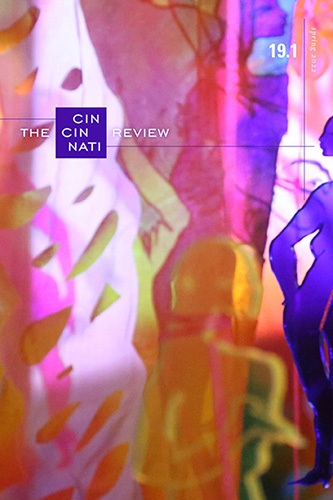
The Cincinnati Review is quite possibly one of the most
gorgeous journals I’ve ever opened—with lovely cover art by Lynda
Lowe, who has a color portfolio inside the magazine. Even though
The Cincinnati Review has only been in print since 2003, it has
all the trappings of a long-established publication: exemplary
production quality, prominent contributors like Antonya Nelson and
Billy Collins, and a selection of consistently engaging and
evocative work. The fiction demonstrates a predilection for
confident, direct narratives and quirky sensibilities. Antonya
Nelson’s “Heart-Shaped Rock” meets her usual standards, and definite
standouts include Tao Lin’s “Three-Day Cruise” and Kevin Wilson’s
“Grand Stand-In,” with its sharp and funny opening: “The key to this
job is to always remember that you aren’t replacing anyone’s
grandmother. You aren’t trying to be a better grandmother than the
first one. For all intents and purposes, you are the grandmother and
always have been. And if you can persuade yourself of this, can
provide this level of grandmotherliness with each family, every
time, then you can make a good career.” This edition also includes a
great selection of book reviews, including three pieces on Saul
Bellow. Definitely pick up this issue of The Cincinnati Review—it
solidifies the magazine’s reputation as one of the strongest new
publications available. [The Cincinnati Review, University of
Cincinnati, Department of English and Comparative Literature,
McMicken Hall, Room 369, P.O. Box 210069, Cincinnati, OH, 45221.
Single issue $9.
www.cincinnatireview.com] — Laura van den Berg
Fence
Volume 9 Number 1
Winter/Spring 2006
Biannual
After creating controversy with the (some say) pornographic cover of
their summer issue, Fence is back with a fine selection of
fiction, poetry, and art. Everything about the magazine radiates
“coolness,” from the idiosyncratic (and slightly creepy) art of John
Lurie, to the experimental poetry, and quirky fiction. Commendably,
Fence provides a forum for experimentation and the results are
often engaging. There’s particularly wonderful poetry from Corey
Mead, Sarah Rosenthal, and Erika Howsare, while Diane Greco’s
“Alberto, A Case History,” which won the Summer Literary Seminar
contest, is a standout in fiction: “I opened the door to find a boy
slumped on the step. A grimy elbow poked through a hole in his
sleeve, and a swag of dull yellow hair cascaded to his nose, which
was tipped with a café-au-lait stain shaped like Australia. His
mother, or someone, had pinned a note to his lapel: Alberto has
been taken by the devil.” There is, however, a bit of unevenness
in this issue; some of the work seems to go awry with its
inventiveness, as the line between innovation and gimmickry is
sometimes thin and examinations of contemporary existential
quandaries often lose appeal quickly. Still, any issue of Fence
is interesting enough to make it worth reading and this one is no
exception. The magazine continues its commitment to original, edgy
work—not to mention brilliant production design and presentation.
And the recommended reading lists in the contributor’s notes, with
enough new titles to fill a small library, provides a nice bonus at
the end of an electrifying ride. [Fence, 303 E. 8th St., # B1, New
York, NY, 10009. Single issue $10.
www.fencemag.com] —Laura van den Berg
International Poetry Review
Volume 31 Number 1
Spring 2005
Biannual
Not to be confused with Poetry International out of San
Diego State, The International Poetry Review is published by
the Department of Romance Languages at the University of North
Carolina at Greensboro. This perfect-bound journal includes 100
pages of poems and a few reviews. Roughly half of the journal
features poems in translation, showing the poem in the original
language and the English translation; the other half features poems
written in English with international subject matter. Some of the
translated poems seem, indeed, to lose something in the move from
their original language to English, where they often seem choppy,
amateurish. Not all, however; Luis Alberto Ambroggio’s poem,
translated by Yvette Neisser, “The Altar of Mirrors,” is quite
lovely: “The pirates knew / how to guard their captives;
/ among mirrors and mirrors / they kept them…” Among the
poems written in English, Susan Rich’s long sectioned poem, “Iska’s
Story” is moving and lyrical, and Jay Groswold’s “Clandestine Music”
is a surreal adventure. [International Poetry Review, Department of
Romance Languages, The University of North Carolina at Greensboro,
Greensboro, NC 27402-6170. Single issue $5.
www.uncg.edu/rom/IPR/IPR.htm] —Jeannine Hall Gailey
Land-Grant
College Review
Issue Number 3
2005
Biannual
Land-Grant College Review, a beautifully produced magazine from
New York City, offers a spectrum of strangeness. The
realities of the ten stories in this issue are all somewhat skewed
and couldn’t be classified as straightforward realism, but there’s
considerable variation within this framework, which is one of the
qualities that makes the magazine so consistently interesting—the
different shades of weirdness. A journal full of stories like
Kenneth Bernard’s heavily annotated “On The Pill,” or Diane
William’s abstract short-short, “Please Let Me Out Again of the
Small Plugged Hole,” might read as impenetrable or pretentious, but
the boldly experimental works are nicely balanced by stories with a
more subtle oddness, like Mary Swan’s “Outlier,” the tale of a
struggling single mother unusually impacted by the death of a man
she barely knows: “They seem to have been driving for a long time
but there are store signs that say Sycamore Cleaners, Subs on
Sycamore, and she wonders if they’ve looped back somehow. Outside
Sycamore Variety there’s a phone booth with someone inside, just a
glimpse as they speed by. For some reason she finds herself thinking
about Sam’s book report, the questions he had so much trouble with.
At what point do you realize that you’re reading a different type of
story? At what point does everything change?” It doesn’t take a
reader of Land-Grant College Review long to figure out
they’re reading a “different type of story,” and the fiction feels
wonderfully innovative and fresh. The art by Marilyn Holsing, which
graces the cover and the title page of each story, is also worth
mentioning—darkly peculiar and graceful images that perfectly
complement the work in this issue. [Land-Grant College Review, P.O.
Box 1164, New York, NY, 10159-1164. Single issue $12.
www.land-grantcollegereview.com] —Laura van den Berg
The
Missouri Review
Volume 28 Number 3
Winter 2005
Triannual
I know that The Missouri Review changed its look and feel
some time ago, so this may be old news to some of you—but The
Missouri Review is bigger, more graphic, and strangely
personality centered—large bios appear next to the work, complete
with author photos, each on its own page—and beginning pages of
stories start with shouting, inch-high fonts. The overall effect a
little distracting, making me feel I was reading some kind of souped-up
“mega” literary magazine. This issue features an interview with A.M.
Homes, a pictorial review of Leon Bakst’s costumes for the Russian
ballet, and poems by R.T. Smith. My favorite poems were those of
Lynn Aarti Changhok, whose formal poems about her childhood in India
and her subsequent life in New York ache with nostalgia. in “Artemesia”
she writes: “In the dream, I walked up narrow streets / Where
butchers string up carcasses, but each / Dead body was a year I’d
been away, / Their angry, hollowed stares accusing me: / You have
no claim. You are no daughter here.” The journal still retains
the charming literary cartoons and a small section of reviews at the
back. The trendy formatting of the magazine aside, the content is as
old-fashioned and solid as always—nothing to challenge the old
guard, certainly not adventurous, but enjoyable poetry and prose.
[The Missouri Review, 1507 Hillcrest Hall, University of Missouri,
Columbia MO 65211. Single issue $7.95.
www.missourireview.com] —Jeannine Hall Gailey
Pleiades
Volume 26 Number 1
Spring 2006
Biannual
This issue of Pleiades, with its cover depicting George
Washington with his scalp on fire, contains a generous review
section (nearly half the issue’s pages are devoted to reviews) and a
few features, including multiple poems by Kevin Honold and Jap
Hopler, with introductions by Cate Marvin and Louise Gluck,
respectively. Kevin Honold had a long sectioned poem about the Iraq
war, quite topical and all that, but my favorite of his was the
brilliant “The Groves of Baal,” meant to echo the Biblical language
of the book of Lamentations with an odd, colloquial voice chiming in
the background:
Remember the weird stories in Scripture?
Yeah. The sea monsters, even.
Even they nursed their young.
And the evil daughters,
become cruel as ostriches in the wilderness?
Yeah. I was on ostrich.
The reviews section covers everyone from Ted Kooser to Dana Levin
to Kent Johnson’s latest chapbook, from Yale Younger poet Richard
Siken to Brigit Pegeen Kelly, each review examining the book with
enough detail and energy to actually help the reader decide whether
or not they might enjoy each book. I always enjoy this journal, and
continue to recommend it for its intelligent work with a leaning
towards the surreal. [Pleiades: A Journal of New Writing, Department
of English, Central Missouri State University, Warrensburg, MO
64093. Single issue $5.
www.cmsu.edu/englphil/pleiades/ ] —Jeannine Hall Gailey
Rhino
2006
Annual
This year’s bright pink issue of Rhino features, as usual, mostly
poetry, with a satisfying section of poetry chapbook and book
reviews in the back called “Rhino Reads.” This issue also features a
section of poetry in translation. The poetry in Rhino
typically flirts with experimentation, drawing in the reader by a
thread of emotional energy, lyric power and sometimes, offbeat
humor. There is a strangeness to the content, an unfamiliar subject
or approach or a dream-like haze of recounting. Here’s a sample bit
from Priscilla Atkins’ prose poem, “I was Telling You About Love”:
“…She craved boundaries, ledger lines, a fur coat. She got so she
counted clouds and would only eat alone, sitting on the stairs
facing south. And, at that, strictly pieces of dry toast cut in
squares, while her family stood outside the back door growing gills
in the rain.” Kristy Bowen and Rebecca Loudon have standout pieces,
not to be missed. Multiple poems in this issue reference science,
questions of the cosmos, and mathematics, including Janet Norman
Knox’s “Gravity Dog,” Diane Furney’s “Lithium, Chromium,” and
Maureen Alsop’s “Finding the Best Mathematician.” This magazine
continues to be a source of pleasurable reading, crowded as it is
with its offbeat, lyrical voices. [Rhino, PO Box 591, Evanston,
Illinois 60204. Single issue $10.
www.rhinopoetry.org] —Jeannine Hall Gailey
the
strange fruit
Volume 1 Issue 2
December 2005
Biannual
This new upstart journal from my hometown of Seattle has already
garnered national attention and deservedly so. Newcomers crowd the
pages next to the occasional more well-known names like Lyn Lifshin
and Joshua Marie Wilkinson, and the mix of poetry and prose, with
interspersed black-and-white art work, is intense and surprising.
Consider these lines from Elise Gregory’s poem, “Hummingbirds”:
“Open-mouthed I caught / a ruby-throated bird. // She mistook my
face / for flowers, knocking / my tonsils out of place…” In a
photograph by William Flitter, a man in a plaid shirt wheels a giant
wooden cross through a hipster neighborhood; in another, an
unattached prosthetic leg wears ankle socks and heels. A moving
story about a child and his mother, “Behind the Candy Factory,” is
disturbing and sharp. Check out this slim, perfect-bound little
journal while you can still say you heard of it first. [the
strange fruit, 300 Lenora Street, #250, Seattle, WA 98121.
Single issue $6.
www.thestrangefruit.com/] —Jeannine Hall Gailey
Witness
Volume 14
2005
Biannual
This issue of Witness focuses on “childhood in America,” a
theme richly explored in an impressive selection of fiction, poetry,
nonfiction, and photography. Much of the work concentrates on
transformative moments in childhood—first experiences with death,
desire, and discovering the limitations of adult figures—and
sketching American landscapes: Maxine Kumin’s Philadelphia corset
shop, Lawrence Raab’s nature camp, and the agonizingly familiar
territory of high school. Rocky adolescence is a popular angle in
this issue, and Cortney Davis’s short story, “Products of
Conception,” provides a captivating exploration of the secret lives
of teenagers: “Miranda’s mother was never married, so Miranda was an
out-of-wedlock baby. I used to tease her a lot about it—at least I
had a father, I’d say—but I stopped teasing her last year when I
found out I was pregnant.” The stories of Richard Hoffman and Bob
Hicok are also highlights, as is Dionisio D. Martinez’s poem “Cradle
Song”: “Because your name is a wafer of questions swallowed whole /
and your words begin to thaw one slow spring afternoon. / Because
small silences gather now like necessary smoke / and you hide very
carefully your sealed box of memories / and your words begin to thaw
one slow spring afternoon.” An artistic kaleidoscope that captures
the gritty and wondrous nature of youth in America. [Witness,
Oakland Community College, Orchard Ridge Campus, 27055 Orchard Lake
Road, Farmington Hills, MI, 48334. Single issue $12.
www.oaklandcc.edu/witness]
– Laura van den Berg
ZYZZYVA
Volume 21 Number 3
Winter 2005
Triannual
The seventy-fifth issue of the
all-West-Coast-all-the-time-journal ZYZZYVA begins with
multi-page editor’s note discussing the careers of writers
ZYZZYVA published for the first time, a very interesting
follow-up attempt that illustrates more concern for new writers than
most lit mag editors display. The art work, as always, was
fascinating – especially impressive were the botanical etchings by
Sarah Horowitz and the photoetchings of interior spaces by Lisa
Rigge. Lots more pages of prose than poetry, as is usual for
ZYZZYVA; my favorite piece was Theresa Sotto’s “Excerpts,” which
juxtaposed political prose from 1904 with lyric poetry fragments
describing the same time period: “:now that the fairs are over /
we’re nostalgic over postcards… / trench coats tossed over loin
cloths / bowler hats teetering / on the back: we’re splendid /
sights we wish you were / here.” Besides the bits of cover letters
usually displayed on the back cover, there is also a section called
“Pitches to the Editor,” which includes various bits from cover
letters to ZYZZYVA, categorized by Merit, Geography, Timing,
and Content. [ZYZZYVA, P.O. Box 590069, San Francisco, CA,
94159-0069. Single issue $11.
www.zyzzyva.org/index.htm.] – Jeannine Hall Gailey
Posted May 1, 2006
Ascent
Volume 29 Number 3
Spring 2005
Triannual
If you have ever wondered why so many high school students
graduate with an indifference to literature; if you have ever
considered the impact of war literature on young people whose heroes
are largely provided by electronic media; if you have pondered the
best words for the dying and what it means to be profoundly changed
by a relative stranger, then, by all means, find a quiet corner and
put yourself in the good company of this issue’s authorial minds.
There is plenty of fiction and poetry here, but it is the
non-fiction that shines with powerful, elegant prose. Thomas
Washington’s thoughtful, cheeky essay chronicles his salmon-upstream
attempt, as a high school librarian, to promote a campus-wide
reading period (p.s. the resistance wasn’t from the students).
College teacher Gail Hosking Gilberg, whose father died in Vietnam,
has high hopes—and an existential weep—for students challenged by
Tim O’Brien’s magical-grit war fiction. Jim Dameron contemplates
both the words and the silence of death, while Richard Goodman’s
volunteer service as a companion for an elderly woman foments an
inner revolution of sorts. All are gutsy and weighty with, to take a
phrase from Dameron, “a nod toward tenderness.” [Ascent, Department
of English, Concordia College, 901 8th St. S., Moorhead, MN 56562.
Single issue $5.
www.cord.edu/dept/english/ascent/index.php] – Lisa K.
Buchanan
Backwards
City Review
Volume 2 Number 1
Winter 2006
Biannual
Part comic book, part ironic guidebook for today’s troubled yet
repeatedly humorous world, the winter edition of Backwards City
Review reveals the more playful side of the more reflective,
more meditative literary journal; and yes, this is possible. While
its contents won’t dazzle your minister—unless, of course, he’s not
put off by a hearty double helping of sarcasm—this issue offers
roughly 100 pages of quirky, if, at times, campy, quality writing,
complete with a giant, purple, city-crushing, donut-eating robot on
its cover. All the world an oddity. Let’s just say you know what
you’re in for when you see the cover and your interest continues its
meandering inside. Andrew Kozma’s en face poetic duet “Of The Civil
Principality” and “Of Cruelty and Mercy_1_, and Whether It Is Better
to Be Loved Than Feared, or The Contrary,” both inspired by
Machiavelli’s classic manifesto The Prince, and J.G.
Brister’s prose-poem-meets-extreme-fiction piece, “If You’re Reading
This, I’m Dead,” are seeming misfits. They’re less jesting in
nature, and stand out against an otherwise blithe and facetious
collection of work, suggesting toward, and likewise foiling,
Backward City Review’s implied personality as a journal. Which
is not to say Backwards City Review
doesn’t offer readers a good read. What it does offer is a different
kind of read, one reminiscent of, say, Breakfast of Champions,
or the more obscure, and less violent, moments in Pulp Fiction.
Perhaps, however, the foils are not meant to steal the show. Martin
Arnold’s poem, “Unhappy Is The Land That needs Heroes,” and C.L.
Bledsoe’s poem ,“Types of Fish I Don’t Like,” provide a more
accurate view of the issue’s mentality and approach, what some might
call the lighter side of literature. But, really, Backwards City
Review merely knows how to laugh, a skill, for literary
journals, worth at least trying, if not trying to master. [Backwards
City Review, P.O. Box 41317, Greensboro, NC 27404-1317. Single issue
$7.
www.backwardscity.net.]
— Erin M. Bertram
Ballyhoo
Stories
Volume 1 Number 2
Fall 2005
The second issue of Ballyhoo (meaning extravagant
publicity—from the American, of course) brings together writers at
all levels of their careers on the theme of “Songs and Cacophony.”
The 8.5 x 11 black and white journal frames each story with a
prominent black or white border. On the third anniversary of his
mother’s death, Andrew Bomback’s narrator prank calls his ex to
misquote the Beatles’ “I Will.” It once made the ex cum; now she
hangs up. Bomback and his narrator avoid the maudlin clichés of
unabated grief with sincerity and song. In Kyla Wetherell’s debut
print story, “The Organ,” a grandfather needs a few more moments
with his organ while his granddaughter waits impatiently. “The music
unpacks every box. The exchange of octaves restores every item she
had carefully, but for the most part thoughtlessly, sorted and
stowed for the auctioneer…” Soundtracks of lives play out in
Seattle, where a man encounters a street choir in “The One Note
Choir” by Paul Michel. The choir sings the same note every day until
one singer remains; Josh is unable to convince anyone of the choirs’
genuine intentions—for the sake of that note. Other tracks on this
Ballyhoo album include: a performance by “The Greatest Hero
Ever” (from Captain Kangaroo) in a high school auditorium is ruined
by a glimpse of underpants; a road trip to a young couple’s musical
idol, now decrepit and housebound, leaves them all drunk in Bill
Cheng’s “Buffalo”; a lounge pianist wearies of the ex-pat life, one
of chosen loneliness, in “Belly Dancing”; songs are as distinctive
as the regionism in Emily Moore’s interesting travelogue of post EU,
pre-ratified Europe. With its global audience and range of voices,
Ballyhoo adds a distinct voice. [Ballyhoo Stories, 18
Willoughby Avenue #3, Brooklyn, New York 11205. Single issue $8.
www.ballyhoostories.com] — RT Duffer
The
Canary
Issue 5
2006
I’ll admit it, at first I was intimidated. It was the periwinkle
of the front and back covers that mollified my disease. Thing is, my
hands aren’t familiar with the heft of a 125 page journal,
especially one comprised entirely of poetry, especially one
comprised mainly of long poems. On first flip-through they felled
me, hard. A substantial journal dedicated entirely to poetry is a
sad rarity these days. The Canary is a necessary and
matchless one. First Brenda Shaugnessy’s “One Love Story, Eight
Takes.” Then Andrew Mister’s “Liner Notes.” Then Alice Notley’s
“Logic.” Then Carrie St. George Comer’s “Winnemucca.” Then Raymond
McDaniel’s “X Y Z.” 1) “Because nothing is truly
forgotten and
loved.” 2) “People on the street will / tell you things if you
stop and listen. I don’t have any money.” 3) ‘‘Please tell me
something / with which I’m familiar. / isn’t there another part of
now.” 4) “They say it’s a hard exhale, a power sigh, / an extreme
haaa, but nothing close to laughing, / the rare opposite of a cough
and impossible to capture, / appearing as dust on the lens.” And 5)
“My tongue’s getting all funny but speak me those words you said. /
ooo vay dublavay eeeks egreeks zed.”
(The) Canary (n): 1. a small, yellow songbird of the finch family
long bred as a cage bird; 2. a sweet white wine; 3. a light yellow;
4. an exceptional journal of various and, at times, progressive
quality, often consisting of lengthier poems and generally pleasing
its reader with its solid footing and candor. Get your hands on this
bird. It's not going anywhere, and going so much further. [The
Canary, 512 Clear Lake Road, Kemah, TX 77565. Single issue $10.
www.thecanary.org] — Erin M. Bertram
Cimarron
Review
Issue 154
Winter 2006
Quarterly
You could sit down and read this issue 100-page issue of the
Cimarron Review in a single afternoon, but I wouldn't advise it.
The contents of this handsome, deceptively thin journal demand a few
long, thought-collecting breaks. The poems and stories here are all
packed to bursting with emotion—big, messy, often ugly emotion. Some
examples of what I mean by messy: the mother in Susan C.
Greenfield's short story, "Binoculars," is not only jealous of her
teenage daughter's beauty and budding sexuality, not only protective
of that same daughter in the face of a creepy voyeuristic neighbor,
she also (and here the mess begins) spies on her daughter herself;
in Theodore Worozbyt's poem, "Beautiful Things," the mess is more
delicate, but just as complex, composed, as it is, of lettuce seeds,
nasturtium petals, old poems, potatoes, a stranger named Gretchen, a
beloved wife, cocoa flavored cereal, and the poet's own "hold on
dimming things." Much of the work in this issue has a casual, almost
conversational tone, and some of it approaches laugh-out-loud funny,
in particular Scott Miles' story, "When You're the Mailman," and
Charles Haverty's story, "Continuo," both of which are laced with
humorous toss-offs that add necessary charm to morally confused
first-person narrators. But what most struck me about this issue was
the sense of an unwavering editorial presence. Not only are all of
the pieces here emotionally powerful, they are powerful in notably
unsubtle (raw, rough around the edges) ways. Clearly the editors at
Cimarron Review are attracted to depth of feeling over stylistic
polish. And although this preference lends itself to the occasional
awkward turn of phrase or slightly blocky plot construction, these
shortcomings don't matter much in the end, as every word in these
pages is sincerely felt, sincerely delivered. [Cimarron Review, 205
Morrill Hall, Oklahoma State University, Stilwater, OK 74078-4069.
Single issue $7.
http://cimarronreview.okstate.edu] — Kim Drain
Circumference
Poetry in Translation
Issue 4
Autumn/Winter 2005/2006
Biannual
What gets translated? is more of a koan than a question. After
all, where does meaning hide if not in words themselves? And what
happens to meaning when words are transformed into another language?
Something remains—but what, exactly? These are the kinds of
questions that this small but important journal sets out to explore.
How one reads Circumference depends largely on one's language
base. I read English, of course, and (rather badly but with much
enthusiasm) French, so the French-English spreads of this journal
(which is formatted like a dual-language book) were most interesting
to me. I stumped my way much more awkwardly through the other
Romance languages, and those poems in Chinese, Hebrew, Greek, and
Russian were, to my uncomprehending eyes, more or less decorative
blocks of text. Yet it's in reading through—or at least looking
at—the many languages gathered between these covers that you taste
the real rewards of this journal, because in doing so, you begin to
track your own mind as it works to fix meaning even in those
languages you can't possibly begin to read, and you can almost feel
the different densities of language as they filter through your
consciousness. As far as the translations themselves go, some are
inspired, others flat. Personal favorites include Ilya Bernstein's
gusty translations of three poems by Osip Mandelstam—but there is
much to choose from. The journal departs from its standard format of
poem-translation in two sections. One of these is the lighthearted
"Homophonic Feature" in which more than a dozen writers (including
Rick Moody and Billy Collins) attempt to "translate" a Flemish poem
by Herman de Coninck by grappling with the implications of its
sound-character alone. The other section is a translation of random
notes, private jottings, and mostly inconsequential musings by Celan,
which, though rather fetishistic in its academic attention to
errata, does contain a few illuminating thought-bits, such as "the
poem has . . . an anti-metaphorical character . . . What separates
you from it, you cannot bridge; you have to decide to leap."
[Circumference, P.O. Box 27, New York, NY 10159-0027. Single issue
$10.
www.circumferencemag.com] — Kim Drain
The
Greensboro Review
Number 78
Fall 2005
Quarterly
Aching for a good, solid story? This issue has four outstanding
ones. The voices are resonant, triumphantly free of cell phone
repartee and brand-name shorthand. Treat yourself to a giggling weep
at the fragile humanity in a story by Michael Poore: ”You can tell
Marie’s brother has problems, like his mind is inside out. He can’t
remember his name the way most people can, so you have to call him
by whatever he last did worth mentioning....Came Upstairs can
remember stories word-for-word.....” Fictions by Lyn Stevens, Kevin
Wilson and Sean Ennis (on a father’s holiday gifts: “It was a
strange, vomiting kind of charity.”) have first-person narrators who
will follow you home. The style is realist; the irony, refined and
gentle. Stevens’ deceptively direct narration questions nothing less
than the nature of mammalian love and survival. Poore, Wilson and
Ennis are particularly adept at drawing eccentric characters that
steer clear from wacky and cute. The issue features work by 16 poets
as well. More than half of the authors and works are in or of The
South, but the most overt address is Natasha Trethewey’s poem,
“Southern History”: “Before the war they were happy, he said, /
quoting our textbook. (This was senior-year / history class.) The
slaves were clothed, fed, / and better-off under a master’s care.”
[The Greensboro Review, English Dept., 134 McIver Building, UNCG, PO
Box 26170, Greensboro, NC 27402-6170. Single issue $5.
www.greensbororeview.com] – Lisa K. Buchanan
Mizna
Prose Poetry and Art Exploring Arab America
Volume 7 Issue 1
2005
Biannual
Mizna, “the country’s first Arab American lit journal,”
includes poems, cartoons, fiction, non-fiction, a play and art work.
You don’t have to be Arab American to submit or to read. Several of
the entries link the revered cuisine of Arab culture to its current
global eminence; this tension, of a proud culture in the midst of
change, permeates the journal. “I just wanted to save my face / But
ended up making an ass of myself / With my checkered cloth and
mistaken identity,” Rosina Hassoun writes at the end of “Accidental
Hijacking.” Two brothers travel with their father to his homeland in
Syria in “American Muezzin” by Jason Makansi. His vaulted image is
doubted by his eldest son, while the youngest observes this
disparity between tradition and the American in he and his brother,
who are “trying to understand the greatest human conundrum of them
all, our father.” Remember Ohio? Yussef El Guindi’s drunken narrator
awaits the results of the last election with his wife and another
couple. Funny and perfectly timed, this allegory captures the mood
of a country through one man’s sodden but sharp perception that
things are not what they seem, “I experience a momentary jolt at the
realization of something I had never considered, and look away…” In
Bushra Rehman’s “Pioneer Spirit,” narrator Razia portrays the
pre-witch trial Puritans at a living history museum. Her inaccurate
but fun tour to a staid old white couple and a group of Harley
bikers, who remind her of her Muslim uncles in Queens, represent the
kind of image-consciousness, both misunderstood and misrepresented,
that permeates Mizna. It works best, as in the pieces
mentioned above, when the characters are dealing with relationships
instead of issues. [Mizna, 2205 California Street NE, Suite 109A,
Minneapolis, MN 55418. Single issue $10.
www.mizna.org] — RT Duffer
New
England Review
Volume 27 Number 1
Winter 2006
Quarterly
Reminiscent of The Paris Review or, to a lesser extent,
Western Humanities Review or The New Yorker,
New England Review asserts itself as a dense academic journal
that takes itself as seriously as academia tends to take itself. And
that’s pretty serious. The journal’s subscription tear-out reads,
assuredly, “Look to NER for the challenges your taste requires.”
After a billboard like that, false advertising is pretty much out of
the question. On first glance, New England Review is an
elitist journal with refined and discerning tastes, anything but bus
ride fodder or dentist office reading material. Refined and
discerning aren’t necessarily negative attributes, only when that’s
all a subject has to offer, and for New England Review,
that’s not all. The journal’s also got poems by Bob Hicok: “The
bottom of this book / is on fire, is where the lies have fallen,
where someone / tells someone they were never loved, where a body is
rhapsodized / as the front of renewal, and eight pages later,
deplored as snare.”; poems by Averill Curdy and Peter Pereira; a
relic from a progressive British legal activist during the
Napoleonic era; an essay on “The Vice of Reading” by Edith Wharton;
and a new translation of Héloïse’s second letter to Abelard. This is
an issue, a journal, of diverse timbre and range, not sure to please
or appeal to all, ultimately an acquired taste, just the kind of
literature it prefers itself. Definitely a unique creature among its
peers, New England Review makes well- known its place in a
room full of literary journals. [New England Review, Middlebury
College, Middlebury, VT 05753. Single issue $8.
http://go.middlebury.edu/nereview] — Erin M. Bertram
One
Story
Issues 67-70
December 20, 2005-February 20, 2006
18 issues per year
One Story publishes 18 journals a year of one story each.
Impeccably edited, professionally dressed, the slender, 5”x7”,
pocketable books are a brilliant addition to the lit scene. “The
Arrival” (Issue 67) by Robin Romm is not another cancer story. Amy
is discovered on shore by Nina, who welcomes any break in dealing
with her cantankerous, terminally ill mother. While Dad’s upstairs
napping, Mom dotes on Amy, exposing emotions dormant in Nina. “Is
this just jealousy? That I can’t make my mother stand for lunch?
That she hasn’t called me dear in ages?” No one knows where Amy came
from and no one cares—Romm lays out the competing emotions of grief
and appreciation too expertly to worry about such triviality.
Another sea born arrival is introduced in Austin Bunn’s mesmerizing
“The Ledge” (Issue 68). I loved this story—there’s no better way to
say it. Vivid, magical, poignant, part Moby Dick, part
Treasure Island, this Columbus-era piece is wholly original.
Finding themselves pulled to imminent death, the crew confronts much
more than mortality at the last corner of the world. “There are many
ledges that split this world.” The other installment for January (One
Story publishes bi-monthly on the odd months), “The Six Poisons”
(Issue 69), by Dana Shapiro, takes place at a yoga retreat in India,
where estranged half-sisters encounter each other and a past
corrupted by jealousy. That and the other poisons must be purified
from the body before one can reach enlightenment, which is distant
for both sisters. Matt Clark’s posthumously published “Baton Rouge:
A Doctor Story” (Issue 70) takes on the
one-picture-one-thousand-words equation. Wives of doctors are
organizing the doctors before a photo shoot and we get clever,
biting bios of each doctor and their relationships. One Story’s
format gives writers and readers the kind of exposure, dedication to
craft and quality that gets lost in busier journals [One Story, PO
Box 1326, New York, NY 10156 1 yr (18 issues) $21.
www.one-story.com] — RT Duffer
Prairie
Schooner
Volume 80 Number 1
Spring 2006
Quarterly
This delicious issue of Prairie Schooner
has a laudable, rare sighting of Letters to the Editor in which
epistlers discuss whether a reviewer’s line—“the pared-down diction
of a Native American Voice”—constitutes modern literary criticism or
ethnic / aesthetic homogenization. Hurrah, I say, for the debate
over a sentence. The fiction here, mostly realist, includes “Story”
with the subtle metaliterary charm readers can expect from both its
title and its author, R.T. Smith. In other stories, protagonists are
haunted and/or redeemed by art: respectively, an ancestral poet and
Leonardo DaVinci’s Last Supper. Several pieces have an
international flavor. Call it multi-culti trend or mindful
expansion, the fiction holds up. Meredith Hall’s memorable essay, “Outport
Shadows,” contemplates aging: “Every time I walk unnoted among
people, every time I glance in the mirror, every time I look down
and see the ropey veins of my hands I have to tangle, in a quiet
stunned moment, with this underlying truth: I am far along the
path.” And whoop-whoop-whoop to Russell Thorburn’s poem, “Watching
the Three Stooges After Fifty, in the Hospital,” which opens
affably: “Let the pie in the face become your Bible / the
finger-poke your lightning bolt.” [Prairie Schooner, 201 Andrews
Hall, University of Nebraska, Lincoln, NE 68588-0334. Single issue
$9.
http://prairieschooner.unl.edu/] – Lisa K. Buchanan
Reviewers
- Contributors Notes
March 2006
February 2006
January 2006
December 2005
November 2005
October 2005
September 2005
August 2005
July 2005
June 2005
May 2005
April 2005
March 2005
February 2005
January 2005
December 2004
November 2004
Cumulative Index
of Lit Mags Reviewed