Home » NewPages Blog » Page 88

NewPages Blog

At the NewPages Blog readers and writers can catch up with their favorite literary and alternative magazines, independent and university presses, creative writing programs, and writing and literary events. Find new books, new issue announcements, contest winners, and so much more!

Sponsor Spotlight: Mom Egg Review

Mom Egg Review - Spring 2020

Mom Egg Review is an annual print journal focused on motherhood. Their issues featured varied voices at all career phases.

This year’s issue is on the theme of “Home,” an apt focus for all of us currently staying at home and practicing social distancing. It’s a nice reminder that we’re not alone. Like many other journals at the moment, the editors have put together a virtual reading for readers. “Voices from HOME” links to contributors inviting everyone into their homes as they explore the theme.

NewPages Book Stand – May 2020

We have a new Book Stand at NewPages. This month, find new and forthcoming book titles, including five featured books at our website.

Audubon’s Sparrow: A Biography-in-Poems by Juditha Dowd  is an indelible portrait of an American Woman in need of rediscovery. The biography-in-poems focuses on Lucy Blackwell and John James Audubon.

Gerry LaFemina’s Baby Steps in Doomsday Prepping pauses time, letting us examine the world with love and intelligence.

Back to the Wine Jug: A Comic Novel in Verse by Joe Taylor is a cross-genre title following Hades as he teleports to Birmingham, Alabama.

Frank Paino’s Obscura sheds light on the most obscure corners of history and human nature, a hagiography of unorthodox saints.

You’ve Got Something Coming by Jonathan Starke is the winner of the Black Heron Press Award for Social Fiction and follows a down-and-outer and his young daughter across the country.

You can learn more about each of these New & Noteworthy books at our website. Our featured titles can also be found at our our affiliate Bookshop.org. You can find out how to place your book in our New & Noteworthy section here: https://npofficespace.com/classified-advertising/new-title-issue-ad-reservation/.

Sponsor Spotlight: RHINO

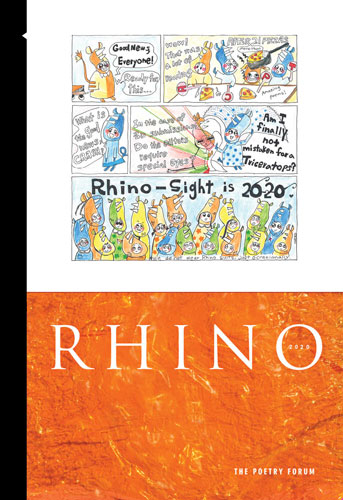
RHINO publishes some of the best and most innovative poetry, short shorts, and translations in their annual issues. For their 2020 issue, the editors have organized an ongoing virtual reading event for the month of May. You still have some time to join in the fun, and you can learn more about these virtual readings here.

To learn more about the annual journal, visit their sponsored listing at NewPages.

Modern Espionage in Ancient Rome

Guest Post by Bill Cushing

Pulitzer Prize winner John Hersey is probably best known for his books dealing with China, where his father served as a missionary, but in The Conspiracy, he takes readers back to the first century AD and Nero’s imperial and mainly insanity-tinged reign.

Like the works of Robert Graves or Leon Uris, Hersey uses a historical backdrop to present a political thriller of the first order. Employing two main characters—Tigellinus, co-consul of the Praetorian guard, and Paenus, tribune of the Roman secret police, along with a series of memos, assorted notes, intercepted letters, and interrogation transcripts—the two members of Nero’s intelligence community try chasing leads concerning a potential assassination attempt against their emperor.

The primary suspects involved in this plan?

The philosopher Seneca and a cadre of poets, artists that Nero had earlier supported and entertained, are surveilled, bringing up images from the Oscar-winning film The Lives of Others.

However, as the layers of the plot open, it begins to reveal Nero’s descent into madness.

Soon, the reader begins to wonder if this is an actual investigation or a means to create a paper trail pointing to others in order to establish scapegoats while the members of Nero’s own security people become the real perpetrators.

One interesting aspect of this book is that it was released in 1972, when news and revelations of the Watergate incident dominated worldwide media and occupied American minds. Hersey’s story produced numerous parallels between the subterfuge and hidden messages of the novel with the events of those days. If readers want to make those connections or draw any parallels with current events is their choice, of course, but the fact that it’s possible only verifies what a relevant story Hersey concocted in any age when he conceived and delivered The Conspiracy.


The Conspiracy by John Hersey. 1972.

Reviewer bio: Bill Cushing writes and facilitates a writing group for 9 Bridges. His poetry collection, A Former Life, was released last year by Finishing Line Press.

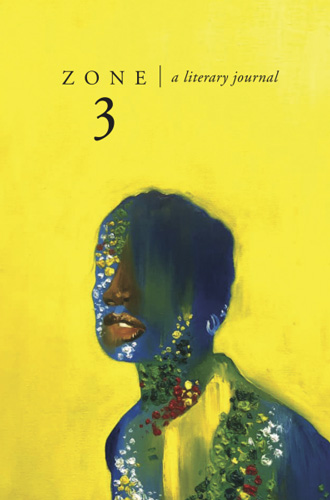
Zone 3 – Spring 2020

The issue of Zone 3 includes poetry by Darius Atefat-Peckham, Colin Bailes, Brian Bender, Daniel Biegelson, Christopher Citro, Lynn Domina, Alexandria Hall, Lauren Hilger, Angie Macri, Martha McCollough, A. Molotkov, Kell Nelson, Amy Seifried, Pui Ying Wong, and more; fiction by James Braun, Janice Deal, Tammy Delatorre, Maura Stanton, and Terry Thomas; nonfiction by Rebecca McClanahan, Katherine Schaefer, and William Thompson, and art by Khari Turner.

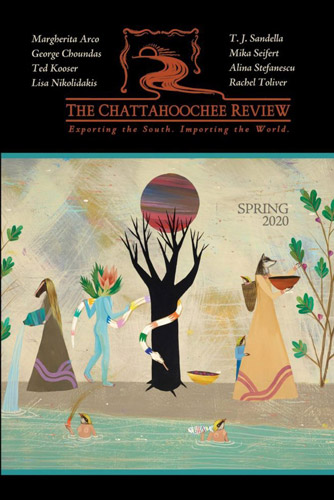
The Chattahoochee Review – Spring 2020

In this issue, poetry by Ruth Bardon, Mirande Bissell, Darren Demaree, Eli Eliahu, Stuart Gunter, Marlon Hacla, Ted Kooser, Len Krisak, Komal Mathew, and more; stories by Margherita Arco, Erin Flanagan, and more; essays by George Choundas, and others; and art by Deedee Cheriel. This issue also features the 2020 Lamar York Prize Winners: Lisa Nikolidakis in Fiction & Rachel Toliver in Nonfiction.

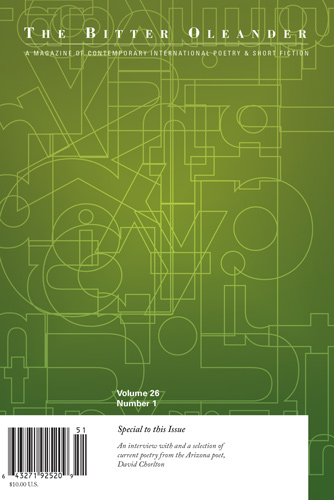
The Bitter Oleander – Spring 2020

The Spring 2020 issue of The Bitter Oleander features the contemporary Arizona poet David Chorlton, interviewed by our editor and including a generous selection of poems from his forthcoming book, Speech Scrolls. The issue also presents translations from the fiction of Sophia de Mello Breyner Andresen (Portugal); and poetry in translation by Paula Abramo (Mexico), Alberto Blanco (Mexico), Maritza Cino (Ecuador), Andre du Bouchet (France), and Elaine Vilar Madruga (Cuba).

AGNI – No 91

With AGNI #91 we welcome a roster of new editors. Collectively chosen work explores impending crises as well as acts of mitigating goodness; elegies marking losses sit side by side with expressions flashing pure surprise. Cover and portfolio artist Christopher Cozier captures the sly globalized vectors of use and misuse, tracing a long history forward to now. Poems by Sandra McPherson, Steven Sanchez, Emily Mohn-Slate, Colin Channer, and others offer the sensory grab of the immediate, as do stories by Shauna Mackay, David Crouse, and Aurko Maitra and essays by Debra Nystrom, Jiaming Tang, and Ann Hood.

AGNI Offers Something Special

AGNI is currently offering something really special for readers: the Virtual Launch of AGNI 91.

Here, the editors present videos from their contributors from all over the world and invite readers (or viewers!) to join the audience. All the pieces from the new Spring 2020 issue are available online, most of which have an accompanying video of the writer reading their work.

This is great not only for people who might not be able to spare extra cash to get their own copy (though if you can, please do consider it), but it’s also great for those of us who are having a hard time sitting down and concentrating on reading while we’re social distancing, and those who currently miss attending readings in person.

You can also learn more about the editors who have put this fantastic project together at the AGNI website.

I for one can’t wait to hit “play” and start hearing quality reading in my own home.

Visual Poetry by Lillian-Yvonne Bertram

Magazine Review by Katy Haas

The Fall 2019 issue of Seneca Review includes four pieces by Lillian-Yvonne Bertram. These visual pieces draw in the eye with text boxes layered over one another, reminding me of a house of cards that’s fallen, the cards now strewn in overlapping angles. They’re all titled “World Map:” with a different year following the colon.

In these pieces, Bertram speaks about race and sexuality. The exploration of these themes comes in snippets that repeat and fade away like memories that resurface repeatedly: instant messenger conversations, conversations with her mother, antagonization on the basketball court.

Bertram uses the visuals in an inventive way that helps the poetry move along and creates a bigger impact for the message. I read the four pieces over and over, fully admiring the way in which they were presented.

Explore Your Wild at the Elk River Writers Workshop

2020 Elk River Writers Workshop FlierThe Elk River Writers Workshop embodies the idea that deep, communal experiences with the wild open the door to creativity. We bring together some of the most celebrated nature writers in the U.S. with students who are serious about fostering a connection with the environment in their writing, all under the big Montana skies. Rolling application deadline. Offering full refunds for coronavirus-related cancellations. elkriverwriters.org

View the full May eLitPak newsletter here.

2020 Chesapeake Writers’ Conference: Words. Water. Woods: Write on the River.

Spend the first week of summer on the St. Mary’s River! The 9th Annual Chesapeake Writers’ Conference offers an immersive experience featuring daily workshops with accomplished faculty in fiction, poetry, creative nonfiction, and songwriting; a diverse schedule of craft talks, lectures, panels, and readings; a youth workshop for high school students; and a Teachers’ Seminar for educators. All levels welcome. www.smcm.edu/events/chesapeake-writers-conference/

**They are monitoring the current situation and are optimistic they will be able to host the June conference as planned. A final decision will be made this month.**

View the entire May eLitPak newsletter here.

A Call to Artful Rebellion

Guest Post by Erin H. Davis

A Measure of Belonging: Twenty-One Writers of Color on the New American South, edited by Filipino-American author Cinelle Barnes, showcases some of the brightest and most poignant work of southern writers of color. Published by Hub City Press located in Spartanburg, South Carolina, this anthology features authors from various backgrounds and ethnicities who, in the joyful spirit of Southern America, explain the idea of a “new” south, an ever-evolving triumph against traditional stereotypes and racial discrimination.

Barnes, anthology editor and author of memoir Monsoon Mansion and Malaya: Essays on Freedom states, “I decided that every one of my projects . . . would be an invitation for other people of color to come, to be visible, and to thrive here [The American South].” Her anthology certainly does just that, and she’s not afraid to let traditionally taboo subjects rise to the surface, bleed through the page, and strike the heart of the reader—independent of race or class.

For example, Soniah Kamal in “Face” explores her personal grief and the collective spirit of women of color as they experience the horrors of miscarriage and the social stigmas attached to the female body. In a similar vein, Devi S. Laskar’s “Duos” dives into the idea of living a dual life between dominant white culture and the culture of the home. She writes, in stunning prose, “Often, I smiled. I learned later that is what primates do when threatened: grin.”

A Measure of Belonging is a stark reminder that, behind the draping magnolias and weeping willows, the south has a loaded history, the effects of which still ripple through today’s society. Cinelle Barnes’ anthology is but one call to awareness, a call to artful rebellion.


A Measure of Belonging: Writers of Color on the New American South Edited by Cinelle Barnes. Hub City Press, October 2020.

Erin H. Davis is an MFA (fiction) graduate student at the College of Charleston. She was born and raised in Charleston, South Carolina.

Sponsor Spotlight: Litowitz Creative Writing Graduate Program, MFA+MA

Northwestern University Litowitz MFA+MA logoThis new and distinctive program offers intimate classes; the opportunity to pursue both creative and critical writing; close mentorship by renowned faculty in poetry, fiction, and creative nonfiction; and three fully supported years in which to grow as writers and complete a book-length creative project. Our curriculum gives students time to deepen both their creative writing and their study of literature. Students will receive full financial support for three academic years and two summers. Both degrees—the MFA in Creative Writing and the MA in English—are awarded simultaneously at graduation.

Program faculty include Chris Abani, Eula Biss, Brian Bouldrey, John Bresland, Averill Curdy, Sheila Donohue, Stuart Dybek, Reginald Gibbons, Juan Martinez, Shauna Seliy, Natasha Trethewey, and Rachel Jamison Webster.

Sponsor Spotlight: University of New Hampshire MFA in Writing

University of New Hampshire logoThe MFA Program at the University of New Hampshire has a clear goal: to help you mold your gifts and passion for the art and to prepare you for the opportunities and demands that all writers will experience in a long career. What happens to you after you leave this program—how you will sustain yourself and your work—is one of our strongest concerns. This supportive community of students and faculty shares a belief that writing matters and that the best books of fiction, poetry, and nonfiction are made out of both the creative imagination and rigorous work.

Focus on fiction, narrative nonfiction or poetry in our graduate M.F.A. program, which has launched the careers of hundreds of poets, novelists, storywriters, essayists and memoirists. What is notable is not just how hard students work on their own creative writing, but how much effort goes into their response to the work of their peers. Writers here care deeply about each other, and the production of honest work that captures life on the page.

Ekphrastic Poetry Bringing New Meaning & Depth

Guest Post by Madhuri Palaji

In the Dark, Soft Earth by Frank Watson is a book of poems about love, nature, spirituality, and dreams.

The specialty of the book is the amazing paintings from historic to contemporary presented in it. There are paintings done by Lenoir, Kandinsky, Dali, Somov, and many more. Some poems are inspired by these paintings, though not all.

Each poem is unique and deep. There is a beauty in the way the author has woven the words. I have seen most of the paintings in the book in some art books and exhibitions but when I look at these paintings after reading the poems, I feel like I’m seeing the painting for the first time. The author has brought a whole new meaning and depth to the art. It’s like the author has translated the painting and colors into words.

There is one poem named “Vanished” where the author says:

there was no fish
that day
but even worse
for the fisherman
there was no sea

This made my heart clench, literally. How true, given the kind of world we are living in right now; there is major destruction happening all around and we are left with too little to fix.

In The Dark, Soft Earth has many wonderful poems which I have read again and again because they make so much sense. The magic, love, pain, dreams and hope in the book give a whole new meaning to the way we look at life!


In the Dark, Soft Earth by Frank Watson. Independently Published, July 2020.

Reviewer Bio: Madhuri Palaji is a writer and book reviewer from India. Her book ‘Poems of The Clipped Nightingale’ is available on Kindle. Find her at http://www.theclippednightingale.com/

Seneca Review – Fall 2019

In this issue of Seneca Review you’ll find poems and essays by Carl Dennis, Donald Revell, Katrina Vandenberg, Adam Clay, Lyllian-Yvonne Bertram, Karen Brennan, James Longenbach, Joshua Marie Wilkinson, Tyler Mills, Katharine Coles, Maya Pindyck, Emma Bolden, Geneviève Paiement, Timothy O’Keefe, and more.

Kenyon Review – May/June 2020

The May/June 2020 issue of the Kenyon Review features the sixth edition of “Nature’s Nature” includes twenty-nine new works by eighteen poets, selected by Poetry Editor David Baker. Featured contributors include Madhur Anand, Elizabeth Bradfield, Stephanie Burt, Stuart Dischell, Rebecca Morgan Frank, Paul Guest, Christian Gullette, Leslie Harrison, Didi Jackson, Devin Johnston, Joanna Klink, Phillis Levin, Leslie Adrienne Miller, Carol Muske-Dukes, Atsuro Riley, Nicole Stockburger, Hannah VanderHart, and Shelley Wong.

Boulevard – Spring 2020

In this issue of Boulevard the winning essay from the 2019 Nonfiction Contest by Emi Nietfeld. An interview featuring Téa Obreht. A new fiction piece by Joyce Carol Oates, and a story by Mary Troy. The winning poems from the 2019 Poetry Contest by A.D. Lauren-Abunassar. A collection translated by Yifei Wu of the initial days of the Wuhan quarantine.

A Quick Yet Powerful Read

Magazine Review by Katy Haas

In the Spring 2020 issue of Southern Humanities Review, Heather Corrigan Phillips dives into the use of language in “A Scattershot Approach.” Broken up into different sections, this piece looks at the idioms and metaphors relating to gunfire that English uses. Each section is a different phrase or word.

This nonfiction piece looks at a span of time immediately after the Sandy Hook Elementary School shooting. Her brother-in-law was a first responder at the school that day and we learn about him and the way his health and family were impacted. Phillips writes about this while living out of the country and learns more in spurts through Skype and phone calls, and readers subsequently learn about this in similar ways. Little bits of his story are revealed and then explorations of gun-adjacent language is placed in between.

Reading this really does bring to light the amount of idioms and metaphors that we use which relate back to guns, and this only scratches the surface. There are plenty more that weren’t included. We’re lead to question why this language is so prevalent while also seeing into the lives of humans who have gone through a traumatic event. Here is the perfect balance of fact and emotion, a quick yet powerful read.

Sponsor Spotlight: Cutthroat

Have you visited Cutthroat lately? They publish an online edition and an annual print anthology with high-quality poetry and prose with an edge.

They offer three awards every years: the Joy Harjo Poetry Award, the Rick DeMarinis Short Story Award, and the Barry Lopez Nonfiction Award which open for submissions in August.

Readers can look forward to Issue 25 which will drop sometime this month. You can learn more about Cutthroat and their past contributors at their listing on our website.

Jenni(f)fer Tamayo Answers “The Citizenship Question”

The Georgia Review - Spring 2020Magazine Review by Katy Haas

The Spring 2020 issue of The Georgia Review was released around the time U.S. citizens were receiving census information in the mail, and the work inside the issue relates back to this: the census and citizenship. Jenni(f)fer Tamayo’s “The Citizenship Question” is a stand-out among these.

The piece reimagines the Application for Naturalization, or the U.S. Citizenship Application. This piece spans three pages, and Tamayo rewrites the questions and options given. The first two pages are straight forward enough, with the third falling into a more chaotic format with text written upside down, overlapping other text, or fading away into blank space.

I always enjoy this type of writing that mixes the cold format of a form (Marissa Spear does something similar with her medical reports in “How Many Ways Can One Spell Hysteria?” found in Moonchild Magazine) and reworks it with heart, feeling, and poetry. It can be a bizarre feeling to see personal information about yourself reduced to a few lines and checkboxes in someone’s files, and Tamayo takes that information back, reclaims it as hers, and connects it back to her life and identity in an inventive and enjoyable read.

2020 Cherry Tree Young Writers’ Conference Moves Online

This year the Cherry Tree Young Writers’ Conference will be held online. With this change, the conference will still involve the same great faculty, craft discussions, readings, and literary camaraderie that the face-to-face conference promised.

The dates stay the same: July 15-18 with a similar schedule, and the price to participate has been discounted. Scholarships are still available.

Learn more about this year’s conference at The Rose O’Neill Literary House page on the Washington College website.

Documenting Awakening

Aimee Liu’s Glorious Boy opens in 1942 but begins in 1936 New York when Claire, aspiring anthropologist, meets Shep, a young British doctor being punished by exile.

They soon marry and depart to his duty station, Port Blair on the Andaman Island in the Bay of Bengal. The island serves as a penal colony for political prisoners. Once there, they hire eight-year-old Nalia to care for their mute son, Ty, the “glorious boy” of the title. Nalia possesses “an uncanny ability to intuit whatever Ty wanted or needed—as if the children had their own spiritual language.”

As British hold over the island falters, they hear more of Japan’s rallying cry of “Asia for Asians.” When Rangoon, a neighboring Burmese city, falls, civilians are ordered out of Port Blair with a single standing order: “No local borns or natives.” Because of the connection between Nalia and young Ty, Claire promises to find a means of getting Nalia off-island as soon as she can.

During the departure, however, an earthquake separates Claire from the rest of her family along with Nalia. Not long after, the island falls to the Japanese army as Nalia hides Ty among the tribes Claire began studying. Claire dedicates herself to retrieving her son. Meanwhile Ty becomes more a creature of the jungle than a child of the empire, seeming to straddle the “primitive” and “civilized.”

Glorious Boy documents the awakening of Claire as nations dive into World War II. She learns “that ambition is worthless unless it’s rooted in human understanding” and is astute enough to understand that “prosperity” is often aligned with, almost synonymous with “slavery,” that those who are politically powerful and connected find deference to their desires, and that “colonial rules [prove to be] a tyranny of injustice, not to mention ineptitude.”


Glorious Boy by Aimee Liu. Red Hen Press, May 2020.

Reviewer bio: Bill Cushing writes and facilitates a writing group for 9 Bridges. His poetry collection, A Former Life, was released last year by Finishing Line Press.

Buy this book through our affiliate Bookshop.org.

Only Nature Reveals Our True Colors

Guest Post by Helen Zapata

“. . . all natural objects make a kindred impression, when the mind is open to their influence.”Nature, Ralph Waldo Emerson.

This is a powerful essay filled with complicated sentences that I had to read over and over again to make sense (and make some justice) to the real meaning behind Emerson’s Nature.

Emerson was in love with nature and for him, we need to truly look at it, observe it, respect it, and acknowledge that nature and humans are the same. Although at times this seemed a little too philosophical for me, I still felt related to this beautifully portrayed subject.

Through every stage that divides this book, Emerson describes nature as the only mirror in which humans should trust, the same one that represents our behavior, personal relationships, and the way we communicate with each other.

There is a chapter regarding language and its links to nature that reminds me of an Intro to Linguistics class, but with a little less theory and a lot more of spirituality. “Language” sums this essay perfectly and makes you really think about the way the earth gives us everything we need to exist, even in the early stages of our lives.

I guess by the time he wrote this essay, grammatical structure and syntax were different than they are now and that definitely adds another layer of complexity. But I also think that the way he built the relationship between men and nature couldn’t be phrased in any other manner.


Nature by Ralph Waldo Emerson. Penguin Books, September 1995.

Reviewer bio: I’m Helen Zapata, a freelance copywriter and editor specialized in independent digital publications.

Buy this title on Bookshop. Disclosure: NewPages earns a commission from any title purchased through our profile.

Valley Voices – Spring 2020

Visit this special issue on Mississippi. Poetry by George Drew, Jerry W. Ward Jr., Diane Williams, Charle R. Braxton, Kalamu ya Salaam, Angela Ball, Annette C. Boehm, Allison Campbell, Kendall Dunkelberg, and more; articles by John J. Han, Junying Jia, William Ferris, and Cassie Osborne Jr.; nonfiction by Hermine Pinson, Joseph Holt, and Kevin Baggett; and interviews with George Drew and Bennie Mae Fortune Harper. Plus, six book reviews.

The Tiger Moth Review – May 2020

Looking for new eco-poetry? Visit The Tiger Moth Review for Issue 4, featuring work by Desmond Kon Zhicheng-Mingdé, Tara Menon, Nsah Mala, Noriko Nakada, Sabrina Ito, Jikang Liu, Prasanthi Ram, Ang Xia Yi, Rachel Kuanneng Lee, Michael Garrigan, Lois Marie Harrod, Jennifer MacBain-Stephens, Remi Recchia, Joe Balaz, Mario Loprete, Edrie Corbit, Nisha Bolsey, and more.

Superstition Review – Issue 25

The latest issue of Superstition Review is featured at this week’s Magazine Stand. The issue offers art by Richard McVetis, fiction by Janelle Bassett, nonfiction by Marina Hatsopoulos, poetry by Grant Clauser, and interview with Roy G. Guzmán.

Southern Humanities Review – 53.1

In this issue, find nonfiction by Diane Mehta and Heather Corrigan Phillips; fiction by Raima Evan, Dewaine Farria, and more; and poetry by Catherine Carter, Julie Choffel, Catherine Esther Cowie, Jane Craven, Caleb Curtiss, Janice N. Harrington, Andrew Hemmert, Clay Matthews, and others. See more contributors at the Southern Humanities Review website.

Mayur Kalbag’s Mythical Voyage

Adventures of Poorna by Mayur KalbagGuest Post by Durdana Parveen

Adventures of Poorna, the debut work of Mayur Kalbag, is a mythical voyage of the protagonist Rudra who wakes up in a strange land and meets a monk there. Upon his guidance, he sets out on a long quest, gains a lot of mystical skills, discovers his past life, meets his guru and friends, and finally finds the purpose of his rebirth.

The plots and characters were so beautifully described that they could get struck in the reader’s mind forever. The concept of shivering was distinctly redefined in many instances. I personally liked the way author personified leaves and thorns in the story: “leaf would bite if not asked permission to pluck it” and “the thorns oozed ink when touched the leaf.” The colored water and the vapors that monk offers Rudra to quench his thirst and satiate his hunger were fascinating.

In addition to the detailed description of the plots and characters the author also mentions many rituals: havan pooja, third eye opening, appearance of Lord Shiva, and many other spiritual and mystical events.

The title is apt to the story and the author’s intentions and scope of the book are well-depicted. Although the story is little lengthy, I like the book as a whole and I’d recommend it for all the readers.


Adventures of Poorna by Mayur Kalbag. Penman Books, March 2020.

Reviewer bio: I’m Durdana Parveen Mohammad from India. I am currently pursuing my MBBS and writes poems, quotes, and reviews as a hobby at my own instagram page: @ifathwrites.

Plume – May 2020

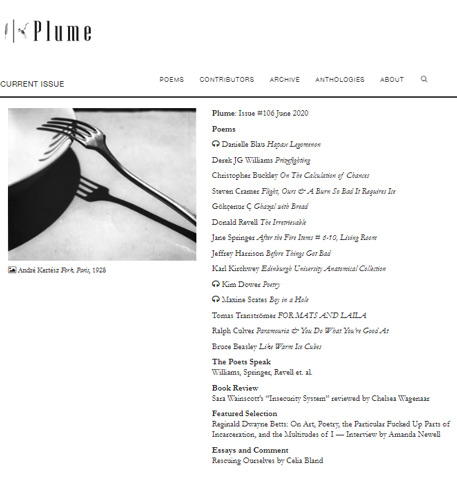
This month’s Plume Featured Selection includes work by and an interview with Fleda Brown. In nonfiction, David Kirby writes “Getting Stabbed Kidna Takes the Fight Out of Ya.” Chelsea Wagenaar interviews The Museum of Small Bones by Miho Nonaka. This month’s poetry selections include Steven Cramer, Terese Svoboda, Mark Irwin, Floyd Skloot, Denise Duhamel, Angie Estes, and more.

The Lake – May 2020

The May issue of The Lake features Jerrice J. Baptiste, Zoe Brooks, Holly Day, George Franklin, Nels Hanson, Jennifer A. McGowan, Warren Mortimer, Leah Mueller, Samuel Prince, Elaine Reardon, David Mark Williams, Rodney Wood, Abigail Ardelle Zammit. Reviews of Emma Lee’s The Significance of a Dress and Rachael Burn’s, a girl in a blue dress.

Hole in the Head Review – May 2020

The second issue of Hole in the Head Review includes poetry by Richard Blanco, David Weiss, Marilyn A. Johnson, Kenneth Rosen, and more, and visual art from Eva Goetz, Jere DeWaters, Jacob Bond Hessler, and others. Plus, tattoo art by Bhagavan Das Shyam Lescault and much, much more.

Anthony Doerr Gives Nature a Voice

Guest Post by Christy O’Callaghan

My happy place in life is also my happy place in words—with nature. The book could be the history of a plant or tree or the natural world herself playing a character. That old conflict of man vs. nature is such a large part of our world, even when we’re under stay at home orders during a pandemic. I have a hardy appreciation for those who approach this subject well.  Anthony Doerr is one of them.

If I admire an author, I’ll read all their works. All the Light We Cannot See was terrific and deserves the praise it receives. Last summer, someone recommended The Shell Collector, and that was what hooked me to Doerr’s work. Most recently, I have been escaping into the frozen winters of Alaska and the tropical island days of the Caribbean in About Grace. In each location of the book, nature is not only an element setting a mood outside of the window. She’s a mighty character.

We follow David Winkler, who studies water, especially snow, and the younger Naaliyah, who studies insects and crustaceans. Our third main character has her own agenda. “The wind assumed its voice: moaning against the window, humming around the roof corners; hissing through drafts. It whispered about darkness, about the coming shadows. Let go, it said, let go.”

Doerr evokes the power and cyclical rhythm of nature, seasons, and time. Even with characters who live in reverence of the natural world, they can’t compare with her. She exists not in the service of people but has her own story to tell.


About Grace by Anthony Doerr. Simon & Schuster, October 2015

Reviewer bio: Christy O’Callaghan lives in Upstate, New York.  Her favorite pastimes include anything in the fresh air.  For her blog and writing, go to christyflutterby.com.

Brevity – No. 64

This issue’s featured authors include Brian Turner, Sue William Silverman, Kristine Langley Mahler, Carly Anderson, Laurie Rachkus Uttich, Sara Ryan, Tyler Mills, Julie Marie Wade, Melissa Grunow, Katy Mullins, and more. Plus, beautiful photography by Christina Brobby. Find more contributors at the Brevity website.

About Place Journal – May 2020

“Practices of Hope” showcases creative processes as ways of making change. The pieces in this issue of About Place ask: How can creative practice allow us to feel and act differently? How can we invent new collaborations and new embodiment practices for humans and other fellow creatures? What can speculative, non-realist, and hybrid forms mean for eco-arts? How can we imagine a different future with more of us in it? What hope can we afford? What hope do we need? Together, we reach for art that activates new relationships to embodiment, climate crisis, species extinction, and environmentally located social pressures.

Reclamation of a Name

Parhelion - Winter 2020

Magazine Review by Katy Haas

In the latest issue of Parehlion, readers can find a selection of poetry by Sierra Lindsay. In this set of four poems, “The Line Between” especially stood out to me.

In this poem, Lindsay explores her name in three stanzas. The beginning draws readers in and explains the origin of this study: “I get lumps cut out of my breasts & on the hospital   bracelet, last name first.” The second stanza studies the name as it’s used by people she “shouldn’t be         fucking,” and the last stanza focuses on the name as it stands on a workplace name tag as customers question its source. The ending is explosive with its reclamation of her name and the power there, “I will put your name on my / tongue &       make you taste it.”

The layout of the poem makes it even more enjoyable to read, along with Lindsay’s careful construction of language that ebbs and flows.

Kari Gunter-Seymour Talks Trigger Warnings

Sheila-Na-Gig online - Spring 2020Magazine Review by Katy Haas

The Spring 2020 issue of Sheila-Na-Gig online features the winner and honorable mentions of the Spring Poetry Contest. Winner Kari Gunter-Seymour pens the poignant “Trigger Warning.”

In this piece, the speaker’s son grapples with PTSD which worsens in November, the result of time in the military. The speaker’s ability to relate is limited; the closest thing she has is watching her father die, and holding dogs as they’ve died. Throughout the poem she mourns not only her father, but also “the farm boy, the quipster, / the Ren & Stimpy impersonator” who her son used to be before he “boarded the plane, now camouflaged / in anxiety meds and a skeletal body.” I really liked the use of “camouflage” here, an image that not only describes the concealing the person he was, but one that also conjures up military uniforms he once donned.

Gunter-Seymour sums up the message of the poem in two truthful lines, “We don’t get to choose our memories, / they are triggered.”

Sponsor Spotlight: Fiction Southeast

Fiction Southeast is all about flash fiction. The online journal shares new fiction on a rolling basis, easily accessible on electronic devices.

A feature I’m especially fond of recently is their Flash Audio Series. I’ve had no attention span for reading while sheltering in place, but these audio versions of flash fiction do the work for you and are great to play in the background while making dinner, relaxing in the tub, gardening out in the yard—a welcome voice to accompany whatever you’re up to.

Lise de Nikolits Interviews Nora Gold

The Dead Man by Nora GoldFind a newly posted interview with Nora Gold at Lise de Nikolits’s blog. The two discuss Gold’s 2016 novel The Dead Man, her writing process, and her favorite ways to relax and unwind.

Gold is the editor of Jewish Fiction .net which just produced its 24th issue this past March. Visit their social media for curated lists of work relating to a similar theme that the journal has published in previous issues if you’re looking for even more good reads.

Driftwood Press Wants Your Graphic Work

Any graphic novelists or comic creators in the house? Driftwood Press is eager to hear from you! They currently accept short graphic works (one image up to 22 pages of comic art) for publication in their biannual, online journal. They’re open to serializing longer graphic works with presentation of the work’s first chapter and a series outline. The editors also seek graphic novel manuscripts for publication consideration. Submit full or partial manuscripts via Submittable.

Comic submissions to the magazine and graphic novel manuscript submissions are both free. Learn more about what they’re looking for at their website.

But if graphic work isn’t for you, the magazine is still accepting submissions for two of their contests until July 1.

The MFA at Florida Atlantic University

Florida Atlantic University MFAFlorida Atlantic University’s MFA program offers concentrations in fiction, creative nonfiction, and poetry. All accepted students are offered a complete funding package including a teaching assistantship, stipend, and tuition waiver. Core faculty include Ayşe Papatya Bucak, Andrew Furman, Becka Mara McKay, Susan Mitchell, Kate Schmitt, and Jason Schwartz. Students have the opportunity to work on national literary magazine Swamp Ape Review.

Event :: Summer 2020 Writers Institute at Washington University in St. Louis

They are monitoring the current situation, but are hopeful the Summer Writers Institute will be able to happen as planned. This annual event brings together many of St. Louis’ finest writers to share their expertise with students who are serious about developing their writing. This year celebrates their 25th anniversary. The Institute is an intensive two-week program featuring workshops in fiction, micro-fiction, poetry, and personal narrative. Deadline to register is July 16. The Institute will run July 17 through 31. summerschool.wustl.edu/summer-writers-institute

James McBride Offers a Moment of Happiness

Deacon King Kong by James McBrideGuest Post by Liz Bertsch

My pleasure reading is typically done at night, in bed with my Kindle. Mid-pandemic, however, reading has become less a pleasure and more an exercise in mindfulness as my mind drifts towards panic about my family, the world, and my zany and delightful middle-school students. I begin and then abandon many a book, just like my students, because who has time to waste on a book that doesn’t hold you?  And then James McBride’s Deacon King Kong stumbles into view, and any book bold enough for that title is something I’ll consider.

McBride’s novel centers on a crime that takes place in and around a Brooklyn housing project in 1969 when a drunken and elderly character named Sportcoat pulls out a gun and shoots a 19-year-old drug dealer.  The crime occurs early afternoon, and although the audience for the shooting in the housing project is young drug dealers, older churchgoers, janitors, and undercover police, the crime reverberates in the surrounding quiet Brooklyn neighborhood of mob bosses and organized criminals. McBride’s novel is part Greek tragedy, police procedural, crime thriller, and there is a bit of ghosty stuff thrown in for good luck.

The nicknames of McBride’s characters are hilarious, and while reading, I think of my students who would delight in encountering the character of Sister T.J. Billings affectionally known as Bum Bum, and Hot Sausage, a friend of Sportcoats.  And in a vignette when church folk tell stories of Sportcoat’s many near-death experiences, and describe the time, “He went “fatty boom bang!” I laugh and keep on reading because I care about Sportcoat, and I’m happy.


Deacon King Kong by James McBride. Penguin Random House, March 2020.

Reviewer bio: Liz Bertsch teaches in an independent school on the East End of Long Island.  Her essays have appeared in a variety of arts and literary journals.

Buy this book through our affiliate Bookshop.org.

Want to Read a Plague Book?

Guest Post by Bill Cushing

Although best known for his Dune series, Frank Herbert’s 1982 book The White Plague may be just what the doctor ordered these days.

In a nutshell, Dr. John Roe O’Neill, an American biophysicist visiting Ireland on a research grant, witnesses his wife and twin sons killed from an IRA bombing. To say he “loses it” would be a serious understatement. The first chapter opens with an ancient Irish curse—“May the hearthstone of hell be his bed rest forever”—and Herbert delivers fully on this hex from there.

O’Neill returns to the states, isolated and vengeful, and decides that since a political cause took his wife and children from him, he would reciprocate. Designing a genetic virus that does not affect men but kills females, he adopts the name “The Madman,” releasing his biological scourge on the world by infecting low denomination bills.

Once released, the plague destroys the world in short order, causing whole nations to collapse, even forcing the Vatican to relocate to Philadelphia. As the world descends further into self-isolated tribes killing anyone approaching, Scotland Yard conducts its hunt for “The Madman.”

However, this is not simply the story of investigators trying to locate and capture The Madman. That is there, of course, but there is much more.

Like Thomas Mann’s allegorical Magic Mountain—where he uses a tuberculosis sanitarium as a vehicle for examining European nations on the edge of World War I, Herbert uses this book as a means to study nations and their peculiarities. It also offers the author an opportunity to study people’s reactions to the direst of situations as well as their use and pursuit of power.

At fewer than 500 pages, The White Plague offers a much more restrained analysis of such behavior as is seen in the massive Dune series.


The White Plague by Frank Herbert. 1982.

Reviewer bio: Bill Cushing writes and facilitates a writing group for 9 Bridges. His poetry collection, A Former Life, was released last year by Finishing Line Press.

De-stigmatize Uncomfortable Realities: Interview with Aby Kaupang & Matthew Cooperman

NOS coverElizabeth Jacobson sat down with Aby Kaupang and Matthew Cooperman to discuss their 2018 release of NOS (disorder, not otherwise specified). The book, published by Futurepoem Books, documents the odyssey into a foreign environment of hospitals, doctors, and diagnoses. Terrain.org published an excerpt from the book along with this interview.

Interviewer Elizabeth Jacobson starts the interview with the question about choosing to make the decision to let your child live or die and explains that she grew up in a family where a different choice was made.

Aby responds, “thank you for sharing your story a bit. I hope to hear more. I say that because I care, but also because I wish more people would write/speak about the difficult choices. De-stigmatize uncomfortable realities.”

She and Matthew Cooperman go on to explain how the book started as a private journal of Aby’s and transformed into something completely different. They also talk about how their lives have changed since its publication and what new challenges they face with their daughter who is now thirteen. Check out the full interview here…and maybe prepare a tissue or two.

Sponsor Spotlight :: Del Sol Review

Originally started in 1997 under the name of “Editor’s Picks,” Del Sol Review has transformed from highlighting select work from print journals to being its very own literary magazine. Contributors include Maxine Chernoff, Paul West, Linh Dinh, Holly Iglesias, Deborah Olin Unferth, Michael Martone, and Daniel Bosch.

Del Sol Review accepts unsolicited works of speculative fiction, poetry, prose poetry, creative nonfiction, short stories, and flash fiction year-round. They love works containing unique and interesting subject matter.

Their latest issue, No. 24, is the Richard Basehart Issue. This contains fiction by Joe Kowalski, Zeke Jarvis, Glen Pourciau, Debbie Ann Ice, Evan Steuber, Jenny Drummey, Andrew Stancek, Richard Leise, Risa Mickenberg, Joseph Couchet, Robert Miltner, Ron Riekki, and Mark Walling; and poetry by Michael Salcman, Nancy Botkin, Wendy Barker, Hilary Sideris, Rich Ives, and Nish Amarnath.

I love the little snippets they put with their issues: “Carnivores. Astonomy. Zsa Zsa Gabor Geeks.” or “Innocent, flight, teeth, yecch, and more!”

Wonderful Book of Laughter, Family, Heartbreak

Guest Post by Doug Mathewson

I watched a TED Talk by Luis Alberto Urrea, and like most TED talks I agreed with every word, but five minutes later I couldn’t remember a one of them. What did stay with me was how smart and well-spoken Urrea was. He has better than a dozen books to his credit, both fiction and nonfiction, as well as numerous awards including a Pulitzer Prize nomination on 2005.

House of Broken Angels is a wonderful book of laughter, family, and heartbreak. Elderly and beloved Mamá has died and grand funeral is planned. The funeral coincides with patriarch Big Angel’s birthday, and he is terminally ill. Big Angel can’t last much longer; his condition worsens daily. The very extended de La Cruz family on both sides of the California – Mexico border comes together for a large farewell party to honor Mamá and Big Angel.

More and more family arrives, and there is food, and there is laughter, but old grievances too. Some to be resolved and forgiven, others as fresh and venomous as ever. New feuds emerge as well. Obscure relatives and friends materialize. Estranged relatives hold back, unsure how they will be received, the pros and cons of reestablishing family contact an ever shuffling deck of emotions. A successor must be chosen for Big Angel, and the logical choice refuses the role.

I loved the world of this book and the de La Cruz family in all of its engaging glory: the romances, the shifts in power, the unresolved mysteries, stories of benevolence, stories of grief and need. The quirky details will make you smile, and the big ideas of the book are very moving and real.


The House of Broken Angels by Luis Alberto Urrea. Little, Brown and Company, March 2018.

Reviewer bio: Doug Mathewson is the Founding Editor of Blink-Ink. His own writing can be found at: www.little2say.org.

Buy this book through our affiliate Bookshop.org.

Earn Your MA Near Some of the Country’s Best Beaches

Earn your MA with an emphasis in Creative Writing in the vibrant city of Mobile, near some of our country’s best beaches. Tuition waivers and assistantships are available as are additional scholarships for excellence and summer creative writing projects. Home of the Stokes Center for Creative Writing. Students who enroll in the program full time, can complete it in four semesters. There are also part time and evening coursework options. For more information, visit our website: www.southalabama.edu/colleges/artsandsci/english/.

The Pleasure of Knowing and Not-Knowing

Guest Post by Carolyn Dille

Cosmological Koans: A Journey to the Heart of Physical Reality by Anthony Aguirre has so entranced me that I’m reading it as slowly as I can and looking forward to beginning again. Aguirre’s title hints at who could fall under the spell of his book of enchantment: readers who gravitate toward questions and find answers intriguing for the questions they raise, as well as those who like time and space travel, and puzzle- and mystery-loving readers.

Aguirre, a cosmologist at the University of California Santa Cruz, creates his nested and far-flung nets of adventure in language that is candid, colloquial, and often witty. These stories often reminded me of campfire stories, the speculations that we engage in with hiking companions when we’re under the stars and far from our routines. The questions our prehistoric ancestors must have asked: what are those lights above us in the dark; do they have anything to do with us? Now, we know some answers to those questions.

But Aguirre takes us further into the shimmering places in mind and body where what and how we don’t know becomes a quest. The book’s arc reminds me of classic journey stories: Don Quixote, One Thousand and One Nights, and The Decameron.

Cosmological Koans begins its physical/metaphysical journeys with Greek and Buddhist philosophers, flies over a millennium and lands in the 17th century. From there it transports us from Venice to the Arabian desert and Japan, to China, India, and Tibet, to the 20th century, and many other places and spaces.

There are meet-ups along the way: Einstein, Buddha, Galileo, Zen Master Dōgen, Zeno, samurai, Richard Feynman, fictional characters, and more. They shed light on Aguirre’s cosmological koans, which include maps, emotions, measurements, values, dangers, happiness, and how we know what we know. Meandering through these pages of spacetime, I’m feeling the pleasure of knowing and not-knowing in very good company.


Cosmological Koans: A Journey to the Heart of Physical Reality by Anthony Aguirre. W. W. Norton & Company, May 2019.

Reviewer bio: Carolyn Dille writes, teaches Soto Zen and Insight meditation, and edits leapingclear.org, an online magazine of art, literature, and contemplation. In these shelter-in-place days in Santa Cruz, California, she’s also reading Heal-ing Resist-ance by Kazu Haga, and Rebecca Elson’s A Responsibility to Awe.

Buy this book through our affiliate Bookshop.org.