Home » Newpages Blog » Fiction » Page 6

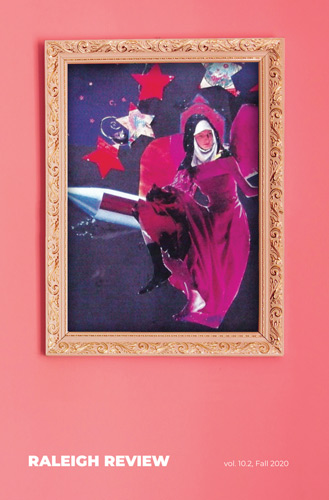
Raleigh Review – Fall 2020

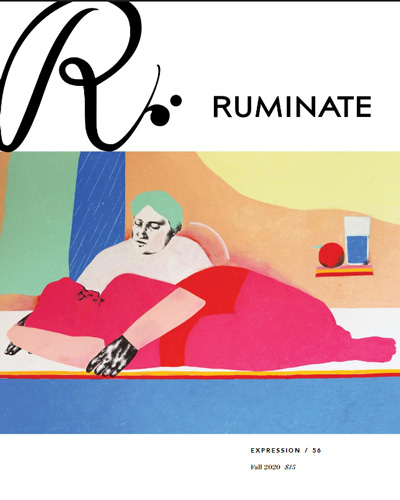
This issue’s featured artist is Janice Joy Little. Fiction by Peter D. Gorman, Trina Askin, James Hartman, Melissa Reddish, and Katherine Conner. Poetry by Melissa Kwasny, Nan Becker, Dionissios Kollias, Colin Bailes, Rob Shapiro, Kabel Mishka Ligot, Hussain Ahmed, Johnny Lorenz, Darius Simpson, Camerin McGill, Jai Hamid Bashir, Melanie Tafejian, Maxine Patroni, Alaina Bainbridge, and Gabriella R. Tallmadge. Check it out at the Raleigh Review website.

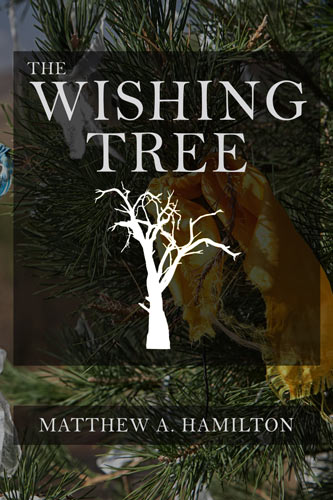
The Wishing Tree

Guest Post by Robert Lamb

It was Union Gen. William Tecumseh Sherman who said, “War is hell.” If you have any doubt that the general was dead right, run and get a copy of The Wishing Tree by Matthew A. Hamilton. You’ll see war up close and personal in his excellent account of the Armenian genocide by the Turks in the early 1900s.

Hamilton, a Richmond, VA writer and former Peace Corps volunteer, shows us through the eyes of a young Christian girl in Armenia how war unleashes unspeakable human savagery in the name of ethnic cleansing.

It is April 1915 and the Turks’ Ottoman Empire, which has lasted for centuries, is on the verge of defeat by the allied forces of Great Britain and the Arabs. In the novel’s first few pages, the heroine, Valia, a teenager, sees her parents, siblings, and neighbors, all Christians, murdered by Turkish “police soldiers,” and flees for her life.

Thus begins an odyssey the reader won’t soon forget. The author’s account of Valia’s struggle to stay alive and hopeful is a hymn to the human spirit, and the story is nothing short of realistic and gripping.

Adding a nice touch of realism, even Lawrence of Arabia and Arab Prince Faisal make cameo appearances near the story’s end.

OK, film producers; you can’t say I didn’t give you a heads up on this novel.


The Wishing Tree by Matthew A. Hamilton. Winter Goose Publishing, September 2020.

Reviewer bio: Robert Lamb is the author of four novels and a book of short stories; he review books for the New York Review of Books; and he has a website at www.robertlamb.net.

Into the Void Magazine – #17

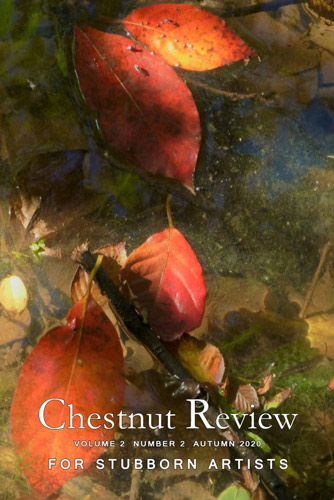
Welcome to a great issue full of vivid, haunting, charming and thought-provoking pieces with a stunning cover image by Jeff Corwin. Fiction by George Choundas, Kathie Giorgio, Rosalind Goldsmith, Alice Ting Liu, Chris Neilan, and Alexander Woods; nonfiction by Audrey Burges, Marie Kilroy, and Ellis Scott; and poetry by Dianna Vagianos Armentrout, Swapnil Dhruv Bose, James Butler, and more.

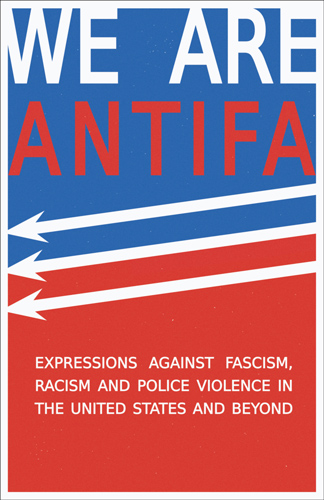
Into The Void Releases We Are Antifa Anthology

Into the Void Antifa Anthology flierAt the beginning of the month, literary magazine Into the Void released it’s We Are Antifa: Expressions Against Fascism, Racism and Police Violence in the United States and Beyond. The anthology features creative nonfiction, fiction, and poetry from diverse writers all over the world, i.e. the US, Canada, Ireland, the UK, Greece, Nigeria, and more.

Into the Void will be donating 100% of proceeds from the anthology’s sales to Black Lives Matter Canada. In order to maximize profits, the book will only be available via Amazon in ebook and paperback formats.

We Are Antifa was edited by Heath Brougher, Jay C. Mims, Amanda Gaines, Andrew Rihn, and Philip Elliot. It features “breathtaking writing condemning fascism, racism and state-sanctioned brutality through powerful expressions of grief, rage, hope and love.”

The title is a response to Donald Trump’s declaration that the US will be designating Antifa as a terrorist organization. The editors encourage readers to check out “A Brief History of Anti-Fascism” in Smithsonian Magazine to better understand why they published this anthology and “how anti-fascism and anti-racism are inextricably linked in the fight against oppression and supremacy.”

The Bitter Oleander – Fall 2020

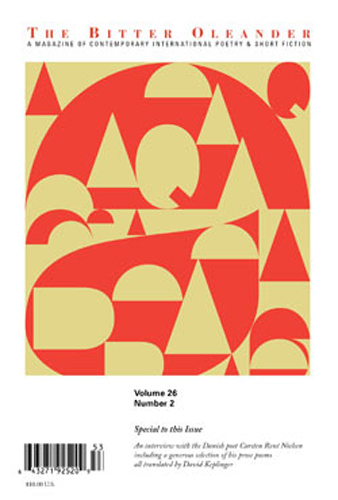
The Autumn 2020 issue of The Bitter Oleander features an interview with the Danish poet Carsten René Nielsen, including a selection of his prose poetry translated by David Keplinger. Also in this issue: fiction by Michael Pearce, Kelly Talbot, and more; essays by Will Stone; and poetry by Dolores Etchecopar, Stephen Tuttle, Madronna Holden, David Cholrton, Matei Vişniec, Silvia Scheibli, Patty Dickson Pieczka, and others.

Event :: SLS x St. Petersburg Review Virtual Master’s Class in Fiction

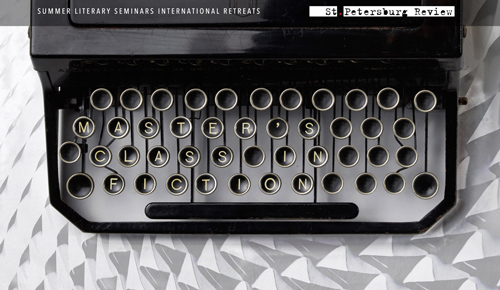
typewriter master's class in fictionEvent Dates: November 8–22, 2020; Location: Virtual;
Extended Deadline: October 30, 2020
Limited to: 10 people. Summer Literary Seminars International Retreats, an offshoot of SLS, in conjunction with St. Petersburg Review/Springhouse Journal invites you to a unique two-week master’s class in fiction taught by internationally acclaimed authors, Dawn Raffel and Laurie Stone. In this online course, you will receive one-to-one feedback; meet the editors of the New Yorker, Graywolf Press, Guernica, and St. Petersburg Review; attend events with Mona Awad, Polina Barskova, and Kadija Sesay; receive discounts for future programs including residencies in Georgia and Kenya; read your work in a publicly advertised event; and more. November 8 to November 22. To learn more and submit, visit stpetersburgreview.com/master-class.

A Handshake Between Time Periods

Guest Post by Jack Graham.

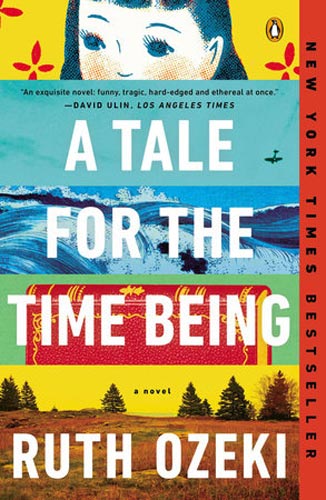
It’s incredibly rare that a novel can leave you feeling as ecstatically powerless as Ruth Ozeki’s A Tale For The Time Being, a strikingly well-crafted novel following the tribulations of both Naoko Yasutani, an early 2000’s teenager and of the more contemporary character of Ruth—an uninspired author reading the diary of the aforementioned Japanese teen.

Ozeki’s texts demonstrate a handshake between two separate periods within time, misting and tearing apart any conceptions of what it means to be ‘contemporary.’ The reader is simultaneously inundated with early references to popular and zany Japanese Maid Cafès and Hello Kitty merchandise (a Japanophile’s dream) in the form on Nao’s diary whilst Ruth provides a far more grounded account of modern normality—one of mundane and domesticated living.

When reading from the perspective of Nao, a readership is forcefully delved into an environment mostly motivated by suicidal thoughts. Being a Western reader, it became increasingly intriguing to be given some understanding into a Japanese mindset in regards to the romantic sentiments surrounding self-killing, one very foreign to my own.

On the other side of the coin, however, Ruth is a character who lives a decade or so after Nao’s accounts, the physical embodiment of dramatic irony. As a reader of Nao’s diary, she can locate Nao within time, using the internet as a tool to fixate her somewhere after 2001 but prior to the Fukushima Nuclear Reactor Incident of 2011—she’s a literary archaeologist of sorts. It is through Ruth that I, the reader, was stripped of all control. It is at Ruth’s pace of reading that we unveil the life of Nao, it is only at the will of her determination that I found myself turning the page, heavy with anticipation.


A Tale for the Time Being by Ruth Ozeki. Penguin Random House, 2013.

Reviewer bio: I’m Jack Graham, currently studying my Masters in English Literary Studies at Durham University.

Buy this book from our affiliate Bookshop.org.

Sky Island Journal – Fall 2020

Sky Island Journal’s stunning 14th issue features poetry, flash fiction, and creative nonfiction from contributors around the globe. Accomplished, well-established authors are published—side by side—with fresh, emerging voices. Readers are provided with a powerful, focused literary experience that transports them: one that challenges them intellectually and moves them emotionally. Always free to access, and always free from advertising, discover what over 75,000 readers in 145 countries already know; the finest new writing is here, at your fingertips.

Event :: Reversed Thunder with Brendan Constantine

Event dates: November 5 – December 3, 2020; Location: Virtual
Join award-winning poet Brendan Constantine for an exciting craft and generative workshop presented by The Poetry Lab. Writers will respond/reflect on the principles of poetic conscious and political poetry as they explore valedictions and liberate their post-election feelings. Class includes three two-hour workshop sessions and ends in a live public performance, where all students will be invited to read alongside Brendan. Registration fee is $150 for adults, $125 for students with a valid student ID. Must be 18 or over to enroll. Class begins Thursday, November 5, 2020 at 6pm PST via Zoom. Learn more at thepoetrylab.com/reversed-thunder.

Split Rock Review – Issue 15

The new issue of Split Rock Review features work by Ted Kooser, David Axelrod, Lauren Camp, William Woolfitt, Celia Bland, and many more writers and artists, including fiction by Adrian Markle; nonfiction by Anna Oberg and Wendy Weiger; a comic by Don Swartzentruber; art & photography by Aaron Burden, Leah Dockrill, Natalie Gillis, and more; and poetry by Ellen Rogers, Connie Post, Jenny Wong, Rebecca Yates, Emry Trantham, and more.

Apple Valley Review – Fall 2020

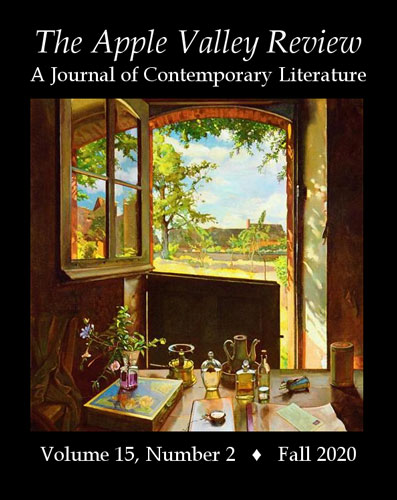
Featuring short fiction by Kevin Bray, Morgan Cross, Adam Luebke, Tove Ditlevsen (translated from the Danish by Michael Goldman), and Epiphany Ferrell; an essay by Samantha Steiner; and poetry by Liana Sakelliou (translated from the Greek by Don Schofield), DS Maolalai, Emily Hyland, Antonio Machado (translated from the Spanish by Thomas Feeny), Tiffany Hsieh, and Joseph Zaccardi. Cover artwork by Konstantin Somov. More info at the Apple Valley Review website.

October eLitPak :: MFA in Creative Writing at UNCG

UNCG MFA in Creative Writing August 2020 eLitPak flier
click image to open PDF

Find Your Story Here

Application Deadline: January 1. One of the first creative writing programs in the country, UNC Greensboro’s MFA is a two-year residency program offering fully funded assistantships with stipends and health insurance. Students work closely with faculty in one-on-one tutorials, take courses in poetry, fiction, publishing, and creative nonfiction, and pursue opportunities in college teaching or editorial work for The Greensboro Review. More at mfagreensboro.org.

View full October 2020 eLitPak here.

Rewards & Consequences of Connection

Guest Post by Eric P. Mueller 

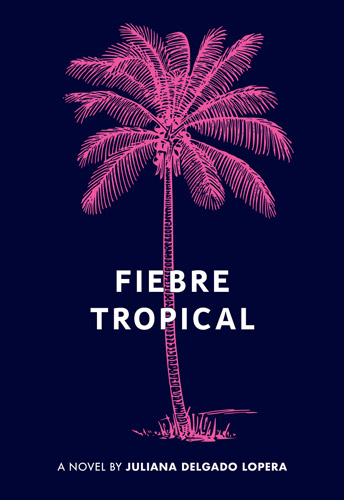
Rarely, if ever, is the narrator of a novel so personal that it’s like they’ve invited you for tea. Juliana Delgado Lopera’s Francisca does that and more, balancing colloquialisms and two languages with stage-speaking authority. Readers learn a lot and a little of Francisca—she is at least in her mid-20s while telling her story, but we mostly stay locked in on one special summer.

Fiebre Tropical reminds readers of monotony that can ensue during long breaks in high school. Living in Miami with little freedom and resources to explore her surroundings, Francisca is limited to watching her neighbor play computer games, watching telenovelas with her abuela, and interacting with the faith-based community her mother almost forcefully wants her to join.

Christian communities are ubiquitous and highly accessible for youths. This novel explores what happens to identity when one joins these spaces. Will Francesca the all-black wearing “heathen” be transformed by God and his followers, or will followers of Christ find themselves shadowed in Francisca’s queer darkness?

Lopera alternates languages almost seamlessly, creating an authentic intimacy that makes the novel’s tone fresh and inviting as opposed to alienating. The distinct voice keeps the novel consistent; as the reader traverses through the plot, they learn more about Francisca’s mother’s and grandmother’s histories, explored in a way that’s not far off from a Junot Diaz or Toni Morrison book.

The novel explores the relationship between mother and daughter, generational trauma, immigrant experience, coming of age as queer, and queerness repression. The book is also about heartbreak. With the pandemic quarantine reminding us of what it means to be powerless and stuck at home, Fiebre Tropical is a reminder of the vulnerable yet necessary act of connection, of it’s rewards and consequences.


Fiebre Tropical by Juli Delgado Lopera. Amethyst Editions, March 2020.

Reviewer bio: Eric P. Mueller is an essayist based in Alameda, CA. His work has appeared in Foglifter, Thought Erotic, and elsewhere. He reads for Longleaf Review. Follow him and his two dogs @realericmueller on Twitter or Instagram.

Buy this book from our affiliate Bookshop.org.

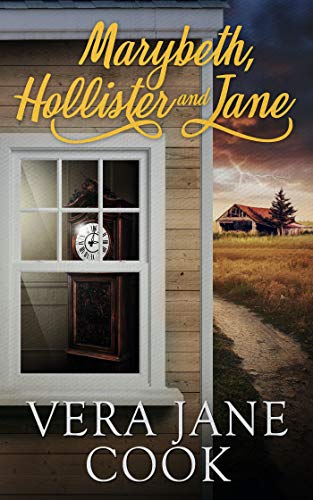
Marybeth, Hollister and Jane

Guest Post by Manasi Patil

Marybeth, Hollister and Jane is a fictional story set in the rural area of  Callicoon, New York.  The book has a very realistic vibe to it and all the characters seem believable. It follows the journey of a handful of people trying to locate the Eagle Diamond, stolen in the 1960’s. At the start, most of them are from the same organization, LVAJ, whose job is to locate stolen arts, artifacts, etc. and then pass them to someone else. But as the story unfolds, the head of the organization, Peter Reece, is too weak to manage the organization, and eventually all the members separate and begin the search on their own.

All through the journey of reading this book, I was on a rollercoaster. The scenes are sketched out in a way that makes the words leap off the page. All the characters too, are perfect for their roles. Author Vera Jane Cook has done an exceptional job. I particularly like Brock Stanley with his wise, witty, and caring nature (for Jane).The unexpected twist of The Sisters and Jane was my favorite scene from this novel.

The ending could have been much better, though. It winded up too simple and easy and I felt that the story had promised a different sort of end. Nonetheless, Marybeth, Hollister and Jane is a great read, and I will certainly be reading more from this author.


Marybeth, Hollister and Jane by Vera Jane Cook. Chatter Creek Publishing, September 2020.

Reviewer bio: Manasi Patil is a young author with a passion for writing.

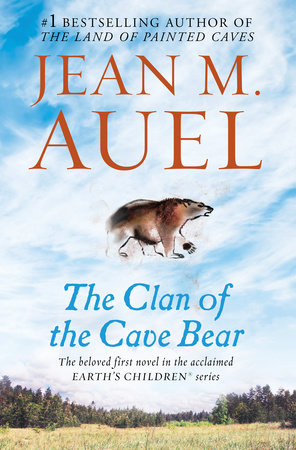
Transport to Another World with Auel

Guest Post by Amy Ballard

Which is more important, the clan or the individual? In Jean Auel’s 500-page series opener, Cro-Magnon Ayla navigates the customs of her adoptive Neanderthal people while pondering what it means that she is “Other.” To assimilate, she must comply with clan rules with which she disagrees. Sometimes she chooses defiance. When her practice of hunting with a sling (a man’s privilege) is discovered, she is placed under a death curse. Ayla isolates in a secret cave, an apt metaphor for the forced solitudes of today’s coronavirus pandemic. As clan political dynamics shift, she must determine whether she can live under the rule of a leader who, despite her valued status as a medicine woman, systematically abuses her.

Since its publication in 1980, the novel and its five sequels in the Earth’s Children series have generated a body of criticism, favorable and unfavorable, around its historicity, feminism, and treatment of race, among other topics. For the quarantined in 2020, though, The Clan of the Cave Bear does what it emphatically must: transport the reader to another world.


The Clan of the Cave Bear by Jean M. Auel. Penguin Random House, June 2002.

Reviewer bio: Amy Ballard writes and teaches in southern Idaho. Her fiction has appeared in Barely South Review and elsewhere. Find Amy at www.amyballard.com.

Buy this book at our affiliate Bookshop.org.

Manifesto on Shared Solitude

Guest Post by Jacqueline Williams

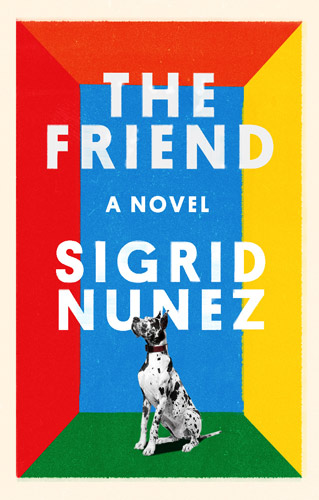
Given to me as a birthday gift, The Friend by Sigrid Nunez is a manifesto on shared solitude and the different ways in which we try to overcome grief. One of the intriguing things about the book is the author’s choice to leave the narrator unnamed along with most of the characters. However, at no point does that choice prove as an obstacle to the reading experience; instead, it renders visible particular details about the personality of the characters thereby allowing the reader to connect more deeply with them.

The book is a fairly easy read about the narrator’s journey of simultaneously losing and gaining someone and the idea of collective grief. As literary fiction, the book is peppered with trivia on various literary writers such as Adrienne Rich, T.S. Eliot, Virginia Woolf, and Franz Kafka among many others. The characters too draw from the similar flavor of what it means to be a writer and the conflicts attached to the profession of writing.

My favorite part of the book is the bond shared between the narrator and Apollo the Great Dane. Nunez’s take on the human-dog relationship is unlike any other. She is spot-on in her representation of the contemporary nature of company that of being alone, together. She writes, “What are we, Apollo and I, if not two solitudes that protect and greet each other?”


The Friend by Sigrid Nunez. Riverhead Books, February 2019.

Reviewer bio: My name is Jacqueline Williams and I’m currently pursuing M.A in English. My field of interests includes Gender Studies, Cultural Studies and Medical Humanities.

Buy this book at our affiliate Bookshop.org.

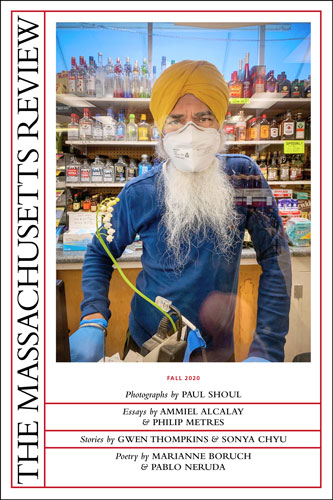
The Massachusetts Review – Fall 2020

In the Fall 2020 issue of The Massachusetts Review: fiction by Gwen Thompkins, Alanna Schubach, Andrea Maturana, Kathleen Hawes, and more; poetry by Marcela Sulak, Emily Schulten, Lance Larsen, Esther Lin, Brooke Sahni, C. P. Cavafy, and others; and nonfiction by Karen S. Henry, Ammiel Alcalay, Margaret Lloyd, and more. Plus, photography by Paul Should and a novel excerpt by Giacomo Sartori. .

EVENT – 49.2

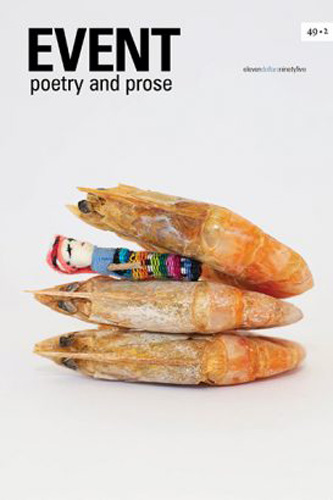
EVENT’s latest offering is jam-packed with a tantalizing assortment of literary goodies. Poetry by Bára Hladík, Alpay Ulku, Alan Hill, Patricia Young, A. Molotkov, Dominik Parisien, and more; fiction by Jason Jobin, Kari Teicher, Fraser Calderwood, and Wayne Yetman; and nonfiction by Scott Randall. Plus, four reviews of poetry, fiction, and nonfiction titles. Read more at the EVENT website.

Boulevard – Fall 2020

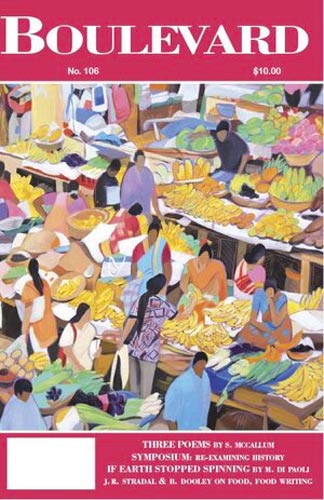
Boulevard No. 106 contains a fantastic and diverse slate of great writing, including the winning story from the 2019 Short Fiction Contest by Sena Moon; a Boulevard Craft Interview featuring a conversation between J. Ryan Stradal and Beth Dooley; new poetry from Shara McCallum, Eloisa Amezcua, Molly Brodak, Doug Ramspeck, Katherine Smith, Lisa Gluskin Stonestreet, Dara Elerath, and Jeannine Hall Gailey; new fiction from Ron Austin, Matthew Di Paoli, Christine Sneed, and Adam Roux; essays by Christine Spillson, Jodie Varon, Matt Jones, Brandon Parker, and Min Han; and a new symposium about re-examining history. Plus, fantastic, and striking cover art by Xizi Liu!

About Place Journal – Oct 2020

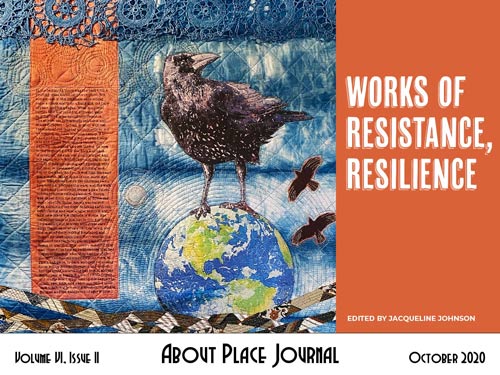
“Works of Resistance, Resilience” is comprised of poetry, fiction, nonfiction and visual art by 83 writers and artists. The issue has five themed sections that explore what it means to live in America at this time of profound reckoning. What does resistance look like? Can resistance contain love, power and empathy? In this age of collective anxiety, the writers and artists from around the world attempt to answer what it means to live and survive during the Covid-19 pandemic and beyond. The Works of Resistance, Resilience will rekindle our desire to learn and thrive and to discover what is needed to change our relationship to the earth and to each other. More info at the About Place Journal website.

Pry into a New Experience

Guest Post by Laurie Jackson

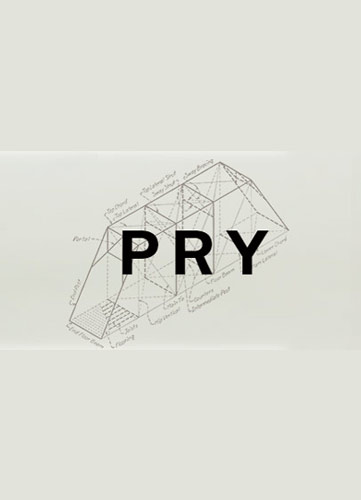
The more you look, the more you learn. Samantha Gorman and Danny Cannizzaro have created an out of the ordinary eBook experience, an app novella, that dives into the overlapping thoughts of James, a demolition consultant who struggles with his vision and his memories of the Gulf War. Pry isn’t just a story you read off a screen, but one you interact with.

Pry has a branching narrative, similar to game writing, which can feel overwhelming at first because it is a new way of interactively reading. The words keep opening and connecting deeper thoughts, enhancing the story. The reader becomes James, not just by reading his thoughts, but by seeing the world around him. The reader pinches and pulls on the screen, revealing the vast layers of images, videos, and text all filtered through James’ mind.

James’ suffering past, and his lack of communication with his best friend, Luke, causes feelings of discomfort. James is disconnected from his current life and distances himself from Luke, even though they presently work together. All he sees is the squad leader version of Luke. During the war, James had feelings for Jessie, another member of their squad, who was secretly involved with Luke. James added photos of Jessie to an album that held memories of his late mother. The album was supposed to be his way to leave thoughts of war and remind himself of human connection; but instead, it became a fire of regrets and the catalyst that led to Jessie’s death.

It would be interesting to change narrators and experience Luke’s perspective. The creativity behind Pry provides a unique and memorable experience. Look deeper and your eyes will catch something else that will pry open that desire for human connection and to keep those we love close.


Pry by Danny Cannizzaro & Samantha Gorman. Tender Claws, October 2014.

Reviewer bio: Laurie Jackson is a writer and artist who is currently working on her first YA series. She started combining her artwork with her creative writing in the imagine section of her blog #words2art.


The End of the Ocean

Guest Post by Kristín M Hreinsdóttir

The End of the Ocean is a novel by Maja Lunde who is a Norwegian author. I started to read this book because it was due to be the next book to read in my book club. When I started reading, I was not sure what I was going to find. I had not at that point read something written by Maja Lunde and was not sure I was going to like it—before my reading, I was told it was about some environmental tragedy and also set in the future. Maybe it is my inner fear or some underlying knowledge about a tragedy like that which makes me dislike the subject, as well as my long-lasting dislike for books or stories set in the future. Why don’t I like stories like that? It is because I think it can be so often overdramatic and superficial and not real. Maja Lunde does the opposite and did hold my attention from beginning to almost the end.

Yes, it is about an environmental tragedy in the future, but it can also be in our time when the water is beginning to be the most important thing, though most of us are not willing to accept that. The novel is also about how the individual handles crises and difficult times, and is a protest against our greedy action against nature. Greed is something we have seriously to think about.

I liked how the book is written but sometimes it lacked flow, but it did not spoil the story so much. The characters are interesting and so well set up that you start to have some strong opinion on them, growing to like or dislike them very much. The weakest part of the story is the end; it almost ended so suddenly that the reader gets the feeling that there is something missing. You are left wanting to know what happens next. But that is maybe a plus that you start to wonder about the end and make your own.


The End of the Ocean by Maja Lunde. HarperVia, January 2020.

Reviewer bio: My name is Kristín M Hreinsdóttir. I live in Iceland and have always like books and literature. I hold B.Ed. in information technology and media and an MA in museum study.

Buy this book from our affiliate Bookshop.org.

Zombie Parallels

Guest Post by Nick D’Onofrio

The whole Covid-19 pandemic got me into reading World War Z by Max Brooks. Published in 2007, the novel follows characters around the world as they struggle to survive a zombie outbreak that overtakes the globe. It takes place before, during, and after the zombie outbreak.

The narrator interviews a new survivor from a different part of the world for each chapter. Some chapters can be two pages long, while others can be twenty pages depending on what is being covered. From clearing the catacombs beneath Paris to managing satellites in space, the novel describes interesting scenarios that I would have never thought of when dealing with the undead.

All this being said, it does have a fair share of gore, which is expected in the zombie genre. So it is not for the faint of heart. What really drew me into picking up World War Z were the parallels people online were pointing out between the book and what has happened with the coronavirus. In the novel, the zombie outbreak starts in China and the government there tries to cover it up but it spreads. The United States is overconfident in its ability to contain the threat and promotes a fake drug, Phalanx, which supposedly cures the new disease. I could go on, but I don’t want to spoil too much.

I bought both the book itself and the audiobook. I follow along as it is being read, because that is how I absorb the information best due to my dyslexia. Even the audiobook has a different voice actor for each chapter. There were even some voices I recognized such as Nathan Fillion, Mark Hamill, Simon Pegg, and Martin Scorsese. However, I noticed the audiobook did have a few paragraphs and chapters missing in the beginning but that didn’t bother me that much.


World War Z by Max Brooks. Penguin Random House, October 2007.

Reviewer bio: I grew up in South Carolina but have lived in Switzerland. My traveling experiences have sparked my creativity and inspired me to write.

Buy this book at our affiliate Bookshop.org.

World Literature Today – Fall 2020

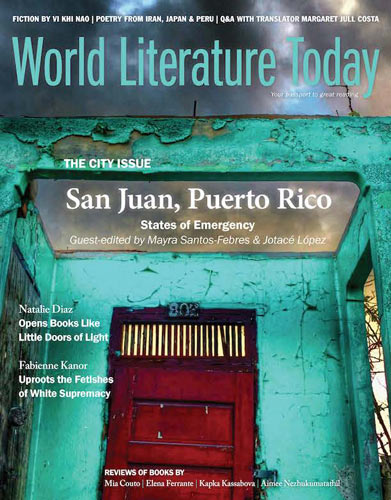
San Juan, Puerto Rico, takes the spotlight in World Literature Today’s annual city issue with a powerful selection of poetry, stories, and essays by 17 writers. Other highlights in the autumn issue include Fabienne Kanor’s essay on uprooting the fetishes of white supremacy; interviews with Natalie Diaz and Margaret Jull Costa; a stunning poem by Achy Obejas on “the universe at absolute zero”; fiction by Vi Khi Nao and Lidija Dimkovska; and much more. Reviews of new books by Elena Ferrante, Mia Couto, Kapka Kassabova, and dozens more make WLT your go-to guide for the best in international literature

Understorey Magazine – Issue 18

Understorey Magazine Issue 18 is out. Read for examinations on the many ways science and technology affect our everyday lives. Poetry by Moni Brar, Daze Jefferies, Kimberley Orton, Dawn Macdonald, Kayleigh Cline, and I. Sabrina Samreen; fiction by Gail Willis; and nonfiction by Jeanne Kwong, Sima Chowdhury, Stacey McLeod, and Rita Kindl Myers. Plus, interviews with Maryam Heba and Chelsey Purdy.

Cimarron Review – Issue 211

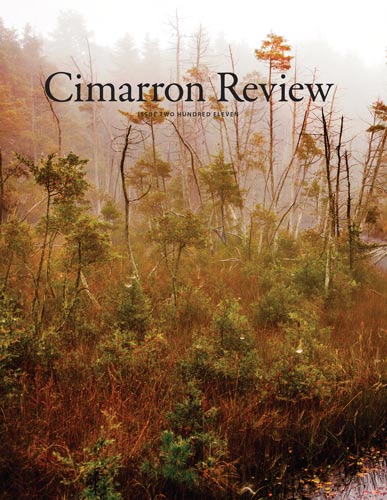
Issue 211 of Cimarron Review features poetry by Bonnie Auslander, Clemonce Heard, Leslie McGrath, Emily Franklin, Chris Haven, Matt Morgan, Laura McKee, Bryce Berkowitz, Elisabeth Murawski, Jan Beatty, Kayla Sargeson, and others; fiction by Andrew Geyer, Molly Anders, and Steven Wingate; and nonfiction by Ephraim Scott Sommers and Caroline Sutton. This issue’s cover art is “River Fog” by Richard Speedy.

Event :: Driftwood Press Virtual Seminars for Fiction & Poetry

Driftwood Press Fall 2020 Virtual Fiction & Poetry Seminars bannerDriftwood Press‘ “Editors & Writers: The Path to Publication” and “Chapbook Creation” seminars are open for registration! Short story writers and poetry chapbook writers seeking to polish their craft and learn about the other side of submissions should apply; each course includes five lectures, critiques, prompts, readings, and more. Both courses are limited to fifteen spots each and will close when those spots are filled or when the course begins on October 19th. Click the link for more testimonials, a lecture list, and additional information.

Abandon Mediocrity with Zero Mirrors

Guest Post by Gerty Haas

In my several decades of reading, I have never encountered the likes of Zero Mirrors.

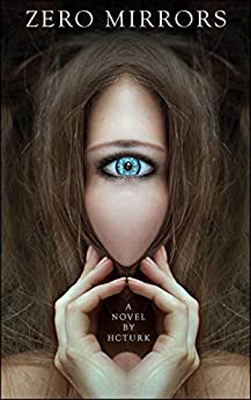
The narrator is a sentient dress worn by the main character, a woman living in a city of boredom. Her companion is a kidult: an adult who had his body modified so he’s the size of a child, because that’s the only time of his life when he was truly happy. The dress is a WAD (Wearable Assistive Data-integrator) worn by Melony, who is a Sashayer in EasyLiving City (not a dancer, because dancing is illegal). Her dearest friend is Robben, the original pilot of the Tree, the area’s greatest building and a grounded spaceship.

Abetted by her companions, Melony’s goal is to sashay through time to save her land from a Plant Plague arriving from the future. Along with being thoughtful and hilarious, this time travel story deals with gender identity, ageism, and family leadership. A key theme is the nature of human movement, from dancing to fleeing to slipping through time.

I’m not going to delineate the story except to say it has three endings: past, present, and future. I’m not able to tell you how often I had to stop reading because the book was making my brain rattle from astonishment or my stomach churn from hilarity or my eyes tear from a poignancy beyond the reality we’re stuck with. A word I hate to see in the description of any artwork is “visionary,” but the word is appropriate here. H. C. Turk has a vision of the future that makes our present seem insubstantial and ignorant, a timeframe that should be left behind. With this book, the reader can abandon that mediocrity for an enthralling experience beyond the norm, exactly equal to the book’s unique, stylish energy.

“You can’t imagine how heartsick you can be when you don’t have a heart.”


Zero Mirrors by H. C. Turk. September 2020.

Reviewer bio: Recently retired from the construction industry, Gerty Haas is an avid reader and art lover living in Florida, which thankfully is not part of The South.

Sponsor Spotlight :: EVENT: The Douglas College Review

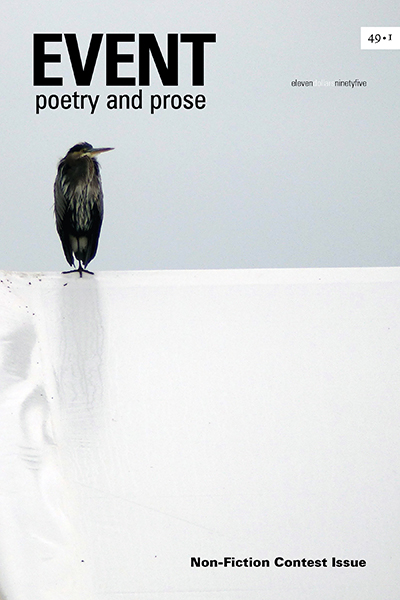
cover of EVENT Issue 49-1Founded in 1971, EVENT is a literary magazine dedicated to nurturing writers and presenting readers with the best contemporary writing from Canada and abroad. They strive to publish a diversity of voices and literary styles and have published many distinguished writers before and after they gained national or international recognition, i.e. André Alexis, George Bowering, Charles Bukowski, Esi Edugyan, Jack Hodgins, Annabel Lyon, Pablo Neruda, Alden Nowlan, Nino Ricci, Diane Schoemperlen, Carol Shields, Timothy Taylor, and Madeline Thien.

Each year they host a Non-Fiction Contest. The contest awards $3,000 in prizes ($1,500 First Place, $1,000 Second Place, $500 Third Place) plus publication in the Spring/Summer issue. This is the longest-running contest of its kind in Canada. The deadline to enter is October 15 annually. Check out Issue 49/1 to view the winning pieces of their 2019 contest: “Judge’s Essay” by Anthony Oliveira, “The Dead Green Man” by Jane Eaton Hamilton, “Things You Think When Your Husband Has a Heart Attack” by Mary Steer, and “My Beautiful Madness” by Rose Cullis.

Besides publishing issues three times a year, EVENT also offers a reading service for writers. Stop by their listing on NewPages to learn more.

A Rewarding Challenge

Guest Post by Judith Pratt

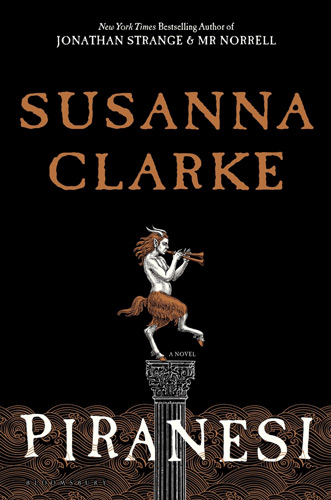
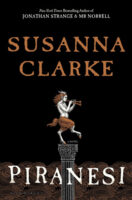
Susanna Clarke’s new novel is much shorter than her wonderful Jonathan Strange and Mr. Norrell, but even more challenging to read. It’s completely worth the trouble. Some novels I give away, but some are keepers. This is a keeper.

The man writing the story lives in a huge House of Halls, Vestibules, and Staircases. The House provides him with everything he needs—fish from the Tides that sweep the House, seaweed for food and fuel, and the Kindness of the many Statues that fill the House.

He writes daily journals in these capital letters, and creates directories of the entries. He feels blessed by the beauty of the House. The man knows only one human, whom he calls The Other. The Other has named him Piranesi, but the man knows that is not his name.

Once you have these basics, things begin to seem strange. Piranesi lives like an early tribal person, but analyzes things like a scholar. How would this Piranesi know that some statues are minotaurs? Why does he know what a crisp packet is? The book wasn’t making sense. For a chapter or two, I found that intriguing, but frustrating.

Don’t give up. The answers are more fantastical than the questions. And the answers create more questions. Would you rather be along in a world of mysterious beauty, or live an ordinary life with family and friends? How can we learn to see the beauty and magic in the world? What does it mean to be lost?

In retrospect, I’m glad that I knew nothing about this novel when I began to read it. I suggest you ignore the reviews—some of which are beautifully written—and go on the adventure as alone as Piranesi.


Piranesi by Susanna Clarke. Bloomsbury Publishing, September 2020.

Reviewer bio: Judith Pratt has acted, directed, and taught theatre. Her plays have been produced internationally. Her novel, Siljeea Magic, was published in 2019. She lives in Ithaca, NY with a husband and three cockatiels.

Buy this book at our affiliate Bookshop.org.

Leaping Clear – Fall 2020

Leaping Clear - logo

Take the time to enjoy and be nourished by the art and writing in this new issue of Leaping Clear. There is humor, poignancy, power, ecstasy, calm, and beauty to be found in essays by Elizabeth Fletcher, Liz Woz, Ranjani Rao, and more; fiction by Taffeta Chime; and poetry by Alan Cohen, Carla Sarett, Fran Markover, J. P. White, Linda Parsons, Sandra Fees, Wayne Lee, and more.

Get in the Halloween Mood

Guest Post by Claudia Gollini

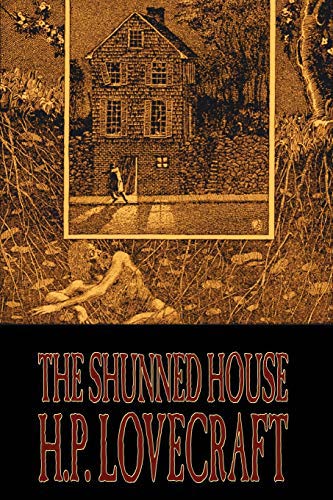
The Shunned House falls into the supernatural and folk genres. It is a horror fiction novelette by American author H. P. Lovecraft, written in October 1924 and first published in the October 1937 issue of Weird Tales.

Lovecraft links, at the story’s beginning, the tale to his idol Edgar Allan Poe. The unnamed narrator finds it ironic that during Edgar Allan Poe’s Providence sojourn, the master of the macabre many times passed a certain house on Benefit Street without recognizing the site of real horrors.

The Shunned House is a house on Benefit Street where a large number of people passed away. With the amount of fungus present in the house, it was declared to simply have “unhealthy” conditions. At worst, the house was deemed “unlucky.” No one suspected anything supernatural was going on.

However, the narrator’s uncle, physician and antiquarian Elihu Whipple, has a shivery fascination for the house. The house was built in 1763 by William Harris. Shortly after the Harrises moved in, his wife Rhoby delivered a stillborn son. For the next 150 years, no child would be born alive in the house. Once the narrator learns of his uncle’s suspicions, they decide to investigate the house.

The story’s narrator suspects that the family is connected to Jacques Roulet of Caude, who was condemned to death for lycanthropy in 1598 before being confined to an asylum.

Jacques Roulet was a real person, whom Lovecraft had read about in John Fiske’s Myths and Myth-Makers. “The family of Roulet had possessed an abnormal affinity for outer circles of entity—dark spheres which for normal folk hold only repulsion and terror.”

The Shunned House of the title is based on an actual house in Providence, Rhode Island, still standing at 135 Benefit Street and the novelette carries the perfect Halloween mood.


The Shunned House by H.P. Lovecraft.

Reviewer bio: Claudia Gollini is a makeup artist, fashion/beauty blogger and journalist, editor and writer, and body painter of events and TV shows.

Event :: Willow Writers’ Fall 2020 Virtual Workshops

Registration Deadline: Rolling
Willow Writers’ Workshops is going virtual this fall! We will offer workshops, providing writing prompts, craft discussions, and manuscript consultations. All levels are welcome. Writers’ Workshops available on Thursday nights, Sunday afternoons, Saturday mornings, and Monday mornings. Fall seminars include Generating Story Ideas and Creating a Strong Sense of Place; Gothic Fiction, and Flash! Writing Short, Short Prose. Workshops and seminars run in September and October. The facilitator is Susan Isaak Lolis, a published and award-winning writer. For more information, check out willowwritersretreat.com.

Read It Again

Guest Post by Preksha Bothra

“Never let anyone make you feel ordinary.”

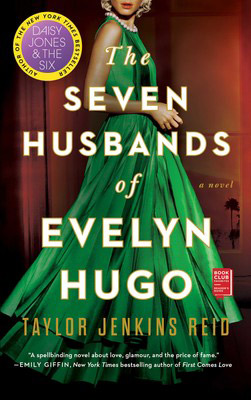
There were a lot of oh-I-wanna-read-this-again moments in Taylor Jenkins Reid’s The Seven Husbands of Evelyn Hugo. Nothing, literally nothing, in this book went the way I expected. A couple of times I was completely surprised with what happened. I didn’t even fully get it until I read the novel twice. Not many books have had that effect.

This book will definitely not bore you, because it’s never slow. The chapters skip from one husband to another quickly but without leaving any important details behind. The only one time that I didn’t like what I was reading was somewhere in the middle of the book, where I became a little tired with Evelyn and her marriages, but that is my only complaint. Highly recommended.


The Seven Husbands of Evelyn Hugo by Taylor Jenkins Reid. Washington Square Press, May 2018.

Reviewer bio: Find Preksha Bothra at on Instagram.

Buy this book from our affiliate Bookshop.org.

New England Review – 41.3

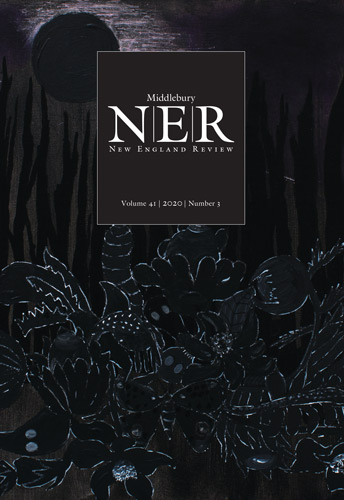
New England Review Volume 41 Number 3 is out. Featured work by May-lee Chai; Jeneva Stone; Laurence de Looze; Alyssa Pelish; John Kinsella; Clifford Howard; and translations of Scholastique Mukasonga, Karla Marrufo, and Nelly Sachs. Fiction by Kenneth Calhoun, Meron Hadero, Kate Petersen, and Kirk Wilson; poetry by Anders Carlson-Wee, Victoria Chang, Justin Danzy, Elisa Gabbert, torrin a. greathouse, Christina Pugh, and more; plus cover art by Heidi P.

Kaleidoscope – No. 81

During periods of unrest and uncertainty, when ominous dark clouds roll in and the sky becomes black, it can be easy to give in to feelings of despair. Kaleidoscope contains stories of adversity but it also offers hope. Featuring the essay “Between Rooms” by N. T. McQueen, the story “Mother Bear” by Melissa Murakami, and the essay “Nacre Upon Nacre” by Jenna Pashley Smith. In addition to these three, this issue contains an array of thought-provoking poetry and other wonderful stories of fiction and nonfiction. Issue 81 brings the promise that storm clouds will dissipate and the sun will shine again.

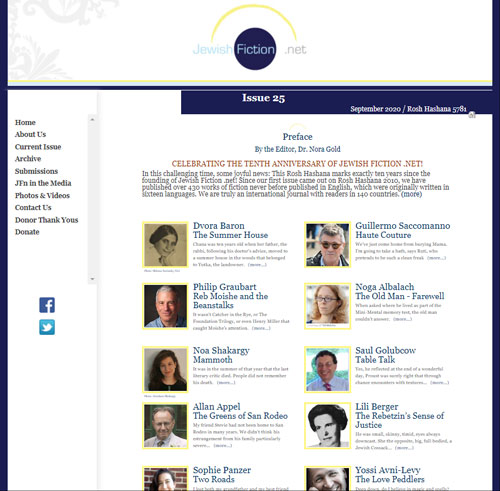
Jewish Fiction .net – #25

This Rosh Hashana marks exactly ten years since the founding of Jewish Fiction .net! Since our first issue came out on Rosh Hashana 2010, we have published over 430 works of fiction never before published in English, which were originally written in sixteen languages. We are a truly international journal with readers in 140 countries. Our new, 10th-anniversary issue of Jewish Fiction .net is now out and features 18 first-rate works of fiction originally written in Spanish, Yiddish, Hebrew, and English. We hope this special issue brings you pleasure, intellectual delight, entertainment, and comfort during this challenging time.

Congrats on 10 Years to Jewish Fiction .net

Congratulations to Jewish Fiction .net for ten years of publication!

From their website: “Since our first issue came out on Rosh Hashana 2010, we have published over 430 works of fiction never before published in English, which were originally written in sixteen languages.”

You can see this writing at their website, starting with their newly released tenth anniversary issue. The new issue offers 18 pieces of fiction originally written in Spanish, Yiddish, Hebrew, and English, including “The Old Days” by David Regenspan in honor of Rosh Hashana.

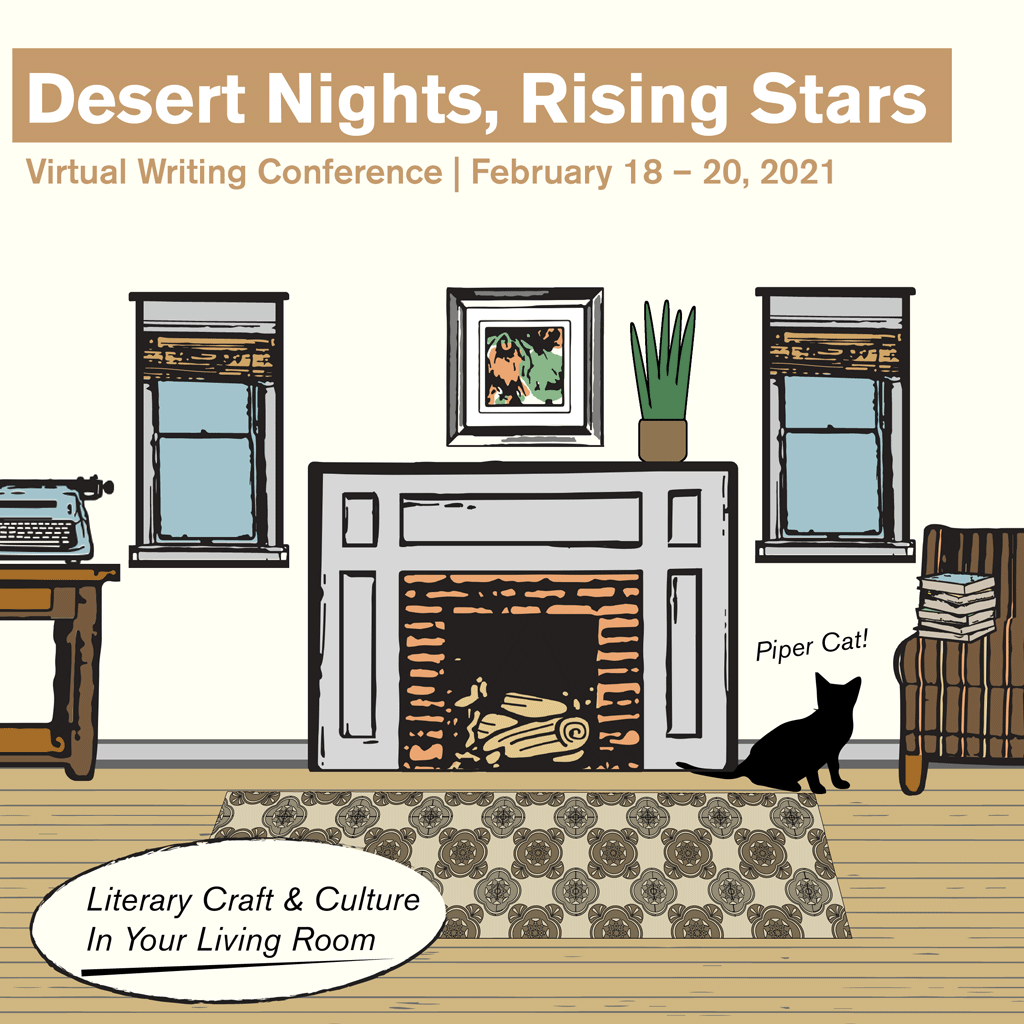
Sponsor Spotlight :: Desert Nights, Rising Stars will be Virtual in 2021

Desert Nights Rising Stars Writers Conference 2021While we would usually start things off with the beautiful desert weather and the southwestern landscape, things are a little different this year. With rising COVID cases in Arizona, restrictions surrounding travel around the nation, and ongoing orders against large public gatherings, we’ve made the choice to move Desert Nights, Rising Stars 2021 to a completely virtual experience.

The 2021 conference will be conducted online via Zoom from February 18 through 20. Program features will include writing workshops, panel discussions, readings, pitch sessions, book fair, author signings, and roundtable discussions. Genres covered this year include fiction, creative nonfiction, poetry, publishing, business of writing, memoir, and young adult.

The faculty for the conference will be Matt Bell, Mahogany L. Browne, Suyi Davies Okungbowa, Alan Dean Foster, Tod Goldberg, Raquel Gutiérrez, Marcelo Hernandez Castillo, Linda Hogan, Beverly Jenkins, C.B. Lee, Connie J. Mableson, Christopher Morgan, Cynthia Pelayo, Evan Winter, and Erika T. Wurth.

Early registration is only $225 before December 31. Swing by their listing at NewPages to get more details.

September 2020 eLitPak :: MFA in Creative Writing at UNCG: Find Your Story Here

UNCG MFA in Creative Writing August 2020 eLitPak flier
click image to open PDF

Application Deadline: January 1
One of the first creative writing programs in the country, UNC Greensboro’s MFA is a two-year residency program offering fully funded assistantships with stipends and health insurance. Students work closely with faculty in one-on-one tutorials; take courses in poetry, fiction, publishing, and creative nonfiction; and pursue opportunities in college teaching or editorial work for The Greensboro Review. More at our website.

View the full September eLitPak here.

A Fallen Kingdom

Guest Post by Caleb Willis

“The Kingdom That Failed” is a piece of flash fiction by Japanese author Haruki Murakami, published by The New Yorker. The introduction grabs you with no hesitation, throwing you into a unique setting that prepares you for a grungy fantasy adventure written around a fallen kingdom. This lasts for a grand total of two paragraphs, at which point the story changes gears to a more modern setting, dealing with life and people, not swords and dragons. It is a change in direction that totally threw me off guard, opening me up to the rest of the narration.

The story continues with an in-depth description of this man named “Q,” or more the struggle to explain Q. He is a handsome man, five hundred and seventy times more handsome than our narrator, with a great personality, from a well-to-do home, yet he isn’t quite extraordinary in anything, yet good at everything. Q is a true kingdom, a character without flaws.
Inspired by the quote, “To see a splendid kingdom fade away, is far sadder than seeing a second-rate republic collapse,” this story quickly and briefly shows a glimpse into the future life of Q. It delivers the known-too-well feeling of failed potential. While we are content to see the narrator complacent with where he is at in life, it is striking yet subtle to see the fall of Q. It isn’t a grand fall of a literal kingdom, and it doesn’t have the imagery of crumbling stone bricks and thick black smoke. Instead, we see a defeated man covered in soda, stuck in a thankless career. “The Kingdom That Failed” is a reminder of the somber reality of humanity, one that trumps any attempts of fantasy.


Reviewer bio: Caleb Willis is a college student studying Biochemistry and Applied Mathematics. He likes to read in his fleeting spare time.

Totally Gothic Chill

Guest Post by Hilary King

I’ve been on a reading tear lately, thanks to the pandemic plus a heat wave and wildfire smoke. So what is the best thing to read in what feels like an apocalypse? How about a spooky Gothic novel? As a reader, I’ll admit I have a sweet tooth. Mysteries are my book dessert, the reading I end the day with, and a Gothic novel with its hints of fantasy, magical realism, and menace is the ultimate decadent dessert.

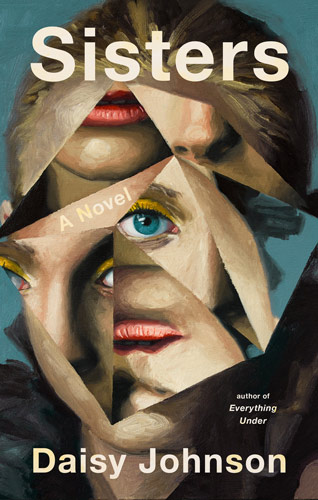
Daisy Johnson’s new novel, Sisters, was a delightful way to spend a 108-degree day. Two teenage sisters, named July and September, escape to a crumbling cottage on the coast of England to recover from Events. What were those Events is the heart of the mystery.  Hints are dropped, the past is visited, nature is wild, and there’s even a mother who takes to her bed. What’s real and what’s not is always the question a Gothic novel asks, and never wants to answer.

What’s fresh about Sisters is how it feels timeless yet doesn’t fear the tacky conveniences of modern life. When is this happening, I wondered at the beginning of the book, so classic were the scenes and characters. But Daisy Johnson weaves in cell phones, the internet, and chat rooms, and gives them a twist. The sisters do some haunting of their own on the World Wide Web.

If you need to spend a day away but can’t get out, let Sisters take you away.


Sisters by Daisy Johnson. Riverhead Books, August 2020.

Reviewer bio: Hilary King is a poet living in the San Francisco Bay Area of California, where she is reading and writing out the pandemic and wildfires.

Buy this book from our affiliate Bookshop.org.