Home » Newpages Blog » Nonfiction » Page 5

Poetry – December 2020

This issue of Poetry features poetry by Jane Wong, Noor Hindi, Pippa Little, Marcus Wicker, Talvikki Ansel, Darius Simpson, Lance Larsen, Maggie Millner, William Fuller, Alec Finlay, Jon Davis, Jordan Keller-Martinez, Ashley M. Jones, Anna Leahy, Jayy Dodd, A.D. Lauren-Abunassar, Austin Smith, Brayan Salinas, John Lennox, Kemi Alabi, Isabella Borgeson, Philip Gross, Ange Mlinko, Cyrée Jarelle Johnson, Imani Cezanne, Leila Chatti, Luther Hughes, and T.J. Clark.

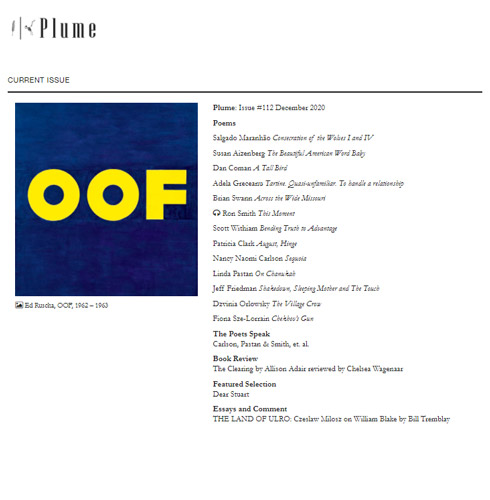
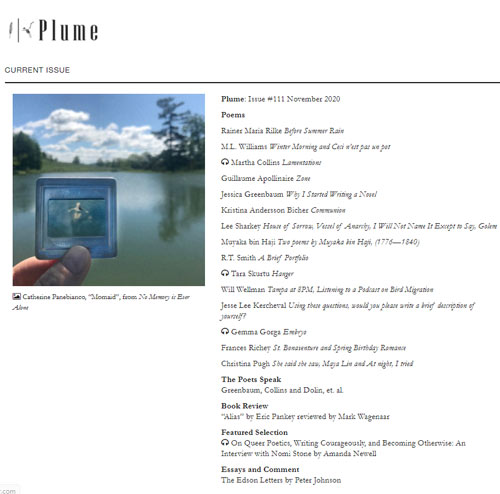
Plume – December 2020

This month’s Plume featured selection is titled “Dear Stuart,” and is a celebration of the work and life of Stuart Friebert. Contributors to this section include Wayne Miller, Marilyn Johnson, Martha Moody, and more. Our nonfiction section features Bill Tremblay’s thoughts in “THE LAND OF ULRO: Czeslaw Milosz on William Blake.” Chelsea Wagenaar reviews Allison Adair’s The Clearing.

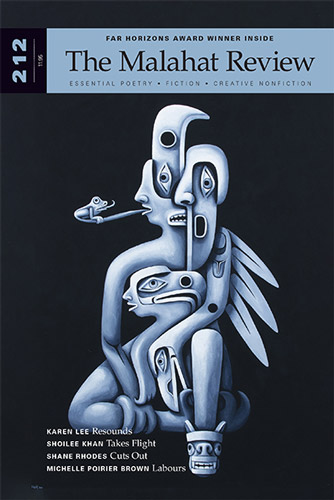
The Malahat Review – Fall 2020

The Autumn 2020 issue features the winner of the 2020 Far Horizons Award for Poetry: A.R. Kung with “Flight.” Also in the issue, find poetry by Karen Lee, Shane Rhodes, Patrick Phoebe Wang, and more; fiction by Shoilee Khan, Francine Cunningham, and John Elizabeth Stintzi; and creative nonfiction by Michelle Poirier Brown, Kathy Mak, and Erin Soros. Plus, a hearty selection of book reviews.

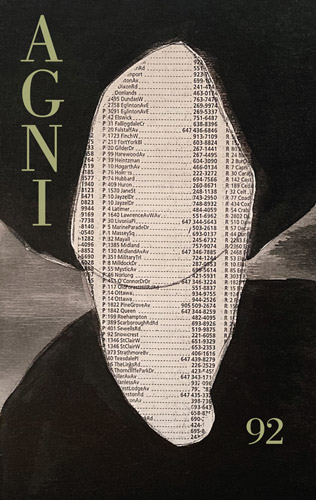
AGNI – No. 92

In Number 92 of AGNI, find an art feature by Sandra Brewster. Essays by Patrick Clement James, Bailey Gaylin Moore & Donald Quist, Nafis Shafizadeh, and My Tran; fiction by Kirstin Allio, Vanessa Cuti, and more; and hybrid work by Nin Andrews, Matt Donovan, and more. Poetry by Bruce Bond, Abby Caplin, Tarik Dobbs, and more.

Lame Duck Season

Guest Post by Geri Lipschultz.

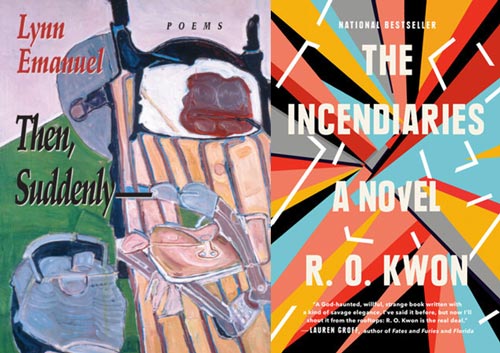
During this Lame Duck season of COVID time, I have written comparatively little of my own work, but the countertops and shelves and even the floors of my living space have been overrun by layered rectangular worlds, breathing quietly in their thought nests. Some of my readings have been the work of my friends, some new friends, some old—some new books, some older. The sharing of books, this time of explosive reading, including R.O. Kwon’s explosive The Incendiaries, with admiration for the construction of her story, for the insight into character. Continue reading “Lame Duck Season”

Kenyon Review – Nov/Dec 2020

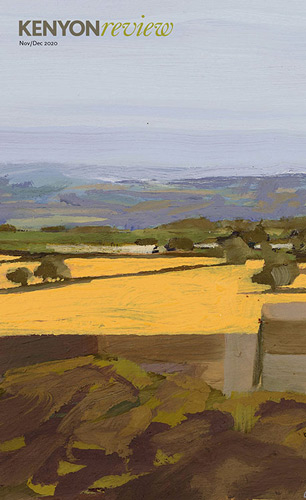
The latest issue of the Kenyon Review—the final issue compiled by editor emeritus, David H. Lynn—features work by writers whom Lynn came to know and admire during his transformative twenty-six-year tenure. Regular Kenyon Review readers will recognize many of the names in the Nov/Dec 2020 issue, among them fiction writers Nancy Zafris and T.C. Boyle; poets David Baker, Natalie Shapero, G.C. Waldrep, Carl Phillips, and Mary Szybist; and nonfiction writers Roger Rosenblatt and Geeta Kothari. Don’t miss this memorable issue curated by our longest-serving editor.

Waking Up Zucked

Guest Post by Kathleen Murphey.

That the 2020 Presidential Election was close depressed me and made me search for higher education jobs in Canada, but then I read the Mother Jones article, “How Facebook Screwed Us All.” If Facebook and other social media platforms are enabling bad actors to undermine democracy across the globe, they could be forced to adhere to better regulation standards.

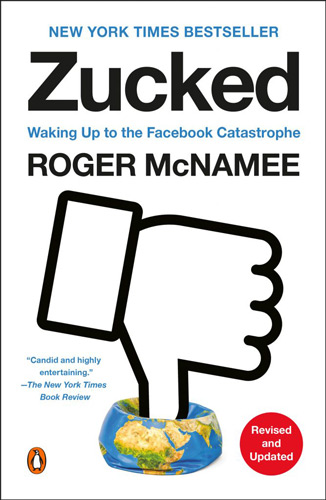
To learn more, I am reading Zucked: Waking Up to the Facebook Catastrophe by Roger McNamee. McNamee outlines Facebook’s rise and its failure to imagine its persuasion architecture being used for nefarious purposes—even though evidence of bad actors using its platform keeps piling up from Brexit to the 2016 U.S. election to incidents in Sri Lanka and Nigeria.


Zucked: Waking Up to the Facebook Catastrophe by Roger McNamee. Penguin Books, February 2020.

Reviewer bio: Kathleen Murphey is an associate professor of English at Community College of Philadelphia.  She does both academic writing and creative writing (www.kathleenmurphey.com).

Buy this book at our affiliate Bookshop.org.

Reevaluate Beliefs with Anita Moorjani

Guest Post by Tiffany Mitchell.

I have always been a reader of philosophy, spirituality and self-improvement books. I really think it is important to have a space in your life to connect directly with yourself in order to make more inspired choices so that the rest of your life is constantly being fed with the best of you. This pandemic has lent the opportunity to do that but in a more deliberate way. It wasn’t just about reading to develop better communication skills or finding new ways to build confidence. It was about reading to stay grounded in faith. When uncertainty became the “norm,” faith became the remedy.  My reading choices mirrored that internal understanding.

When I read Dying to Be Me by Anita Moorjani, I was quickly reminded of the beliefs woven throughout religious and spiritual teachings. This book was the culmination of all those understandings that we know but somehow allow our circumstances to silence. Moorjani’s relocations of her near-death experience and the knowing that she developed made relying on higher power even more purposeful and necessary. It made our current pandemic feel like a shared manifestation of our internal fears and offers still an opportunity to shift and renew our beliefs and values. It is time that we transition into more connected individuals and a unified world. It was an understanding of the power of compassion, acceptance, and self-love and how that directly impacts everyone and everything around us. This is an opportunity to reevaluate beliefs and how they are affecting our lives. This book provokes you to do just that. One thing is for sure, we are changed forever. But how we change is our responsibility.


Dying to Be Me by Anita Moorjani. Hay House, September 2014.

Reviewer bio: Tiffany Mitchell is a Certified Life coach and founder of DearlifeIgetit.com.

Buy this book from our affiliate Bookshop.org.

Magical and Practical Inspiration

Guest Post by Renée Cohen.

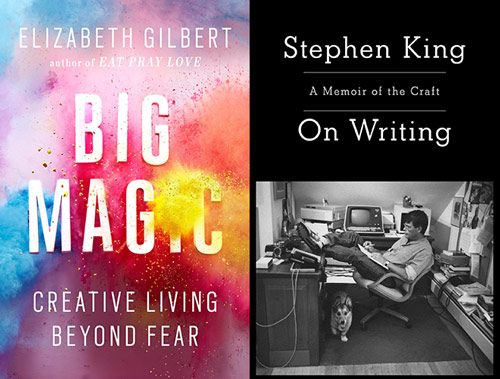
Throughout the quarantine, I took to rereading old favorites. Most notably, Elizabeth Gilbert’s Big Magic: Creative Living Beyond Fear and Stephen King’s On Writing: A Memoir of the Craft—two books on the craft of writing that I recommend, particularly to aspiring writers.

Oddly enough, I was never a huge fan of either author’s prior works of fiction. (Although, admittedly, I have enjoyed movies based on some of their oeuvres.) In 2015, I purchased Big Magic prior to boarding a long-haul flight. Some fluff to pass the time, I reasoned at the time. By pure luck, On Writing was given to me at a holiday party during a random gift exchange. Continue reading “Magical and Practical Inspiration”

A Lesson in Leadership

Guest Post by Jennifer Brown Banks.

It goes without saying that effective leadership is not exactly a dinner table topic, a trending news item, or a subject matter that most of us consider on a daily basis. Yet, good leadership is firmly ingrained in many roles and rites of passage in our daily lives.

Consider this. Good leadership is needed to be an effective parent, a supervisor, a mentor, and even an American president. Which is why so many people have a definite opinion on Donald Trump—be it good or bad.

In the book, Leadersh!t by former CEO and leadership development coach, Rande Somma, many aspects and attributes of an effective leader are explored; as he addresses the need for accountability, transparency, and integrity to fix what he considers a “broken system” in corporate America.

This compelling read includes chapters on the dumbing down of values, the price of incompetence, the enormous ROI (return on investment) of character, and more.

Leadersh!t provides a paradigm shift for tomorrow’s leaders and reflection for stake holders in current business affairs.


Leadersh!t by Rande Somma. Booklocker.com, November 2016.

Reviewer bio: Jennifer Brown Banks is a veteran freelance writer, award-winning blogger and avid reader, residing in Illinois. Follow her on Twitter: https://twitter.com/Jenpens2.

Hippocampus Magazine November 2020

We’re thrilled to announce the winner of our 2020 contest (Claire O’Brien’s essay “Dead Weight”), as well as to share all six finalist stories—and more great CNF content—with you in our November issue. Our runner-up and finalists: Nicole Graev Lipson (runner-up), Shea Williams, Laura Joyce-Hubbard, DW McKinney, and Lori Jakiela. See more contributors at the Mag Stand.

Steinke’s ‘Flash Count Diary’

Guest Post by Joe Taylor.

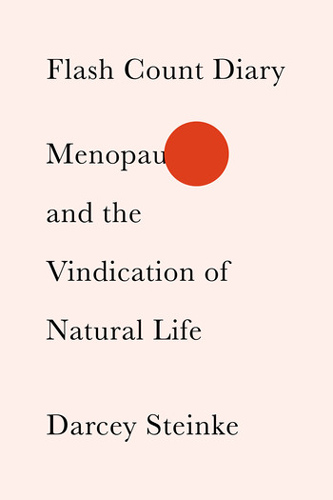
For sure, this book is about menopause and all the related inconveniences, silly jokes, and notions—but it’s also about sexuality, patriarchy, mortality, acceptance, spirituality, wisdom, and whales. Yes whales, for it seems those creatures that can live well over a century elect matriarchs who have experienced menopause to lead their packs in something of a crone’s position. And why not? Experience matters. Lack of distraction matters. It’s called wisdom. And this, Steinke tells us, is precisely why women should not pursue hormone treatment, why men should not pursue Viagra. Acceptance of life’s stages and the accompanying wisdom, not denial and infantile retreat.

This book presents Darcey Steinke par excellence, perhaps a bit angrier than her usual when discussing the mostly male-dominated medical and pharmaceutical fields, but then, as she would no doubt insist, she has earned that anger. As have we all.


Flash Count Diary: Menopause and the Vindication of Natural Life by Darcey Steinke. Farrar, Straus and Giroux, June 2019.

Reviewer bio: Joe Taylor has published five novels and three story collections. He is the director of Livingston Press: https://livingstonpress.uwa.edu.

Buy this book from our affiliate Bookshop.org.
CRAFT 2nd Annual All-Flash November

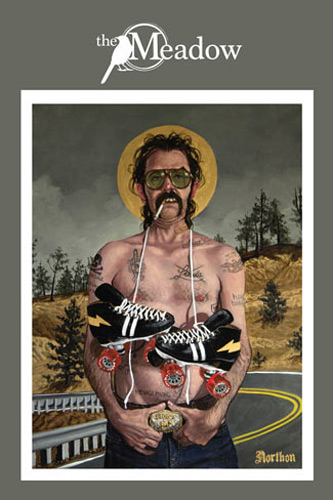
For the second year in a row, literary magazine CRAFT will be focusing on flash pieces in November. This was kicked off with new flash fiction from Kim Magowan on November 6.

Follow their site for the latest flash pieces from Despy Boutris, Lori Sambol Brody, Lindsey Harding, and Paul Crenshaw. Plus, you’ll also find Amy Barnes tackling Nancy Stohlman’s Going Short and Kristin Tenor’s hybrid interview with Tara Isabel Zambrano on Death, Desire, and Other Destinations.

The Main Street Rag – Fall 2020

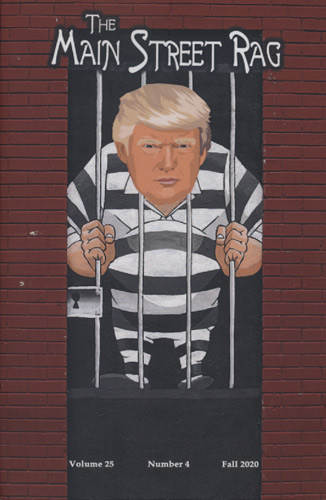
This issue’s featured interview is with Doralee Brooks, whose poetry is also included. Also in this issue: creative nonfiction by Frederick W. Bassett; fiction by Nathan V. Baker, Mari Carlson, Linda Griffin, Alan Nelson, and Eudora Watson; and poetry by Joan Barasovska, Rachel Barton, Ranney Campbell, Maria Ceferatti, Sally Dunn, Caroline Goodwin, Cleo Griffith, Dorinda Hale, Dennis Herrell, Zebulon Huset, Craig Kittner, Mike Jurkovic, and more.

The Gettysburg Review – 33.1

The Gettysburg Review is out and features paintings by Tollef Runquist, fiction by Julialicia Case, Martha Shaffer, Kirsten Vail Aguilar, and Andrea Marcusa; essays by Elizabeth Kaye Cook, Kathy Flann, Don Lago, Christine Schott, Rebecca McClanahan, and Melissa Haley; poetry by Christopher (c3) Crew, Peter Grandbois, Despy Boutris, Douglas Smith & George Looney, John Hazard, Brian Swann, Maura Stanton, Cindy King, John Brehm, and more.

Anomaly – No 31

In the new issue of Anomaly: comics by Tamara Jong, Jennifer Murvin, Chloe Martinez, Andie Frein, Amelia L. Williams, and Alina Viknyanskiy; poetry by Tian-Ai, Stephanie Jean, Shay Alexi, Saddiq Dzukogi, Noor Ibn Najam, Noʻu Revilla, Michal Jones, KL Lyons, Irteqa Khan, Ima Odong, Heather Simon, Eunice Kim, Chavonn Williams Shen, Bailey Cohen-Vera, Asmaa Jama, and Amanda Holiday, fiction by Laurence Klavan, LaToya Jordan, and Carson Faust; and nonfiction by Tasha Raella, Jody Chan, and Anjoli Roy.

Into the Void Magazine – #17

Welcome to a great issue full of vivid, haunting, charming and thought-provoking pieces with a stunning cover image by Jeff Corwin. Fiction by George Choundas, Kathie Giorgio, Rosalind Goldsmith, Alice Ting Liu, Chris Neilan, and Alexander Woods; nonfiction by Audrey Burges, Marie Kilroy, and Ellis Scott; and poetry by Dianna Vagianos Armentrout, Swapnil Dhruv Bose, James Butler, and more.

Into The Void Releases We Are Antifa Anthology

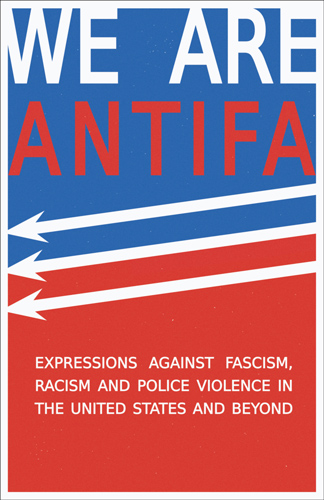
Into the Void Antifa Anthology flierAt the beginning of the month, literary magazine Into the Void released it’s We Are Antifa: Expressions Against Fascism, Racism and Police Violence in the United States and Beyond. The anthology features creative nonfiction, fiction, and poetry from diverse writers all over the world, i.e. the US, Canada, Ireland, the UK, Greece, Nigeria, and more.

Into the Void will be donating 100% of proceeds from the anthology’s sales to Black Lives Matter Canada. In order to maximize profits, the book will only be available via Amazon in ebook and paperback formats.

We Are Antifa was edited by Heath Brougher, Jay C. Mims, Amanda Gaines, Andrew Rihn, and Philip Elliot. It features “breathtaking writing condemning fascism, racism and state-sanctioned brutality through powerful expressions of grief, rage, hope and love.”

The title is a response to Donald Trump’s declaration that the US will be designating Antifa as a terrorist organization. The editors encourage readers to check out “A Brief History of Anti-Fascism” in Smithsonian Magazine to better understand why they published this anthology and “how anti-fascism and anti-racism are inextricably linked in the fight against oppression and supremacy.”

A Playful Conglomeration of Experiments

Guest Post by Shamae Budd

Patrick Madden’s third collection of essays is a playful conglomeration of experiments (in form, in collaboration, in thought). Interspersed among more traditional personal essays, you will find a menagerie of borrowed forms. The collection opens with an essay masquerading as an eBay listing for “Writer Michael Martone’s Leftover Water.” (Or is it an eBay listing masquerading as an essay? We can’t be sure, which is half the fun.) You will find blackout poetry (“Insomnia”), an essay written with the help of predictive text algorithms (“Unpredictable Essays”), mixed up proverbs (“The Proverbial ____” ), and a series of “Pangram Haiku.” Continue reading “A Playful Conglomeration of Experiments”

The Bitter Oleander – Fall 2020

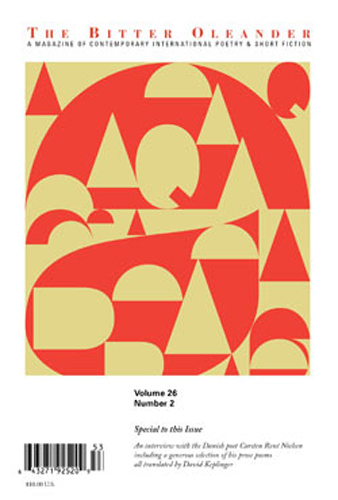
The Autumn 2020 issue of The Bitter Oleander features an interview with the Danish poet Carsten René Nielsen, including a selection of his prose poetry translated by David Keplinger. Also in this issue: fiction by Michael Pearce, Kelly Talbot, and more; essays by Will Stone; and poetry by Dolores Etchecopar, Stephen Tuttle, Madronna Holden, David Cholrton, Matei Vişniec, Silvia Scheibli, Patty Dickson Pieczka, and others.

Sky Island Journal – Fall 2020

Sky Island Journal’s stunning 14th issue features poetry, flash fiction, and creative nonfiction from contributors around the globe. Accomplished, well-established authors are published—side by side—with fresh, emerging voices. Readers are provided with a powerful, focused literary experience that transports them: one that challenges them intellectually and moves them emotionally. Always free to access, and always free from advertising, discover what over 75,000 readers in 145 countries already know; the finest new writing is here, at your fingertips.

Event :: Reversed Thunder with Brendan Constantine

Event dates: November 5 – December 3, 2020; Location: Virtual
Join award-winning poet Brendan Constantine for an exciting craft and generative workshop presented by The Poetry Lab. Writers will respond/reflect on the principles of poetic conscious and political poetry as they explore valedictions and liberate their post-election feelings. Class includes three two-hour workshop sessions and ends in a live public performance, where all students will be invited to read alongside Brendan. Registration fee is $150 for adults, $125 for students with a valid student ID. Must be 18 or over to enroll. Class begins Thursday, November 5, 2020 at 6pm PST via Zoom. Learn more at thepoetrylab.com/reversed-thunder.

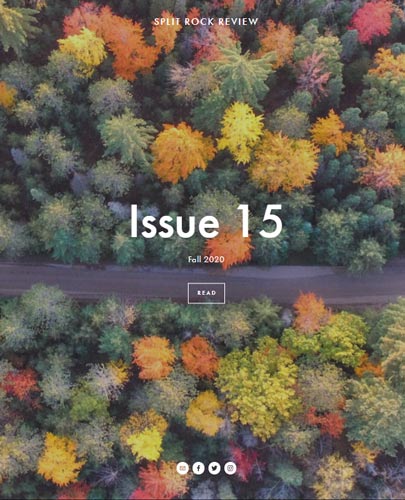
Split Rock Review – Issue 15

The new issue of Split Rock Review features work by Ted Kooser, David Axelrod, Lauren Camp, William Woolfitt, Celia Bland, and many more writers and artists, including fiction by Adrian Markle; nonfiction by Anna Oberg and Wendy Weiger; a comic by Don Swartzentruber; art & photography by Aaron Burden, Leah Dockrill, Natalie Gillis, and more; and poetry by Ellen Rogers, Connie Post, Jenny Wong, Rebecca Yates, Emry Trantham, and more.

Poetry – October 2020

The October 2020 issue of Poetry is out. Work by Maya C. Popa, Ed Roberson, Dorothy Chan, Arvind Krishna Mehrotra, Chester Wilson III, Oli Rodriguez, Tianru Wang, Nathan Sppon, heidi andrea restrepo Rhodes, Cathy Song, Orlando Ricardo Menes, Martin Dyar, Ingrid Wendt, John Lee Clark, Jennifer Jean, Adrienne Su, Tom Pickard, Katie Hartsock, and more.

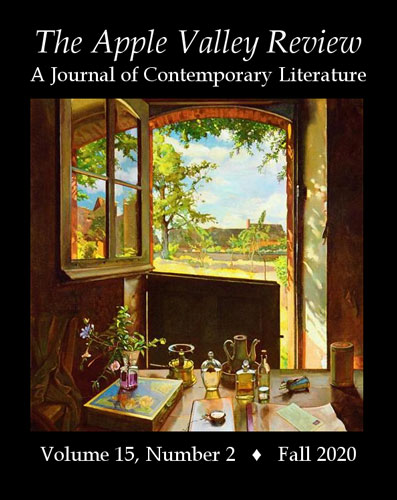
Apple Valley Review – Fall 2020

Featuring short fiction by Kevin Bray, Morgan Cross, Adam Luebke, Tove Ditlevsen (translated from the Danish by Michael Goldman), and Epiphany Ferrell; an essay by Samantha Steiner; and poetry by Liana Sakelliou (translated from the Greek by Don Schofield), DS Maolalai, Emily Hyland, Antonio Machado (translated from the Spanish by Thomas Feeny), Tiffany Hsieh, and Joseph Zaccardi. Cover artwork by Konstantin Somov. More info at the Apple Valley Review website.

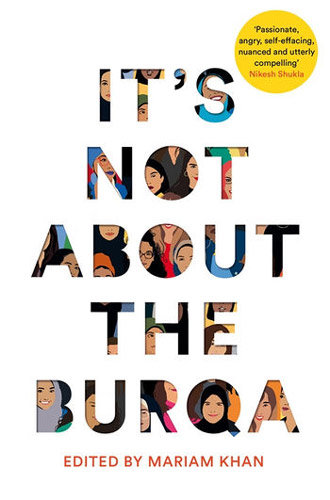
“It’s Not About the Burqa”

Guest Post by Reem Ali

I genuinely don’t think I can recommend Mariam Khan’s It’s Not About the Burqa enough. Wow, just wow. I’m not much of a nonfiction gal, however, this was the exception. As a Muslim woman living in a western country, I’ve accepted that descriptive representation requires decades more of advocacy and activism. However, what I don’t accept is the blatant islamophobia and racism portrayed by the media that’s being fueled by white supremacists (and the like) commanding elected positions. This collection of essays not only expands upon this issue, but many others as well.

The authors are all successful women in their respective careers, breaking down stereotypes of Muslim women ingrained into western society. There have been so many cultural, moral, and systemic issues that I have pondered and struggled with, but these essays articulate and address them in such a succinct and thoughtful manner. I sincerely believe that this is a definite must-read. With the wave of people aiming to educate themselves on BLM issues, I suggest picking this up as well.


It’s Not About the Burqa by Mariam Khan. Pan Macmillan, February 2020.

Reviewer bio: Reem Ali is a third-year law student, and a born-and-raised Texan. She loves spending her free time reading, traveling (pre-coronavirus) and playing backgammon. She enjoys engaging with tough readings and sharing her perspectives. For more book reviews: @reemsreads.

Buy this book from our affiliate Bookshop.org.
October eLitPak :: MFA in Creative Writing at UNCG

UNCG MFA in Creative Writing August 2020 eLitPak flier
click image to open PDF

Find Your Story Here

Application Deadline: January 1. One of the first creative writing programs in the country, UNC Greensboro’s MFA is a two-year residency program offering fully funded assistantships with stipends and health insurance. Students work closely with faculty in one-on-one tutorials, take courses in poetry, fiction, publishing, and creative nonfiction, and pursue opportunities in college teaching or editorial work for The Greensboro Review. More at mfagreensboro.org.

View full October 2020 eLitPak here.

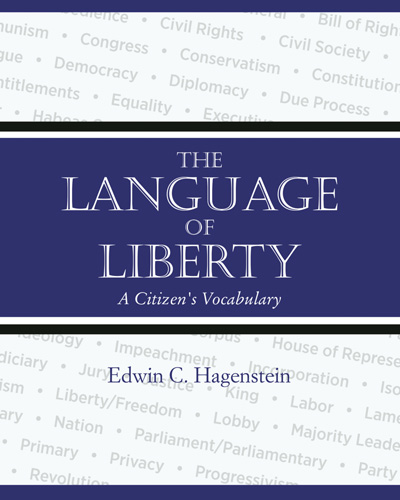
Brush Up on “The Language of Liberty”

Guest Post by Wilfred M. McClay

For at least the past thirty years, we have done a terrible job in this country of educating the young for the tasks of citizenship in a republic. Despite endless talk about the problem, little is actually done to improve matters. The concept of “civic literacy” is the latest buzzword of educators, and yet no one seems to know what the word signifies, let alone how to achieve it. But help is on the way.

Civic literacy, meaning the body of knowledge that enables a citizen to function actively, intelligently, and effectively, is precisely what is offered us in Edwin Hagenstein’s splendid new book The Language of Liberty. To call it a “citizen’s vocabulary,” as the author does, is true enough; but the book is much more than that. It is not a treatise, but instead a collection of wise, subtle, and reflective essays on the keywords of our political and social discourse, covering everything from “the administrative state” to “the referendum,” with topics as philosophical as “conservatism” and “liberalism” and as down-to-earth as “gerrymander” and “whip.” It is both a handy reference book and a work of philosophy, nicely parceled out into easily digested essays. I’ve never seen anything quite like it.


The Language of Liberty: A Citizen’s Vocabulary by Edwin C. Hagenstein. Rootstock Publishing, October 2020.

Reviewer bio: Wilfred M. McClay is the G.T. and Libby Blankenship Chair in the History of Liberty at the University of Oklahoma.

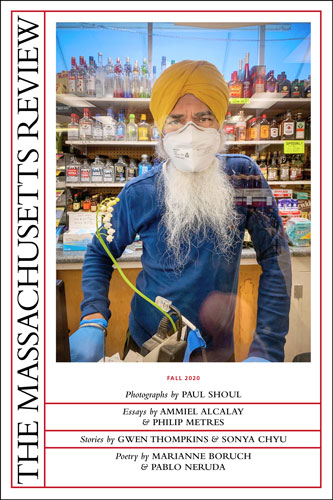
The Massachusetts Review – Fall 2020

In the Fall 2020 issue of The Massachusetts Review: fiction by Gwen Thompkins, Alanna Schubach, Andrea Maturana, Kathleen Hawes, and more; poetry by Marcela Sulak, Emily Schulten, Lance Larsen, Esther Lin, Brooke Sahni, C. P. Cavafy, and others; and nonfiction by Karen S. Henry, Ammiel Alcalay, Margaret Lloyd, and more. Plus, photography by Paul Should and a novel excerpt by Giacomo Sartori. .

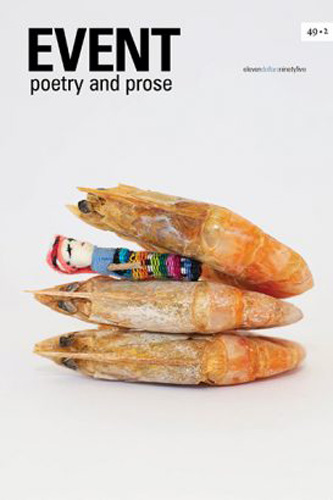
EVENT – 49.2

EVENT’s latest offering is jam-packed with a tantalizing assortment of literary goodies. Poetry by Bára Hladík, Alpay Ulku, Alan Hill, Patricia Young, A. Molotkov, Dominik Parisien, and more; fiction by Jason Jobin, Kari Teicher, Fraser Calderwood, and Wayne Yetman; and nonfiction by Scott Randall. Plus, four reviews of poetry, fiction, and nonfiction titles. Read more at the EVENT website.

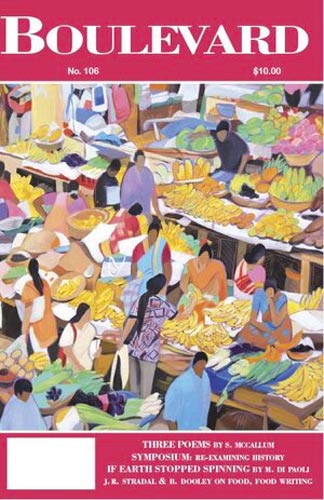
Boulevard – Fall 2020

Boulevard No. 106 contains a fantastic and diverse slate of great writing, including the winning story from the 2019 Short Fiction Contest by Sena Moon; a Boulevard Craft Interview featuring a conversation between J. Ryan Stradal and Beth Dooley; new poetry from Shara McCallum, Eloisa Amezcua, Molly Brodak, Doug Ramspeck, Katherine Smith, Lisa Gluskin Stonestreet, Dara Elerath, and Jeannine Hall Gailey; new fiction from Ron Austin, Matthew Di Paoli, Christine Sneed, and Adam Roux; essays by Christine Spillson, Jodie Varon, Matt Jones, Brandon Parker, and Min Han; and a new symposium about re-examining history. Plus, fantastic, and striking cover art by Xizi Liu!

About Place Journal – Oct 2020

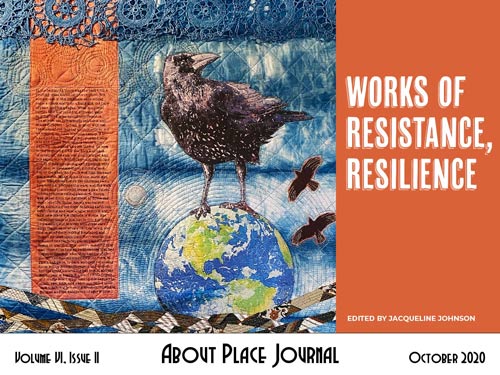
“Works of Resistance, Resilience” is comprised of poetry, fiction, nonfiction and visual art by 83 writers and artists. The issue has five themed sections that explore what it means to live in America at this time of profound reckoning. What does resistance look like? Can resistance contain love, power and empathy? In this age of collective anxiety, the writers and artists from around the world attempt to answer what it means to live and survive during the Covid-19 pandemic and beyond. The Works of Resistance, Resilience will rekindle our desire to learn and thrive and to discover what is needed to change our relationship to the earth and to each other. More info at the About Place Journal website.

River Teeth Launches Weekly Online Magazine of Micro-Essays

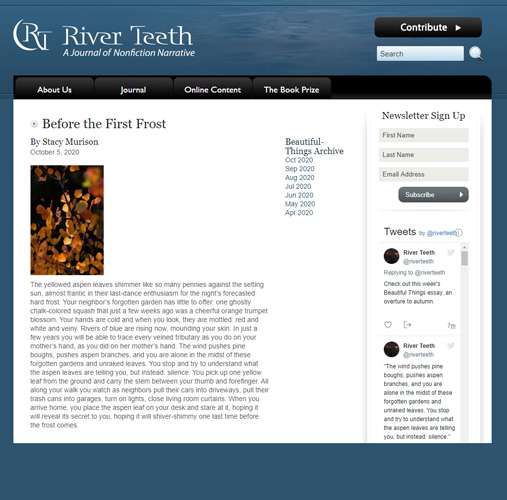
Screenshot of River Teeth's online column Beautiful Things

In April 2020, biannual print literary magazine River Teeth launched the online weekly journal Beautiful Things. This publication is devoted to very brief nonfiction that finds beauty in the everyday. Readers can subscribe to receive the latest micro-essay in their inbox every Monday morning. Today’s essay is “Before the First Frost” by Stacy Murison.

Beautiful Things was inspired by Michelle Webster-Hein’s essay “Beautiful Things” which was originally published in Volume 15, Number 1 of River Teeth. This column is co-edited by Michelle Webster-Hein and Jill Christman.

River Teeth is devoted to publishing the best creative nonfiction, including narrative reportage, essays, and memoir. Stop by their listing on NewPages to learn more about them and their new online publication.

World Literature Today – Fall 2020

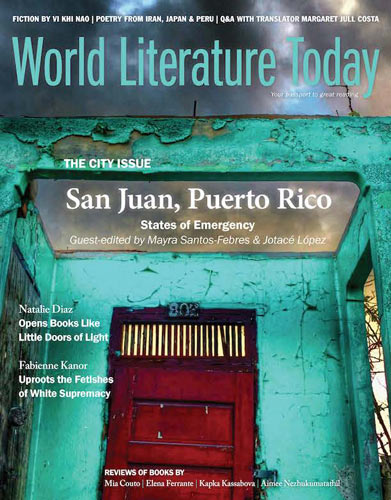
San Juan, Puerto Rico, takes the spotlight in World Literature Today’s annual city issue with a powerful selection of poetry, stories, and essays by 17 writers. Other highlights in the autumn issue include Fabienne Kanor’s essay on uprooting the fetishes of white supremacy; interviews with Natalie Diaz and Margaret Jull Costa; a stunning poem by Achy Obejas on “the universe at absolute zero”; fiction by Vi Khi Nao and Lidija Dimkovska; and much more. Reviews of new books by Elena Ferrante, Mia Couto, Kapka Kassabova, and dozens more make WLT your go-to guide for the best in international literature

Understorey Magazine – Issue 18

Understorey Magazine Issue 18 is out. Read for examinations on the many ways science and technology affect our everyday lives. Poetry by Moni Brar, Daze Jefferies, Kimberley Orton, Dawn Macdonald, Kayleigh Cline, and I. Sabrina Samreen; fiction by Gail Willis; and nonfiction by Jeanne Kwong, Sima Chowdhury, Stacey McLeod, and Rita Kindl Myers. Plus, interviews with Maryam Heba and Chelsey Purdy.

Cimarron Review – Issue 211

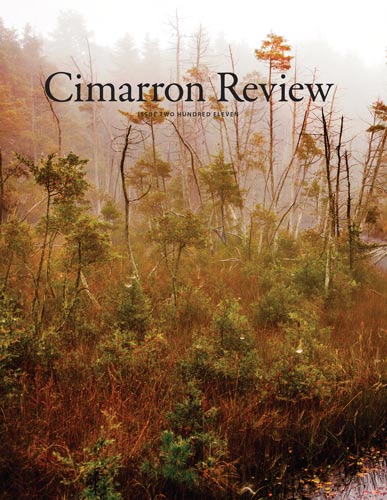
Issue 211 of Cimarron Review features poetry by Bonnie Auslander, Clemonce Heard, Leslie McGrath, Emily Franklin, Chris Haven, Matt Morgan, Laura McKee, Bryce Berkowitz, Elisabeth Murawski, Jan Beatty, Kayla Sargeson, and others; fiction by Andrew Geyer, Molly Anders, and Steven Wingate; and nonfiction by Ephraim Scott Sommers and Caroline Sutton. This issue’s cover art is “River Fog” by Richard Speedy.

Hippocampus: Devoted to Memorable Creative Nonfiction

Hippocampus website screenshotLaunched in 2011, online literary magazine Hippocampus was first dreamed about by founder and editor Donna Talarico when she was working on her MFA in creative writing at Wilkes University. Talarico wanted to create not just a literary magazine, but also develop a venue to education and inform those interested in reading and writing creative nonfiction.

Their sea horse logo was created since the hippocampus, the part of the brain dealing with memories, is sea-horse-shaped.

Over the years, they have launched a nonfiction writing contest, an annual nonfiction writing conference, and now a book publishing division. They are open to submissions annually from March through December.

Their September 2020 issue features work by Katie Parry, Kirsten Reneau, Rachel Fleishman, Brad Wetherell, Daniel K. Miller, Gwen Niekamp, and more.

Learn more about this magazine by stopping by their listing on NewPages.

Sponsor Spotlight :: EVENT: The Douglas College Review

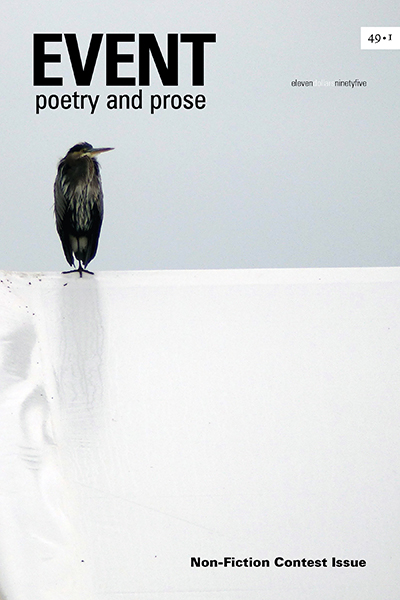
cover of EVENT Issue 49-1Founded in 1971, EVENT is a literary magazine dedicated to nurturing writers and presenting readers with the best contemporary writing from Canada and abroad. They strive to publish a diversity of voices and literary styles and have published many distinguished writers before and after they gained national or international recognition, i.e. André Alexis, George Bowering, Charles Bukowski, Esi Edugyan, Jack Hodgins, Annabel Lyon, Pablo Neruda, Alden Nowlan, Nino Ricci, Diane Schoemperlen, Carol Shields, Timothy Taylor, and Madeline Thien.

Each year they host a Non-Fiction Contest. The contest awards $3,000 in prizes ($1,500 First Place, $1,000 Second Place, $500 Third Place) plus publication in the Spring/Summer issue. This is the longest-running contest of its kind in Canada. The deadline to enter is October 15 annually. Check out Issue 49/1 to view the winning pieces of their 2019 contest: “Judge’s Essay” by Anthony Oliveira, “The Dead Green Man” by Jane Eaton Hamilton, “Things You Think When Your Husband Has a Heart Attack” by Mary Steer, and “My Beautiful Madness” by Rose Cullis.

Besides publishing issues three times a year, EVENT also offers a reading service for writers. Stop by their listing on NewPages to learn more.

Lyrical Examinations

Guest Post by Amber Caron

Like other readers, I had grand plans when the world went on lockdown. I would begin with War and Peace. I went as far as borrowing the book from a friend, left it on my shelf unopened, and instead turned to newly published nonfiction that grappled with the question of what it is to live a good life. The most recent addition to this stack of books is Jennifer Sinor’s Sky Songs. (Disclosure: Sinor and I teach at the same university.)

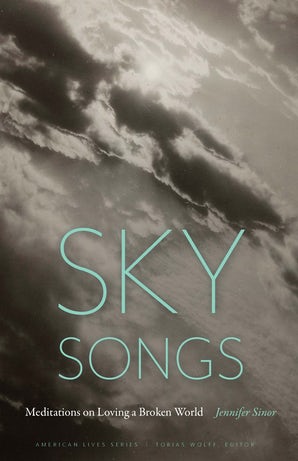
Both the title and cover image of Sinor’s essay collection are drawn from Alfred Stieglitz’s photographic study Songs of the Sky (later titled Equivalents), nearly four hundred abstract images captured when Stieglitz turned his camera to the clouds. “What is of greatest importance,” Stieglitz said, “is to hold a moment, to record something so completely that those who see it will relive an equivalent of what has been expressed.”

It was an emotional equivalence Stieglitz sought, and the same could be said of Sinor’s fifteen essays. Sky Songs meditates on the defining moments of a life—the tragic death of an uncle, a dissolving marriage, new love, the birth of a child, an encounter with wildlife, the loss of one religion and, years later, the unfolding of another. Read on their own, each essay offers a patient, lyrical examination of these moments. Together, the essays offer a profound reading experience, enriched by a layering of images, a deep sense of place, and the inescapable truth that although we are often haunted by our earliest tragedies, we are equally shaped by the beauty we find in the world around us. Ultimately, Sky Songs delivers what it promises, and what it promises is no small thing: the emotional equivalence of a life well lived.


Sky Songs: Meditations on Loving a Broken World by Jennifer Sinor. University of Nebraska Press, October 2020.

Reviewer bio: Amber Caron’s fiction and non-fiction can be found in The Threepenny Review, PEN America Best Debut Short Stories, Southwest Review, Longreads, and elsewhere.

Buy this book from our affiliate Bookshop.org.
Valley Voices – Fall 2020

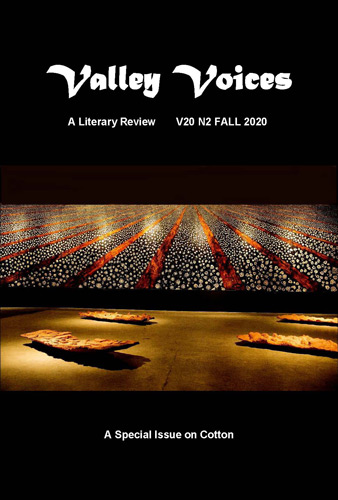
The Fall 2020 issue of Valley Voices features poetry by Paul Mariani, Gary Fincke, Janet McCann, Luci Shaw, Marge Piercy, Ted Kooser, D. S. Martin, Walter Bargen, Virginia Sullivan, Ed Madden, Le Hinton, Joseph Pearce, Jean-Mark Sens, John J. Han, and more; memoirs by Billy Middleton, Frederick W. Bassett, and Carol Coffee Reposa; and articles & interviews by Bruce Boyd Raeburn, Adam Gussow, Joseph Millichap, Janet Greenlees, Dominic Reisig, John J. Han, Gab D. Smith and Thomas H. Sayre, and David Tisdale.

Leaping Clear – Fall 2020

Leaping Clear - logo

Take the time to enjoy and be nourished by the art and writing in this new issue of Leaping Clear. There is humor, poignancy, power, ecstasy, calm, and beauty to be found in essays by Elizabeth Fletcher, Liz Woz, Ranjani Rao, and more; fiction by Taffeta Chime; and poetry by Alan Cohen, Carla Sarett, Fran Markover, J. P. White, Linda Parsons, Sandra Fees, Wayne Lee, and more.

Shape Your Fiction with Jerome Stern

Guest Post by James Gering

Here is a born creative writing teacher generously imparting dollops of warmth, humor, and wisdom in three sections that combine to resemble no other book in this crowded genre.

“The Shapes of Fiction” is the first section, where Stern vividly demonstrates his ideas in original and artful little storylines often featuring engaging dialogues. The first three shapes “show (you) how to handle thoughts, dialogue and action—techniques you’ll use over and over.” In “Iceberg,” a writer focuses on what characters choose to express or choose to keep in mind:


Brian thought, Oh God, here it comes. My Principal. The Pig That Walks Like a Man. “Hello, sir. What a fine day.”

Eiswold nodded. “What’s that on your tie, boy? Your lunch?”

“Oh, goodness,” Brian said, “I hadn’t noticed. Thank you, sir.”

A dynamic interplay between thought and speech unfolds, and it should be noted that fulsome conveyance of thought is where fiction triumphs over film.

Other shapes include “Bear at the Door,” “Onion,” “Visitation,” “Aha!,” and “Explosion,” the last of which advises you to blow the rest of the advice to smithereens and exclusively celebrate your own brilliance. The point: these are Stern’s insights (culled from decades of teaching at tertiary level), not cumbersome rules.

In the second section, “A Cautionary Interlude,” Stern points out common pitfalls on narrative journeys. Find out how to avoid “Population Explosions,” “The Banging-Shutter Story,” “The Hobos-in-Space Story,” and more.

The final section, is a comprehensive alphabetical rendering of writing terms, some universally known, others, like ‘intrigant,’ less so. The terms are deftly cross-referenced, making it a pleasure to follow related strands.

Befriend Jerome Stern! His wisdom and generosity will enrich your writing.

Making Shapely Fiction by Jerome Stern. W.W. Norton & Company, November 1991.
Reviewer bio: James Gering is a poet and short story writer from the Blue Mountains in Australia. He welcomes visitors at jamesgering.com.

Buy this book at our affiliate Bookshop.org.