Home » NewPages Blog » Page 90

NewPages Blog

At the NewPages Blog readers and writers can catch up with their favorite literary and alternative magazines, independent and university presses, creative writing programs, and writing and literary events. Find new books, new issue announcements, contest winners, and so much more!

No Shortage of Creativity in BWR

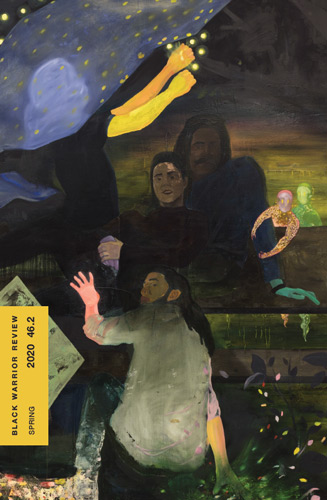
Black Warrior Review - Spring 2020There is no shortage of creativity in the Spring 2020 issue of Black Warrior Review. Paging through the issue, readers eyes are drawn to the variety of forms and use of images within the pages.

Amy Lee Scott’s “Field Guide to a Common Pregnancy: Notes on Loss and Growth” include field drawings by the author. Each section is introduced to a drawing of a different plant or fruit.

In “the magpie poem,” Jasmine Khaliq’s words come in small spurts across the poem’s seven pages.

“Composite Material // Spirit Willin” by Cherise Morris includes images—snapshots, Instagram posts, slideshow images from news articles, a photo of a framed photo. It’s so visually compelling, it’s difficult to skip by it.

This issue’s featured chapbook—Translator of Soliloquies: Fugues in the Key of Dissociation by Seo-Young Chu is also creatively formatted, each section broken up by a heading, a nice treat at the end of the issue.

If you want to take in some writing that’s out of the box alongside traditional forms, this refreshing issue of Black Warrior Review is a good place to start.

Focus on Flowers

Colorado Review - Spring 2020Magazine Review by Katy Haas

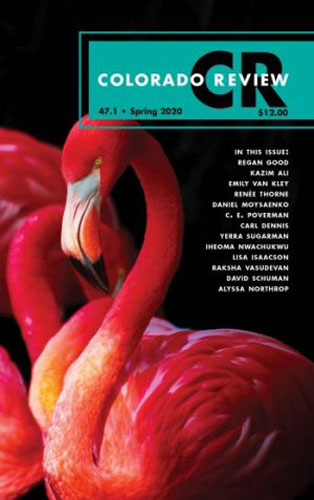
With the weather warming up, I see new green sprouting in my backyard daily. This seems like a good time to focus on poems about flowers found in the Spring 2020 issue of Colorado Review.

In “Bloom,” Emily Van Kley’s speaker talks to the forsythia plant “beside the house.” Together, they move through the seasons: gray in winter, blooming in summer just for the blooms to quickly disappear into leaves. Van Kley’s images are beautiful and strong with lines that really pulled at me, like “The sadness that carries / my thoughts close to its chest / will unpack it’s summer / wardrobe,” and “Soon the last rains // will poor themselves down / storm sewers’ gullets.”

Leah Tieger also writes of flowers in “Five Sunflowers,” which are a gift from “the man who loves me.” The flowers “turn the room from real / to magazine, so picture my life perpetually happy.” The flowers urge the speaker to be grateful, “if not for your presence, / at least for the hands that brought you.” The piece feels warm and loving, the same “brilliant / and saturated” yellow of the flowers.

Welcome in spring and some much needed color with these poems from Colorado Review.

Graphic Nonfiction for Everyone

World Literature Today - Spring 2020

Magazine Review by Katy Haas

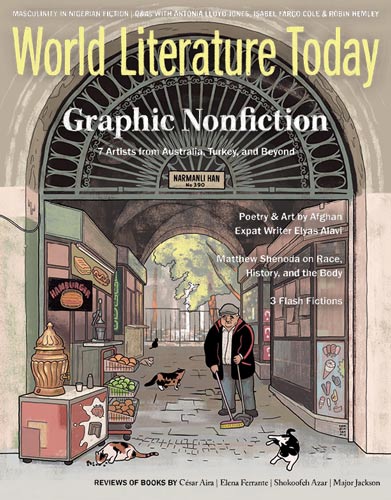
A big fan of graphic novels (and nonfiction and poetry), I’m always thrilled when a literary magazine releases an issue featuring graphic work. World Literature Today’s Spring 2020 issue features a selection of graphic nonfiction by seven artists.

Each piece brings something different to the table. The art styles are all vastly different and each focuses on something unique: politics, history, art, ego, love.

My favorite of these is “Shadow Portrait” by Rachel Ang. Ang’s art is calming and enjoyable to look at, muted tones splayed across the page. She writes of love and ego, the ways in which we see ourselves in art, in stories, in the people we love.

On the opposite end of the spectrum is an excerpt from Guantanamo Voices: True Accounts from the World’s Most Notorious Prison by Sarah Mirk, illustrated by Omar Khouri. Unlike Ang’s calming tones, this excerpt uses bold lines and an orange color scheme which ramps up the feeling of anxiety the story produces. I’m a little disappointed at the length of the excerpt—the four pages we’re given leave on a cliffhanger that left me wanting more, though I suppose that just highlights the writer’s and artist’s skill.

This selection of graphic nonfiction has a little bit of something for everyone, and each artist/writer utilizes their craft impressively. This issue of World Literature Today is a real treat to read.

Take Risks with Adam Grant

Originals by Adam GrantGuest Post by Alicia Wilcox

Adam Grant’s Originals: How Non-Conformists Move the World gave me a powerful new outlook on not only my abilities, but my untapped potential. Grant explains how big thinkers are not just the ones with big ideas, but the ones that take action. Reading this has not only changed the way I think, but the way I act. This book has helped me challenge the norm and foster innovative ideas, as well as getting others to believe in those ideas too.

Surprisingly, risk taking can make your career less fragile. Grant dives into the art of taking risks and challenging the status quo, giving a conclusive guide on transparently communicating and ensuring trust from others along the way. He busts the myths that hold us back from success and goes deep into the paradox: the ones who suffer most within a system are the least likely to challenge it. You can have talent and work ethic, but you have to be original for your ideas to win. How do we create original ideas? Grant shares his secrets on how to defeat perfectionism and produce a large volume of ideas to not only be seen by others, but also utilized for the better.

Originals is a five-star read, giving readers a sturdy foundation for how to embrace change and achieve success in a multitude entirely divergent atmospheres.


Originals: How Non-Conformists Move the World by Adam Grant. Penguin Random House, February 2017.

Reviewer bio: Alicia Wilcox’s work has most recently been published in The Health Journal, The Dewdrop Weekly and is sold in stores across Manhattan.

Buy this book through our affiliate Bookshop.org.

Learn Online with Carve Magazine

Carve Online Writing ClassesBesides being both an online and print literary magazine, Carve also offers online writing classes and online workshops. Did you know that?

They currently offer two writing classes on the Wet Ink platform: Short Story Writing: Fundamentals and Short Story Writing Techniques. Theses classes both run five weeks and are held multiple times during the year.

Fundamentals consists of five lessons: Character & Plot, Point of View, Dialogue, Inner Monologue, and Description.

  • June 15 – July 19
  • August 24 to September 27

Techniques consists of five lessons: Use of Senses, Imagery, Metaphors & Similes, Rhythm & Pacing, and Threading.

  • May 11 – June 14
  • July 20 – August 23
  • September 28 – November 1

Their Online Writing Workshop is devoted to editing for short stories or essays. This is a 10-week course where you get one-on-one attention from a Carve editor. Their next workshops start on June 1 and September 14.

Lock-Down Pleasures in Recent Reading

Ruins of Us by Keija ParssinenGuest Post by S.B. Julian

Recently I moved into a new apartment building for people age 55-plus: the generations that grew up with books, not digitalia. Their schooling emphasized reading, which means the building’s shared library is a serendipitous treasure trove.

Why is it that a book you find by chance is often more pleasurable than an equally worthy book you specially ordered? Some delightful chance findings: Continue reading “Lock-Down Pleasures in Recent Reading”

Sniffing Out the Boogeyman

In the Dream House by Carmen Maria Machado

Guest Post by Lily Anna Erb

Carmen Maria Machado creates a dark, dreamlike landscape in her experimental memoir, In The Dream House. Her story of queer domestic abuse, written as a collection of short vignettes, begins as a fairy tale. There’s a monster lurking somewhere, and the desire to sniff out the boogeyman makes you forget you’re even turning pages. Machado’s addition of fairy tale citations adds a semi-lighthearted and humorous touch to an otherwise darker narrative. Machado’s fairy tale monster takes the form of the woman who lives in the “dream house.”

Machado creates a fascinating practice in self-analysis and reader involvement by using all three modes of perspective. She utilizes third person to explain an airy concept, second person to tell the lurid contents of her tale, and first person to speak directly to the reader. The most frequently utilized perspective is the second person, where Machado seems to rip her hand through the spine of the book to touch the reader. Perhaps the most nerve-wracking example of this technique is the section titled “Dream House as Choose Your Own Adventure” where the reader is given multiple choices of action which all lead to the same abusive conclusion.

No matter how fascinating a world Machado can craft, it doesn’t save her from unnecessary pedanticism. The form of the book, utilizing “The Dream House as . . .”  before every vignette quickly loses its original charm. The book seems to drag on unnecessarily long. Once the story loses its driving force of conflict, the reader is ready for it to end. However, these small annoyances did not totally hinder my consumption of Machado’s work. In The Dream House is full of minefields that you don’t expect. By the end of the book, the reader cheers on Machado as she recovers from her time in the “dream house.”


In The Dream House by Carmen Maria Machado. Graywolf Press, November 2019.

Reviewer bio: Originally from New York, Lily Anna Erb is a sophomore studying poetry at Eckerd College in St. Petersburg, Florida.

Buy this book through our affiliate Bookshop.org.

Literacy Teaching Informed by & Mindful of Stress & Trauma

The National Writers Project Radio recently posted a podcast version of their interview and discussion with Richard Koch and Elizabeth Dutro who have both recently authored books in regards to teaching in an age of stress and trauma. The interview was conducted on February 18, 2020.

Richard Koch, now retired, is a former English professor from the University of Iowa and Adrian College (my alma mater), and is the author of The Mindful Writing Workshop: Teaching in the Age of Stress and Trauma. Elizabeth Dutro is a professor and chair of Literacy Studies at the University of Colorado at Boulder and author of The Vulnerable Heart of Literacy: Centering Trauma as Powerful Pedagogy.

” . . . the space we’re in with all these proliferated programs around trauma and that they can be one more way that certain children are marginalized in school, seen as damaged rather than full of knowledge that should count in schools . . .”

NWP Radio is also offering a free download of The Mindful Writing Workshop on their site. Do check out the full discussion. It’s an interesting conversation on education, children, and teaching and definitely worth a listen to in these stressful times.

Bible studies, Burgess style

Moses by Anthony BurgessGuest Post by Bill Cushing

Retiring in mid-February, I foresaw a sedentary future. However, this virus has taken even that to unexpected heights. With my time in isolation (so to speak; I have a family), I’ve been able to read Moses, a fictional narrative based on the biblical figure’s life by Anthony Burgess.

While most know Burgess for Clockwork Orange, that’s hardly his best. He is the primary reason I pursued an MFA after a 15-year absence from school.

Now I recall why I love (and envy) his writing so much. Moses is a bit closer to two of his earlier works: Napoleon Symphony, where he presents his interpretation of the diminutive conqueror’s life while dividing the book into four sections attempting to replicate the pacing of Beethoven’s Third Symphony, and Man of Nazareth, a look at the life of Jesus as narrated by a Greek merchant returning from business in Jerusalem at the time of the crucifixion.

Moses strikes out on its own in several ways, beginning with its structure. A narrative in verse. it reminds the reader of the Greek epic poems. It humanizes its characters—even Ramses. Moses himself suffers from a speech impediment. This is not unexpected for readers familiar with Burgess; most of his characters with outward defects tend to be the only complete person: recall the grotesque minister defending Alex in Clockwork Orange or the narrator’s disfigured sister in Earthly Powers.

But, like all things coming from Burgess, there are lessons to derive from this one. Issues such as free will, individual responsibility, and respect for simply stated (not grandiose and intricate) law are chief among those. This may be one of the easiest books from Burgess to read although I’d still recommend having a dictionary handy since the linguistic “tricks” found in his diction are always entertaining.


Moses: a narrative by Anthony Burgess. Dempsey & Squires, 1976.

Reviewer bio: Bill Cushing writes and facilitates a writing group for 9 Bridges. His poetry collection, A Former Life, was released last year by Finishing Line Press.

A Comprehensive Search for Explanations

The Catholic School by Edoardo AlbinatiGuest Post by Katy Scrogin

Sheltering in place has provided the perfect opportunity to dive into Edoardo Albinati’s The Catholic School, a thorough exploration of the author’s coming of age in a particular Roman neighborhood in the 1970s. More than simple description or reminiscence, the book is propelled by a comprehensive search for explanations—specifically, regarding a gruesome crime committed by a few of the quarter’s well-heeled young inhabitants. The story is itself an unsparing quest to understand the conditions and sentiments and reigning assumptions that made such a thing even conceivable.

This is no straightforward mystery or crime novel, and indeed, readers not fond of philosophical or sociocultural speculation will probably not enjoy what for this reader amounts to delicious intellectual revelry. But if the lengthy and incisive discourses on bourgeois morality and hypocrisy, the nature of violence, the troubling and troubled realities of masculinity, the strange arena that is the family, or religion and politics in Italy, aren’t your bag, all is not lost! The 1200-plus-page behemoth can most certainly be incorporated into that weight-training routine you have time to take up now that we’re all stuck inside.


The Catholic School by Edoardo Albinati. Macmillan, August 2019.

Reviewer bio: Katy Scrogin’s most recent online work is featured at The Book Smuggler’s Den and The Bookends Review. She can also be found at katyscrogin.wordpress.com.

Buy this book through our affiliate Bookshop.org.

Carve Spring 2020 Preorder Week

Carve Magazine screenshotThat’s right! This week is the week you can preorder Carve Magazine‘s Spring 2020 issue. From now until April 12, you can reserve your copy of the special print edition and receive automatic free shipping to anywhere on print preorders. You also get 15% off a 1-year print or digital subscription. Need more reasons to preorder this issue? It features four new stories, five new poets, two essays and the winners of the 2019 Prose & Poetry Contest selected by Lydia Kiesling, Analicia Sotelo, and Benjamin Busch.

Exploring Loss with Page Hill Starzinger

Vortex Street by Page Hill StarzingerGuest Post by Shin Yu Pai

In Page Hill Starzinger’s Vortex Street, the poet explores many different kinds of loss, to resist squandering what is given. In her revisions of complicated grief, she takes up the subjects of unborn children, the ending of fertility, and becoming an orphaned adult after the death of parents. The fleeting life cycle of a mayfly which only endures for 24 hours is held against the cognitive decline of an aging father. In this act of ongoing “rentrayage” or remaking, the poet turns towards locating the quiet harbor where grief can be held—through the senescent body, its memories, and the exterior dwelling places that anchor us to the past.


Vortex Street by Page Hill Starzinger. Barrow Street Press, May 2020.

Reviewer bio: Shin Yu Pai is the author of AUX ARCS, Adamantine, Sightings, and Equivalence. In March 2020, Entre Rios Books published Ensō, a 20-year survey of her work across disciplines. For more info, visit www.shinyupai.com.

Rereading Jane Eyre

Jane Eyre by Charlotte Bronte

Guest Post by Eliza Mimski

When I go through troubling times, I often reread certain chapters in Charlotte Brontë’s Jane Eyre. It’s the part starting in Chapter 27 where Jane knows that she can’t morally stay at Thornfield Hall any longer and that in order to be true to herself she must leave Mr. Rochester. On her sad voyage away from him, she loses her money and is homeless and starving and yet her connection to nature and to her God is at its strongest. She carries on, not knowing that she will soon happen upon her long-lost relatives and will later reconnect with Mr. Rochester.

What Jane, or Charlotte Brontë, does for me here is to remind me that when I’m in the middle of a crisis I need to remember to connect to my spirituality in a big way, and also to remember that no matter how bad the situation seems, the future can bring change and that I won’t stay stuck forever. To place this in the present situation, it is necessary for me to remember that the suffering brought about by the pandemic will end.


Jane Eyre by Charlotte Brontë. October 1847.

Reviewer bio: I live in San Francisco, California, and am doing my best, like the rest of you, to stay healthy during the pandemic. Find my website here.

Poetry – April 2020

Poetry Magazine - April 2020

The latest issue of Poetry features work by Michael Hofmann, Martha Sprackland, Harmony Holiday, Pascale Petit, Jeannine Hall Gailey, Gertrude Stein & Bianca Stone, Tishani Doshi, Madeline Gins, Joy Ladin, Emily Jungmin Yoon,Sumita Chakraborty, Katie Pyontek, Sun Yung Shin, Torrin A. Greathouse, Sally Wen Mao, Lucy Ives, Shane Neilson, Nelly Sachs, Ocean Vuong, and more. Plus, an essay by Joy Ladin.

C.J. Sansom’s 16th Century Reality

Tombland by CJ SansomGuest Post by M.C. LeBrun 

In C.J. Sansom’s seventh addition to the marvellous Shardlake series, we find ourselves in 1549 and once more at the whims of the Lady Elizabeth, a self-possessed and impassioned fifteen-year-old with little hint of teenage naivety. A missing woman reappears and is then savagely murdered. Her estranged husband, a distantly related Boleyn, stands accused of the crime. Matthew Shardlake is sent to Norfolk to investigate and uncovers intrigue at the highest echelons of elite society. While there, he is captured and caught up in a Kett’s Rebellion, a revolt of the peasant classes against greedy land grabs of the local gentry.

Born with a curvature of the spine and an astute and clear-sighted intellect, Matthew navigates the unsanitary conditions and unjust realities of 16th century England in the years after Henry VIII’s demise, leaving an eleven year old boy on the throne and in the midst of a lion’s den of power players. He is a man of his time but the disability which has marks him as an outsider has also engendered an empathetic awareness of the plight of others. His own critical reckoning and that of those around him, crosses the centuries, offering more relevance to modern thinking while remaining plausibly within the realms of 16th century reality and experience.

The intimacy of Matthew’s asides along with the minutiae of his daily tasks enhances the sense we are shadowing this man through each hour of his life, adding to the immersive experience of the reader into his medieval reality. And what an existence it is: political intrigue, civic unrest, religious discord, intensely unequal economic disparity, ruptured innocence, and war crimes. Add to that Matthew’s own reluctant investigations into gruesome murders, the duplicitous doings of the social elite, and the undue suffering of the poor and powerless and we have a meticulously researched novel of such scope and depth that, by god’s wounds, it is often hard to pull oneself back from it into modern life.


Tombland by C.J. Sansom. Pan MacMillan, October 2018.

Buy this book through our affiliate Bookshop.org.

Activities and Insight from James W. Pennebaker

Secret Life of Pronouns - James PennebakerGuest Post by Colleen M. Farrelly

As a lifelong logophile, I’ve found folks who are acerbic, insipid, and (occasionally) inimitable. However, I’d never thought about the his or hers or theirs aspect of life (or the importance of these words) until reading James Pennebaker’s The Secret Life of Pronouns.

By analyzing the words that knit together what I’d assumed were the important words of a sentence, one can learn a lot about the sentence’s writer or speaker—his/her personality, truthfulness, social status, and even future behavior. Pennebaker even includes links to writing activities used to analyze traits described in the book. According to the bottle project, I’m likely to attend art shows and avoid blow-drying my hair (guilty on both counts).

With a fairly low reading level required for the activities sections and insight from disparate fields like psychology, politics, and law, this book offers something for everyone in the family. Happy reading!


The Secret Life of Pronouns by James Pennebaker. Bloomsbury Press, August 2011.

Reviewer bio: Colleen M. Farrelly is a freelance writer in Palmetto Bay, FL, whose poetry has appeared in many haibun and haiku journals.

Buy this book through our affiliate Bookshop.org.
World Literature Today – Spring 2020

World Literature Today - Spring 2020

A special section devoted to Graphic Nonfiction, showcasing seven writers and artists from around the globe, headlines the Spring 2020 issue of World Literature Today. The issue also presents interviews with translators Antonia Lloyd-Jones and Isabel Fargo Cole; new fiction from Italy, France, and the Philippines; essays on Nigerian fiction and the “humanity on display” in museum exhibitions; poetry by Elyas Alavi (Afghanistan), Khaled Mattawa (Libya/US), and Mohamad Nassereddine (Lebanon); and Poupeh Missaghi’s recommended booklist about cities. More than forty book reviews also round out the issue, giving readers a wealth of titles to inspire their spring reading adventures.

Prime Number Magazine – April-June 2020

Prime Number Magazine - April 2020

The latest issue of Prime Number Magazine includes the winners of the Flash Fiction Contest: Alan Sincic, Danielle Gillespie, and Christopher Notarnicola; winners of the monthly 53-word Story Contest: Scott B. Shepherd, Elizabeth Barton, and Eric Waddon; poetry by alyssa hanna, Forrest Rapier, Jeff Schiff, and Terin Weinberg; and fiction by Alyssa Asquith, Lisa Cupolo, and Richard Farrell.

The Massachusetts Review – Spring 2020

The Massachusetts Review - Spring 2020

The Spring 2020 issue includes poetry by Desirée Alvarez, Danusha Laméris, Julie Murphy, Nancy Miller Gomez, Charlie Peck, Cynthia White, Keith Leonard, Augusta Funk, and more; fiction by Sylvia Hanitra Andriamampianina, Karin Cecile Davidson, Tad Bartlett, Gabriella Kuruvilla, Hebe Uhart, Jung Young Moon, and others; and nonfiction by Gianni Celati, Lesley Wheeler, Amy Yee, and Melanie McCabe.

The Georgia Review – Spring 2020

The Georgia Review - Spring 2020

The Georgia Review‘s Spring 2020 issue presents authors’ and artists’ explorations of what it means to attempt representation of the diverse communities that comprise the United States. Special features include “Un-Redacted: A Census of Native Land,” a collection of writings by Native authors on the legacy of settler colonialism in the U.S.; a section on the internment of people of Japanese descent in North America during WWII; and dispatches from an innovative research project on prison labor in the post–Civil War “New South.” Art by Eddie Arroyo.

Colorado Review – Spring 2020

Colorado Review - Spring 2020

Featured in this issue of Colorado Review, find poetry by Jack Ridl, Amanda Gunn, and Yerra Sugarman; fiction by Alyssa Northrop; and nonfiction by David Schuman. Plus Raksha Vasudevan, Emily Van Kley, Leah Tieger, Gay Baines, Michael Homolka, Kazim Ali, Franco Paz, Laura Kolbe, Angie Macri, Benjamin Seanor, and many more. See other contributors at the Colorado Review website.

Find Balance with Leaping Clear

Leaping Clear - Spring 2020Leaping Clear offers readers poetry, prose, and so much more.

In the current, Spring 2020 issue, readers can find “Reflections,” by Jon Tho, a light and flowing song on the piano; “Letter to My Mum” by Zangmo Alexander, a video made in response to Alexander’s mother questioning Alexander’s choice to become ordained as a Buddhist nun; mixed media with fabric art by Barbara Parmet; and poetry and prose by writers like Terri Maue, Christien Gholson, Mobi Warren, Stephanie Peek, and others.

The variety found in this issue is refreshing and keeps readers engaged. Now is a great time to check it out as a bit of an escape from what’s going on in the world around us. With calming music, engaging video, and more than a handful of traditionally written pieces, Leaping Clear gives readers a moment to find balance in their lives.

Palette Poetry’s Featured Favorites

Palette Poetry - FavoritesLooking for some good poetry to read during National Poetry Month? Visit Palette Poetry where Associate Editor Benjamin Bartu has put together a list of “Featured Favorites of 2019.” This list includes links to five different poems published on Palette throughout 2019, and he introduces each piece with a little insight on the editors’ feelings about them.

The list includes work by Márton Simon translated by Timea Balogh, Logan February, Julia C. Alter, Jaime Zuckerman, and Dorothy Chan. Visit the Palette website to learn more about each piece and then delve in and enjoy.

Poetry Offers April 2020 Issue Free During NaPoMo

Poetry Magazine - April 2020April is here, ringing in National Poetry Month. To celebrate the occasion, Poetry Magazine is currently offering a free download of the April 2020.

You can find the free issue in the Poetry Magazine App, available through the Apple App Store, Google Play, and Amazon.

Poets in this issue include Ocean Vuong, Emily Jungmin Yoon, Jeannine Hall Gailey, Gertrude Stein and Bianca Stone, Michael Hoffman, and plenty more. Go snag your free copy and spend the month celebrating the poems and poets you love.

Frontier Poetry New Voices Fellow 2020: Dujie Tahat

Frontier FellowshipFrontier Poetry’s New Voices Fellowship is for uplifting and supporting “emerging poets from traditionally marginalized communities.” Congratulations to the newly announced Fellow for 2020: Dujie Tahat.

Tahat will receive a $500 grant, editorial guidance, the opportunity to read for Frontier, and publication of his work.

You can learn more about Tahat, listen to his podcast, and read recent work linked from the Frontier Poetry website.

A Speaker Readers Can Root For – Three Poems by Laurinda Lind

High Desert Journal - Issue 29Magazine Review by Katy Haas

Three poems by Laurinda Lind can be found in Issue 29 of High Desert Journal: “When I Lived in Soda Springs, Idaho & I Had a Belly at the Bar,” “When I Lived in Soda Springs, Idaho & the Cashier at the Convenience Store Was Friendly to Me,” and “When I Lived in Soda Springs, Idaho & I Had Not Yet Killed a Black Widow Spider.”

This series of prose poems is strong in its storytelling. They read quickly with sentences that run on as if the speaker can’t wait to get the words out. The speaker is not the only person in these pieces. They all include other people the speaker interacts with, a cast of characters that Lind brings to life for us: her neighbor “who later stole several hundred dollars from me & nearly killed my cat,” the “old guy” who “wanted to buy us beers,” the friendly cashier who was “short & pretty” with “huge green eyes” and later robbed the store she worked at, and the man who calls her and harasses her over the phone.
There’s an edge to the writing, a take-no-nonsense attitude in every piece. The speaker is a woman who is surviving against the odds in this strange, unfamiliar place with people and animals who make living there difficult. Lind fleshes out a speaker who readers can root for.

2020 VanderMey Nonfiction Prize Winners

Ruminate - Spring 2020The latest issue of Ruminate features the writers who placed in the 2020 VanderMey Nonfiction Prize.

First Place
“Destiny of Cumin” by Jasmine V. Bailey

Second Place
“A True Prayer is One That You Do Not Understand” by Kelly J. Beard

Honorable Mention
“How To Ruin a Persian Wedding” by Atash Yaghmaian

Finalists include Avra Aron, Kaimana Farris, Dorothy Neagle, Alexandra Loeb, Sally Pearson, Arielle Schussler, Jamie Smith, Shannon Tsonis, and Shannon Yarbrough.

Selections were made by Ruminate’s founder, Brianna Van Dyke and says of her first-place selection: “Jasmine V. Bailey’s ‘Destiny of Cumin’ offers a wide-searching exploration of food and slavery and motherhood and becomes an essay about power and love and what it means to live among the contradictions of our own hearts.”

Blackout by Burgess

Willow Springs - Spring 2020Magazine Review by Katy Haas

I’m a fan of reading and making blackout poetry, and the Spring 2020 issue of Willow Springs offers one piece of blackout by Jackson Burgess. What makes this a little more unique than other pieces of blackout I’ve read in the past is that Burgess blacks out his own poem.

On one page, readers can find a prose poem called “Medicine,” which details an almost nightmarish account of medical themes exploring a “lifetime trying to learn what another body needs.” On the next page, the prose poem is blacked out leaving only twelve words from the original piece. Dark and creative, I enjoyed the construction and deconstruction of Burgess’s work.

Internet Archive Launches National Emergency Library

Last week Internet Archive launched the National Emergency Library which contains 1.4 million digitized books to serve the needs of students, educators, and learners. This means that they have suspended the waitlists, at least through June 30. This allows students to have the access they need to assigned readings and other library materials.

Brewster Kahle, founder of Internet Archive, says, “Think of this as a huge experiment. In one big push, we can improve online learning and its infrastructure in a way that may otherwise have taken years. This crisis encourages universities to be bold, to make investments that ultimately may mean many more students can benefit. Perhaps 500 undergraduates can fill a hall at MIT, but how many millions can take an online MIT course, once the books, materials and lessons are online?”

The library brings together all the books from Phillips Academy Andover and Marygrove College with much of Trent University’s collections. There is also over a million other books donated by other libraries to readers worldwide. Yes, worldwide. The timeline for the waitlist is timed to the crisis in the U.S., but readers all over the world are able to utilize this collection.

This launch has met with much criticism from the publishing community and writers. In a recent NPR article, it has been revealed that many writers and publishers say that the Internet Archive has been sharing full digital copies of books without permission before the establishment of this new library. The Authors Guild, which provides legal assistance to writers, stated the Internet Archive “tramples on authors’ rights by giving away their books to the world” without permission.

They recommend utilizing your own local libraries and their own e-book lending platforms instead.

24th Annual Poet Hunt Winners

MacGuffin - Winter 2020The winners of the 24th Annual Poet Hunt can be found in the Winter 2020 issue of The MacGuffin. Judge Richard Tillinghast introduces his selections and gives some insight about the winner and the two runners-up in the issue.

Winner
“The Sketchbooks of Hiroshige” by Jane Craven

Honorable Mentions
“Sonnet from the German Front, 1944” by Jill Reid
“Aergia in the Overworld” by John Blair

The 2020 contest opened for submissions today and will run until June 15. Winners receive publication and a $500 grand prize. Visit The MacGuffin’s website to learn more.

Event :: Summer Writers Institute Celebrates 25 Years

Registration Deadline: July 16, 2020
Event Dates: July 17 – July 31, 2020; Washington University in St. Louis
The Summer Writers Institute is excited to celebrate its 25th anniversary in 2020. We are known for bringing together adult writers of all levels to work with published authors and exceptional teachers in a supportive, non-competitive format. Our intensive two-week program features workshops in fiction, micro-fiction, poetry, and personal narrative. Whether this is your first foray into the writing life or the next step in honing your craft, we look forward to welcoming you in St. Louis this summer! summerschool.wustl.edu/summer-writers-institute

The Antioch Review: Keep Calm & Read On

Antioch Review - Keep CalmThe Antioch Review offers visitors to their website a reminder to “Keep Calm and Read On.” During these times, they give some suggestions and encourage: “Reading to family who want a moment and modicum of normalcy” or “Reading to someone who just wants to close their eyes and escape into the lines of literature” or “Reading to appreciate the literary arts as these have uplifted us, offered us sanctuary, filled our minds (and often our hearts), opened our eyes, challenged our souls, and satisfied our spirits for eons.” They give some other ideas of who could use some reading to at their homepage, a reminder that we can find comfort or an escape in the worlds writers create.

Publishing for seventy-five years, The Antioch Review’s archive contains plenty of reading material if you need to stock up on some calming words.

Bonus Issues with The First Line

The First Line typewriter

Readers, did you know you get a bonus when you subscribe to The First Line? Each subscription comes with one free issue of The Last Line. For those unfamiliar with the journal, The First Line features stories that all start with the same opening sentence, and The Last Line features stories that end with the same closing sentence.

A subscription to The First Line gets you one free issue of The Last Line per subscribed year. It doesn’t matter if you go for the print or the digital subscription—both offer the free issue. The issues are already very affordably priced, but you should still take advantage of the offer and get yourself another source of great writing.

Update Your Bookmarks – New Website for Gargoyle

Gargoyle - homepage

Gargoyle Magazine has moved over to a new website. The new site still has everything the old one had—the ability to order the current issues and back issues, recommended magazines, reader testimonials, a bit of history, news and announcements, and more. The page is a little easier to navigate and has a nice, clean design.

Go visit the website and see for yourself everything Gargoyle has to offer.

Ruminate – Issue 54

Ruminate - Spring 2020

“The Everyday” issue celebrates Ruminate‘s focus on finding the sacred within everyday moments and routines. This issue features work from our 2019 Broadside winner Meredith Stricker, as well as the winning pieces from our 2020 VanderMey Nonfiction Prize written by Jasmine V. Bailey, Kelly J. Beard, and Atash Yaghmaian chosen by judge Brianna Van Dyke. Also in this issue: Erin Malone, Chelsea Dingman, Sneha Subramanian Kanta, Nick Yingling, Alyse Bensel, Daniel Seth Kraus, Andrew Huot, Stacy Trautwein Burns, and more.

New England Review – 41.1

New England Review - Volume 41 Number 1

In this issue of New England Review you’ll find fiction by Maud Casey, David Allan Cates, Nandini Dhar, Elin Hawkinson, Christine Sneed, and Lindsay Starck; poetry by Su Cho, John Freeman, Rodney Gomez, Zach Linge, Vandana Khanna, Joanna Klink, Philip Metres,, Maura Stanton, Emily Jungmin Yoon, and more; nonfiction by Kazim Ali, Jennifer Chang, Ching-In Chen, Julia Cohen, and others; and Max Frisch in translations, translated by Linda Frazee Baker. Plus cover art by Brian Nash.

Event :: Driftwood Press Erasure Poetry Seminar

Event Location: Online Only
Application Deadline: April 30, 2020
Applications are now open for the “Erasure Poetry” seminar! This seminar is offered completely online. The “Erasure Seminar” is perfect for poets looking to explore the history and techniques behind erasure poetry. Deadline to join is April 30th, and all students will be admitted on a first come, first served basis.

Gargoyle – No. 71

Gargoyle - Number 71

Check out the new issue of Gargoyle. Contributors include: Laura Arciniega, Paula Bonnell, Sarah Browning, Michael Casey, Grace Cavalieri, Patrick Chapman, Bonnie Chau, Katie Cortese, celeste doaks, Gabriel Don, Cornelius Eady, Blair Ewing, Abby Frucht, Patricia Henley, George Kalamaras, Louise Wareham Leonard, Trish MacEnulty, Franetta McMillian, Tony Medina, Nancy Mercado, Susan Neville, A.L. Nielsen, Josip Novakovich, James J. Patterson, bart plantenga, Bern Porter, Doug Rice, Jane Satterfield, Davis Schneiderman, Claire Scott, Gregg Shapiro, Rose Solari, Maya Sonenberg, Marilyn Stablein, Susan Tepper, Michael Waters, and many more.

The MacGuffin

MacGuffin - Winter 2020

Discover a new issue of The MacGuffin. Volume 36 Number 1 spotlights the winners of our 2019 Poet Hunt Contest as selected by guest judge Richard Tillinghast. Jane Craven’s first place “The Sketchbooks of Hiroshige,” begins on p. 74, followed by our two honorable mention poets, Jill Reid and John Blair. This issue’s prose selections include Lucy Mihajlich’s “When I Infiltrated IKEA, They Greeted Me at the Door” and Teresa Milbrodt’s “Playing Krampus.” Featured artist Alison Devine graces the book’s inside and outside with a stroll through the Hamilton, Ontario countryside.

Black Warrior Review – Spring 2020

Black Warrior Review - Spring 2020

The Spring 2020 issue of Black Warrior Review is out. In this issue: Aliza Ali Khan, Sébastien Bernard, Agata Izabela Brewer, Naomi Day, Meg E. Griffitts, Katherine Indermaur, Sara Kachelman, Jasmine Khaliq, Jessica Lanay, M.L. Martin, Cherise Morris, Mónica Ramón Ríos (translated by Robin Myers), Monica Rico, Angie Sijun Lou, Molli Spalter, Qianqian Ye, and more. Chapbook by Seo-Young Chu. Cover art by Dominic Chambers.

Event :: Driftwood Press Online Editors & Writers Seminar

Event Location: Online Only
Application Deadline: April 30, 2020
Applications are now open for the “Editors & Writers: The Path to Publication” seminar. This is offered entirely online. The “Editors & Writers: The Path to Publication” seminar is perfect for short fiction writers who are submitting to magazines; come see the process and the craft from an editor’s point of view. Deadline to join the class is April 30th, and all students will be admitted on a first come, first served basis.

The Adroit Journal – March 2020

Adroit Journal - March 2020

Find the newest issue of The Adroit Journal is out. Readers can check out poetry by Bryan Byrdlong, Steven Duong, Garous Abdolmalekian, Emily Lee Luan, John Freeman, Erin Adair-Hodges, Peter Streckfus, Ae Hee Lee, Matthew Gellman, Sara Elkamel, Seth Simons, Imani Davis, Kim Addonizio, Sahar Romani,  Zach Linge, Matthew Rohrer, Joanna Klink, and more; prose by Cathy Ulrich, K-Ming Chang, Connor Oswald, and others; plus conversations with Natalie Diaz, Matthew Rohrer, Brian Teare, Deb Olin Unferth, and Matthew Zapruder.

THEMA Puzzles Writers, Pleases Readers

THEMA Spring 2020 issue coverMagazine Review by Katy Haas

Each issue of THEMA invites writers to explore a given theme. The Spring 2020 issue’s theme is “Six Before Eighty,” which Editor Virginia Howard explains in her Editor’s Note, gave writers a run for their money. It “tended to puzzle more authors than usual.”

Despite the challenge, sixteen on-theme pieces made it into the issue. H.B. Salzer in “Her Number Six” writes of a woman’s bucket list—six things to do before she turns eighty. James “Jack” Penha in “Eulogy for My Elder Brother,” writes fondly of his brother who passed away at age seventy-four—six years before turning eighty. In “Written in Gold,” Larry Lefkowitz’s characters try their own hand at translating the theme finding it in a Mayan inscription in a temple. But my two favorite pieces in the issue each interpret the theme as different roads.

In “Mantra” by Lisa Timpf, the numbers are a reminder for a man’s fading memory. Regional Road 6 comes before Sideroad 80 and then he’s home. Readers can feel the anxiety in the piece as he repeats his mantra, trying to get home while admitting he “hasn’t told his wife / how much has slipped away.” But his mantra always gets him back home.

Cherie Bowers’s “Off-Ramp” is a short poem conjuring up Exit 6 as it merges onto 1-80. Here, a memorial with “fading words” reads, “We love you, Jason.” “To see it clearly,” the speaker says, “you must slow down,” a reminder for readers it’s necessary to slow down to truly see everything around us and to give thought to these fading signs we see beside the road.

I’m sure it was a lot of run writing for this issue of THEMA, and it was a lot of run reading what everyone was able to come up with.

Crowing & Hosanna-Singing with Margot Farrington

Blue Canoe of Longing - Margot FarringtonGuest Post by Robert Bensen

We can go to Margot Farrington’s The Blue Canoe of Longing (as Seamus Heaney wrote of poetry at large) “to be forwarded within ourselves,” to conceive “a new scope for our mind’s activity”—and that of the heart, as Farrington’s art draws desire out to longing, from the familiar to the exotic, lowly to lofty, in Catskill country poems and Brooklyn city poems.

The pleasure begins in effortless, exacting metaphors that create (for instance) space for the “orchestral silence” of heat lightning, the “rogue shapes” of clouds, the “buffed dominos” of Holstein cows,” the “starlight / beading like solder on a running brook.” Her imaging steadies our gaze on what we seldom glimpse of bird or bush or hill or people, for that matter.  Her heart is in the right place, which helps ours get there too.

The poems take on large ecological, cultural, personal and other issues in playing out their dramas.  Consider Robbie (“Counterweight”), a farmer pressed by his wife to kill a fox that had taken two of his Bantam roosters to feed her kits.  He should kill the fox, but the fox is old, he knows, probably on her last litter. He resolves the small war in him, coming down on the side of the angels: “Pardon was Robbie’s province. / Sharpening, silvering, the old mother would persist / as long as rough gods bid before her fade into the mists / the island made.” And he’d be rewarded with “hatchings and crowings since.”

There should be plenty of crowing and hosanna-singing over Margot Farrington’s The Blue Canoe of Longing.  Or maybe better would be paying quiet attention and being forwarded within ourselves, with new ranges for the mind’s activity.


The Blue Canoe of Longing by Margot Farrington.  Dos Madres, October 2019.

About the reviewer: Robert Bensen’s Before (2019) is his sixth book of poems. He taught at Hartwick College (1978-2017), now conducts the poetry workshop at Bright Hill Press.

Interview with Native American Writer CMarie Fuhrman

Did you know online literary magazine High Desert Journal features an exclusive podcast interview with Native American writer CMarie Fuhrman? If not, definitely go check it out. You may need to really crank the volume so you can hear her responses to the interviewer’s questions.

And I think that says something, too, about our culture not wanting to face death.

Listen to the the full interview here: www.highdesertjournal.com/podcast.

Ann S. Epstein Questions What’s in a Name

biostories

Magazine Review by Katy Haas

bioStories invites readers into the daily lives of those around us. Ann S. Epstein’s “My Name Could Be Toby Gardner” explores a topic that follows all of us daily: our names.

Born to a family of immigrants, Epstein begins by breaking down her parents’, grandparents’, sibling’s, and aunt’s name, each of them going by one that was not given to them at birth. Once she makes it to her own name, Epstein considers the ways which we tie identity to the name people call us. But she’s never felt connected to neither her first nor last names.

There is something almost comical about the way Epstein rights about this. The constant back and forth and corrections of the names of the people she’s mentioning in her piece are handled with levity, but she concludes on a more serious tone, wondering if names can be lost if they don’t make their mark on their person when they’re young.

Whether you want to spend some time thinking about what names mean to identity, or you just want to learn about the intricacies of the names of Epstein’s family, this is a quick and interesting read.


About the reviewer: Katy Haas is Assistant Editor at NewPages. Recent poetry can be found in Taco Bell Quarterlypetrichor, and other journals. She regularly blogs at: newpages.com/blog.