Home » Newpages Blog » Nonfiction » Page 8

Goldmine of Wisdom

Guest Post by Bright Heaven’s

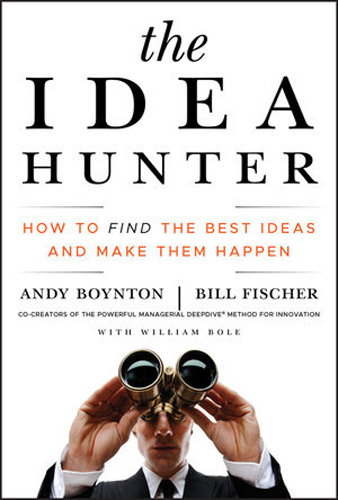
Have you ever wondered to yourself (like I did): how do the world’s great entrepreneurs and innovators come up with such unique and brilliant ideas for their businesses? Then this book, The Idea Hunter, a very recent read of mine, is what I will recommend for you.

Ideas rule the world. In fact, the global space runs on an idea cum knowledge economy. It is on this premise that the book was written and it serves to bust the myth that brilliant, earth-shaping, and career-boosting ideas come from brilliant minds. Rather, it seeks to reveal that breakaway ideas come to those who are in the habit of looking for them all the time. These people are referred to as Idea Hunters.

In this book, I learned about how and what it takes for people to create a superb idea that leads to the creation of a successful innovation through the description of the characteristics and behaviors of several successful idea hunters. The Idea Hunter informs and unearths the habits shared by many great innovators and inventors of the past century. From very popular innovators such as Thomas Edison, Walt Disney, Warren Buffet, Steve Jobs etc., to less popular names such as Jack Hughes, Paul Romer, Jim Koch, Greg brown Jay Hooley, Michael D White etc., readers get a raw perception into how they developed their ideas and the steps they took to bring them into reality. What I find most interesting is how several top global brand/companies such as Apple, Walt Disney, Gore-tex, Elixir Strings, and Boston Beer, among others, came into being through a simple albeit conscious act—the serious business of Idea Hunting.

This is quite an average volume consisting of six chapters, and I can tell you that each of the chapters is a goldmine deposited with wisdom on how to generate and actualize ideas.


The Idea Hunter: How to Find the Best Ideas and Make them Happen by Andy Boynton, Bill Fischer, William Bole. Wiley, April 2011.

Reviewer bio: Bright Heaven’s is an educator, a writer, poet, author, public speaker, information scientist, and a budding musician from Nigeria. He has publications in the Korea-Nigeria Anthology and several Association of Nigerian Authors (ANA) literary journals. Find him at: https://bright-heavens.site.live.

Buy this book through our affiliate Bookshop.org.
The Gettysburg Review – 33.4

The Autumn issue of The Gettysburg Review is out. The issue features paintings by Jared Small, fiction by Jennifer Anne Moses, Jared Hanson, Darrell Kinsey, and Sean Bernard; essays by Andrew Cohen, K. Robert Schaeffer, and Christopher Wall; poetry by Jill McDonough, Max Seifert, K. A. Hays, Albert Goldbarth, Mary B. Moore, R. T. Smith, Jill Bialosky, Katharine Whitcomb, Corey Marks, Kimberly Johnson, Margaret Ray, Danusha Laméris, Linda Pastan, Christopher Bakken, Christopher Howell, and Margaret Gibson.

The Adroit Journal – May 2020

The May 2020 issue is here with poetry by Jenny George, Arthur Sze, Jessica Abughattas, Melissa Crowe, Jamaica Baldwin, C.X. Hua, Kara van de Graaf, Hala Alyan, Mark Wunderlich, Raymond Antrobus, Stephanie Chang, and more; prose by Scott Broker, Alyssa Proujansky, Maura Pellettieri, and Mina Hamedi, with a prose feature by Dima Alzayat. See what else the issue has in store for you at The Adroit Journal website.

Emi Nietfeld Investigates Her Past

Magazine Review by Katy Haas

Opening the Spring 2020 issue of Boulevard is the winner of the journal’s 2019 Nonfiction Contest for Emerging Writers: “My Mom Claims I Had a Drink with My Rapist. I Investigate.” by Emi Nietfeld.

In this piece, Nietfeld looks back to June 28, 2010 when she was raped while in Budapest and to the conversations she had with her mother immediately after and eight years later about the incident. This investigation focuses on the drink that Nietfeld did or didn’t have and the influence the drink had on her mother’s reaction to the rape.

Nietfeld breaks the piece up into sections, investigating in-person conversations, emails that were sent in 2010, and her old computer documents. After she presents the “evidence,” she breaks it down and discusses it. I found this approach to be interesting and impactful as she turns a critical eye on past conversations, her memory, and her relationship with her mother.

Not only is this piece a strong start to the issue, but it demonstrates why Nietfeld deserves to have won the Nonfiction Contest for Emerging Writers.

Zone 3 – Spring 2020

The issue of Zone 3 includes poetry by Darius Atefat-Peckham, Colin Bailes, Brian Bender, Daniel Biegelson, Christopher Citro, Lynn Domina, Alexandria Hall, Lauren Hilger, Angie Macri, Martha McCollough, A. Molotkov, Kell Nelson, Amy Seifried, Pui Ying Wong, and more; fiction by James Braun, Janice Deal, Tammy Delatorre, Maura Stanton, and Terry Thomas; nonfiction by Rebecca McClanahan, Katherine Schaefer, and William Thompson, and art by Khari Turner.

AGNI – No 91

With AGNI #91 we welcome a roster of new editors. Collectively chosen work explores impending crises as well as acts of mitigating goodness; elegies marking losses sit side by side with expressions flashing pure surprise. Cover and portfolio artist Christopher Cozier captures the sly globalized vectors of use and misuse, tracing a long history forward to now. Poems by Sandra McPherson, Steven Sanchez, Emily Mohn-Slate, Colin Channer, and others offer the sensory grab of the immediate, as do stories by Shauna Mackay, David Crouse, and Aurko Maitra and essays by Debra Nystrom, Jiaming Tang, and Ann Hood.

Explore Your Wild at the Elk River Writers Workshop

2020 Elk River Writers Workshop FlierThe Elk River Writers Workshop embodies the idea that deep, communal experiences with the wild open the door to creativity. We bring together some of the most celebrated nature writers in the U.S. with students who are serious about fostering a connection with the environment in their writing, all under the big Montana skies. Rolling application deadline. Offering full refunds for coronavirus-related cancellations. elkriverwriters.org

View the full May eLitPak newsletter here.

2020 Chesapeake Writers’ Conference: Words. Water. Woods: Write on the River.

Spend the first week of summer on the St. Mary’s River! The 9th Annual Chesapeake Writers’ Conference offers an immersive experience featuring daily workshops with accomplished faculty in fiction, poetry, creative nonfiction, and songwriting; a diverse schedule of craft talks, lectures, panels, and readings; a youth workshop for high school students; and a Teachers’ Seminar for educators. All levels welcome. www.smcm.edu/events/chesapeake-writers-conference/

**They are monitoring the current situation and are optimistic they will be able to host the June conference as planned. A final decision will be made this month.**

View the entire May eLitPak newsletter here.

Sponsor Spotlight: Litowitz Creative Writing Graduate Program, MFA+MA

Northwestern University Litowitz MFA+MA logoThis new and distinctive program offers intimate classes; the opportunity to pursue both creative and critical writing; close mentorship by renowned faculty in poetry, fiction, and creative nonfiction; and three fully supported years in which to grow as writers and complete a book-length creative project. Our curriculum gives students time to deepen both their creative writing and their study of literature. Students will receive full financial support for three academic years and two summers. Both degrees—the MFA in Creative Writing and the MA in English—are awarded simultaneously at graduation.

Program faculty include Chris Abani, Eula Biss, Brian Bouldrey, John Bresland, Averill Curdy, Sheila Donohue, Stuart Dybek, Reginald Gibbons, Juan Martinez, Shauna Seliy, Natasha Trethewey, and Rachel Jamison Webster.

Sponsor Spotlight: University of New Hampshire MFA in Writing

University of New Hampshire logoThe MFA Program at the University of New Hampshire has a clear goal: to help you mold your gifts and passion for the art and to prepare you for the opportunities and demands that all writers will experience in a long career. What happens to you after you leave this program—how you will sustain yourself and your work—is one of our strongest concerns. This supportive community of students and faculty shares a belief that writing matters and that the best books of fiction, poetry, and nonfiction are made out of both the creative imagination and rigorous work.

Focus on fiction, narrative nonfiction or poetry in our graduate M.F.A. program, which has launched the careers of hundreds of poets, novelists, storywriters, essayists and memoirists. What is notable is not just how hard students work on their own creative writing, but how much effort goes into their response to the work of their peers. Writers here care deeply about each other, and the production of honest work that captures life on the page.

A Quick Yet Powerful Read

Magazine Review by Katy Haas

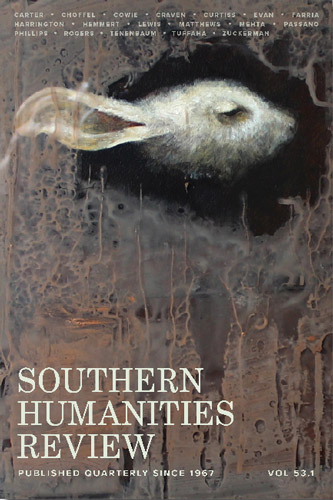
In the Spring 2020 issue of Southern Humanities Review, Heather Corrigan Phillips dives into the use of language in “A Scattershot Approach.” Broken up into different sections, this piece looks at the idioms and metaphors relating to gunfire that English uses. Each section is a different phrase or word.

This nonfiction piece looks at a span of time immediately after the Sandy Hook Elementary School shooting. Her brother-in-law was a first responder at the school that day and we learn about him and the way his health and family were impacted. Phillips writes about this while living out of the country and learns more in spurts through Skype and phone calls, and readers subsequently learn about this in similar ways. Little bits of his story are revealed and then explorations of gun-adjacent language is placed in between.

Reading this really does bring to light the amount of idioms and metaphors that we use which relate back to guns, and this only scratches the surface. There are plenty more that weren’t included. We’re lead to question why this language is so prevalent while also seeing into the lives of humans who have gone through a traumatic event. Here is the perfect balance of fact and emotion, a quick yet powerful read.

Only Nature Reveals Our True Colors

Guest Post by Helen Zapata

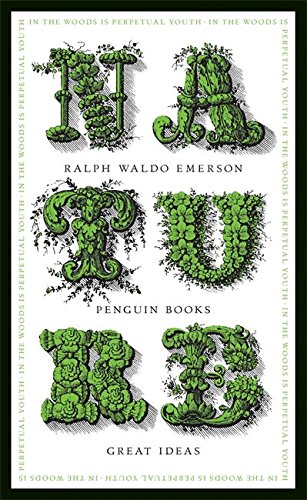
“. . . all natural objects make a kindred impression, when the mind is open to their influence.”Nature, Ralph Waldo Emerson.

This is a powerful essay filled with complicated sentences that I had to read over and over again to make sense (and make some justice) to the real meaning behind Emerson’s Nature.

Emerson was in love with nature and for him, we need to truly look at it, observe it, respect it, and acknowledge that nature and humans are the same. Although at times this seemed a little too philosophical for me, I still felt related to this beautifully portrayed subject.

Through every stage that divides this book, Emerson describes nature as the only mirror in which humans should trust, the same one that represents our behavior, personal relationships, and the way we communicate with each other.

There is a chapter regarding language and its links to nature that reminds me of an Intro to Linguistics class, but with a little less theory and a lot more of spirituality. “Language” sums this essay perfectly and makes you really think about the way the earth gives us everything we need to exist, even in the early stages of our lives.

I guess by the time he wrote this essay, grammatical structure and syntax were different than they are now and that definitely adds another layer of complexity. But I also think that the way he built the relationship between men and nature couldn’t be phrased in any other manner.


Nature by Ralph Waldo Emerson. Penguin Books, September 1995.

Reviewer bio: I’m Helen Zapata, a freelance copywriter and editor specialized in independent digital publications.

Buy this title on Bookshop. Disclosure: NewPages earns a commission from any title purchased through our profile.

Valley Voices – Spring 2020

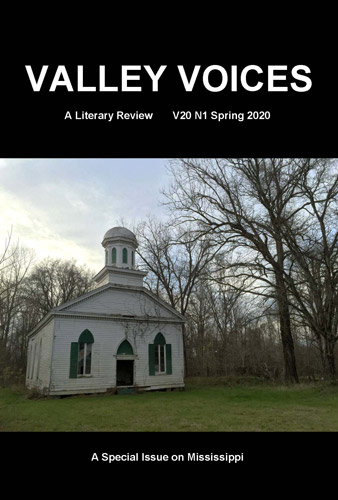
Visit this special issue on Mississippi. Poetry by George Drew, Jerry W. Ward Jr., Diane Williams, Charle R. Braxton, Kalamu ya Salaam, Angela Ball, Annette C. Boehm, Allison Campbell, Kendall Dunkelberg, and more; articles by John J. Han, Junying Jia, William Ferris, and Cassie Osborne Jr.; nonfiction by Hermine Pinson, Joseph Holt, and Kevin Baggett; and interviews with George Drew and Bennie Mae Fortune Harper. Plus, six book reviews.

Plume – May 2020

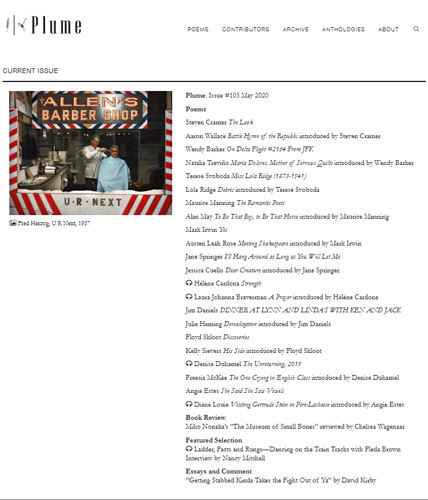
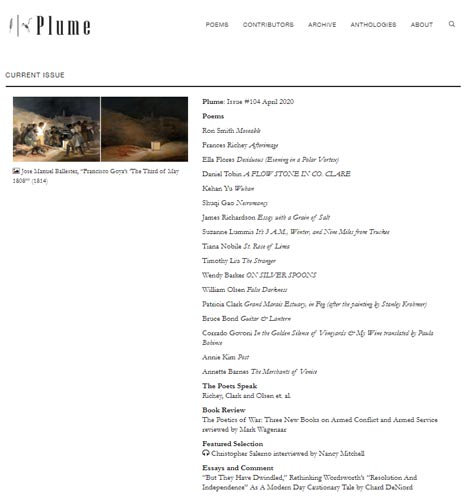
This month’s Plume Featured Selection includes work by and an interview with Fleda Brown. In nonfiction, David Kirby writes “Getting Stabbed Kidna Takes the Fight Out of Ya.” Chelsea Wagenaar interviews The Museum of Small Bones by Miho Nonaka. This month’s poetry selections include Steven Cramer, Terese Svoboda, Mark Irwin, Floyd Skloot, Denise Duhamel, Angie Estes, and more.

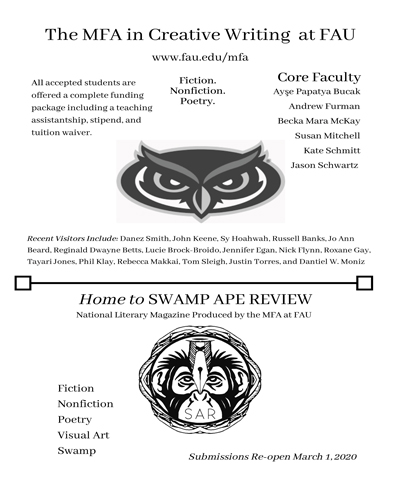
The MFA at Florida Atlantic University

Florida Atlantic University MFAFlorida Atlantic University’s MFA program offers concentrations in fiction, creative nonfiction, and poetry. All accepted students are offered a complete funding package including a teaching assistantship, stipend, and tuition waiver. Core faculty include Ayşe Papatya Bucak, Andrew Furman, Becka Mara McKay, Susan Mitchell, Kate Schmitt, and Jason Schwartz. Students have the opportunity to work on national literary magazine Swamp Ape Review.

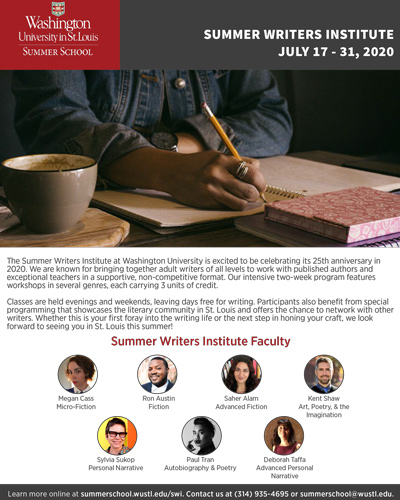
Event :: Summer 2020 Writers Institute at Washington University in St. Louis

They are monitoring the current situation, but are hopeful the Summer Writers Institute will be able to happen as planned. This annual event brings together many of St. Louis’ finest writers to share their expertise with students who are serious about developing their writing. This year celebrates their 25th anniversary. The Institute is an intensive two-week program featuring workshops in fiction, micro-fiction, poetry, and personal narrative. Deadline to register is July 16. The Institute will run July 17 through 31. summerschool.wustl.edu/summer-writers-institute

Earn Your MA Near Some of the Country’s Best Beaches

Earn your MA with an emphasis in Creative Writing in the vibrant city of Mobile, near some of our country’s best beaches. Tuition waivers and assistantships are available as are additional scholarships for excellence and summer creative writing projects. Home of the Stokes Center for Creative Writing. Students who enroll in the program full time, can complete it in four semesters. There are also part time and evening coursework options. For more information, visit our website: www.southalabama.edu/colleges/artsandsci/english/.

The Common- Spring 2020

The Common - Spring 2020

The Common’s Spring 2020 issue released today. Inside the issue: an Arabic Portfolio from Sudan with work by Andel-Ghani Karamalla, Ishraga Mustafa Hamid, Bwader Basheer, Jamal Aldin Ali Alhaj, Mustafa Mubarak, and more. Also in this issue is fiction by Thoraya El-Rayyes, Catherine Buni, Bina Shah, and others; essays by A. Kendra Greene, Suraj Alva, and Tanya Coke; and poetry by January Gill O’Neil, Emily Leithauser, Megan Pinto, Mira Rosenthal, Tara Skurtu, John Freeman, marcus scott williams, and more.

Able Muse – Winter 2019

In this issue, find essays by Edward Lee and Tony Whedon; a photographic exhibit from artists around the world on the theme “Hunt”; poetry by Daniel Galef, Len Krisak, Katie Hartstock,  Hailey Leithauser, and more. Featured in this issue are the 2019 Write Prize for Poetry winners and finalists and the 2019 Write Prize for Fiction Winner. Find a full list of contributors at the Able Muse website.

A Multilayered Achievement

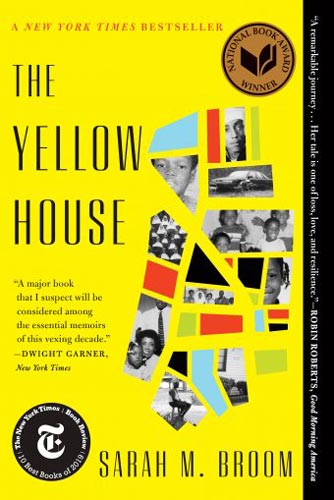
Yellow House by Sarah BroomGuest Post by Andrea Roach

I am reading Sarah M. Broom’s The Yellow House, a memoir about generations of family and place (New Orleans, pre & post-Katrina, and their family homes). One of the things that I like about this book is the artful way the author brings the reader into what could be an extremely confusing story, with so many characters and the landscape of New Orleans, by initially laying it out like a map: this is where my neighborhood and my house fit into the history of NOLA, and here’s a blueprint of my relatives leading to me. She refers to Katrina as The Water and so, like the Yellow House, makes it its own complicated character. It’s a multilayered achievement that connects history, politics, race, culture, disaster, and identity, while also telling the ways in which we become our homes and our homes become us. I’d recommend!


The Yellow House by Sarah M. Broom. Grove Press, August 2019.

Reviewer bio: Andrea Roach is a writer of memoir, essays, and creative nonfiction. She received her MFA in Creative Writing from Lesley University and was a finalist for The Writer’s Room of Boston Fellowship Award.

Buy this book through our affiliate Bookshop.org.

Leading Readers Back Into the Sun

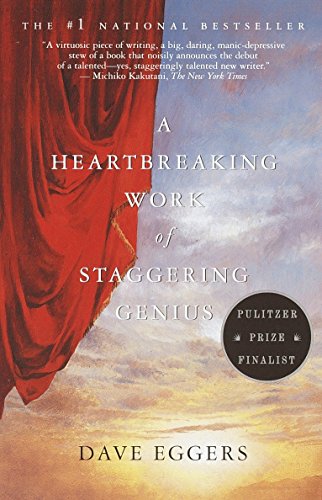
A Heartbreaking Work of Staggering Genius by Dave EggersGuest Post by Kelsey Owen

Lately, I’ve been finding solace in rereading A Heartbreaking Work of Staggering Genius by Dave Eggers. Written to be read like a novel, Eggers’s genre-splicing memoir follows him through becoming a parent by proxy to his eight-year-old brother after the sudden losses of both parents.

What’s so enduring about this book is how, on the surface, Eggers embodies the pessimism and acid-reflux-irony of postmodernism, but he swiftly and frequently undercuts his own nihilism by exalting the constructive power of familial bonds and solidarity between characters—or, real people. Character-ish people. The narrative style itself draws on the ironic, self-aggrandizing voices of writers like David Foster Wallace, sharing the same undercurrent of desire to locate and create meaning in the seemingly vapid and obscene.

Eggers’s competing aspirations to distinguish himself from others and assimilate into something greater than himself makes his journey both intense and darkly humorous, but Eggers’s often last-minute refusals to abandon the silver-lining, his enduring sentimentality amid existential and physical destitution, never fail to lead you back out into the sun.


A Heartbreaking Work of Staggering Genius by Dave Eggers. Vintage, February 2001.

Reviewer bio: Kelsey Owen is an editorial assistant at Under the Gum Tree.

Buy this book through our affiliate Bookshop.org.
Shocking, Elegiac, Revelatory

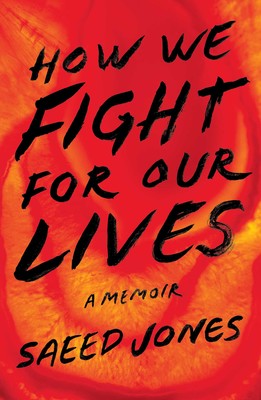
How We Fight for Our Lives by Saeed JonesGuest Post by Evan White

I’ve been reading the memoir How We Fight for Our Lives by Saeed Jones. What I like about the book is this: the story of a young, gay black man growing up in the south could go any number of expectedly tragic ways. And in the hands of a lesser writer, a story like Jones’s might have fallen prey to the unrelenting misery that is so often a substitute for poignancy. As it stands, however, How We Fight for Our Lives clips along without stopping to cry, and it’s this clear-eyed observation—this cataloguing of experience, and, by implication, the self—that makes Jones’s story by turns shocking, elegiac, and revelatory. Plus, he’s funny.


How We Fight for Our Lives by Saeed Jones. Simon & Schuster, October 2019.

Reviewer bio: Evan White is a graduate of the University of California, Davis. White co-founded Absurd Publications and published the anthology, All the Vegetarians in Texas Have Been Shot, in addition to the creative journal The Oddity.

Buy this book through our affiliate Bookshop.org.

Every Cloud Has A Silver Lining

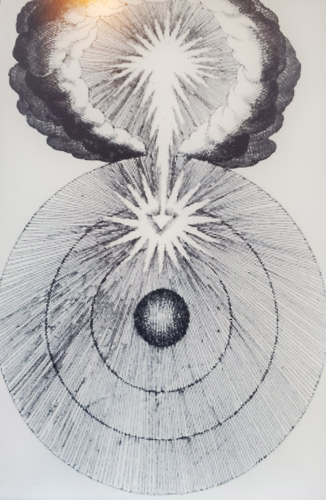
Cloud Upon the Sanctuary by Karl von EckartshausenGuest Post by Katie Anderson

The Cloud Upon the Sanctuary is a beautifully written series of letters about the evolution of humankind published in 1793. Karl von Eckartshausen describes the “mystery of the New Man” as the synthesis of an alchemical union between man and spirit, or man and God. This transformative art he explains must occur as the mystery teachings from ancient Greece, through a series of stages. This formula espouses an evolution of knowing thyself outwardly, then inwardly.

Eckartshausen illustrates the formula for the transformative art as one that confers wisdom at successive levels, but not as an undertaking belonging to an elite group. He had envisioned it as a spiritual pursuit that the whole of humankind would enter, not a secret practice known only to men in the lodges and salons of the eighteenth century. Eckartshausen uses biblical symbolism and allegory to express the philosophy of an esoteric spiritual counsel 55 years before the advent of Spiritualism and 102 years before Theosophy. This “interior community of light” in union with humankind, produces the illuminated community. Two archetypes embody the exoteric and the esoteric, the Priest and the Prophet, whose union produces the archetype of the illuminated man.

People are looking towards traditional and alternative forms of spirituality to find inner peace of mind. This is in response to the constraints of shelter orders and social distancing measures in place to cope with the Covid-19 pandemic. Quarantine has stripped away human social interaction, but it also has dissolved our illusions. We’re no longer comfortably numb. When there isn’t anyone to talk to, we listen to the silence and talk to ourselves. What might we learn in the interim?


The Cloud Upon the Sanctuary by Karl von Eckartshausen, edited by Isabel de Steiger. William Rider & Son, Ltd, 1909.

Reviewer bio: Katie Anderson is a historian and writer living in Troy, Missouri.  Her work has appeared in Eternal Haunted Summer and The Far Shining One.

Wordrunner eChapbooks – 2020

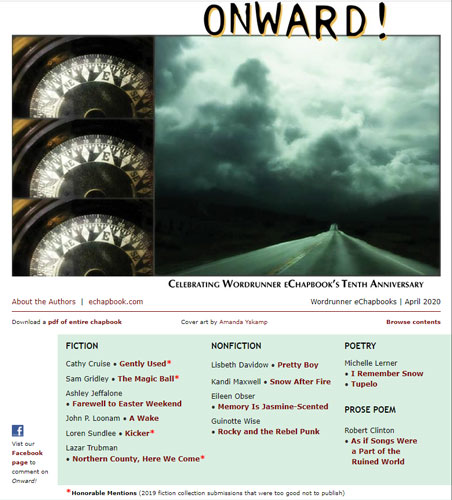
Wordrunner eChapbooks - April 2020

The title and cover art for Wordrunner eChapbook‘s 2020 anthology reflect a future more uncertain than usual, as well as hopefulness as we intend to publish more excellent writing in the next decade. Fiction by Cathy Cruise, Sam Gridley, Ashley Jeffalone, Lazar Trubman, and more; nonfiction by Lisbeth Davidoff, Kandi Maxwell, and others; poetry by Michelle Lerner and a prose poem by Robert Clinton.

Books from the Past Warning Us of the Present

Hot Zone by Preston & Blood Work by TuckerGuest Post by Leland Davidson

As COVID-19 has ravaged this world effecting many emotionally and physically, the emotions of how governments are handling are telling as well. Two books show a serendipitous attitude we are dealing with today as a society, while also showing history repeating itself.

One of these is The Hot Zone by Richard Preston, which gives a in depth story and research on Ebola. The book is based around different stories detailing where it came from, how it spread, and close call to a pandemic that almost ravaged the United States. What makes this book so chilling are the stories that took place in the 1980s and 90s in the continent of Africa and United States, but are detailed examples of what we are seeing today. These stories range from the beginning of the disease’s origins showing how messing with nature can cause a pandemic, or how nonuse of safety measures will help spread the disease. This book is a chilling narrative of how history, disease, and panic is not new, which should be a lesson for all.

Blood Work: A Tale of Medicine and Murder in the Scientific Revolution by Holly Tucker details the history of blood transfusion in England and France in the 1600s, going into detail of its history and the people involved in its transformation. Showing medical science experiments of the time may seem crazy today, but it is still relevant in modern thinking. With current news stories of people selling snake oils or ways to cure COVID-19, we see similarities in the core belief of the time that blood from a cow transfused with a sheep will make a monster. The book shows how scientific, political, and religious clashes of the 1600s mimic today’s clashes. Tucker details the narrative that stopping science and medical experiments will not only stop breakthroughs but keep humans in the dark instead of forward thinking to a better life.


The Hot Zone by Richard Preston. Penguin Random House, June 1999.
Blood Work: A Tale of Medicine and Murder in the Scientific Revolution by Holly Tucker. W. W. Norton & Company, May 2012.

Reviewer bio: Leland Davidson, a native of East Tennessee, holds an M.A. in Conflict Resolution and Coexistence from Heller School at Brandeis University, 2020.

Buy this book through our affiliate Bookshop.org.
Valuable Tool for Activists

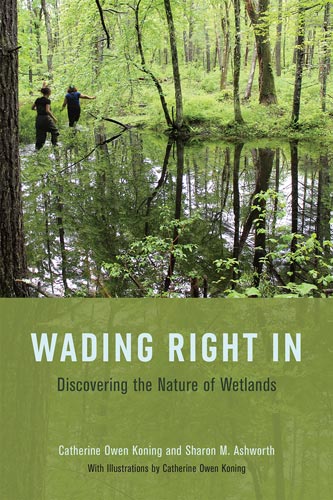
Wading Right In by Catherine Owen Koning and Sharon M. AshworthGuest Post by Richie Swanson

Ever dreamt of saving turtles squashed on highways? Of creating clean water and carbon sequestration? Of undoing the havoc humanity has wrought upon nature? Then read Wading Right In. It interprets crucial science for the layman and sometimes reads like a novel, depicting wetland-loving characters irrepressibly driven to protect nature. Some wetland lovers save and incubate eggs from road-killed diamondback turtles and release hatchlings into the wild. Another knocks on doors with a rare spadefoot toad in hand and convinces a landowner to conserve its habitat. Another invents tidal gates made of olive barrels to restore a city’s impounded (and dying) saltmarshes. Others restore an eroding island, unloading 500 barges of sand and gravel by hand, growing their own native vegetation and enlisting 350 ninth graders to help plant a shoreline.

The wetland-loving scientists present themselves with humor. One describes sinking into freezing mud in the dark until a professor pulls her out. The book reveals nature’s genius: a fishing spider the size of a human hand has a waxy coating and hairs on legs that allows it to zoom through water as it turns prey five times its weight into “a sushi smoothie.” Wetland plants create their own air pipes and oxygen pumps, and beavers build mud piles and secrete scents that enable other beavers to know their nutritional health and kinship connections.

Authors Ashworth and Koning discuss the science of ecosystem services to assess mitigation, the legal process of compensating wetlands loss in one place by creating wetlands in another. The assessment involves water filtration, flood control, carbon storage, shoreline protection and species diversity—not dry details but valuable tools for activists. This book inspired me as much as Aldo Leopold and Rachel Carson.


Wading Right In: Discovering the Nature of Wetlands by Catherine Owen Koning and Sharon M. Ashworth. The University of Chicago Press, August 2019.

Reviewer bio: Richie Swanson’s novel First Territory depicts the Yakama War 1855-56. His short stories about Indian-white relations and bird-related nonfiction are republished from journals at richieswanson.com.

Buy this book through our affiliate Bookshop.org.
Traveling the World While at Home

Guest Post by June Calender

While “sheltering in place,” I’m taking a serious look at the natural world through what I’m reading.

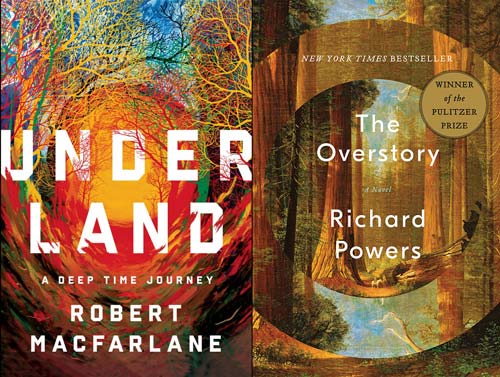
I began with Robert Macfarlane’s nonfiction Underland which explores the world of fungi and root systems under forests then goes much, much deeper in caves all over the world. I am a claustrophobic and had many breathless moments but survived with a sense of awe.

That was followed by Richard Powers’s novel, The Overstory, which is about old growth forests and people trying to save them.

Trapped in my apartment, I have still been able to see many parts of the world in depth.


Underland: A Deep Time Journey by Robert Macfarlane. W. W. Norton & Company, June 2019.
The Overstory by Richard Powers. W. W. Norton & Company, April 2019.

Reviewer bio: June Calender retired to Cape Cod after 20+ years as an off-off-Broadway playwright in NYC. She now teaches writing skills at the Academy for Lifelong Learning at Cape Cod Community College. Her work has been published in various small journals.

Buy The Overstory and Underland: A Deep Time Journey through our affiliate Bookshop.org.
Inside The Ring

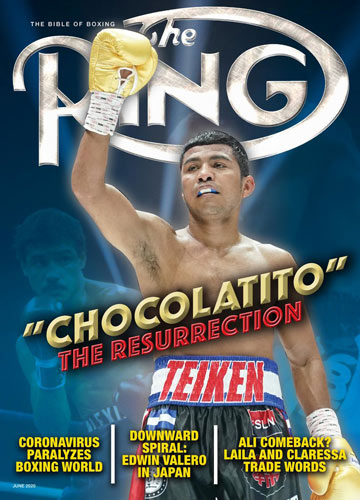
The Ring - April 2020Guest Post by Andrew Rihn

This month’s issue of The Ring magazine (“The Bible of Boxing”) straddles what has come to feel like two very distinct, almost distant, time periods. It arrived two days ago but, given the timeline for magazine publishing, most of the issue’s content covers events that happened roughly six weeks ago.

Example: the cover features Román “Chocolatito” González, hand raised in victory after his Feb 29 defeat of Khalid Yafai. Example: Robert “The Nordic Nightmare” Helenius is deemed “Fighter of the Month” for his upset over rising star Adam Kownacki on March 7.

I savor this issue of The Ring with a hastily cultivated sense of nostalgia; so much distance between that March to this April. Locked down in Ohio, it feels like time is telescoping away, these fights from another world, another life. Didn’t I just have friends over to watch Helenius vs Kownacki? Didn’t we share a pizza? Sit next to each other on the couch? How long ago was that?

There is some coronavirus coverage as well. An article titled “Standstill” opens with an arresting photo of an amateur bout being held in an empty stadium. And in “Voices from the Outbreak,” various fighters comment on how shutdowns and fight cancellations have upended their lives. “This is a time when we shouldn’t be talking about ‘We miss boxing,’” says recent Hall of Famer Bernard Hopkins. “This is a time we have to re-evaluate our good deeds and evil deeds.”

Known for responding to short questions with passionate, sometimes drifting monologues, Hopkins continues: “Ask someone you love how they’re doing. Ask someone about their dog.”


Reviewer bio: Andrew Rihn wrote Revelation, a book of poetry about Mike Tyson. He also writes The Pugilist, a monthly boxing column with a literary edge.

Ijeoma Oluo’s Call to Action

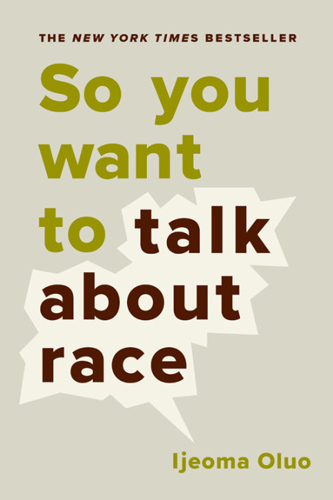
So You Want to Talk About Race by Ijeoma OluoGuest Post by C.L. Butler

Have you ever read a book and felt that it was actually a call to action? I have been fortunate enough to be able to take refuge in art while social distancing. I’ve read a variety of different books written by authors ranging from Ta-Nehisi Coates to Bram Stoker. One book that stood out to me was Ijeoma Oluo’s So You Want to Talk About Race. Oluo tells of her personal experiences as not only a Black woman, but also a queer woman, single mother, middle class, biracial feminist. I found this intersectional approach to be a metaphoric glass of ionized water. It’s the refreshing kick in the ass that society needs in order to come to terms with progress.

By adopting a multilayered intersectional lens, Oluo allows the reader to fully explore numerous alternate perspectives beyond their own. Oluo asserts that societal norms and social constructs including, but not limited to, patriarchy, misogyny, and heteronormativity dictate the world around us. In reading the book, I felt that the author had a true understanding that these topics are uncomfortable which provides an authentic vulnerability rather than a purely academic narrative.

Oluo provides a conversational manual for all backgrounds. She also owns her personal privileges throughout the book. Her work challenges skeptics to not only hear, but also feel her point of view. After reading So You Want to Talk About Race my eyes were opened even wider. We all need the dosage of reality that Oluo offers being a queer female of color.

So You Want to Talk About Race is the perfect read and cultural model for a 21st century audience. This book illuminates the aspects of patriarchy running rampant throughout various institutions. I highly recommend to it anyone looking to do more for inclusion.


So You Want to Talk About Race by Ijeoma Oluo. Seal Press, January 2018.

Reviewer bio: C.L. Butler is an African American poet, historian, and entrepreneur from Philadelphia based in Houston, TX. In 2017 his poem ‘Laissez Faire’ was published by the University of Houston-Downtown Bayou Review. In 2019 he published academic research with the Journal of International Relations & Diplomacy.

Buy this book through our affiliate Bookshop.org.
Tangible Acts of Resistance

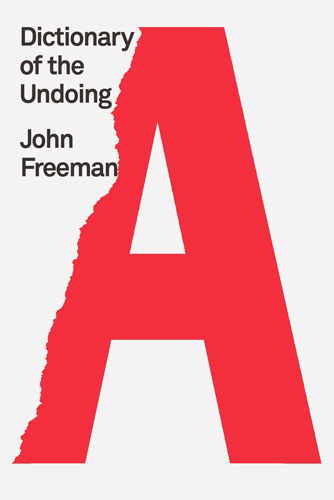
Dictionary of the Undoing by John FreemanGuest Post by RS Deeren

John Freeman’s Dictionary of the Undoing, a collection of twenty-six alphabetical short essays, is a reclamation project, collating a “lexicon of engagement and meaning” for progressive political protest. Freeman sees language as “the one tool being vandalized before our very eyes” in the news, on social media, and in public spheres. Starting with “Agitate” and charging through words like “Citizen” and “Hope,” Freeman highlights the ways in which the meanings of single words have been split, twisted, or ignored until they are either used against us, like in the section “Police,” or until they lose much of their power, a notion present in the section “Vote.” Of particularly high import in a book filled with immediacy, are the sections on “I” and “You.”

In “I,” Freeman tackles the internet as used today: to promote and protect an image of ourselves, to ensconce the self, through algorithms and polishing of persona. The phone resembles a mirror and our capacity for seeing the world beyond the mirror, of hearing voices outside the echo chamber, has severely limited our compassion for one another. Freeman argues that this curation of the individual “I” keeps us from becoming a much more powerful “we” capable of bringing about social change. This pitting of my “I” against your “I”, keeps us fighting among ourselves and not against the powerful and wealthy who benefit from our infighting.

In “You,” the penultimate call-to-kindness, Freeman directs a challenge plainly to You, dear reader, to engage in “one act of resistance in the form of love . . . without restriction.” Freeman echoes the “I” section here, stating that to connect through kindness is a tangible act of resistance against a society that sells us an idea of the “I” who stands on their own.


Dictionary of the Undoing by John Freeman. Farrar, Straus and Giroux, November 2019.

Reviewer bio: RS Deeren received his BA from Saginaw Valley State University, his MFA from Columbia College Chicago, and is a PhD candidate at UW- Milwaukee. You can read his creative work at www.rsdeeren.com.

Buy this book through our affiliate Bookshop.org.
Graphic Nonfiction for Everyone

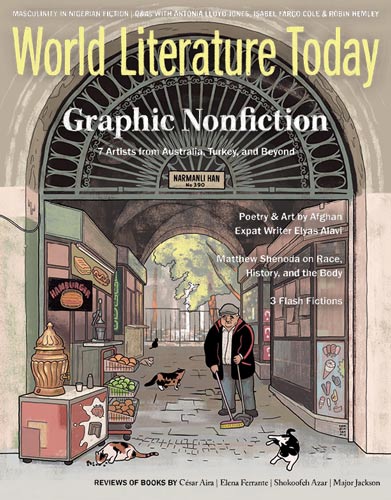
World Literature Today - Spring 2020

Magazine Review by Katy Haas

A big fan of graphic novels (and nonfiction and poetry), I’m always thrilled when a literary magazine releases an issue featuring graphic work. World Literature Today’s Spring 2020 issue features a selection of graphic nonfiction by seven artists.

Each piece brings something different to the table. The art styles are all vastly different and each focuses on something unique: politics, history, art, ego, love.

My favorite of these is “Shadow Portrait” by Rachel Ang. Ang’s art is calming and enjoyable to look at, muted tones splayed across the page. She writes of love and ego, the ways in which we see ourselves in art, in stories, in the people we love.

On the opposite end of the spectrum is an excerpt from Guantanamo Voices: True Accounts from the World’s Most Notorious Prison by Sarah Mirk, illustrated by Omar Khouri. Unlike Ang’s calming tones, this excerpt uses bold lines and an orange color scheme which ramps up the feeling of anxiety the story produces. I’m a little disappointed at the length of the excerpt—the four pages we’re given leave on a cliffhanger that left me wanting more, though I suppose that just highlights the writer’s and artist’s skill.

This selection of graphic nonfiction has a little bit of something for everyone, and each artist/writer utilizes their craft impressively. This issue of World Literature Today is a real treat to read.

Take Risks with Adam Grant

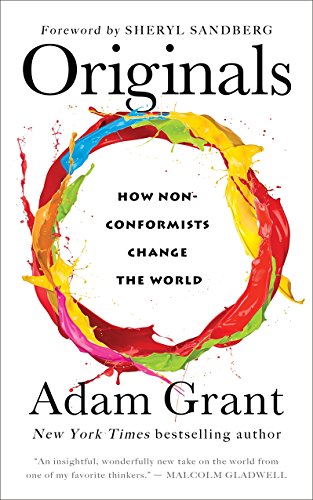
Originals by Adam GrantGuest Post by Alicia Wilcox

Adam Grant’s Originals: How Non-Conformists Move the World gave me a powerful new outlook on not only my abilities, but my untapped potential. Grant explains how big thinkers are not just the ones with big ideas, but the ones that take action. Reading this has not only changed the way I think, but the way I act. This book has helped me challenge the norm and foster innovative ideas, as well as getting others to believe in those ideas too.

Surprisingly, risk taking can make your career less fragile. Grant dives into the art of taking risks and challenging the status quo, giving a conclusive guide on transparently communicating and ensuring trust from others along the way. He busts the myths that hold us back from success and goes deep into the paradox: the ones who suffer most within a system are the least likely to challenge it. You can have talent and work ethic, but you have to be original for your ideas to win. How do we create original ideas? Grant shares his secrets on how to defeat perfectionism and produce a large volume of ideas to not only be seen by others, but also utilized for the better.

Originals is a five-star read, giving readers a sturdy foundation for how to embrace change and achieve success in a multitude entirely divergent atmospheres.


Originals: How Non-Conformists Move the World by Adam Grant. Penguin Random House, February 2017.

Reviewer bio: Alicia Wilcox’s work has most recently been published in The Health Journal, The Dewdrop Weekly and is sold in stores across Manhattan.

Buy this book through our affiliate Bookshop.org.

Lock-Down Pleasures in Recent Reading

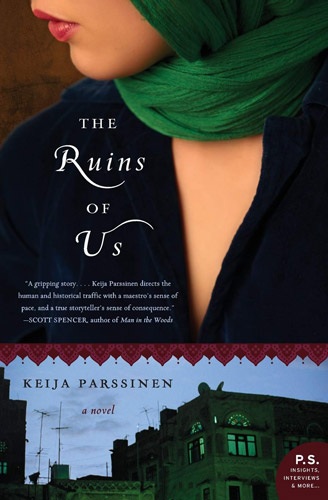
Ruins of Us by Keija ParssinenGuest Post by S.B. Julian

Recently I moved into a new apartment building for people age 55-plus: the generations that grew up with books, not digitalia. Their schooling emphasized reading, which means the building’s shared library is a serendipitous treasure trove.

Why is it that a book you find by chance is often more pleasurable than an equally worthy book you specially ordered? Some delightful chance findings: Continue reading “Lock-Down Pleasures in Recent Reading”

Sniffing Out the Boogeyman

In the Dream House by Carmen Maria Machado

Guest Post by Lily Anna Erb

Carmen Maria Machado creates a dark, dreamlike landscape in her experimental memoir, In The Dream House. Her story of queer domestic abuse, written as a collection of short vignettes, begins as a fairy tale. There’s a monster lurking somewhere, and the desire to sniff out the boogeyman makes you forget you’re even turning pages. Machado’s addition of fairy tale citations adds a semi-lighthearted and humorous touch to an otherwise darker narrative. Machado’s fairy tale monster takes the form of the woman who lives in the “dream house.”

Machado creates a fascinating practice in self-analysis and reader involvement by using all three modes of perspective. She utilizes third person to explain an airy concept, second person to tell the lurid contents of her tale, and first person to speak directly to the reader. The most frequently utilized perspective is the second person, where Machado seems to rip her hand through the spine of the book to touch the reader. Perhaps the most nerve-wracking example of this technique is the section titled “Dream House as Choose Your Own Adventure” where the reader is given multiple choices of action which all lead to the same abusive conclusion.

No matter how fascinating a world Machado can craft, it doesn’t save her from unnecessary pedanticism. The form of the book, utilizing “The Dream House as . . .”  before every vignette quickly loses its original charm. The book seems to drag on unnecessarily long. Once the story loses its driving force of conflict, the reader is ready for it to end. However, these small annoyances did not totally hinder my consumption of Machado’s work. In The Dream House is full of minefields that you don’t expect. By the end of the book, the reader cheers on Machado as she recovers from her time in the “dream house.”


In The Dream House by Carmen Maria Machado. Graywolf Press, November 2019.

Reviewer bio: Originally from New York, Lily Anna Erb is a sophomore studying poetry at Eckerd College in St. Petersburg, Florida.

Buy this book through our affiliate Bookshop.org.

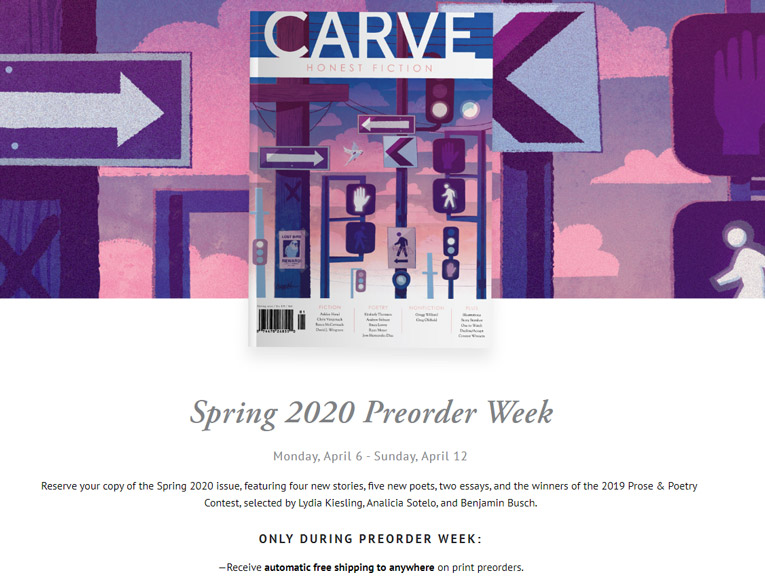
Carve Spring 2020 Preorder Week

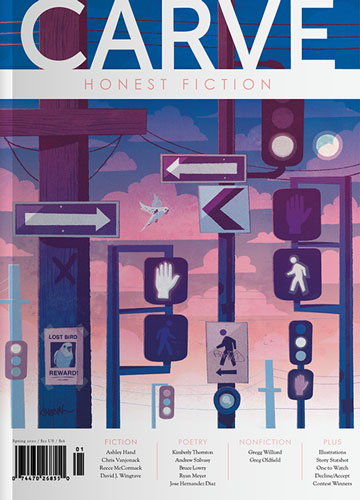
Carve Magazine screenshotThat’s right! This week is the week you can preorder Carve Magazine‘s Spring 2020 issue. From now until April 12, you can reserve your copy of the special print edition and receive automatic free shipping to anywhere on print preorders. You also get 15% off a 1-year print or digital subscription. Need more reasons to preorder this issue? It features four new stories, five new poets, two essays and the winners of the 2019 Prose & Poetry Contest selected by Lydia Kiesling, Analicia Sotelo, and Benjamin Busch.

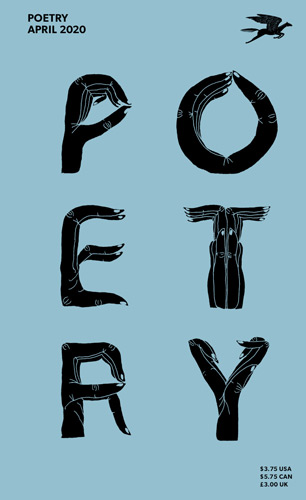
Poetry – April 2020

Poetry Magazine - April 2020

The latest issue of Poetry features work by Michael Hofmann, Martha Sprackland, Harmony Holiday, Pascale Petit, Jeannine Hall Gailey, Gertrude Stein & Bianca Stone, Tishani Doshi, Madeline Gins, Joy Ladin, Emily Jungmin Yoon,Sumita Chakraborty, Katie Pyontek, Sun Yung Shin, Torrin A. Greathouse, Sally Wen Mao, Lucy Ives, Shane Neilson, Nelly Sachs, Ocean Vuong, and more. Plus, an essay by Joy Ladin.

Activities and Insight from James W. Pennebaker

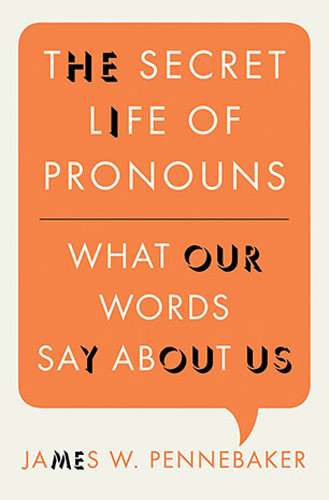
Secret Life of Pronouns - James PennebakerGuest Post by Colleen M. Farrelly

As a lifelong logophile, I’ve found folks who are acerbic, insipid, and (occasionally) inimitable. However, I’d never thought about the his or hers or theirs aspect of life (or the importance of these words) until reading James Pennebaker’s The Secret Life of Pronouns.

By analyzing the words that knit together what I’d assumed were the important words of a sentence, one can learn a lot about the sentence’s writer or speaker—his/her personality, truthfulness, social status, and even future behavior. Pennebaker even includes links to writing activities used to analyze traits described in the book. According to the bottle project, I’m likely to attend art shows and avoid blow-drying my hair (guilty on both counts).

With a fairly low reading level required for the activities sections and insight from disparate fields like psychology, politics, and law, this book offers something for everyone in the family. Happy reading!


The Secret Life of Pronouns by James Pennebaker. Bloomsbury Press, August 2011.

Reviewer bio: Colleen M. Farrelly is a freelance writer in Palmetto Bay, FL, whose poetry has appeared in many haibun and haiku journals.

Buy this book through our affiliate Bookshop.org.

World Literature Today – Spring 2020

World Literature Today - Spring 2020

A special section devoted to Graphic Nonfiction, showcasing seven writers and artists from around the globe, headlines the Spring 2020 issue of World Literature Today. The issue also presents interviews with translators Antonia Lloyd-Jones and Isabel Fargo Cole; new fiction from Italy, France, and the Philippines; essays on Nigerian fiction and the “humanity on display” in museum exhibitions; poetry by Elyas Alavi (Afghanistan), Khaled Mattawa (Libya/US), and Mohamad Nassereddine (Lebanon); and Poupeh Missaghi’s recommended booklist about cities. More than forty book reviews also round out the issue, giving readers a wealth of titles to inspire their spring reading adventures.

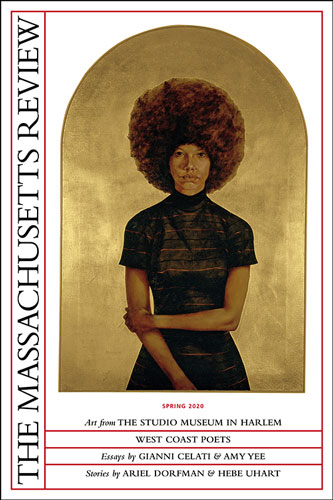
The Massachusetts Review – Spring 2020

The Massachusetts Review - Spring 2020

The Spring 2020 issue includes poetry by Desirée Alvarez, Danusha Laméris, Julie Murphy, Nancy Miller Gomez, Charlie Peck, Cynthia White, Keith Leonard, Augusta Funk, and more; fiction by Sylvia Hanitra Andriamampianina, Karin Cecile Davidson, Tad Bartlett, Gabriella Kuruvilla, Hebe Uhart, Jung Young Moon, and others; and nonfiction by Gianni Celati, Lesley Wheeler, Amy Yee, and Melanie McCabe.

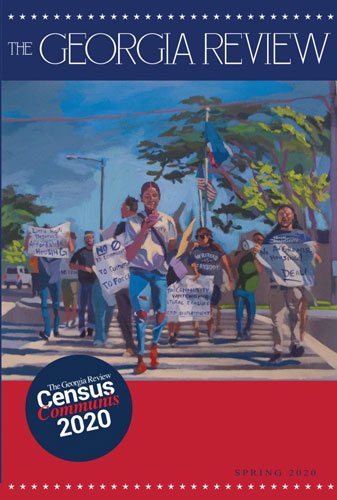
The Georgia Review – Spring 2020

The Georgia Review - Spring 2020

The Georgia Review‘s Spring 2020 issue presents authors’ and artists’ explorations of what it means to attempt representation of the diverse communities that comprise the United States. Special features include “Un-Redacted: A Census of Native Land,” a collection of writings by Native authors on the legacy of settler colonialism in the U.S.; a section on the internment of people of Japanese descent in North America during WWII; and dispatches from an innovative research project on prison labor in the post–Civil War “New South.” Art by Eddie Arroyo.

Colorado Review – Spring 2020

Colorado Review - Spring 2020

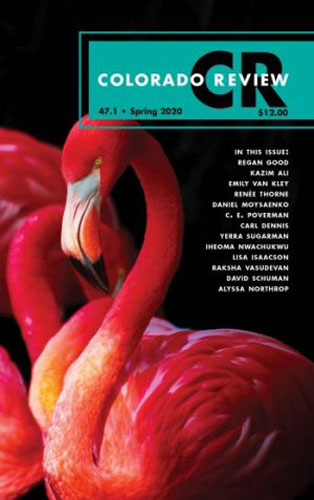
Featured in this issue of Colorado Review, find poetry by Jack Ridl, Amanda Gunn, and Yerra Sugarman; fiction by Alyssa Northrop; and nonfiction by David Schuman. Plus Raksha Vasudevan, Emily Van Kley, Leah Tieger, Gay Baines, Michael Homolka, Kazim Ali, Franco Paz, Laura Kolbe, Angie Macri, Benjamin Seanor, and many more. See other contributors at the Colorado Review website.