Home » NewPages Blog » Page 76

NewPages Blog

At the NewPages Blog readers and writers can catch up with their favorite literary and alternative magazines, independent and university presses, creative writing programs, and writing and literary events. Find new books, new issue announcements, contest winners, and so much more!

Eulogy for a Father

Magazine Review by Katy Haas

At a time when I felt incredibly alone, Ira Sukrungruang kept me company with his collection of essays, Buddha’s Dog: & Other Meditations. I stayed up all night reading it, telling myself I’d just read one more essay and then sleep and before I knew it, the book was finished and dawn was right around the corner. So now when I again feel those nagging feelings of loneliness, I was excited to see he had a new nonfiction piece in the Spring 2020 issue of Crazyhorse to help fill in the spaces around me: “Eulogy for My Father.”

This eulogy is written in short, one-sentence paragraphs that rapidly fall down the sixteen pages they occupy. “Let me start again,” he repeatedly states and follows another thread as he sorts the complicated thoughts and feelings surrounding the relationship he had with his father, his father’s absence, and the ways in which these feelings now echo over his relationship with his son.

The piece is honest and tender, bringing tears to my eyes by the time I reached the end and his final “restart.” It was nice seeing Sukrungruang once again show off his mastery of the nonfiction form. Even sitting with his grief, it was also nice to feel close to something for the moment.

Sponsor Spotlight :: Reunion: The Dallas Review

Reunion: The Dallas Review website screenshotOriginally titled SojournReunion: The Dallas Review is a literary magazine which has been publishing exceptional short fiction, drama, visual art, poetry, translation work, nonfiction, and interviews for over twenty years. Their mission is to cultivate the arts community in Dallas, Texas and promote the work of talented writers and artists both locally and around the world.

Reunion is published by The School of Arts & Humanities, home of the creative writing program of the University of Texas at Dallas. They publish an annual print volume as well as featuring a new piece of work monthly on their website. You can view past interviews with writers on their website as well.

Stop by their listing on NewPages to learn more.

Sponsor Spotlight :: Ohio State University MFA in Creative Writing

The Ohio State University logoMFA in Creative Writing at The Ohio State University is designed to help graduate students develop their talents and abilities as writers of poetry, fiction, and creative nonfiction. Graduate teaching assistants teach special topics undergraduate creative writing courses as well as first-year and second-year writing. Students also have the option to work as editors of the prize-winning literary magazine, The Journal, and to serve on the editorial staff of two annual book prizes.

All students are fully funded for three years in a program well known for its sense of community and a faculty that is committed to teach as much as they are to their own writer. Current faculty includes Kathy Fagan Grandinetti, Michelle Herman, Marcus Jackson, Lee Martin, Elissa Washuta, and Nick White. Recent writers who have visited the program include Tarfia Faizullah, Melissa Febos, Garth Greenwell, Dan Kois, Nicole Sealey, and Danez Smith.

The program also offers special topics in addition to the regular workshops so opportunities abound for students to experiment.

Stop by NewPages to learn more about the program.

Event :: The Poetry Lab offers Submit It Like You Mean It

Event Dates: August 27, October 8; Virtual
Deadline: Rolling
New six-week virtual seminar offered by The Poetry Lab, Submit It Like You Mean It: All You Need to Know to Successfully Submit Poetry for Publication. Reliable, effective submissions strategy with in-depth guidance on cover letters, bio statements, simultaneous submissions, where to submit, how to create a tracking sheet, and much more. Our goal is to demystify the path to publication with practical tools and insider knowledge in friendly environment. Registration fee $85 and includes one-month subscription to Duotrope. Scholarships are available. First session begins August 27. Learn more at thepoetrylab.com/submit-it.

A Vivid Landscape of Sensual Experiences

Guest Post by Chuck Augello

The stories in Death, Desire, and Other Destinations, a new collection by Tara Isabel Zambrano, depict a vivid landscape of sensual experiences ranging from a widowed mother’s kitchen to the surface of the moon. A desire for escape is a recurrent theme. In “Lunar Love,” a couple flies to the moon to exchange their vows. “We have been excited about doing something that everyone we know does these days since they find nothing exciting about the earth anymore,” the narrator says, and it’s a telling line. Daily life, with its expectations and social conventions, no longer excites. Zambrano’s characters seek their pleasures elsewhere, often in the body.

One of the strongest stories is “Up and Up,” in which a daughter interrupts her widowed mother during an intimate moment with another man. While the daughter is shaken, the mother is nonchalant and unapologetic. “It’s a blessing to be alive with no one to answer to,” the mother says, dismissing her daughter’s questions about the neighbors and the memory of the recently departed husband/father. The mother’s new lover, Santosh, soon reappears holding three mangoes, a perfect detail, the succulent fruit signaling the sensual tour-de-force to come. Santosh stands behind the narrator, and a scene that could have been uncomfortable or even creepy becomes a passionate delight, Zambrano surprising the reader with what happens between the characters, her language lush and evocative, the daughter’s “pores opening onto wonder, previous half-baked climaxes and affairs slipping out, my body poured into a new cast.” It’s a moment charged with desire, sexy and emotionally revealing.

The stories in Death, Desire, and Other Destinations are imaginative and unique, Zambrano’s collection the perfect destination for readers looking to escape the doldrums of quarantine and sheltering in place.


Death, Desire, and Other Destinations by Tara Isabel Zambrano. Okay Donkey, September 2020.

Reviewer bio: Chuck Augello is the author of the novel The Revolving Heart and the story collection The Inexplicable Grey Space We Call Love.

The Exploits of Nicole “Nick” Doughty

Guest Post by Lynn Levin

What a thrill it is to read Nola Schiff’s magical, vivid, fast-paced novel A Whistling Girl. Set in Southern Rhodesia in the early 1950s, the story follows the exploits and coming-of-age struggles of a young girl named Nicole “Nick” Doughty.

Smart, daring, and serious, Nick, who hates dresses, is the leader of her gang of kids and eggs them on to all sorts of misadventures. More than that, Nick dreams of befriending the intrepid journalist Sarah J. Bridgeworthy, then journeying through Africa on a dangerous mission to interview members of the Mau Mau. Nick follows S. J. through news reports and her own imaginings to the journalist’s final tragic end, which Nick takes harder than any trauma that befalls her, including being raped by the brother of one of her gang members.

Setting and society play key roles in this novel. Schiff weaves a tapestry rich with the flowers, trees, birds, and other wildlife of the region. Her young heroine never fails to notice the social inequality among the races, and her world intersects with those from many different walks of life and ethnic backgrounds. Young Nick is part Peter Pan, Huck Finn, and Tom Sawyer. I feared for her, but more than anything I cheered for her in this page-turner of a book.


A Whistling Girl by Nola Schiff. BookBaby, July 2020.

Reviewer bio: Lynn Levin’s most recent book is the poetry collection The Minor Virtues (Ragged Sky, 2020).

Sponsor Spotlight :: Grand Little Things Seeks to Promote Formal Poetry

Grand Little Things logoFledgling online literary magazine Grand Little Things is a journal that embraces versification, lyricism, and formal poetry. Founded in 2020, they feature new poems on a rolling basis. They have recently published work by Dawn Corrigan, Chris Bullard, Brian Yapko, Liana Kapelke-Dale, Peggy Landsman, Ken Gosse, Dan Campion, and P.J. Martin.

They like all formal poems from the sestina to the couplet to sonnets to villanelles and seek to feature new, established, and emerging poets. They also publish blank or free verse poems that utilize traditional poetic techniques.

They believe “language is small. It’s just markings that we’ve assigned meaning to. However, that meaning fills the entirety of our universe.”

Swing by their listing on NewPages to learn more and don’t forget they are open to submissions.

Sponsor Spotlight :: Michener Center for Writers MFA in Writing

Michener Center for Writers logoThe Michener Center for Writers is the only MFA program in the world that provides full and equal funding to every writer, yet it is the extraordinary faculty and sense of community that most distinguishes them. Theirs is a three-year, fully funded residency program with a unique interdisciplinary focus. While writers apply and are admitted in a primary genre—fiction, poetry, playwriting, or screenwriting—they also study a secondary genre during their time in Austin.

Enrolled students have no teaching duties, allowing them to fully commit themselves to their writing. Only 12 writers are admitted to the program each year so that faculty have ample time to devote to every writer. Current faculty includes Joanna Klink, Lisa Olstein, Roger Reeves, Dean Young, Edward Carey, Oscar Casares, Peter LaSalle, Bret Anthony Johnston, Elizabeth McCracken, Deb Olin Unferth, Stuart Kelban, Richard Lewis, Cindy McCreery, Beau Thorne, Annie Baker, Liz Engelman, Branden Jacobs-Jenkins, Kirk Lynn, and KJ Sanchez.

Writers also have the opportunity gain professional editing experience with literary magazine Bat City Review; a collaborative process between the Michener Center for Writers, the New Writers Project, and Studio Art.

Stop by their listing at NewPages to learn more.

Life & Death in Sharp Focus

Guest Post by M.G. Noles

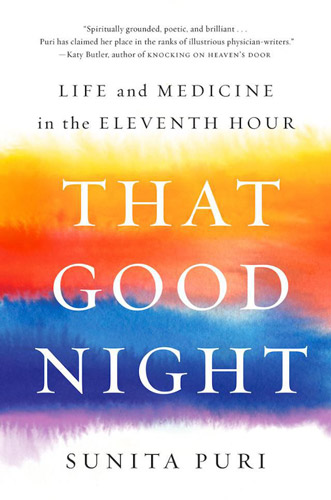
Sunita Puri’s memoir That Good Night: Life And Medicine in the Eleventh Hour is poetic, beautiful, and insightful.

The book traces Dr. Puri’s journey into the world of palliative care. Offering a collection of wisdom stories taken from her work with the dying, she gives us a view of death as a moment of dignity and grace.

Dr. Puri is the doctor whom hospitals call when a patient enters the terminal phase of illness. Some patients are antagonistic toward her presence and despise her, thinking she is encouraging them to give up. Yet, she is actually there to give dying patients and their loved ones the strength to know when it is time to let go. It is a fine distinction to make, but she does it beautifully.

In this memoir, Puri shares spiritual and philosophical insights into the dying process. She demystifies and unfolds the process of death as a journey we must all make. In so doing, she teaches lessons about the ways to embrace life until we must release it. And in that release can come great peace.

As she writes, “For we will each age and die, as my father told me years ago. We will lose the people we love. No matter our ethnicity, place of residence, income, religion, or skin color, our human lives are united by brevity and finitude, and the certainty of loss. Just as we strive for dignity and purpose throughout our lives, well before the light fades, we can bring this same dignity and purpose to our deaths, as we each journey into our own good night.”

As we all struggle to make sense of death and dying during this long and arduous road of the pandemic, Dr. Sunita Puri’s memoir shines a light in the darkness.


That Good Night: Life And Medicine in the Eleventh Hour by Sunita Puri. Penguin Random House, March 2020.

Reviewer bio: M.G. Noles is a freelance writer. whose work appears on Medium’s The Pine Wood Review (https://medium.com/@writinglife). She also reviews books for GoodReads.com (https://www.goodreads.com/user/show/118714169-mg-noles).

Buy this book at our affiliate Bookshop.org.

Tyranny from Good Intensions

Guest Post by Claudia Gollini

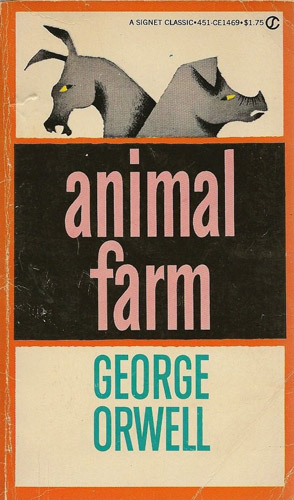
Animal Farm by George Orwell was first published in 1945 and will be celebrating its seventieth birthday next year.

One of Orwell’s finest works, it is a political fable based on the events of Russia’s Bolshevik revolution and the betrayal of the cause by Joseph Stalin.

Parents need to know that Animal Farm is a biting satire of totalitarianism, written in the wake of World War II and published amid the rise of Soviet Russia. Although it tells a fairly simple story of barnyard animals trying to manage themselves after rebelling against their masters, the novel demonstrates how easily good intentions can be subverted into tyranny.

The fable is alive with brilliant touches. At first the victorious pigs write out a set of revolutionary rules, the seventh and most important is of which is “All animals are equal.” It was a brilliant idea to have the clever pigs simplify this for the dimmer animals (the sheep, hens and ducks) into the motto “Four legs good, two legs bad.” But it was a real stroke of genius for Orwell to later have the pigs amending these rules, most notoriously amending rule seven to become “All animals are equal—but some are more equal than others.“ This says something so profound about human beings and our laws and rules that it can be applied anywhere where laws are corrupted and distorted by the powerful.

The book seems relatively simple on the first read but there are several layers of complexity to represent the Soviet government. The novel contains a fair amount of satire and humor, which personally is one of the main reasons why I recommend reading it.


Animal Farm by George Orwell. 1945.

Reviewer bio: Claudia Gollini is a makeup artist, fashion/beauty blogger and journalist, editor and writer, and body painter of events and TV show (Make-up Deborah-Gucci and Castrocaro TV talent show, body painter to Art gallery ‘Spazio l’altrove’ and TV show Sky 869 Village festival and another fairs & exhibition on Italy).

Escape from Reality with Classic Fantasy

Guest Post by Chang Shih Yen

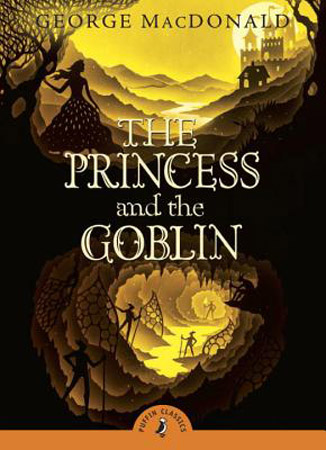
Perhaps you need a little bit of an escape from reality at the moment. This is a good book to do that. The Princess and the Goblin is a classic fantasy novel written by Scottish writer George MacDonald (1824-1905). It first appeared in 1871, before being published in book form in 1872.

The Princess and the Goblin tells the story of Princess Irene who is rescued from a goblin attack by a miner boy called Curdie. The book tells of a battle between goblins who live underground and humans. With her new friend Curdie and some magical help, Princess Irene must find a way to defeat the goblins and save her father’s kingdom.

Despite being written in the Victorian era, the language in this book is very easy to follow. You can’t tell that it was written almost 150 years ago. This was a very enjoyable book. It’s the type of book where illustrations are not necessary because it’s better to use your own imagination to picture all the goblins and other creatures. This classic fantasy novel inspired Tolkien’s Lord of the Rings and The Chronicles of Narnia by C.S. Lewis. George MacDonald wrote at least 50 books, but most of his work is not remembered now, which is a shame. George MacDonald deserves more recognition.


The Princess and the Goblin by George MacDonald. 1872.

Reviewer bio: Chang Shih Yen is a writer from Malaysia, seeing through the pandemic in New Zealand. She writes a blog at https://shihyenshoes.wordpress.com/.

Buy this book from our affiliate Bookshop.org.

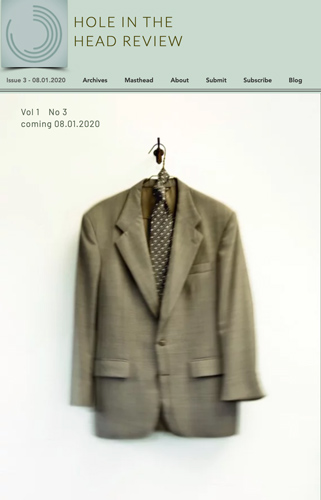
Hole in the Head Review – August 2020

Issue 3 of Hole in the Head Review is out. New work from Betsy Sholl, Charles Simic, Alison Harville, Amalia Galdona Broche, Patrick Cole, Dawn Potter, Linda Aldrich, Janet Powers, Peter Bruno, Jaina Cipriano, Alice B. Fogel, Greg Clary, Richard Heckler, and many others. Michael Hettich interviews Denise Duhamel. In commentary: Baron Wormser.

Crazyhorse – Spring 2020

The Spring 2020 issue is here and it features the winner of the Crazyshorts! Short-Short Fiction Competition (“Spinning Stories” by Bailey Cunningham) alongside outstanding stories, essays, and poems by Rebecca Morgan Frank, Afabwaje Kurian, Iheoma Nwachukwu, W. Scott Olsen, Ira Sukrungruang, Amy M. Alvarez, and more. Read more at the Crazyhorse website.

Cimarron Review – Winter 2020

In the Winter 2020 issue of Cimarron Review: poetry by Allison Hutchcraft, Jennifer Funk, Toshiaki Komura, Amy Bilodeau, Monica Joy Fara, Darren C. Demaree, Laura Read, Isabelle Barricklow, Amber Arnold, Meriwether Clarke, Amie Irwin, Ben Swimm, Sophia Parnok, Brooke Sahni, Will Cordeiro, and Patrick Yoergler; fiction by Nancy Welch, Dan Pope, and Michael Deagler; and nonfiction by R Dean Johnson and Jon Volkmer.

Event :: Center for Creative Writing Offers Virtual Opportunities for Writers

Deadline: Year-round
The Center for Creative Writing has been guiding aspiring writers toward a regular writing practice for more than 30 years. Our passionate, published teachers offer inspiring online writing courses in affordable six-week sessions, as well as one-on-one services (guidance, editing) and writing retreats (virtual for 2020). Whatever your background or experience, we can help you become a better writer and put you in touch with the part of you that must write, so that you will keep writing. Join our inclusive, supportive community built on reverence for creativity and self-expression, and find your way with words. Creativewritingcenter.com.

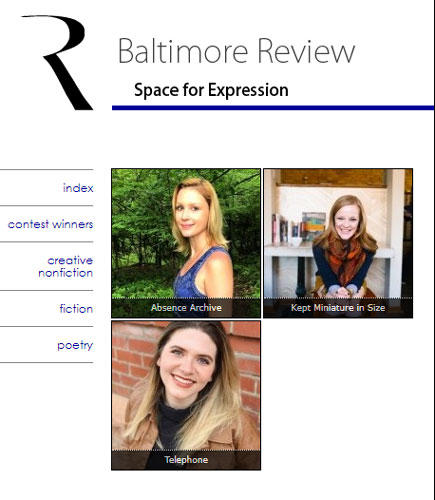
Baltimore Review Summer 2020 Contest Winners

Have you visited the latest issue of Baltimore Review yet? In the Summer 2020 issue, readers can find the latest contest winners.

Flash Fiction
“Telephone” by Cara Lynn Albert

Flash Creative Nonfiction
“Kept Miniature in Size” by Ellie Roscher

Prose Poetry
“Absence Archive” by Anita Olivia Koester

Check out the full new issue, or spend some time just taking in the contest winners. Either way is a great way to spend some of your Sunday.

Finding Relief in Anne Kilfoyle’s Fiction

Magazine Review by Katy Haas

In the early days of lockdown, I had friends comment to me that they felt almost a sense of relief. Despite the tragedies reported in the news and the uncertainty of the new world we found ourselves in, they felt like they were able to breathe for the first time—to spend days resting or creating or getting personal work done or fully focusing on their families, none of which they were able to accomplish during the busyness of everyday life.

In the Spring/Summer 2020 issue of Salamander, Anne Kilfoyle’s story “Double-Yolked” reminded me of those conversations and feelings. As narrator Keera and her husband Jesse prepare for an emergency evacuation following an unnamed global threat, she reflects:

The last three days have been good days, some of the best. We have been holding our breath but also our problems got smaller. [ . . . ] Our biggest fear wasn’t mass annihilation, it was that we’d have to go back to how things were, back to our jobs and our lives [ . . . ].

Despite their lack of preparation, she feels okay with what’s coming to them, feels capable knowing they have each other, now somehow stronger together, as they move forward.

The short piece is relatable and timely: empty store shelves, last minute orders from Amazon in an attempt to ease the new worries, the uncertainty that surrounds them, and that strange relief of being released from normal life. It can be difficult to read disaster-themed writing while living through a similar situation, but Kilfoyle manages to cover the topic in a way that’s casual and comforting without adding to the current, similar stresses.

Sponsor Spotlight :: Radar Poetry

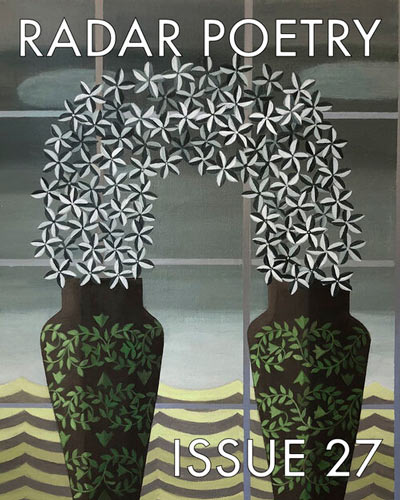
Radar Poetry is an online literary magazine devoted to publishing poems from both established and emerging writers. The journal was founded in 2013 by Rachel Marie Patterson and Dara-Lyn Shrager. Each issue features pairings of poetry and visual art, selected by the editors and contributors. They seek to feature visual art that interprets, reimagines, or responds to the poem with which it appears.

Issues are published quarterly and the founders and editors also host workshops and retreats.

Each year, Radar Poetry hosts the Coniston Prize. This award is open to female-identifying poets writing in English. The prize is currently accepting submissions through September 1. This year’s judge is Ada Limón. The winning poet receives $1,500 and publication. $10 reading fee.

Issue 27, published in July, features poetry and art by Lauren Camp, Walker Evans, Jen Jabaily-Blackburn, Dante DiStefano, Honour Mack, Martha McCollough, Jack Delano, and more.

Stop by their listing on NewPages to learn more.

A Dose of Fantastic

Guest Post by Christopher Linforth

In her debut collection Collective Gravities, Chloe N. Clark offers a dose of the fantastic into the ordinary, and sometimes humdrum, lives of her characters. Twenty-five aesthetically similar stories make up the book, which dilutes the power of the collection as a whole, but shows the range of Clark’s fascination with parallel universes, zombies, and the breakdown of relationships. The strongest stories reveal Clark’s gift as a storyteller and as a purveyor of the weird.

In the collection’s opener “Balancing Beams,” the astronaut narrator Ava struggles with an unknown, debilitating ailment in a futuristic America. In a beautifully written flash of insight, she tells us:

I couldn’t speak for a moment. The weight of words on my tongue. In the Out, there had been so many times I fumbled words, slurred them. They don’t tell you that zero-gravity even affects your tongue. Your mouth can feel so heavy when you try to say something.

Other stories seem to take their cues from B-movies and horror stories and the world of science fiction. Throughout the collection, Clark remakes these historically male-dominated forms to center her stories on women and the deleterious effects of culture on their bodies.

Clark’s debut is a mixed collection, yet it shines so brightly in spots that it’s clear she is destined to wow us with her next book.


Collective Gravities by Chloe N. Clark, Word West Press, 2020.

Reviewer bio: Christopher Linforth is the author of three story collections, The Distortions (Orison Books, 2021), winner of the 2020 Orison Books Fiction Prize, Directory (Otis Books/Seismicity Editions, 2020), and When You Find Us We Will Be Gone (Lamar University Press, 2014).

Buy this book at our affiliate Bookshop.org.

Narrative Pattern & Design

Guest Post by Anthony DiAntonio

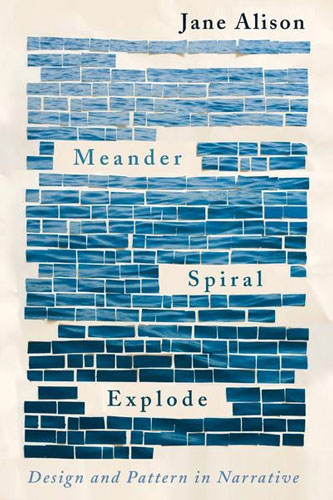
Jane Alison’s Mender, Spiral, Explode, is a nonfiction, creative writing guidebook for both writers and avid readers alike. Alison argues that there are multiple ways to craft a narrative, other than the Aristotelian “masculo-sexual arc” we have all come to know and love. Narratives can follow many patterns that we see in nature, like the spiral, the fractal, or even the meandering trail of snails. Alison provides examples from multiple contemporary works of fiction to prove her premise, including Murray Bail’s Eucalyptus, Marguerite Duras’ The Lover, and Sandra Cisneros’ The House on Mango Street. Starting each part with a personal reflection, Alison connects her own experience with these patterns to further validate their influence on human life. Through exquisite vocabulary that fuels a powerful, humorous, and direct work, Jane Alison’s Mender, Spiral, Explode is a must-read for those who admire pattern and design in any narrative.


Meander, Spiral, Explode: Design and Pattern in Narrative by Jane Alison. Catapult, April 2019.

Reviewer bio: Anthony DiAntonio is a high school English teacher at Cumberland County Technical Education Center in New Jersey. He is also currently studying for his Masters in Writing Arts at Rowan University. To achieve his Masters, he will be completing a novel focused on mindfulness, positivity, and moving forward from emotional trauma.

Buy this book from our affiliate Bookshop.org.

Plume – August 2020

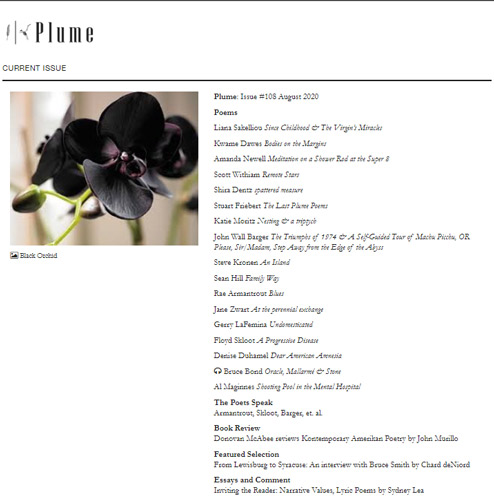
Visit this month’s Plume featured selection: “From Lewisburg to Syracuse: An interview with Bruce Smith by Chard deNiord.” Sydney Lea, in nonfiction, writes “Inviting the Reader: Narrative Values, Lyric Poems” and Donovan McAbee reviews Kontemporary Amerikan Poetry by John Murillo.

The Lake – August 2020

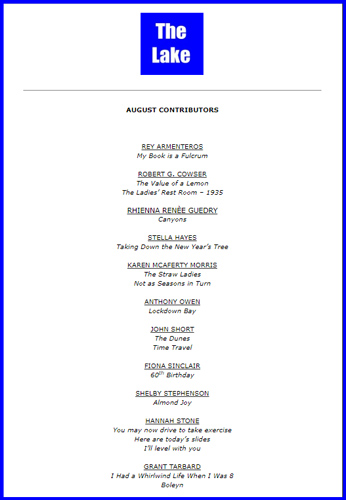
The August issue of The Lake features Rey Armenteros, Robert G. Cowser, Rhienna Renèe Guedry, Stella Hayes, Karen McAferty Morris, Anthony Owen, Fiona Sinclair, Shelby Stephenson, Hannah Stone, Grant Tarbard. Reviews of Oz Hardwick’s The Lithium Codex, Jeffrey McDaniel’s Holiday in the Islands of Grief, and J.R. Solonche’s The Time of Your Life.

Chinese Literature Today – Vol 9 No 1

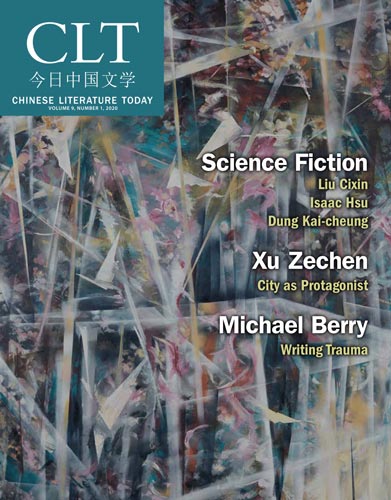
Chinese Literature Today Volume 9 Number 1 features short science fiction by Liu Cixin, Isaac (Shuntang) Hsu, and Dung Kai-cheung; an exploration of Xu Zechen’s urban fiction; a novella by Li Jing; and a look at diverse works by Sinologist Michael Berry.

Sponsor Spotlight :: Rockvale Review: Bold & Vulnerable Poetry

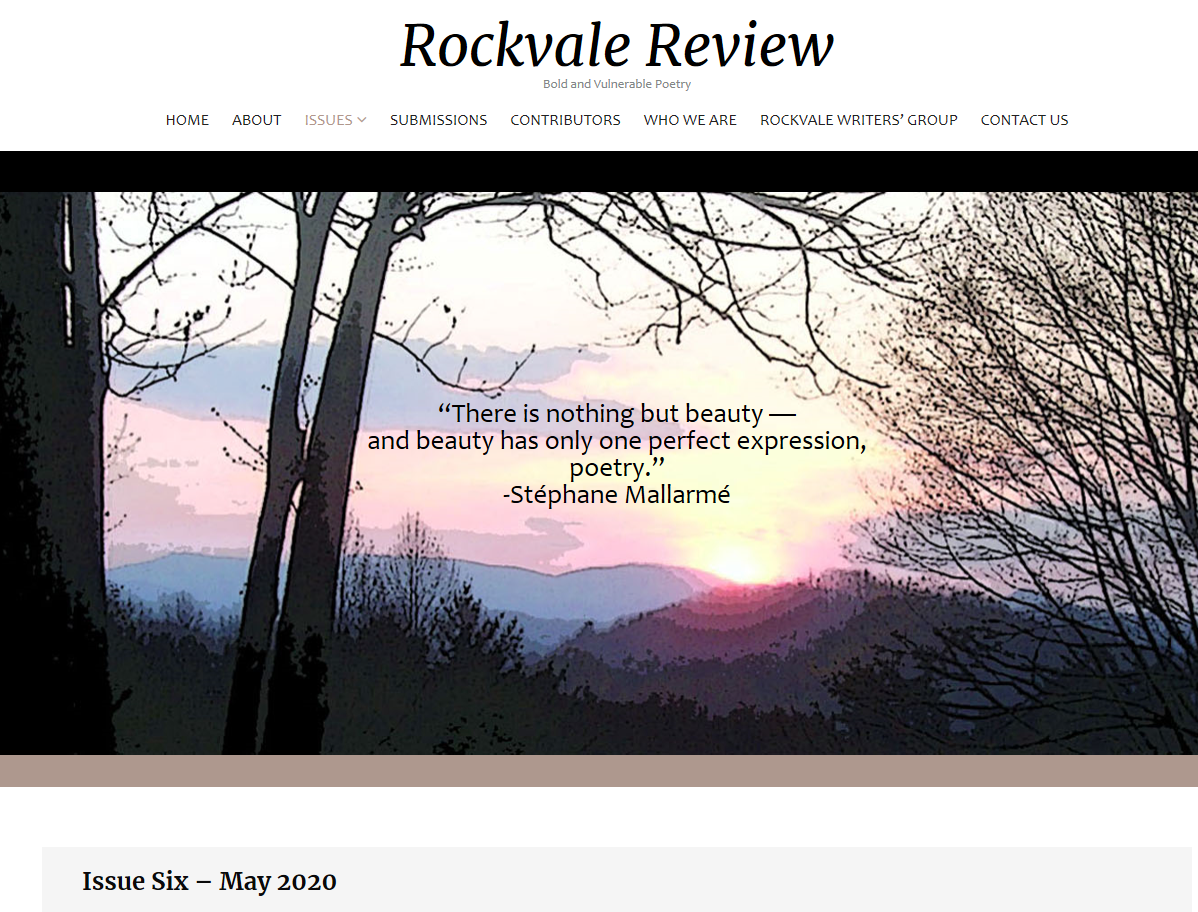
Rockvale Review screenshotRockvale Review was founded in 2017 as an online journal devoted to “bold and vulnerable poetry.” They publish work from new, emerging, and established writers and feature image-driven poems that are hard-edged and finely crafted. They do offer optional print editions of their issues which are released in May and November of each year.

They have a unique feature where every poem accepted for publication is paired with a piece of art created by a Featured Artist. A Featured Musician will also craft music to respond to several of the poems in each issue. In doing so, Rockvale Review produces a journal that speaks beyond words, moving into the visual and auditory layers of the human spirit.

Their sixth issue was published in May 2020 and features work by Travis Stephens, Ivo Drury, Kate Deimling, Shannon Wolf, M.G. Hofmann, Wendy Drexler, and more. Stop by their listing at NewPages to learn more.

They the Mothers

Magazine Review by Katy Haas

From Issue 38 of Bellevue Literary Review, Kathi Hansen’s “We the Mothers” (honorable mention in the 2020 BLR Prize) imagines the mothers of boys who have been accused of sexual assault. They meet together in book-club-like fashion, able to speak freely with one another when no one else understands.

Hansen writes of them in a collective. They speak of their sons as one being as they look back to their childhoods, their teenage years, and the ways their boys were raised in their homes. Only when one woman begins to question her son’s innocence does the story diverge, separating her from the rest of the group, finally naming her apart from the others. I found this to be a cool, well done device for this piece, and a unique point of view to have on these now familiar stories.

Despite focusing on this side of the story, Hansen does a good job of avoiding too much sentimentality. The mothers tell their collective story without demanding understanding or sympathy from the reader. After all, as they point out, only those in their group can truly understand.

Witness. Vulnerable. Mystery.

Guest Post by Susan Kay Anderson

Witness.

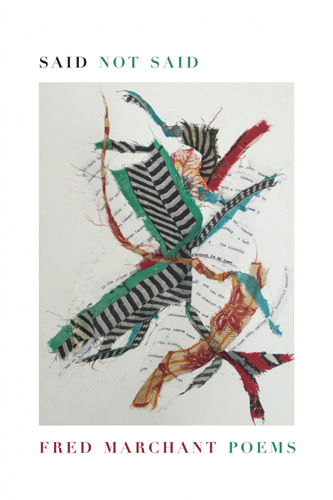
Fred Marchant views the inexplicable and gives us the air it breathed in his poems in Said Not Said. I have been looking at this book, reading it, studying with Marchant, and looking at it again for the past three years. Most of that time I worked as a graveyard-shift custodian cleaning university buildings. Now, I live at my parents’ and take care of the both of them during the days of the pandemic. What Marchant sees in his life is revealed in this book. He sees what is not fair. He sees reality but events he cannot control. Here we are in 2020: sitting ducks. Marchant’s poems get into the feeling of this but also access the profound stability of peace and understanding. In “Fennel” he writes:

At the end maybe you were thinking
of Whitman and his claim that dying
was luckier than we had supposed.
Or not. Or not. Here is the bee . . .

Marchant shows us that nature with a capital N intercedes, maybe not to change the course of events he witnesses, but to carry an event to another place, a different emotion. Continue reading “Witness. Vulnerable. Mystery.”

Program :: University of South Alabama’s MA in English with a Concentration in Creative Writing

University of South AlabamaSpring 2021 Application Deadline: December 1
The MA in English with a concentration in Creative Writing offers students an opportunity to develop their writing in a variety of genres (including screenwriting) and to work with the writers sponsored by the Stokes Center for Creative Writing. The Stokes Center enhances the English department’s offerings in creative writing by sponsoring readings, lectures, forums, community projects, and other events that are free and open to the public. It also supports students through its undergraduate and graduate awards in poetry, fiction, and creative nonfiction. A number of competitive scholarships are available to augment the assistantships and tuition waivers such as summer creative writing awards for work on individual projects. For students who enroll full time, the MA in English can be completed in four semesters. Students also have the option of enrolling part time and/or completing the degree through evening coursework. Come develop your craft in a diverse and vibrant city near world-class beaches.

What Is Real?

Guest Post by Susan Kay Anderson

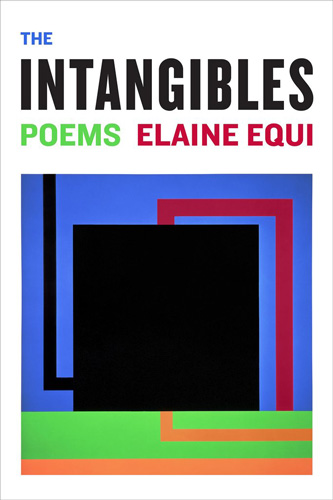
Rereading The Intangibles by Elaine Equi, during the pandemic, it suddenly reads like a meditation, yet it was published “before” in 2019. Well, it matches the feeling of ennui of the pandemic, police brutality, and the more overarching panic of the climate crisis. This is also true of a lot of poetry I read now, Because of my state of mind, and I am sure others would agree (desperate/bored/searching/hopeful/raw/terrorized), we are also mesmerized by poetry and what poets have to say.

What Equi has to say in The Intangibles is as straightforward as she’s always been. From her titular poem: “Prove you’re not a robot / Answer the question: / What color is the silver basket?”

Her poems are directed outwards but also fold endlessly in on themselves. They are playful in their sense of what it feels like to be confined, in quarantine, yes, and even before the quarantine period we are currently in even happened. From her poem “Faces” we see ourselves and others in a bleak, yet hopeful way: “I love to watch / the dough of faces / flower.”

This book slays with amazing titles. Here are some:  “Deep In The Rectangular Forest,” “Ode To Weird,” “Ghosts and Fashion,” “Home On The Range” (okay, not such a weird title, but a very exquisite and wonderful poem), “Granular Time/Granular Distance,” and “Looking Out The Window In A Novel.”

Each of these poems blossoms into a novel (and not a virus).


The Intangibles by Elaine Equi. Coffee House Press, 2019.

Reviewer bio: Susan Kay Anderson’s first book of poems is Mezzanine, from Finishing Line Press, 2019. She also has work forthcoming in Sleet, and another book from Finishing Line Press. She lives in Oregon.

Weaponized Information

Guest Post by Eron Henry

Information and news are increasingly weaponized. While not new, the weaponization of news and information has been set on steroids by the rise of social media. Facebook, Twitter, YouTube and their counterparts in other countries, such as in Russia and China, have become the main source of news for citizens.

It is in and through social media that propaganda, misinformation, and disinformation thrive. The first, propaganda, is a way to tell one’s own story and can be used for good or ill. Advertising, for instance, is a form of propaganda. The second, misinformation, is false and faulty news that need not be deliberately false but can be harmful. The last, disinformation, is the deliberate spreading of false and misleading news and information with the intention to create confusion and cause harm.

Because social media is now the most widely used source of news and information, persons become easily misled and fooled because social media is a fertile breeding ground for misinformation and disinformation.

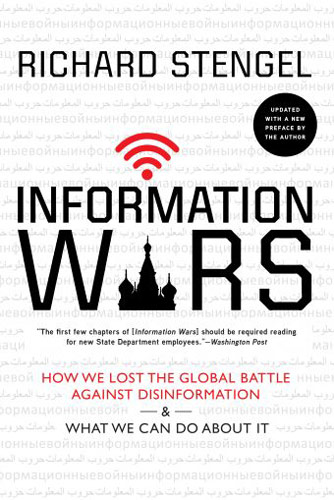
In Information Wars: How We Lost the Global Battle Against Disinformation and What We Can Do About It, Richard Stengel tells how false and faulty news is now normalized. The former editor of Time Magazine, Stengel was recruited by the State Department during the Obama Administration to counter misinformation and disinformation, especially those put out by Russia and ISIS, the terrorist group.

It was a Byzantine experience. An admixture of outdated technology, ill-prepared and ill-informed government officials and workers, turf wars, career ambitions, ego, and more, got in the way of countering the coordinated and concerted attack on truth and facts, both within the United States and globally.


Information Wars: How We Lost the Global Battle Against Disinformation and What We Can Do About It by Richard Stengel. Atlantic Books, October 2019

Reviewer bio: Eron Henry is a communications consultant. He blogs at https://oletimesumting.com.

Buy this book at our affiliate Bookshop.org.

Eerie Reflections: Lacrimore

Guest Post by Laura Kincaid

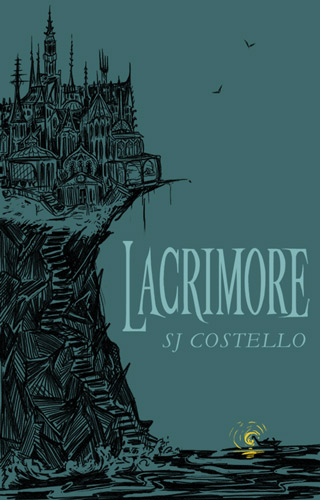
Lacrimore by SJ Costello explores our relationship with grief and tragedy through a speculative lens. The gothic novel draws readers in with beautifully dark prose that builds a haunting world. While the story unfolds slowly, the flawed characters and mystery compel readers to turn the page.

The novel opens with Sivre Sen, a faithless medium journeying across a stormy lake to a small island. There sits Lacrimore, a crumbling labyrinth of a mansion shrouded by legends. During a vision, a ghost called her there to complete his funeral rites. In Costello’s Victorian-inspired world, mediums are revered and influential, especially after a recent epidemic. However, Sen has never before experienced visions of the dead. After arriving, she meets the dead man (who is still alive), a staff trapped by circumstances, and a dubious doctor in exile. As Sivre searches the house for answers and closure, she discovers dark secrets in its rotting walls. The book is like Lacrimore itself—a quiet, mysterious tale standing alone in a much larger world.

Though in development before the COVID-19, the novel was a poignant and refreshing take on pandemic literature. Instead of focusing on dystopian survival, the story centers on what happens after survival. How do we process our grief? How do we reflect on the societal failures that came to light? What change is required to be better? Lacrimore doesn’t claim to answers all these questions. It remains a spooky story that is fun to read, but opens the door for those who want to ponder its deeper themes.


Lacrimore by SJ Costello. June 2020.

Reviewer bio: Laura Kincaid is a writer, editor, and lover of the fantastical. Find her work in Twist in Time and at laurakincaidmusings.wordpress.com.

Literature that Rattles the Soul

Guest Post by Brian Phillip Whalen

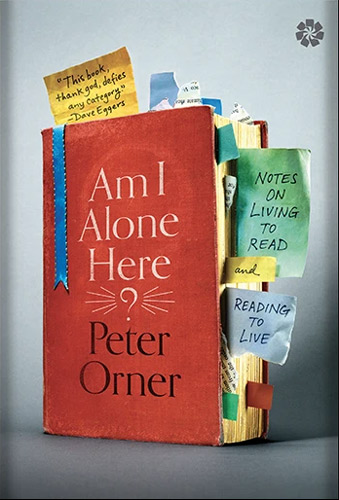
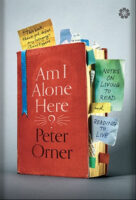
I’m rereading Peter Orner’s collection of essays, Am I Alone Here?: Notes on Living to Read and Reading to Live. (What a title! I’m also rereading Jonathan Franzen’s How to Be Alone.) Orner’s essays are ideal stay-at-home reading—easy-to-digest, elegantly composed—and his sparing prose is second-to-none at conveying depths of feeling in few words. The result is a perfectly-paced, heartfelt, sad, funny, and breathtaking book.

Orner seamlessly blends craft analysis (examinations of Chekhov, Welty, Malamud, Hurston, Wideman, Kafka, and scores of other writers) with memoir (stories of fathers, children, love, loss, joys, regrets, the pleasures—and solitude—of reading). Each essay is inspired by an act of reading, prompting explorations into the ways in which the books we read inform, intersect with, and sometimes mirror our lives:

It gets me every time. The way a story about characters, nonexistent people, pushes us back to our own, the people who do exist, who do walk the earth.”

It’s Orner’s voice, however, that draws me in. Though I’ve never met him, the feeling I get reading his essays is akin to sharing stories of hurt and redemption with an old friend over a cold beer, sitting on lawn chairs in the yard at sunset.

We have all done things we wish we could erase, forever, from the record. No matter how we airbrush our histories, the hurt we have caused will, always, reach out for us—like for me today—out of the December rain.”

Orner’s objective was to write about literature that “rattles the soul,” and in so doing, he amassed a collection of essays that continues to rattle mine. This is my go-to recommendation for readers wanting bite-size, ruminative literary essays—and these days, for anyone looking, as the title beckons, for some company in isolation.


Am I Alone Here? by Peter Orner. Catapult, 2016.

Reviewer bio: Brian Phillip Whalen’s debut collection of fiction, Semiotic Love [Stories], will be released in 2021 (Awst Press). Find him here: www.brianphillipwhalen.com.

Buy this book from our affiliate Bookshop.org.

Bluegrass Writers Studio Open to Fall 2020 Applications through August 1

Bluegrass Writers Studio logoThere is still a few days left to submit your application to the low-residency MFA in Creative Writing program at Eastern Kentucky University. The Bluegrass Writers Studio offers one of the most affordable and progressive low-residency programs in the nation.

They offer a close-knit and supportive writing community, are devoted to their students creative and professional success, and are supportive of both literary and literary genre writing. The program offers online workshops conducted with live audio, intensive residency workshops, international literary and cultural experiences, and web-based courses in contemporary literature. Students also have the option of working on Jelly Bucket, the annual graduate-student-produced literary journal.

To be considered for their Fall 2020 program, applications need to be received by August 1. To start their program in spring, applications need to be received by December 1.

Swing by their listing on NewPages to learn more.

Vulnerability Is Strength

Guest Post by Joshua Lindenbaum

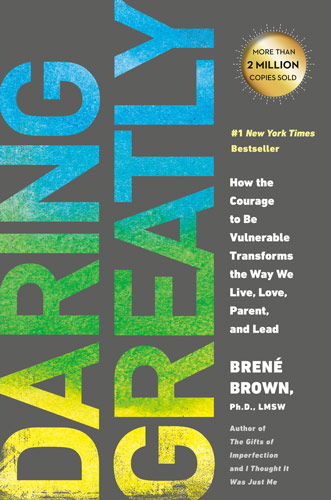
When one thinks of courage, they usually think about someone going into a burning building to save a person’s life; however, Dr. Brené Brown provides a unique, much-needed lens in which to view bravery in a broader sense in her book Daring Greatly: How the Courage to Be Vulnerable Transforms the Way We Live, Love, Parent, and Lead. The writing is a beautiful concert of personal anecdotes alongside empirically-based research. Furthermore, Dr. Brown reveals not-so-flattering details about herself, and therefore lives the practices in which she details in her book. It is a lovely trident of logos, pathos, and ethos designed to pierce into the stubbornness of convention and tradition, especially amongst men who have been taught to not show emotions.

This incredibly organized text uproots widely-held beliefs, such as “vulnerability is weakness.” On the contrary, in her previous book The Gifts of Imperfection, Dr. Brown declares, “vulnerability is our most accurate measurement of courage.” She defines ” . . .  vulnerability as uncertainty, risk, and emotional exposure,” which comprises everyday life, especially during this pandemic. That’s what I think many readers will appreciate about her work: Brown manages to quantify concepts like vulnerability, shame, and even joy. She includes accounts from her own qualitative research alongside a panoply of reliable sources. In addition to providing background, there are also practical steps in, for example, fostering trust. For instance, there’s a section on “the marble jar,” a metaphor used to help us in assessing whether an individual is trustworthy or not based upon specific criteria. This approach allows one the ability to express themselves while also creating boundaries against those that don’t deserve our trust.

I know what you’re thinking: this sounds like a corny self-help book. You are wrong. It is a humanity book. Step into its pages!


Daring Greatly: How the Courage to Be Vulnerable Transforms the Way We Live, Love, Parent, and Lead by Brené Brown. Avery/Penguin Random House, April 2015.

Reviewer bio: Joshua Lindenbaum’s poetry has appeared in Drunk Monkeys, Breadcrumbs, Yes Poetry, The Bangalore Review, Five:2:One, 3Elements ReviewTypishly, and elsewhere.

Buy this book from our affiliate Bookshop.org.

It’s Always the Person You Least Expect

Guest Post by Caroline V.D.

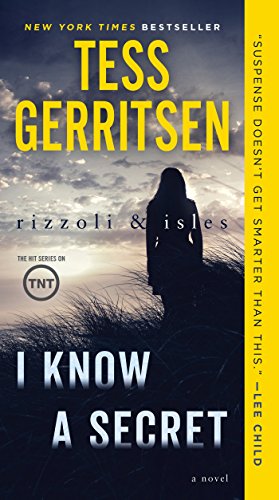
As a first timer being introduced into the world of Rizzoli and Isles’s grisly world, I found myself left exposed to the intensity and intricately woven plot in Tess Gerritsen’s addition.

In I Know a Secret, we are pushed straight into the unfortunate murder of Cassandra Coyle, an indie filmmaker and are soon greeted with Rizzoli and Isles. For those like me who are meeting the two strong women quite late into the series, Gerritsen does a wonderful job in establishing familiarity and understanding of their characters as the murder investigation goes on. The characters throughout the book all contribute to the tension and suspense in deducing the culprit’s motives and next actions, as the number of bodies pile up and pasts uncovered. There are no moments that are wasted and no conversations that do not provide a twist to the story, as Coyle’s colleague says “Horror 101 . . . it’s always the person you least expect.”

The symbolism and messages throughout the story are consistent and well placed by Tess Gerritsen who had impressively created an impression of a web laid out by a culprit who could not be traced yet by the end of the book; the web could be followed into a single string as the culprit’s motives are laid out to the reader. It is an amazing feat done by Gerritsen who I commend for roping in another reader into her series!


I Know a Secret: A Rizzoli & Isles Novel by Tess Gerritsen. Penguin Random House, April 2018.

Reviewer bio: Hey all, it’s Caroline, and I am an aspiring book reviewer. Currently I’m working on a personal project where you’ll be seeing me and a lot more books in the future. Check it out at: https://theladywithinkstainedhair.tumblr.com/.

Buy this book at our affiliate Bookshop.org.

Sponsor Spotlight :: Mills College Flex Res MFA in Creative Writing

Mills College logoMills College is now offering a new kind of MFA in creative writing that enables its students to earn a degree in poetry, fiction, or nonfiction in their own way.

Along with offering more traditional classroom-based workshops and craft classes, Mills College also offers the ability to complete the degree by working one-on-one with a faculty mentor. This allows students to be on campus as much or as little as they desire. They are also expanding the amount of online offerings available during summer and January terms.

The program offers concentrations in education, literary arts administration, PhD preparation, and young adult fiction. Students can also create their own unique concentration with electives in podcasting, performance, and pedagogy. They offer a literary editing and production course that gives students hands on experience in editing their annual graduate journal 580 Split.

Stop by their listing on NewPages to learn more about their program.

Terrain.org – July 2020

New in July on Terrain.org, find poety by Kim Parko, Anna B. Sutton, Dean Rader, and Andrea Cohen; nonfiction by Meg Mills-Novoa, Jason BreMiller, Samantha Scibelli, and Lucy Bryan; and fiction by Susan M. Gaines. Plus, Matthew Cooperman reviews Joshua McKinney’s Small Sillion.

Southern Humanities Review – 53.2

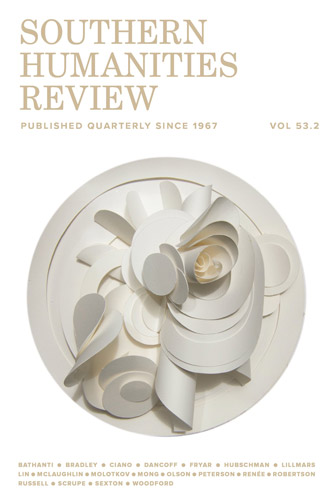
In this issue find nonfiction by Charlotte Taylor Fryar and A. Molotkov; fiction by Kim Bradley, Judith Dancoff, Janis Hubschman, Jeff McLaughlin, and Ann Russell; and poetry by Joseph Bathanti, James Ciano, Bryce Lillmars, Esther Lin, Derek Mong, Christina Olson, Lee Peterson, L. Renée, Kristin Robertson, Mara Adamitz Scrupe, Wesley Sexton, and Annie Wodford. Find more info at the Southern Humanities Review website.

Bellevue Literary Review – No 38

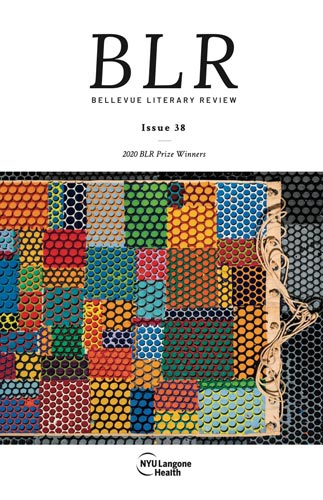
Issue 38 of the Bellevue Literary Review (BLR) came together just as NYC and Bellevue Hospital were in the throes of the Covid-19 pandemic. Some of the BLR staff were alternating N95 masks with red pens, balancing patient-care with literary work. But the issue made it to the presses and is packed with good reads. It features the winners of the 2020 BLR Literary Prizes. The poems, essays, and stories in this issue travel from China to Texas to Tehran, from small town to big city, from World War I-era to the present. Stay tuned for Issue 39, coming in the fall, whose theme is “Reading the Body.” Read more at the Bellevue Literary Review website.

Eastern Michigan University Alumni wins the Sawtooth Prize

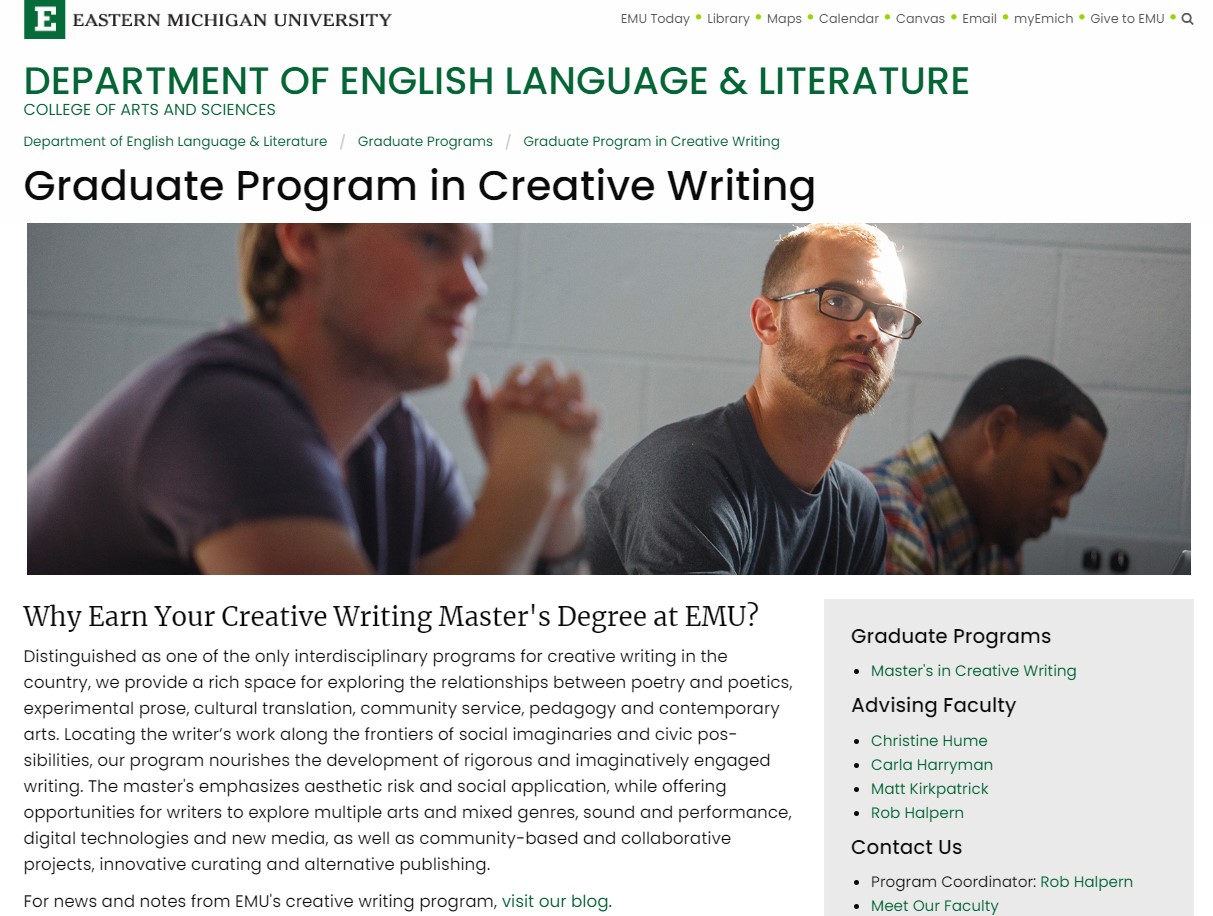
Eastern Michigan University Graduate Program in Creative Writing websiteThe creative writing program at Eastern Michigan University is distinguished as one of the only interdisciplinary programs for creative writing in the country. They provide a rich space for exploring relationships between poetry and poetics, experimental prose, cultural translation, community service, pedagogy and contemporary arts. Their goal is to nourish the development of rigorous and imaginatively engaged writing.

Rosie Stockton, who graduated from their MA program in 2017 is currently pursuing their PhD at the University of California, Los Angeles. Rosie has become the recent winner of the Sawtooth Prize. Their book Permanent Volta will be published soon by Nightboat Books.

Christina-Marie Sears, current blog writer/admin staffer for EMU’s online journal BathHouse sat down with Stockton to discuss their work, current practice, and time at Eastern Michigan University.

One of my daily rituals is- I get up and I journal. It’s not narrative. Journaling for me is a stream-of -consciousness and image-focused practice. I have a really active dream life and I just wake up and write before I even look at my phone, but of course on some days that doesn’t always work.

Check out the full interview here.

Take a Walk “In the Woods” with Emily Steinberg

Magazine Review by Katy Haas

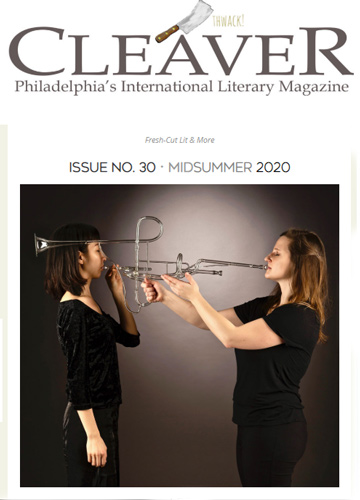
Emily Steinberg takes a walk “In the Woods” with her dog, Gus, in her visual narrative found in the Midsummer 2020 issue of Cleaver. During her walk, she focuses on Gus and her surroundings, reflecting on the way the real world and its real problems seem far away. In the woods, “All human makings disappear . . .” and there is only the sounds of the wind in the trees and the creek and Gus’s paws around her. This moment doesn’t last forever, though. She has to cross the threshold back into the real world where everything “comes sweeping back. Crowding my brain. Not letting me breathe.” But for a moment there is peace.
This short visual narrative gives readers a moment of peace as well as we soak in the quiet moment of respite along with Steinberg. Each panel features only Gus, a fluffy scribble of a dog padding through the woods, a dog always good comfort when it’s needed. The piece works as a good reminder to take a moment to find calm and quiet in the midst of the tragedies and turmoil swirling around us. By taking these moments, we’re able to recharge as we head back into the real world to face everything once more.

Creative Nonfiction Now Enrolling for Fall Online Classes

Creative Nonfiction Fall 2019 coverThat’s right! Literary magazine Creative Nonfiction‘s Fall 2020 online writing courses are open to enrollment. They offer courses for writers of all levels from those just starting out to the more advanced. All courses will begin on September 7. If you sign up by August 15, you will save $50. If you have a buddy you want to do these courses with, you could save an additional $25.

Courses include a Creative Nonfiction Boot Camp, Introduction to Audio Podcasting & Storytelling, Magazine Writing, The Building Blocks of the Personal Essay, Writing for Change: The Study & Craft of Environmental Writing, Advanced Memoir: From First Sentence to Resolution, Advanced Personal Essay: Finding a Way Through, and Advanced Science Writing.

Learn more about all their courses and how to sign up at their website.

Seeing Dead People

Magazine Review by Katy Haas

Say, “I see dead people,” to just about anyone, and they’ll likely be able to name the movie it came from. But unlike Haley Joel Osment’s character in The Sixth Sense, attempting to help the dead find peace, Jasmine, the narrator in Catherine Stansfield’s “I See Dead People and Other Gags” uses the concept to help herself.

Jasmine tells people she can speak to their dead loved ones, and uses social media to glean information that she later uses in her sessions. Having lost her own mother at a young age and never really speaking about it again gives her a detachment from death and the sentimental feelings surrounding it, so she profits off other people’s pain and grief. However, at the end of the story, she’s hit with a surprise that may make her change her mind about her career path.

I would’ve enjoyed reading more about Jasmine and her work, getting to know more about her clients and her grandmother who casts a shadow over her mother’s death. Stansfield’s writing style is matter of fact and straight forward, fitting for Jasmine’s no-nonsense character. But what we are given is a fun read, a peak behind the medium’s curtain.
Moran Remembers

Magazine Review by Katy Haas

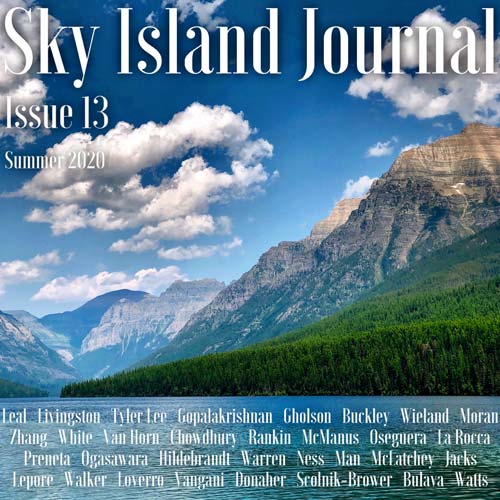
March and the beginning of lockdowns in the United States somehow seems like it was years ago and just days ago. Time continues to slip by in strange ways. Emma Moran touches upon this in her nonfiction piece “What I Will Say” found in the Summer 2020 issue of Sky Island Journal: “Times had changed.  The quality of time had changed.  Hours extended and compressed.  Two hours talking to your sister passed in ten minutes.  Ten minutes extended into days, as you listened to the clock counting out the seconds you couldn’t sleep through.”
In this piece, she reflects on her dad’s instruction to “Remember this. One day your grandchildren will ask what it was like, living through this. Remember it all, so you can tell them.” In the following four paragraphs she explains the way life changed during the first few months of the pandemic, and she does so poetically and eloquently: “People built fortresses out of plans.  I will write those letters, I will train the dog, I will learn to speak French, I will learn to knit, I will learn, I will learn.  We would try to learn.”

Time continues to pass and the push to return to the normal life we used to know is insistent, but Moran remembers and gives a reminder of what we did for others and how we “learned; how we changed” during those first few weeks and months, writing with a thoughtful and sympathetic voice.

Permission to Be Creative Granted

Guest Post by Jaimie Hanson

Creativity. Merriam-Webster defines creativity as “the ability to create.” In Called to Be Creative, author Mary Potter Kenyon not only writes about creativity, what it is, what it means, how it affects and benefits us mentally, physically, emotionally, and even spiritually, but she does so by graciously giving the reader a glimpse into her own life throughout the book. This book will grant the permission we often feel we need to be a little (or a lot) creative, and you will be inspired and encouraged, for yourself, and I dare say for others in your circle, as you read through the pages. The chapters, each with their own creative focus, are supported by research and resources throughout the book and the easy-to-do exercises at the end of each chapter allow for the very guidance and reference we seek. Write in the margins, underline the ah-ha moments that speak to you, and get your creative self active.

Called to Be Creative, whether read individually or with a group (yes, even a Zoom group), belongs in everyone’s hands. It’s a book club book, a girlfriends group book, a book for those who are single or married, it’s even a book for guys (and dare I say it would be a fun challenge to create a space and opportunity for that to happen!). It’s perfect for families, for creative minds and those who don’t see themselves that way. A teaching tool for young moms, homeschool moms, and moms looking for a way to cure summer boredom. Add this book to your reading list, discover or uncover the creativity within you, embrace the creative opportunities, and be ready to be amazed as you laugh and smile, enjoying the creative moments within your everyday journey.


Called to be Creative by Mary Potter Kenyon. Workman, August 2020.

Reviewer bio: Jaimie Hanson lives in the Midwest with her family. She enjoys writing and photography. You can find her sharing both on her blog at jelizabethhanson.com.

A Woman’s Experience in the Gold Rush

Guest Post by Christina Francine

Is making a living worth risking life and reputation? For Au Toy during the American Gold Rush, it was. There isn’t another way. When her abusive husband dies from consumption on the journey by ship from China in 1849, Au is left with her freedom, but without a way to support herself.

The price women pay for independence and safety historically is high. Many women used the only resource they had – their body. For Au Toy, her choices are even more limited due to her bound feet. Not wanting to subject herself to sex work, Au opens a “Lookee shop” instead. The San Francisco bay held unspeakable danger though, especially when Au is “fragile” and “dainty,” twenty years-old, and “varmints” and “ruffians” fill the streets. Her loyal servant, Chen, is big and strong, yet the two need safer accommodations. Mining camps spring up and more men than women roam the area. Au has to be careful with who she allows inside her shanty to look at, but not touch her naked body. When one of her observing customers is a policeman from New York assigned to protect the area, he unnerves her. Ever careful, she works to not encourage him or any of her clients. And yet, John Clark’s gentle nature and soft voice give her pause. He tells her “You are so very lovely, Mrs. Toy. Your skin is like alabaster, your hair like spun silk.” He agrees to pass by regularly on his round for her safety. John Clark warms Au and yet she’s not sure exposing her heart is a good idea. She may never recover.

Grossenbacher’s Madam in Silk is a suspenseful romance to be sure, but also a treat for those longing to travel through history. She captures the essence of people, time-period, setting, and historical events perfectly. Her dedicated research is obvious. She also captures the dangers and stigma women face in order to make a living no matter the time in history. Though a historical account, the situation unfortunately exists present day. Grossenbacher reminds readers of humankind’s ability for cruelty and evil, but also for kindness and love. A heartwarming novel intricately plotted with historical data. A valuable exploration too of how women, especially foreign women, fit into the larger scheme of Gold-Rush history.


Madam in Silk by Gini Grossenbacher. Jgks Press, July 2019.

Reviewer bio: Christina Francine is an enthusiastic author for all ages. She is the author of Special Memory (picture book) and the Mr. Inker series (leveled readers). Journal of Literary Innovation published her analysis on students’ writing across the nation Spring 2016. She believes individual learning style may solve world problems.

A Treat for Duras Fans

Guest Post by M.G. Noles

Published in English in 1993, Practicalities is a rare peek inside the mind of the elusive French author, Marguerite Duras. As the author of some of the greatest French novels of the twentieth century (The Lover, Hiroshima, Mon Amour), Duras’ work has a spellbinding effect on the reader. With a hypnotic prose style unlike any other, she is at once strikingly realistic and dreamily meditative. As a lifelong fan of Duras, I was trepidatious about what to expect from this lesser known work.

But now, after having spent the day reading Practicalities, I have to say that it is stunning! The book is in fact a brief series of transcribed discussions the author had with interviewer Jerome Beaujour, and these discussions were compiled into the present book and translated by Barbara Bray.

In free-form, avant-garde style, Duras discusses everything from her love affair with alcohol to her life in French Indochina. She speaks about her approach to writing and her hatred for being often misinterpreted by critics and “fans.” She talks brilliantly about everything from surviving the war to the details of housekeeping.

Practicalities is a real treat for Duras fans and for anyone who wants an incisive mind’s perspective on the art of writing.


Practicalities by Marguerite Duras. Grove Atlantic, August 1992.

Reviewer bio: M.G. Noles is a freelance writer and history buff.

Buy this book from our affiliate Bookshop.org.