 Studies in the Novel, a scholarly journal in its 47th year, invites submissions of guest blog posts and teaching resources to be considered as content on their newly-launched website. For the blog forum, the editors welcome incisive, humorous, and intellectually speculative posts from the journal’s readers, contributors, and the novel-loving community at large on issues of relevance to scholarship on the novel, new and noteworthy novels, or other novel topics. The selection and publication of blog posts will be at the discretion of the editor and the Studies in the Novel editorial advisory board. This intellectual forum extends the journal’s mission by publicizing new directions in the scholarship and teaching of novels and by promoting intellectual exchange. Visit their website for more information.

NewPages Blog
At the NewPages Blog readers and writers can catch up with their favorite literary and alternative magazines, independent and university presses, creative writing programs, and writing and literary events. Find new books, new issue announcements, contest winners, and so much more!
Dis- Phoebe’s Poetry Special Feature
 Issue 44.1 of George Mason University’s MFA-student-run Phoebe includes a special feature Poetry Editor Elizabeth Deanna Morris Lakes first starting mulling over as “disparity.”
She writes, “So many of the struggles in my life and the lives of people I see in the world seem to revolve around some sort of disparity: of place, of mind, of circumstance. After speaking with Qinglan Wang, my assistant editor, I realized I was less interested in the ‘parity’ and more interested in the ‘dis-‘ – in poems that explored disability, in poems that confronted things that dissatisfied or disappointed, and in poems that grappled with disaster.”
Authors contributing to this special dis- poetry feature include Catherine Pierce, Stacey Kidd, Richard Greenfield, Dorothea Lasky, Matt Bell, Martha Collins, and Adam Clay.
Spread the word!
American Tanka: An Inch of Freedom
 The newest issues (January 2015) of Ameican Tanka is themed “an inch of freedom.” A sampling of first lines: “from my garden / bindweed creeps” (Robert Amis); “the storm / predicted and mapped” (Jari Thymian); “temple-bell / stirs devout thougts” (Vishnu P. Kapoor); “Uncle A with the rolling / musical chuckle -” (Roger Jones).
American Tanka is an online publication that “seeks to present a small selection of some of the most well-crafted English-language tanka being written today, in a visually calm space that allows the reader’s eye to focus on the single poem and linger in the moment it evokes.” Having begun as a print journal in 1996, Founder and Editor Laura Maffei produced the publication until 2008. After a two-year hiatus, Maffei brought the journal back online in the original one-poem-per-page format. American Tanka is published once or twice per year.
Spread the word!
Lit Mag Covers :: Picks of the Week

What’s not to adore about this image on the cover of Grain? The theme for the issue (42.2) became “Artist as Watcher / Writer as Witness” and was influenced by the featured artist Wilf Perreault. “Two Waiting Ladies” (1982) graces the cover.
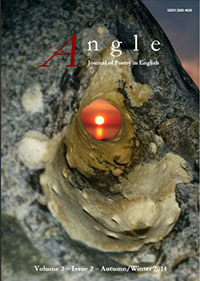 This cover image of the online poetry journal Angle mesmerized me. Though it’s from the Autumn/Winter 2014, Amy Wiseman’s photo, “Sunset Through Hag Stone on Cromer Beach,” warmed me through and has me looking forward to summer.
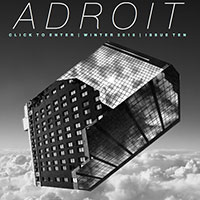 The online Adroit Journal regularly features cool cover art. The last several issues have a “floaty” theme about them. “Whirl” is an award-winning piece by Jedidiah Gist, a freshman at Clemson University.
Spread the word!
American Life in Poetry :: Kathleen Aguero
American Life in Poetry: Column 517
BY TED KOOSER, U.S. POET LAUREATE
The Dalai Llama has said that dying is just getting a new set of clothes. Here’s an interesting take on what it may be like for the newly departed, casting off their burdens and moving with enthusiasm into the next world. Kathleen Aguero lives in Massachusetts.
Send Off
The dead are having a party without us.
They’ve left our worries behind.
What a bore we’ve become
with our resentment and sorrow,
like former lovers united
for once by our common complaints.
Meanwhile the dead, shedding pilled sweaters,
annoying habits, have become
glamorous Western celebrities
gone off to learn meditation.
We trudge home through snow
to a burst pipe,
broken furnace, looking
up at the sky where we imagine
they journey to wish them bon voyage,
waving till the jet on which they travel
first class is out of sight—
only the code of its vapor trail left behind.
American Life in Poetry is made possible by The Poetry Foundation (www.poetryfoundation.org), publisher of Poetry magazine. It is also supported by the Department of English at the University of Nebraska-Lincoln. Poem copyright ©2013 by Kathleen Aguero from her most recent book of poems, After That, (Tiger Bark Press, 2013). Poem reprinted by permission of Kathleen Aguero and the publisher. Introduction copyright © 2015 by The Poetry Foundation. The introduction’s author, Ted Kooser, served as United States Poet Laureate Consultant in Poetry to the Library of Congress from 2004-2006. We do not accept unsolicited manuscripts.
Spread the word!
SubTerrain Eating Meat & Lush Triumphant
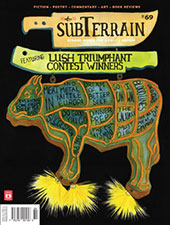 Issue #69 of SubTerrain: Strong Words for a Polite Nation is the result of a call for submissions on the theme of Meat – animal flesh that is eaten for food. Editor Brian Kaufman opens with his editorial “Conflicted, in Carnivore Land,” in which he writes that wading “into the thorny debate on meat consumption” was not intended. Still, he understands there may be just such perceptions with consequences: “While this issue is not intended to be a celebration of meat consumption so much as an exploration into our relationship with meat, we leave ourselves open to the flood of responses from the vegetarians and vegans – please send your letters in!”
This issue also includes winning entries from the 2014 Lush Triumphant Literary Awards:
Fiction
Winner: Vickie Weaver (Hagerstown, IN) for “Suggestion”
Poetry
Winner: Matt Whiteman (Vancouver, BC) for “Do Good, You Go”
Creative Non-fiction
Winner: George Ilsley (Vancouver, BC) for “Storytelling”
Spread the word!
Event Non-Fiction 2015 Contest Winners
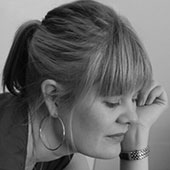
Event: Poetry and Prose, the Douglas College Review, issue 43.3 features the winners of the 2014 Non-Fiction Contest judged by Deborah Campbell [pictured], author of A Disappearnce in Damascus (August 2015, Knopf Canada).
 “Vocational Rehabilitation” by Hilary Dean
Scarborough, ON
“Whatever It Is” by Zachary Hug
West Hollywood, CA, USA
“Twenty Miles Above the Limit” by Alessandra Naccarato
Toronto, ON
The other short-listed entries can be found here.
Spread the word!
Segurson on Travel and the Arts
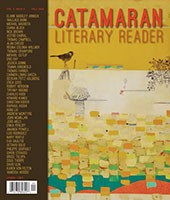
I enjoy reading editor introductions to publications as much as the content itself sometimes. Readers and writers alike can be duly informed of the ‘sensibilities’ of a publication based on what they’ll find in those brief opening notes. In her opening letter to the Fall 2014 Catamaran Literary Reader, Founding Editor Catherine Segurson gives much to inform as well as contemplate:
 “The freedome to move, to travel and explore, is core to our being. Pulling up roots and heading off to parts unknown frees us from our patterned lives and promotes growth. The journey can be both liberating and terrifying, filled with wonder and potential dangers, every step a lesson about the world and about ourselves – how we deal with the unexpected, how we cope with not knowing what the next turn in the road will bring.”
. . .
“We don’t have to travel halfway around the world or to distant planets to experience the wonder of what it means to be alive. As long as we are fully aware, even a walk around the block can inspire us; closely studying the structure of a primrose can add to our view of the world. These are lessons we learn from art and litearature as well. Writers, artists, and scientists are in the business of examining life and revealing what they’ve discovered – this, in turn, benefits us as readers and gallery visitors.”
Following these sentiments is much to support Segurson’s perspective, in poetry, fiction, nonfiction, and art (including photography, sculpture, paintings, mixed media, and more – all in full color!). Samples of the artwork and written works published in this issue can be read on the publication’s website.
[Cover art: Candy Tree by Michael Cutlip, 2011, mixed media on panel, 40 x 48 in]
Spread the word!
Malahat Review Contest Winners
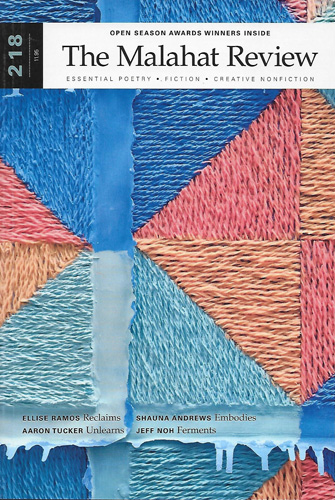 The Malahat Review #189 includes winners of the 2014 Far Horizons Award for Poetry and the 2014 Constance Rooke Creative Nonfiction Prize.
Far Horizons Award for Poetry winner Laura Ritland’s poem “Vincent, in the Dream of Zundert” can be read on the publication’s website, along with an interview with her regarding the award.
“Venn Diagrams” the Constance Rooke Creative Nonfiction Prize winning piece by Rebecca Foust is only available in print, but the website includes an interview with Foust as well.
Spread the word!
Whitefish Review: Encouraging Young Writers
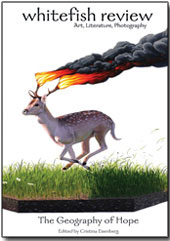 Whitefish Review‘s most recent issue, themed “The Geography of Hope,” includes a feature entitled “Freeflow: Getting into the minds and hearts of Whitefish High School students.” The editors worked with WHS teachers Nikki Reed and Eric Sawtelle to gather students and “gain insight on their sense of place in the mountains and the work they do with Project FREEFLOW (Flathead River Educational Effort for Focused Learning in Our Watersheds).”
Coupling literary magazines with young activists to support their work, give them an audience, and create a bond with the printed arts is a great concept other publications could emulate. In addition, while Whitefish Review charges a nominal fee for submissions, there is no charge for writers high school age and younger, encouraging their participation.
This is especially good to know, considering the publication’s latest call for submissions for a themed issue: Mythic Beasts & Monsters. If THAT doesn’t encourage young writers, I don’t know what will!
Until March 15, 2015: “Whitefish Review wants you to dig into supernatural history: Nessie, Sasquatch, and cousin Yeti—the Brontosaurus still rumbling somewhere deep in the Congo’s swamps. Fairies, Trolls, Dragons, Gods ‘n’ Demons. Our own Flathead Lake Monster. What natural models are these beasts based on? What human hopes and fears? Why do we seem to wish that those creatures are really out there? How big and strange is creation anyway — the real pageant of creatures? What about all the bizzarro beasts that are stranger than any legend? (Thank you to Douglas H. Chadwick for the writing prompt.)”
Spread the word!
Books :: Delta Dogs
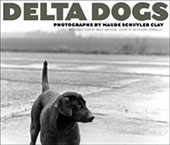 This new book, Delta Dogs from University Press of Mississippi, celebrates the canines who roam this most storied corner of Mississippi. Some of Clay’s photographs feature lone dogs dwarfed by kudzu-choked trees and hidden among the brambles next to plowed fields. In others, dogs travel in amiable packs, trotting toward a shared but mysterious adventure. Her Delta dogs are by turns soulful, eager, wary, resigned, menacing, and contented.
Writers Brad Watson and Beth Ann Fennelly ponder Clay’s dogs and their connections to the Delta, speculating about their role in the drama of everyday life and about their relationships to the humans who share this landscape with them. In a photographer’s afterword, Clay writes about discovering the beauty of her native land from within. She finds that the ubiquitous presence of the Delta dog gives scale, life, and sometimes even whimsy and intent to her Mississippi landscape.
Delta Dogs
By Maude Schuyler Clay
Introduction by Brad Watson
Essay by Beth Ann Fennelly
96 pp. / 10.5 X 9 inches / 70 duotone photographs
[Text from the publisher’s website.]
Spread the word!
Lit Mag Covers :: Picks of the Week
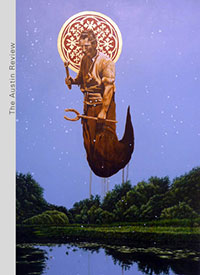
In addition to featuring Pulitzer Prize winning poet James Tate, “captivating fiction and nonfiction,” the cover of The Austin Review issue 3 is equally captivating. “Iron Age” is a work by Austin local Irish artist John Mulvany.
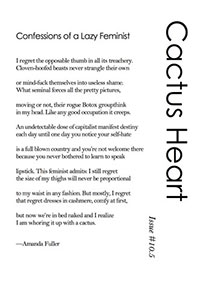
Nope. No stunning imagery here. Instead, I was completely drawn to the cleaver concept of printing one of the publication’s submissions on the front cover. I’ve seen this done on the back cover, but not the front. Cactus Heart #10 is an e-issue, with #10.5 this print version. Featured: “Confessions of a Lazy Feminist” by Amanda Fuller.
Spread the word!
Cincinnati Review: So Much to Recommend!
The most recent issue of Cincinnati Review is unique for a number of reasons. The issue comes with a separately printed, full-color graphic novel, Moth: The Play written by Declan Greene and illustrated by Gabe Ostley. Check out this sweet YouTube video The Making of Moth for a teaser.
The publication also received a grant from the National Endowment for the Arts that allowed the editors to focus on longer forms. “In fiction, this includes several extended stories. In poetry, sequences and long poems lead off each section.” In total, this issue offers almost one hundred additional pages of fiction and poetry.
 And finally, the magazine features a unique partnering of music and poetry. Award-winner composer of chamber works Ellen Ruth Harrison has created music to express three poems by Jakob Stein, originally printed in the Summer 2008 issue. The full score for “Sefiros” appears in this issue along with the reprinted poems and introduction by Poetry Editor Don Bogen. Additionally, the art-song will be performed in the Robert J. Werner Recital Hall at UC’s College-Conservatory of Music on Monday February 16, 2015 at 8 p.m. A podcast of the performance will be posted on the publication’s website following the event.
I think that’s quite enough to recommend, don’t you?
Spread the word!
Green Mountains Review – 2014
This issue of Green Mountains Review focuses on different moments, how writers choose to capture those moments, what they bring into those moments, what they take out of those moments, and what these shared moments can provide to the reader. Every piece of work seems to say “This is a moment that has happened or is happening and how, dear reader, will you handle it?” Continue reading “Green Mountains Review – 2014”
Spread the word!
The Antioch Review – Fall 2014
The Fall 2014 issue of The Antioch Review took on the theme of what they have chosen to call “word trucks,” which are similar to “food trucks.” The Antioch Review positions themselves to be like a food truck, “serving up a variety of dishes that were intended to stimulate the intellectual palate with ‘the best words in the best order.’” In order to stimulate the palate of every reader, this issue is packed with essays, poetry, fiction, and reviews, thoughtfully crafted and organized. Continue reading “The Antioch Review – Fall 2014”
Spread the word!
Gigantic Sequins – 2014
Literature is at its best when it resonates, when the reader is inclined to make connections to other texts, genres, and media in an effort to make sense of the work at hand. The resonant quality of the summer issue of Gigantic Sequins is high, indebted to the finely crafted works within its pages. According to Editor-in-chief Kimberly Ann Southwick, “The whole reason we do this thing is to present you some of the finest writers and artists around these days.” In this issue, they have fulfilled this promise. Continue reading “Gigantic Sequins – 2014”
Spread the word!
Left Curve – 2015
For their final print issue, after the recent passing of their editor and publisher, Csaba Polony, Left Curve provides readers with a strong collection of essays, poetry, and a variety of other musings, including a play and an interview with artists Victor and Margarita Tupitsyn. Although the journal will continue to make use of their website, the final hard copy, like Dylan Thomas suggests in his canonized villanelle, does not go gentle into that good night. The selections are designed, written, and selected by thinkers. Continue reading “Left Curve – 2015”
Spread the word!
Ekphrasis – Fall/Winter 2014
Returning to “Girl Eating a Bird” by Vanessa Zimmer-Powell published in this issue of Ekphrasis is becoming a habit. The language haunts as it depicts, surmises as it reveals. In just ten lines, the poem written after viewing Rene Magritte’s painting, Girl Eating a Bird, exposes more of the painting and its subject. The first line “She chewed open cardinal” evokes in iamb, trochee, and dactyl, a nearly cannibalistic gnaw at the bone. In the next line, in the single syllable “raw,” a reader might feel a twinge of sulfuric delight before reading on to the satisfying end. “She won’t stop / until it is well tasted,” and neither will readers. Continue reading “Ekphrasis – Fall/Winter 2014”
Spread the word!
Glimmer Train Stories – Winter 2014
In my admittedly brief career as a reviewer, I’ve not encountered any literary journals that concentrate almost exclusively on the short story. I really like the idea, and obviously so do many other readers. Two differences I noticed about Glimmer Train Stories: this is the only lit mag I’ve read so far that isn’t connected to a college or university; and it’s the only one that includes a bookmarker as a bonus. Continue reading “Glimmer Train Stories – Winter 2014”
Spread the word!
The Antigonish Review – Autumn 2014
I’m honored to review this particular issue of The Antigonish Review because it announces the 2014 poetry and fiction contest winners. I’m glad I wasn’t a judge. It must have been an agonizing process to glean the wheat—the winners—from what couldn’t possibly have been literary chaff. Continue reading “The Antigonish Review – Autumn 2014”
Spread the word!
Main Street Rag – Fall 2014
The Main Street Rag has a different vibe from your distantly intellectual, even-tempered literary journal. It’s unpredictable, quirky. At the very beginning, Publisher/Editor M. Scott Douglass writes in The Front Seat column about why the issue is late and about the kerfuffle of the North Carolina governor inserting himself into the selection of state poet laureate. When he’s had his say on these topics, he directs us to The Back Seat (distinguished by cream-colored pages) toward the end of the issue, where he takes on the U.S. Senate race in North Carolina. This is a hands-on, opinionated rag. Continue reading “Main Street Rag – Fall 2014”
Spread the word!
Enizagam – 2014
If Volume 8 of Enizagam is an accurate measure, age is no indicator of ability. The literary magazine is produced by 9th-12th grade students at the School of Literary Arts at Oakland School for the Arts in Oakland, California. The urban public arts charter school students design, edit, and publish the journal, and they do an excellent job. Enizagam is a beautifully designed read, full of the kind of poetry and fiction that not only delights, but sticks with the reader long after putting the publication down. Continue reading “Enizagam – 2014”
Spread the word!
GreenPrints – Winter 2015
The centennial of anything is generally cause for celebration, but when one is an independent gardening magazine with homegrown roots (pun intended) and a lot of heart, reaching Issue 100 is an even more exciting accomplishment. Issue 100 of GreenPrints does not disappoint. It is a celebration of not only the gardening and gardeners GreenPrints regularly embraces, but also the magazine itself and all those whose impassioned writing is surely on par with their artfully tended begonias and apricot trees. Continue reading “GreenPrints – Winter 2015”
Spread the word!
Eleven Eleven – 2014
Not long after opening Eleven Eleven Issue 17, the reader finds two photographs by Ken Morisawa (“Fishman speed light #4” and “Fishman #18”). The two black and white images ostensibly depict a man diving into dark water, surrounded by chaos and a disturbance of bubbles. One may read this in other ways, but it strikes me as a man diving into the wild, the unknown, a bold and determined move. He may not know what to expect, but he jumps anyway. It is exhilarating. This interpretation fittingly mirrors the experience of opening Eleven Eleven. Continue reading “Eleven Eleven – 2014”
Spread the word!
Burnside Review – Winter 2014
When sitting down to read Burnside Review, I feel you have to be in the right mood: opening to something different with every turn of the page, and craving something that makes you see things in a new way. At my first sit-down, I wasn’t quite prepared, but during my second chance, I got lost in the words, wanting more when I had finished. Continue reading “Burnside Review – Winter 2014”
Spread the word!
Happy Valentine’s Day Poem
American Life in Poetry: Column 516
BY TED KOOSER, U.S. POET LAUREATE
Kurt Brown was a talented poet who died in 2013, and his posthumous selected and new poems opens with this touching late poem to his wife, Laure-Anne.
The Kiss
That kiss I failed to give you.
How can you forgive me?
The kiss I would have spent on you is still
There, within me. It will probably die there.
But it will be the last of me to die.
American Life in Poetry is made possible by The Poetry Foundation (www.poetryfoundation.org), publisher of Poetry magazine. It is also supported by the Department of English at the University of Nebraska-Lincoln. Poem copyright © 2014 by the Estate of Kurt Brown, “The Kiss,” from I’ve Come This Far to Say Hello: Poems Selected and New by Kurt Brown (Tiger Bark Press, 2014). Poem reprinted by permission of The Estate of Kurt Brown and Tiger Bark Press. Introduction copyright © 2015 by The Poetry Foundation. The introduction’s author, Ted Kooser, served as United States Poet Laureate Consultant in Poetry to the Library of Congress from 2004-2006. We do not accept unsolicited manuscripts.
Spread the word!
Freedom to Read Week Canada
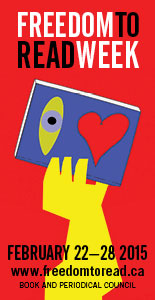 February 22-28, 2015 is Freedom to Read Week, an annual event that encourages Canadians to think about and reaffirm their commitment to intellectual freedom, which is guaranteed them under the Charter of Rights and Freedoms.
Freedom to Read Week encourages Canadians to focus on issues of intellectual freedom as they affect community, your province, country, and countries around the world. Whether a librarian, bookseller, educator, student, or member of the community, there are lots of ways you can help mark this annual event.
Each year, the Freedom to Read Kit includes a “Get Involved” section that provides activities designed for classroom instruction and discussion. “Get Involved” is also intended for citizens outside the classroom who wish to plan community events, and the organization’s website includes a number of ideas and resources as well.
Freedom to Read Week is organized by the Freedom of Expression Committee of the Book and Periodical Council.
Spread the word!
Special Issue :: New York School and Diaspora
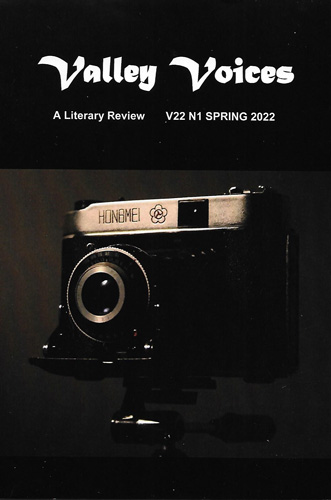 The newest issue of Valley Voices (Fall 2014, published by Mississippi Valley State University) is a special issue focused on New York School and Diaspora. Guest Editor Angela Ball writes in her introduction that she hosted a symposium on New York School Poetry and the South and extended the conversation of that gathering with this special issue, including the works of former U.S. Poet Laureate Billy Collins, Denise Duhamel, Barbara Hamby, David Kirby, and David Lehman, who had originally attended the symposium.
David Lehman agreed to join the project as Associate Editor, suggesting Angela Ball include blog entries she had written for Best American Poetry discussing the “big four poets of the New York School”: Frank O’Hara, Kenneth Koch, John Ashbery, and James Schuyler.
Also included in the issue are student essays and comments written as part of a seminar Ball was teaching at the time, “The Poetry of the New York School.” Ball writes that these “record what graduate students in poetry writing, fiction writing, and literature have to say about the special qualities of the New York School that make it a potent force for leavening and enlivening contemporary poetry in the South and elsewhere.”
Spread the word!
Women and the Global Imagination
 Prairie Schooner Winter 2014 includes a generous poetry portfolio edited by Alicia Suskin Ostriker: Women and the Global Imagination. In her preface, Ostriker writes:
“‘Imagination’ is a key word here. . . There is an amazing fullness of poetic imagination in these pages. The poets imagine their ancestors going back to ‘the first cave,’ as Venus Khoury-Ghata says, or to their immediate parents. They imagine freedom, and the struggle for freedom. They inventory the body and its appetites. They tell stories. They speak in the voices of invented or historical characters. . . There is no narrowly defined female aesthetic here. The poems are lyric, satiric, mythic, experimental, surreal, expansive, laconic, conversational, tender, angry, allegorical, oracular.”
Authors included in the portfolio: Judith Vollmer, Diana Garcia, Aliki Barnstone, Margo Berdeshevsky, Karen Alkalay-Gut, Dahlia Ravikovitch, Fiona Sze-Lorrain, Cynthia Hogue, Katie Bickham, Veronica Golos, Ann Fisher-Wirth, Anne Germanacos, Vénus Khoury-Ghata, Ladan Osman, Nathalie Handal, Rebecca Gayle Howell, Lorraine Healy, Ursula K. Le Guin, Naoko Fujimoto, Marilyn Krysl, Olga Sedakova, Tsitsi Jaji, Adélia Prado, Jeannie Vanasco, Judith H. Montgomery, Martha Collins, Liliana Ursu, Karthika Naïr, Batsirai E. Chigama, Suzanne Gardinier, Maria Kelson, and Eleanor Wilner.
Spread the word!
Iowa Review Tim McGinnis Award Winner
 Dinika M. Amaral, winner of the Iowa Review Tim McGinnis Award, has her story featured in the newest issue as well as online, along with a YouTube video of her reading and excerpt from the story. “No Good Deed Unpunished” is described by the editor as “a Hinglish tale of schoolgirl misadventures, comic and otherwise” and as providing “an ideal example of the sort of quirky creativity the McGinnis Award is meant to celebrate.”
At the end of each year, The Iowa Review editor and staff choose, from all the work published in their pages over the previous year, a piece that they think most fits the comic spirit of one-time contributor Tim McGinnis. The award comes with a $1000 prize.
Spread the word!
What’s New KENYON Review?
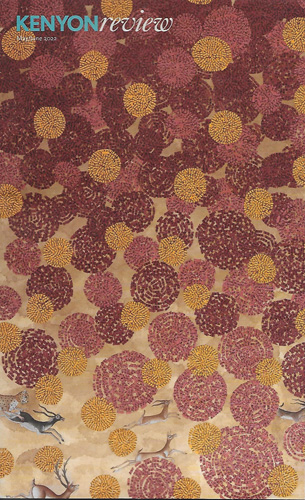 It was the change in format that first caught my eye with the new KENYON Review. Editor David H. Lynn comments on this altered physical appearance, but also a great deal more about how he and the staff and editors at Kenyon Review looked at the changing landscape of its readers to update the publication:
“I am delighted to present this first issue of a new volume year and with it the boldest revisions of design and frequency in the seventy-five-year trajectory of the Kenyon Review. Even that last ‘the’ has been challenged. More on that later. But note, please, that not only the look and feel of our magazine are dramatically new. It will now appear every two months, six times a year, rather than the quarterly iterations of many decades. All of this comes after two years of questions and debate and planning.”
Read Lynn’s full commentary here (and how he got cheeky with the “the”).
Spread the word!
Lit Mag Covers :: Picks of the Week
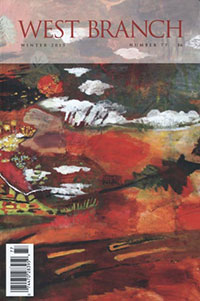
Still in the bleak of Michigan winter, I’m going for color first this week. West Branch Winter 2015 features Wetlands at Dawn by Sophia Heymans (2012, acrylic, papter mache, oil on board).
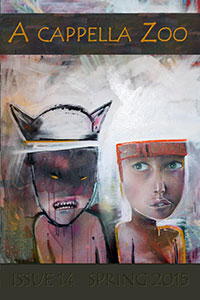
Inappropriate Fear, mixed paints on canvas by Julian Kimmings is the feature image on the cover of A cappella Zoo. “Fear makes the wolf look bigger,” is the accompanying text, appropriate perhaps for this publication of magic realism and slipstream stories.
Spread the word!
American Life in Poetry :: Paul S. Piper
American Life in Poetry: Column 515
BY TED KOOSER, U.S. POET LAUREATE
Dogs are smart enough to get people to take care of them, a skill that a lot of people haven’t learned, but they’re still wild at the heart. Paul S. Piper lives in Washington.
Dog and Snow
 Dog sees white. Arctic
light, the bright buzz in the brain
of pure crystal adrenaline. In a flash
he is out the door and across the street
looking for snowshoe hares, caribou, cats.
His wild ancestry ignited, Dog plunges
his nose into snow up to his eyes. He sees
his dreams. Master yells from the front porch
but Dog can’t hear him. Dog hears nothing
except the roar of the wind across the tundra, the ancient
existential cry of wolves, pure, devastating, hungry.
Time for crunchies. Taking many detours, Dog
returns to the porch. Let master think what he
wants. Freedom comes at a price.
American Life in Poetry is made possible by The Poetry Foundation (www.poetryfoundation.org), publisher of Poetry magazine. It is also supported by the Department of English at the University of Nebraska-Lincoln. Poem copyright ©2011 by Paul S. Piper from his most recent book of poems, Dogs and Other Poems, (Bird Dog Publishing, 2011). Poem reprinted by permission of Paul S. Piper and the publisher. Introduction copyright © 2015 by The Poetry Foundation. The introduction’s author, Ted Kooser, served as United States Poet Laureate Consultant in Poetry to the Library of Congress from 2004-2006. We do not accept unsolicited manuscripts.
Spread the word!
Encouraging Young Writers
Hanging Loose magazine, first published in 1966, includes a special section for “Writers of High School Age.” High school authors published receive the same fee as others selected for publication and two copies of the issue in which their work appears. “We feel a special responsibility to those young writers who look to us not only for possible publication but sometimes also for editorial advice,” write the editors, “which we are always happy to give when asked. Our work as editors is of course time-consuming, but we feel a strong commitment to give as much time and attention as possible to the work we receive from high school age writers.” Full guidelines for submissions can be found here.
NewPages also has a Young Authors Guide, a listing of publications written for and accepting submissions by young writers as well as contests for young writers. This is an ad-free space and all listings are vetted for ethical treatment of minors submitting writing for publication and contests. If you know of a publication or contest we could list here, please contact us. Encouraging young writers is essential!
Spread the word!
SRPR Editors’ Prize Winners
Spoon River Poetry Review Editors’ Prize 2014 contest winner, runners up and honorable mentions, selected by Joshua Corey, are all featured in the winter 2014 issue of Spoon River Poetry Review. First place winner Emma Bolden received $1000, an introduction included in the publication written by Corey, and an invitation to read at this year’s annual SRPR Lucia Getsi Reading Series, to be held in Bloomington, Illinois, in April 2015.
Winner
Emma Bolden, “It was no more predictable”
First Runner Up
Jonathan Soen, “Fragments from a Book”
Second Runner Up
Lynne Knight, “The Gospel of Infinity”
Honorable Mentions
Emma Bolden, “My little apparition, my little ghost”
Kathryn A Hindenlang, “This is the Nature”
Tori Grant Welhouse, “mor/bid”
Carine Topal, “Bone Jar: The Oven {An Elegy}”
Lynne Knight, “Sex”
The SRPR Editors’ Prize is an annual contest in which one winning poem is awarded $1,000, two runners-up are awarded $100 each, and 3-5 honorable mentions will be selected. All winning poems, honorable mentions, and several finalists are published. The annual deadline is postmark April 15.
Spread the word!
The End Is Nigh Contest Winners
Carolina Quarterly Winter 2014 issue features the winners of their “End Is Nigh” contest, in which the editors asked for “dispatches about anxious endings, anticipated apocalypses, doomsday prepping, or getting right with God and family before it all comes crashing down.” The pool of entries was so strong, contest Judge Jim Shepard selected two winners ($575 each + publication) and two runners up ($150 each + publication).
Grand Prize Winners
“When Trains Fall From Space” by Ian Bassingthwaighte
“Cold Snap” by Robin McLean
Runners Up
“Blood by Blood” by Dominic Russ-Combs
“A Brief Chronicle of Jeff and His Role in What is Colloquially Known as ‘The End of Civilization'” by Caitlin Campbell
The magazine originally announced that the winners and runners up would be published in separate issues, but all four appear in this issue (volume 64.2) along with commentary from Shepard on his selection, which can also be read here in the original announcement.
Spread the word!
February 2015 Book Reviews
February’s Book Reviews are now up! Check out what our reviewers have to say about tiles from Altaire Productions & Publications, University of Iowa Press, Burning Deck Press, Brooklyn Arts Press, Write Bloody Publishing, New Issues Press, Red Hen Press, and Pleiades Press. With only one fiction title covered this month, lovers of poetry have plenty to read about.
Spread the word!
Emergency Anthems
Alex Green’s collection of short prose is aptly titled Emergency Anthems. Brooklyn Arts Press wisely bills the book as a collection of “Short Fiction/Prose Poems,” leaving elbow-patched professor types to duke it out over finer genre distinctions. Alas, I regularly cling to genre like it’s a life-raft in wild waters. The stories/poems are presented as block paragraphs with justified left and right margins. The majority of these shorts don’t feature any traditional narrative arc, no building and releasing of tension. Without the floatation device of genre, the word “Anthem” feels like an appropriate designation for Green’s short bursts of prose. Continue reading “Emergency Anthems”
Spread the word!
Sylph
The poems in Sylph, Abigail Cloud’s debut collection, are comprised of multiple balancing acts. They are graceful, self-assured poems, beautifully executed with a tightly focused imagistic sensibility. But they are also searching, inquisitive poems—their arrivals are real-time events, self-discoveries. They have an airy quality, as the title of the collection would suggest (there are “wings” everywhere), yet are also deeply rooted in the material world. They are as at-home in myth and the spirit world, or the haunting voices in archives, as they are in the garden and in the home. Continue reading “Sylph”
Spread the word!
Once, Then
Once, Then by Andrea Scarpino is a collection of elegies that are caught in the tension of two worlds, the scientific and the spiritual. In attempting to understand the aftermath of loss, Scarpino turns to form, and her lyrical, shortly-woven lines sing. The collection often features the profiles of people, those closest to Scarpino, and also mythic figures such as Persephone and Achilles. What results is a poet deeply engaged with the world. Continue reading “Once, Then”
Spread the word!
Landscape with Plywood Silhouettes
Lyrical, honest, descriptive, Landscape with Plywood Silhouettes by Kerrin McCadden is a thoughtful meditation on wandering through a human landscape, one full of loss and desire. Often elegiac, this collection of poetry accepts the world before it, acknowledging the quotidian value of our lives while also seeing the beauty in it. Continue reading “Landscape with Plywood Silhouettes”
Spread the word!
Control Bird Alt Delete
What do a grass skirt, refrigerator, buttons, bones of a dairy cow, magnets, an old cake mix, and a spider all have in common? All, somehow impressively, appear in the first poem of Control Bird Alt Delete, a collection of poetry by Alexandria Peary. In it, Peary deconstructs our worlds and examines our environment from the perspective of deletion. If we destroy our natural resources to make products that will never deteriorate, what will exist of our world? Peary offers a world with unicorn rainbow stickers and fake lilacs. Continue reading “Control Bird Alt Delete”
Spread the word!
Corporate Relations
Corporate Relations opens with a series of broken analogies that illustrate the ridiculousness of the idea of corporate personhood. Even from the first section, “The Beautiful Life of Persona Ficta,” Jena Osman makes this ridiculousness plain: “it is a nightmare that Congress endorsed. mega-corporation as human group, the realm of hypothesis.” Continue reading “Corporate Relations”
Spread the word!
The Antigone Poems
Ancient wound. Politicians, monarchs, and religious fanatics still use this phrase to justify vengeance. Its literary applications are no less tragic. To give a Pulitzer and Nobel winning example, Eugene O’Neill knew how to channel that fury and apply it to his highly ordered dysfunctional universe. Continue reading “The Antigone Poems”
Spread the word!
Everyone I Love is a Stranger to Someone
The poetry in Everyone I Love is a Stranger to Someone by Annelyse Gelman is witty, comfortable, and contemporary. Nothing too heavy waits inside the bright blue cover, and even the heavier moments are lightened by Gelman’s sly humor, a welcome presence throughout the poems. Continue reading “Everyone I Love is a Stranger to Someone”
Spread the word!
MR Novella Issue
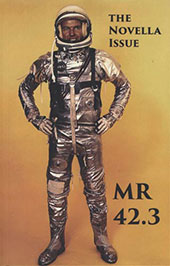 The newest issue of Mississippi Review (42.3), besides having a pretty swank cover image, is The Novella Issue, featuring works by only four authors: Katie Chase (46pp), Kevin A. Gonzalez (62pp), Jaimy Gordon (28pp), and Paola Peroni (25pp). Rare to see this kind of page dedication to the long form in an entire issue, making this a great collection for the long read.
Spread the word!
NER Welcomes New Poetry Editor
 New England Review editor, Carolyn Kuebler, introduces the publication’s new poetry editor, Rick Barot, in her Editor’s Note (v35.4). Not new to the publication, Barot was published in its pages in the past, then became a submissions reader. Kuebler writes that Barot “has a penchant for asking the hard questions, the big questions: What is NER for? What is our role in current events and conversations? What makes a piece of writing last beyond its immediate publication date? Must it, will it, should it? Why is so much of what we select so dark?” He turns these questions into conversation, and Kuebler shares what he comes to when considering works for the pages of NER. The Editor’s Note can be read in full here.
Spread the word!
Amiri Baraka Special Folio
 The newest issue of Indiana Review includes a special folio, “Understanding Readiness,” which is “meant to present diverse explorations and meditations on the impact of the writing, the figure, and political influence of Amiri Baraka” Poetry Editor Nandi Comer and Editor Britt Ashley write, “The voices in this section share Baraka’s aesthetic bravery – one that grabs its audience, demanding we listen to issues concerning contemporary American life. It also must be noted that the diversity in aesthetic and background of these writers speaks to the span of Baraka’s reach.”
Writers contributing to this folio: francine j. harris, Patricia Smith, Roger Reeves, Tarfiah Faizullah, Toi Derricotte, Matthew Shenoda, and avery r. young. Included with the written works are Amiri Baraka’s original drawings curated from Indiana University’s Lily Library.
Spread the word!
Conium Collectible
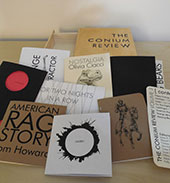 Volume 3 of Conium Review is one of the most unique collectible editions of a literary magazine I’ve seen to date. “This is a book for book lovers,” say the editors. The “container” is a hand-stamped wooden box, conditioned with linseed, mineral, and orange oils. Inside are eight new stories from Olivia Ciacci, Tom Howard, D. V. Klenak, Jan LaPerle, Zach Powers, Christine Texeira, and Meeah Williams. Each individual micro-chapbook, broadside, and booklet is printed on unique paper, including parchment, linen, and recylced stock. This volume is also available in the standard perfect bound book form for non-collectors simply looking for good reading. Both can be ordered from the publication’s website.
Spread the word!
2014 Gulf Coast Prize Winners Featured
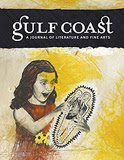
The Winter/Spring 2015 issue of Gulf Coast: A Journal of Literature and Fine Arts features the winners of the 2014 Gulf Coast Prizes:
 Poetry
“Engagement Party, Georgia” by Raena Shirali
Selected by Rachel Zucker
Nonfiction
“Love Drones” by Noam Dorr
Selected by John D’Agata
Fiction
“Kansas, America, 1899” by Edward McPherson
Selected by Andrea Barrett
The deadline for this annual prize is March 22, 2015. This year’s judges are Sarah Shun-lien Bynum (Fiction), Maggie Nelson (Nonfiction), and Carl Phillips (Poetry). The contest awards publication and $1500 each to the best poem, essay, and short story, as well as $250 to two honorable mentions in each genre. The winners will appear in Gulf Coast 28.1, due out in Fall 2015, and all entries will be considered for paid publication on the Gulf Coast website as Online Exclusives. The reading fee includes a one-year subscription to Gulf Coast and submissions are accepted both online and via postal mail.