At the NewPages Blog readers and writers can catch up with their favorite literary and alternative magazines, independent and university presses, creative writing programs, and writing and literary events. Find new books, new issue announcements, contest winners, and so much more!
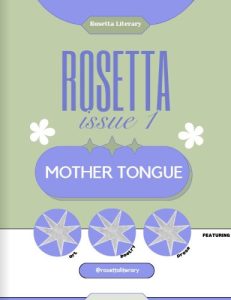
Rosetta Literary is a new online international literary magazine promoting diverse global voices that favors exploring the intersection of culture and language to challenge stigma and bias. This authentic, original, and creative publication connects writers and artists worldwide through inclusive storytelling and especially welcomes submissions from first-generation and low-income creators with a special focus on youth 14-25.
The name of the publication, the editors share, is “inspired by the Rosetta Stone and its global symbolism of diversity, multilingualism, and ‘deciphering’ the inner human spirit. Just like the Stone, we seek to be a beacon of culture through artistic expression.”
There is always something a little magical about stories that invite us to make assumptions only to quietly turn those assumptions on their heads. What seems obvious at the outset proves to be something entirely different by the end, making the emotional payoff all the more poignant. That kind of narrative confidence requires a careful balance of misdirection and honesty, and Wendy Elizabeth Wallace achieves it beautifully in “Help Is on the Way.”
Wendy Elizabeth Wallace’s “Help Is on the Way” begins with a familiar winter disaster: a driver has crashed into the utility pole outside the narrator’s house. As she rushes out to help, she continually measures herself against Ryan, the former partner who always seemed to know exactly what to do when accidents happened on the dangerous curve outside their home.
At first, Wallace encourages readers to assume Ryan is gone because of tragedy. Instead, Wallace gradually reveals a far messier and more human truth. Through a series of increasingly awkward interactions with the injured driver, we learn that the narrator’s loneliness is self-inflicted: Ryan left after she cheated on him, and she is struggling with the consequences of that loss. Her attempts to recreate Ryan’s warmth and competence only expose the gulf between who she wants to be and who she is.
The story’s painful climax arrives when the narrator realizes she never called 911—a basic step Ryan always handled. Even after the accident victim leaves in frustration and emergency responders finally arrive, the narrator clings to Ryan’s reassuring text message despite recognizing its hollowness. Wallace crafts an uncomfortable, compassionate portrait of self-deception, regret, and the desperate hope that next time we might become the person we wish we already were.
Recommended Reading, curated by Managing Editor Nicole Foor, is one of the many features included in our weekly newsletter. Subscribe to receive new issues of literary magazines, book releases, bookstore updates, writing prompts, and submission opportunities, all delivered straight to your inbox.
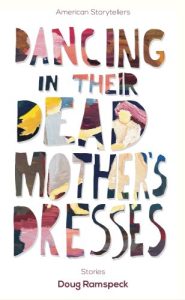
Dancing in Their Dead Mother’s Dresses by Doug Ramspeck Wolfson Press, August 2026 (Pre-order available)
In Dancing in Their Dead Mother’s Dresses, Doug Ramspeck’s luminous stories feel set as much in the characters’ minds as they are set in the Midwest. The muddy Midwestern rivers, train bridges, and winter lakes are sources of metaphors that help the characters make sense of unsettling realities: dead mothers, absent fathers, sick siblings, inscrutable friends, and intriguing neighbors. Dancing in Their Dead Mother’s Dresses calls to mind other language-rich story collections about the harsh realities of the urban and rural Midwest: The Luck of the Fall by fellow poet Jim Daniels and American Salvage by Bonnie Jo Campbell. Ramspeck shares an interest in traumatic events that destabilize our world. In our circumscribed realities, where mothers die but children live on, or brothers die and siblings must live on, sometimes all we have are the worlds of our imaginations.
“Rarely does a book hold me so firmly in its thrall, but Dancing in Their Dead Mother’s Dresses did from its first page to its last. The writing is masterful, and the characters are indelible. I loved these stories.” — Christine Sneed, author of The Virginity of Famous Men
Doug Ramspeck taught at The Ohio State University and now lives in Black Mountain, NC.
A trip to The Lake sounds like a great way to spend a hot summer’s afternoon, so lucky for readers, the July 2026 of this journal of poetry and poetics is now online featuring new work by Gemma Blakeley, Marilyn Cavvichia, Joe Garvey, Eric D. Goodman, Marcia Roberts Gregorio, Harriet Pinklock, J. R. Solonche, Shogo Olalekan Uthman, Ping Yee, and Lee Yongha.
The Lake offers readers reviews of newly published books of poetry. For readers this July 2026, Hannah Stone reviews Life Immediately by Lily Blacksell, Usha Kishore reviews Map of the Self by Mona Dash, Dustin Pickering reviews The Tao According to Calvin Coolidge by Charles Rammelkamp, and Loralee Clark reviews Love Song by Ann Chinnis.
Unique to The Lake are “One Poem Reviews” which share a sample poem from a recently published collections, with this issue spotlighting poems by both Martin Agee and Maggie Mackay. Poets with published books who would like to share a poem with The Lake readers only need to email Editor John Murphy to start the process.
Editor John Murphy has had his own work published in Notes, which can be purchased on The Lake‘s SHOP page. The poems in this book focus on artists and producers in the music industry, covering all major genres: rock, jazz and blues. Some of the artists: Joni Mitchell, John Mayall, Cleo Laine, Chuck Berry, Brian Wilson , Buddy Holly, Jimi Hendrix, and more.
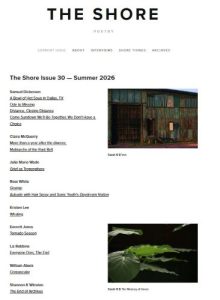
The Shore Issue 30!! has popped just in time for some summer reading! It features hot new poems by Samuel Dickerson, Claire McQuerry, Julie Marie Wade, Ross White, Kristen Lee, Everett Jones, Liz Robbins, William Alexis, Shannon K Winston, Verona Charman, Heather Hamilton, M J Young, Abraham Porschet, John Estes, Leqi (Angela) Xiao, Maggie Rue Hess, Maggie Wang, Emilee Wigglesworth, Alexa Doran, David Moolten, Paul Potts, Dan Albergotti, Matthew Toth, Michelle Turner, Peyton Cole, Daniel DeVaughn, Jennifer Bullis, Christine Light, Jingxuan William Zhuang, Chris Monier, Daniel Amster, Carly Osborne, Grant Clauser, Christy Prahl, Barbara Daniels, Cici Zhang, Peter Leight, Tom Laichas, Svetlana Litvinchuk, Olivia Burgess, Cole Pragides, and Natasha Kochicheril Moni. It also features vivid art by Sarah N B!
Fate seems determined to rain on our parade this year, with Mother Nature volunteering to handle the pyrotechnics across Michigan. Hopefully the oppressive heat and humidity that settled over much of the country this week has started to loosen its grip. If you’re celebrating the Fourth, here’s hoping the rain and storms wait until the festivities are over.
Don’t have plans, or need a backup if the forecast gets its way? NewPages is back with our first Weekly Roundup of submission opportunities for July, plus a creative prompt to help you make a little noise of your own this holiday weekend.
Submission Opportunities: 107 Ways to Share Your Work
Looking for places to submit your writing, artwork, or hybrid work? You’re in the right place.
Each week, NewPages curates and updates a comprehensive list of open submission opportunities, including literary magazines, journals, presses, contests, and calls for themed issues. Opportunities span poetry, fiction, nonfiction, cross-genre, visual art, and more, with options for both emerging and established writers.
It happens to us all. Nodding off at the keyboard mid-sentence. Eyes drooping during a show, reopening on a completely different episode (or worse, the credits). You weren’t sleeping. You were resting your eyes. Sure. Whatever helps.
And it only gets more complicated with age, doesn’t it? That surplus of energy we once took completely for granted has quietly negotiated itself down. Then factor in circumstances: tossing and turning, unable to find a comfortable position, a body and mind locked in high alert waiting for a call, running through a list, going past the point of no return out of sheer stubbornness and a flat refusal to admit there are limits.
There’s a word for the space where sleep and waking can’t agree on who’s in charge. Liminal, from the Latin limen, meaning threshold. Not in. Not out. Suspended at the door.
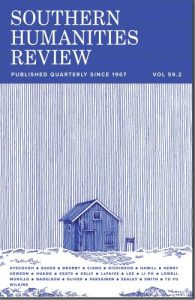
Southern Humanities Review 59.2 is a bird-filled summer issue featuring reprinted poetry from an exhibit titled Radical Naturalism: Lyric Birdscapes, including poems from Mary Oliver and Maggie Smith, selected by Nicole Sealey as Poet-in-Residence at The Jule Collins Smith Museum of Fine Art at Auburn University. The issue also features poetry from David Baker, James Ciano, Emily Dickinson, John Keats, Donika Kelly, Li-Young Lee, Li Po translated by Sam Hamill, John Murillo, Nicole Sealey, Tu Fu translated by Florence Ayscough and Amy Lowell, and Joe Wilkins; nonfiction from Matthew E. Henry and Courtney Ann LaFaive; and fiction by Taylor Brorby, Elissa C. Huang, Scott Nadelson, and Keija Parssinene. The cover art is “Solitude” by Katie Hewson.
Bear Review online journal issue 12.2 welcome a wide variety of poetry, reading submissions year-round to publish in two issues: spring and fall. “We do admire experimentation and blurred genres,” note the editors, who also hope to give readers “a view of the many and varied poetries written presently in English.”
This issue features the 2025 Michelle Boisseau Poetry Prize Winner Isaac Salazar, Runner Up Alexa Doran, and works by each finalist: KT Herr, Ellen Kombiyil, Arlene DeMaris, and Isaac Salazar.
Readers can also enjoy new poems by July Westhale, Jess Yuan, Nico Amador, Sarah Lynn Hurd, Flora Field, Jennifer Moore, Maria Picone, Nichole Turnbloom, Silvia Bonilla, Morgan L. Jenkins, John Fadely, Sarah Brockhaus, Keith Woodruff, Cecelia Hagen, Austin Segrest, Angie Macri, Joannie Stangeland, Emily Adams-Aucoin, Miriam Milena, Catherine Broadwall, Ashley Vogel, Ha Kiet Chau, and Clayton Adam Clark.
A.D. Nauman’s “Unbound” begins like a ghost story, or perhaps a childhood hallucination brought on by abandonment, when the narrator’s father leaves in 1972 and a piano begins to play by itself in the night. But what unfolds is something much larger: a coming-of-age story that interrogates identity, gender, desire, and the cost of forcing oneself into a shape that never quite fits.
Beryl’s relationship with Masha is especially revealing. The two are drawn together because they are both “strange”—outsiders in a world that rewards sameness. Beryl clings to Masha not just out of friendship but out of recognition, a sense of shared difference. Yet even here, identity proves unstable. Beryl tries to make sense of her feelings using the limited language available to her, wondering if she is “homo,” even as her desires resist easy categorization—split between her fascination with boys and the intimacy she shares with Masha.
There’s an irony in the fact that the Quaker school, ostensibly unconventional, becomes a place of relative acceptance, while the larger social world continues to enforce rigid norms. Over time, that tension sharpens: Masha eventually embraces her identity and, in doing so, becomes legible—almost “normal” within a framework that can now name her. Beryl, however, remains caught much longer in that in-between space, unable to fully inhabit any category offered to her.
As the story moves forward, Beryl tries on versions of herself—performing femininity, shaping herself into something recognizable—while the presence of Albert (a remnant of those earlier years when she and Masha claimed to be inhabited by spirits) persists as a deeper truth she cannot fully articulate. Only decades later does she claim it outright: “I’m a gay man in a female body.” What makes “Unbound” so compelling is not just this realization, but the long, uneven path toward it—where belonging is always provisional, and identity resists even the categories that seem, for others, to offer clarity.
Recommended Reading, curated by Managing Editor Nicole Foor, is just one part of our weekly newsletter. Subscribe to get new lit mags, books, bookstore updates, inspiration prompts, and submission opportunities delivered straight to your inbox.
Cleaver Magazine showcases innovative literary and visual art by both emerging and established creators, publishing poetry, fiction, essays, flash prose, dramatic monologues, and artwork open access online. The Spring 2026 issue opens with the Visual Poetics Contest Finalists as selected by Judge Kazim Ali and features works by Warren C. Longmire, Amy Beth Sisson, Alison Powell, Jack Brummett, Beth Kephart, Kristen Gallagher, Alan Pelaez Lopez, and G. Dylan Sessoms. The issue also includes fiction by EJ Green, David Driscoll, June Martin, Tracy Morin; flash prose by Jamie Holland, Lauren Woods, Ellen Winn, Karen Laws, Jacqueline Doyle, Christopher Passante, Debbie Weaver, Brooke Middlebrook, Laurie Blauner; and creative nonfiction by Amy Beth Sisson. Clifford Thompson’s visual narrative, “CONNECTICUS DIGGS — Cultural Detective Episode 5: The Path” closes out the issue.
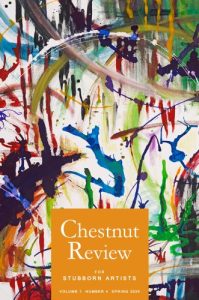
Celebrating seven years of publication, Chestnut Review publishes poetry, short fiction, flash fiction, art, and photography from creators around the globe. A selective, writer-focused publication, Chestnut Review releases quarterly online issues and an annual print edition. The journal compensates contributors and staff and responds to all submissions within 30 days.
Their newest online issue, Spring 2026, features two interviews: Kate Caraballo interviews Kate Garcia, author of Bartending for a Stamp with my Face on It, and Maria S. Picone interviews Jad Josey, author of Cast Your Longest Shadow. Readers will also enjoy exploring new poetry by Daniel Aôndona, Donna Vorreyer, Hayley Clin, Jad Josey, Kate Garcia, Leonardo Chung, Spencer Jewell, Talan Tee, Wale Ayinla, Zixuan Angel Xin, Zoleikha Baloch; prose by Audrey Coldwell, Chip Houser, Haliru Ali Musa, Sarah Juma, Tina Kapousis; artwork by Adishi Gupta, Barbara Bitondo, Odunayo Abiodun, Ojo Olaniyi, and Shee Gomes. Chestnut Review 7:4 Launch Party – Spring 2026 with select authors reading their works is available on YouTube.
Chestnut Review Spring 2026 cover art is Eight by Emily Rankin: “Using layers of color and tangled shapes, Eight explores the intertwined nature of dreaming and wakefulness, memory and reality, and the confusing network of connections we have with one another.”
Happy Friday! Can you believe this is our final submissions roundup for June? How is 2026 already halfway over? Someone once said time flies when you’re having fun—but they clearly weren’t an adult, where time seems to fly no matter what.
That’s life, isn’t it?
In any case, enjoy this last roundup of the month—and don’t miss those end-of-June deadlines! Need a spark before you submit? Check out the latest inspiration prompt below.
Submission Opportunities: 116 Ways to Share Your Work
Looking for places to submit your writing, artwork, or hybrid work? You’re in the right place.
Each week, NewPages curates and updates a comprehensive list of open submission opportunities, including literary magazines, journals, presses, contests, and calls for themed issues. Opportunities span poetry, fiction, nonfiction, cross-genre, visual art, and more, with options for both emerging and established writers.
From 2019 to 2022, I was a Pampered Chef consultant on top of my day job as NewPages Managing Editor. The gig itself was nice on paper: work from home, run your parties on Facebook, no garage full of inventory, no hauling gadgets into someone’s kitchen. Low pressure, low risk, or so it seemed.
Here’s what the recruitment pitch doesn’t tell you: the whole thing runs on connection, and “200+ friends” on Facebook is not the same thing as 200 real, tangible relationships. Some of those names were core friends. A lot of them were distant family, old coworkers, people I’d liked a few photos for over the years but hadn’t actually talked to in forever…if I knew them personally at all. Selling requires reaching past that surface layer into something real enough to ask someone for their time, their money, their living room—and that gap between the friend list and the actual friendship was where most of the exhaustion lived.
Then the pandemic hit, and the math got worse. Asking people to host a virtual party during a year of layoffs and economic free-fall didn’t just feel awkward, it got you shamed for it. Guilted for daring to ask, even gently, even apologetically. I was supposed to keep hitting a quota built on relationships that were mostly performance, during a year when even real relationships were straining under the weight of everything else.
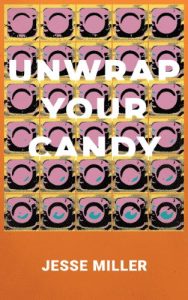
Unwrap Your Candy: A Bloomsday Novel by Jesse Miller LJMcD Communications, June 16, 2026
Eluding narrative structure conventions, Jesse Miller’s cinematic Unwrap Your Candy: A Bloomsday Novel is a novel about being madly in love with — and consequently, blissfully intoxicated by — language. If you had planted James Joyce’s wayward, disjointed, but actually very loving son in contemporary America, he might have written this book.
Unwrap Your Candy: A Bloomsday Novel is the story of Thom Evans and a day/night he spends after he leaves his miserable job at a condom factory for a night on the town with his compellingly attractive, but seriously wounded lover, Samantha. Over the course of the evening, in much the same way that Leopold Bloom and his surrogate son, Stephen Dedalus, bumbled through Joyce’s Dublin, Thom and his memories of his father drunkenly bumble through a modern American city in all its glitter and crassness.
“An energetic but also tragicomic depiction of industrial-corporate life in ways that alternate between the mundane and grotesque. Irreverent, occasionally surreal, and with structural quirks, the prose is vivacious. Shades of The Pale King run throughout the novel.” — Daniel Davis Wood, author of At the Edge of the Solid World
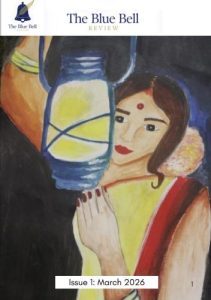
Within its first year, The Blue Bell Review has earned widespread trust within the literary community, leading to numerous collaborations with organizations and youth-led initiatives. Recent partnerships include a Young Writers’ Ekphrastic Contest with Phosphorescent Lit, creative arts and writing workshops for rural students in Hosapete with the Sakhi Trust, and ongoing projects with the Sama Foundation and Beyond the Lines. The platform attracts contributors at all levels, from emerging writers seeking certificates to established authors participating in in-depth interviews. Its international reach is reflected in submissions from India, the United States, Canada, Indonesia, Luxembourg, and South Korea.
The Blue Bell Review publishes quarterly issues with occasional special issues as well as regularly updated content on their website, accepting a wide range of submissions in writing (poetry, prose, essays, reviews, op-eds, travelogues, and articles), art (drawings, paintings, collages, 3D art, digital art, Best-Out-Of-Waste, etc.), and multimedia (animations, audio, video, apps, and music). Each issue is published as an HTML Flipbook, PDF, free download, and open online access.
If you haven’t subscribed yet to our weekly newsletter (seriously—what are you waiting for?), you can dive into this week’s recommended reading here. Selections come mainly from literary magazines and websites and are curated based on Managing Editor Nicole Foor’s tastes.
“Burning Juniper” by Bruce McRae
There’s something in the language and word choices of Bruce McRae’s “Burning Juniper” that feels like an old-time spell—talk of witches, warding off evil, summoning something protective—yet it unfolds alongside a relationship rendered with striking intimacy. The poem seems to hover at a point of farewell, arriving at that surprising, almost offhand “when o’clock in the fare-thee-well,” even as it insists on a love that feels boundless: someone the speaker would “wed every day for a year. / Infinite love. Eternal honeymoon.” That juxtaposition—of enchantment and ending, of something slipping away and something that feels like it should last forever—gives the poem its quiet charge.
Read the poem in the Spring 2026 issue ofBloodroot.
“The Horror of Forward Motion” by John Grey
As we get older, when more and more time comes to stand between youth and the present, you can’t help but feel how brutal forward motion can be. John Grey captures that unease perfectly in “The Horror of Forward Motion.” Unlike wine, not everything improves with age; relationships fray, and our own bodies begin to betray us. Grey gives that erosion shape in lines like, “From afar, your friends / speak well of who you were. / What use is that? / What was laughter / thirty years ago is silence now.”
The poem insists on movement as something inescapable and indifferent—time as a force you can’t negotiate with, only endure. Even memory becomes a burden, something “large, a dead weight,” always ahead of you, something you stumble over rather than return to. It’s a stark, unsettling meditation on aging, where the past is no longer accessible comfort but a kind of obstruction, and forward motion offers no relief, only continuation.
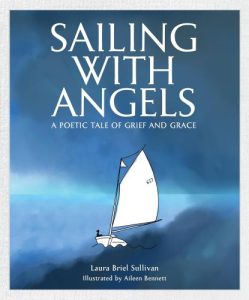
Sailing with Angels: A Poetic Tale of Grief and Grace by Laura Briel Sullivan, Illustrated by Aileen Bennett Susan Schadt Press, May 2026
Sailing with Angels: A Poetic Tale of Grief and Grace by first time author Laura Briel Sullivan is a luminous, comforting fable that beautifully navigates the heavy waters of loss. Shortlisted in the Faulkner Society Wisdom Competition, Sailing with Angels is a love letter to her parents’ generation.
The story follows Princess Briel, a young girl mourning the loss of the generation ahead of her. Armed with a mysterious talisman, she sets sail on the open water. Along her journey, she encounters a series of guiding figures — the Judge, the Alchemist, and the Harbormaster — who offer nautical pearls of wisdom. These “angels” help her realize that honoring the past means keeping the door to memory open, allowing love and laughter to sail through.
This moving debut feels like a treasured keepsake, born from the author’s childhood summers spent along the shores of Martha’s Vineyard. Sullivan invites the reader to bask in the warm, sun-faded nostalgia of long-ago coastal days, serving as a beautiful tribute to the real-life characters of her summer life. Structurally, Sullivan’s solid rhymes and vivid imagery mirror the gentle, rhythmic flow of a tide.
Ultimately, this poetic journey offers a gentle reminder that love remains bright against strong headwinds.
Publishing weekly online, bioStories showcases literary essays that illuminate both ordinary and notable lives, capturing moments of grace through vivid, compassionate storytelling. Recent featured stories include “In the Rumor of Forests” by Jeff Beyl, “The Blue House in the Hemlocks” by Katherine Casey, “Winter Protocol” by Joe Class III, “Veterans” by Pamela Cravez, “Locked” by Natassia Guyton, “A Love Letter to Linens” by Vicki Holder, “The Day the River Spoke” by Nisar Kakar, “Lost Footing” by Katje Lattik, “A Last Custard Cup” by Sydney Lea, “Better at Being Human” by Allysa Raymond, “Frozen in Midair and Soup-hound Tales” by Sharman Ober-Reynolds, “Magnificent Otis” by Brady Rhoades, “V-Cuts” by Matt Rosenberg.
bioStories accepts nonfiction prose submissions between 500 and 7,500 words, with most published essays averaging about 2,500 words. The journal also welcomes artwork that reflects its mission and complements featured essays, as well as cover art for its digital issues and print and digital anthologies. Visit the bioStories website for submission guidelines and additional information.
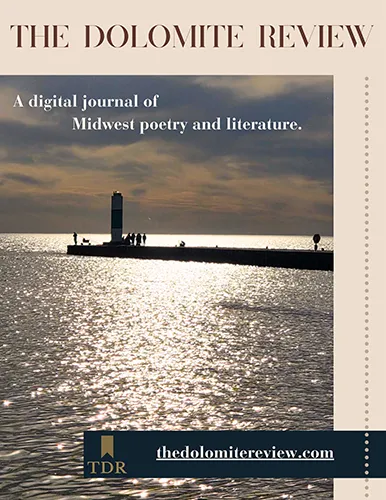
The Dolomite Review is a dynamic literary magazine highlighting narratives from the Midwest. We feature poetry, short fiction, and essays from new and established writers. We also now accept photography. Our focus is storytelling; therefore, we prefer prose or narrative poetry. We want character driven short stories and relatable essays. Send us your finest work, keeping our mission in mind. Deadline: Rolling, Year Round. Submit here.
Want early access to our eLitPak flyers? Subscribe to our weekly newsletter! You can also support NewPages with a paid subscription and get early access to the majority submission opportunities, upcoming events, and more before they are posted to our site.
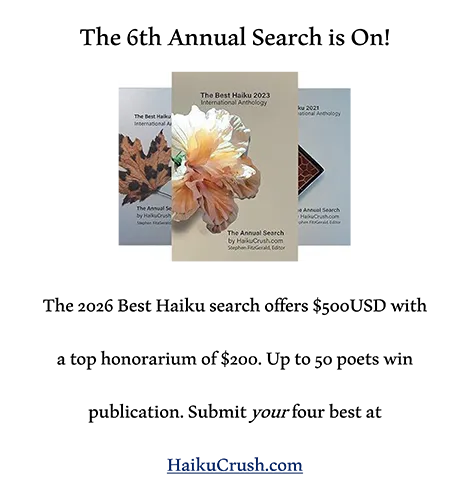
The 2026 Best Haiku international search offers $500USD with a top honorarium of $200 awarded by Haiku Crush’s three judges. Up to 50 poets will win book publication. Submit your four best at HaikuCrush.com. Deadline: October 18, 2026
Want early access to our eLitPak flyers? Subscribe to our weekly newsletter! You can also support NewPages with a paid subscription and get early access to the majority submission opportunities, upcoming events, and more before they are posted to our site.
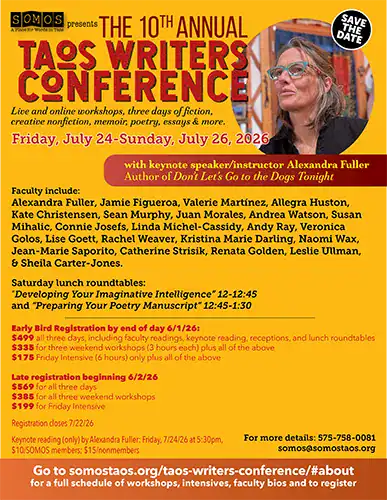
Join us at the 10th Annual Taos Writers Conference in beautiful Taos, New Mexico, July 24-26, 2026, with keynote speaker and featured faculty member, Alexandra Fuller (Let’s Not Go to the Dogs Tonight, Fi, and many others). Other instructors include Connie Josefs, Valerie Martinez, Juan Morales, Allegra Huston, Sean Murphy, & Kristina Marie Darling. Offering over twenty workshops in poetry, fiction, memoir, playwriting, screenwriting, and more. FMI: view flyer, [email protected], www.somostaos.org, or 575-758-0081.
Want early access to our eLitPak flyers? Subscribe to our weekly newsletter! You can also support NewPages with a paid subscription and get early access to the majority submission opportunities, upcoming events, and more before they are posted to our site.
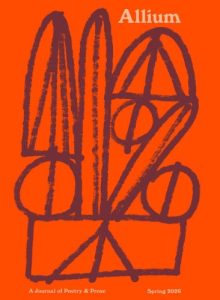
Published by Columbia College Chicago’s Department of English and Creative Writing, Allium: A Journal of Poetry & Prose features evocative, daring poetry, prose, interviews, and reviews in one annual print and one annual online issue, alongside a monthly podcast highlighting contemporary literary voices. The Spring 2026 issue features new poetry, fiction, and nonfiction by Sara Atwater, Hadara Bar-Nadav, Martine Bellen, Ana da Silva, Lucy Doherty, Sean Thomas Dougherty, Mark Fishbein, Zachary Salman Green, Rowan Hartfield, John Levy, Joseph Bardin, Giorgio Fontana, Rachana Pathak, Beth Richards, Derek Anderson, Adeeb Chowdhury, A.M. Gordon, Rebecca Johnesee, Kendall Repins, Andrew Ruhnke, Riley Skinner, Dylan Terry, and many more.
Happy Friday! Summer decided it didn’t want to be hot and went to cool and rainy for the week. We needed the rain after that dry, hot spell…but now the grass is growing like a weed and with more rain in the forecast it’s definitely not getting cut.
If rainy or cool weather has cancelled your outdoor plans, NewPages has plenty to keep you busy with our weekly roundup of submission opportunities and a little spark to ignite your creativity.
A single shift in diction (house to home, father to dad) can hold an entire emotional history; this week's prompt asks you to write into that distance and what closes…
Submission Opportunities: 100+ Ways to Share Your Work
Looking for places to submit your writing, artwork, or hybrid work? You’re in the right place.
Each week, NewPages curates and updates a comprehensive list of open submission opportunities, including literary magazines, journals, presses, contests, and calls for themed issues. Opportunities span poetry, fiction, nonfiction, cross-genre, visual art, and more, with options for both emerging and established writers.
Paid newsletter subscribers receive early access to many of these calls before they’re posted publicly, along with our monthly eLitPak Newsletter, featuring additional opportunities, events, and industry news.
✏️ Have young writers at home? Don’t miss our Young Writers Guide, which highlights contests and publications open to grades K–12.
🏆 Interested in writing contests, book awards, and literary prizes? Explore our curated list of current contests from literary magazines, independent and university presses, writing organizations, and events.
🔔 What’s new this week? Items marked with a bell icon are newly added to this roundup.
Language. Semantics. Word choice. If two words are essentially the same thing, then why do we struggle so much to figure out sometimes the perfect word to embody something? Having lived in the house that I have lived in for 39 out of my 41 years of life and being a first-time homeowner, I became fixated on the idea house versus home. Since I grew up here, it truly is my “home”—memory and ghosts live here.
Most everyone knows the difference between house and home in our bones, even if we’ve never stopped to examine the why. One is a structure while the other is something you carry with you.
The same quiet revolution happens in other word pairs. Mother is the formal term—clinical, correct, used in paperwork and introductions. Mom is something else entirely. It’s the word worn soft by use, the one you say when you’re scared or homesick or calling from three states away. And then there’s the pair that carries the sharpest edge: father and dad. Anyone can be a father. It takes something more—time, presence, choice—to become a dad.
What makes these pairs so powerful isn’t that the informal version is “better.” It’s that the shift between them contains a whole story. And this week, we want you to create that story.
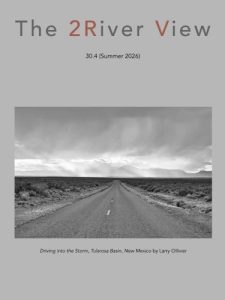
The Summer 2026 issue of The 2River View online journal of poetry features new work by Eileen Gloster, Dmitry Blizniuk, Pam Crow, Dolo Diaz, Erin Evans, Will Falk, Reina Garcia, Emily Light, Madeleine Pool, Forrest Rapier, and Ellen June Wright. 2River is an independent press offering free, innovative, print-ready poetry literary magazines as well as individually authored chapbooks. Authors also provide audio recordings, so readers can download and print the publication, listen to it online and via SoundCloud, and access the publication’s archive of issues and chapbooks. Submissions for the Fall 2026 issue of 2RV close August 30.
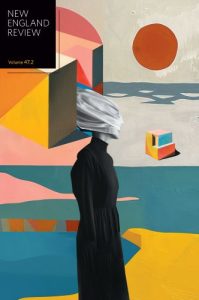
In the Summer 2026 issue of New England Review (47.2), readers can experience excerpts from New England Review’s international folio “Brazilian Badlands: Seven Women Writing the Brazilian Northeast,” guest edited by Bruna Dantas Lobato; rewarding prose by Laurence de Looze, Olaniyi Omiwale, L. F. Khouri, and Douglas Silver; and multifaceted poetry by Jennie Malboeuf, Cynthia Cruz, and Matty Layne Glasgow. Cover art by Gustavo Amaral.
The issue opens with a note from Poetry Editor Jennifer Chang reflecting on a graduate seminar about endings and offering a farewell to her role as poetry editor. Chang explores poetic closure, artistic experience, and the persistence of meaningful conversations. Through literature, music, teaching, and editorial work, Chang argues that the most powerful endings resist resolution, continuing to resonate, transform, and inspire. Indeed, the editors note that while Chang “will conclude her duties as poetry editor shortly after this issue is released from the printer, more of her selections will appear in the next issue. In the spirit of her editor’s note above, this ending is to be continued.”
Do you ever read a piece and think, that sounds a lot like my childhood? Granted, I would be outside sledding down hills in winter, building snowmen and snow forts—unlike the narrator—but I also spent a fair amount of time indoors, nose buried in a book.
Scherfling does an excellent job setting the scene: a boy with his feet resting on a radiator, lost in stories that carry him far away—the San Francisco Bay instead of the Lake Erie shoreline. The sense of transport feels immediate and familiar, but what lingers is how real those imagined places become. The boy may see his own life as mundane, but he reshapes what he knows into something larger—imagining himself in those distant settings, drinking pop while the adults drink cheap beer and whiskey, filling in the gaps with details from his own world. Even the differences matter: where his Ohio fog arrives all at once, in San Francisco it rolls in slow and theatrical.
And anyone who has spent time in a library knows another detail he captures perfectly: the scent. That musty paper smell. Old leather. Dust. It doesn’t take much description to bring it all back.
By the end, the piece opens outward in a quiet, surprising way. The boy isn’t just imagining other lives—he begins to wonder if someone, somewhere, might be imagining his. It’s a small turn, but a powerful one, reminding us how easily we become part of someone else’s imagined world, just as vividly as they become part of ours.
Read the story in iExile, a journal coming back after a long hiatus.
Recommended Reading, curated by Managing Editor Nicole Foor, is just one part of our weekly newsletter. Subscribe to get new lit mags, books, bookstore updates, inspiration prompts, and submission opportunities delivered straight to your inbox.
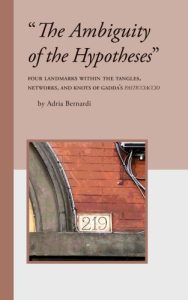
“The Ambiguity of the Hypotheses”: four landmarks within the tangles, networks, and knots of Gadda’s Pasticciaccio by Adria Bernardi Bordighera Press, April 2026
An extended hybrid essay, The Ambiguity of the Hypotheses is part personal essay, part travel essay, part family and cultural history, part literary analysis, and part philological obsession, which emerged from a reconsideration of Carlo Emilia Gadda’s Quer pasticciaccio brutto de via Merulana, a masterpiece of 20th century Italian literature. A great experimental novel and influencer of the crime genre, Gadda’s Pasticciaccio considers fascism and the language of fascism. The essay is part of the Robert Viscusi Essay Series.
“It’s a tangle. It is a big tangle of a novel. A series of knots within knots within knots.” — from The Ambiguity of the Hypotheses
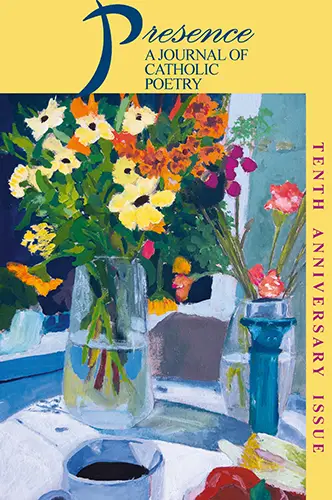
The 2026 annual issue of Presence marks its 10th Anniversary of publishing the best poetry informed by the Catholic faith as well as book reviews, interviews, and “life’s work” essays. This newest issue’s featured poet is Judith Valente, and the Featured Translations section focuses on works by Kutsugen, Mei Sheng, and Rihaku — translated by Ezra Pound, and works by Li Bai — translated by Vayda Pascarella.
Readers will find two interviews in Presence 2026: “’A Way of Saying Yes’: Samuel Hazo on the Communion of Poetry and Faith” by Janine Molinaro and “Evidence of the Divine: Landscape, Dream and Transformation in the Poetry of Linda Nemec Foster” by Anne-Marie Oomen. In addition, there are 26 book reviews, and “Life’s Work” features “Spending Time with Martha Silano” by J. D. Schraffenberger and “Joseph Bathanti: A Life Redeemed Through Poetry” by Ann Ritter.
Sadly, Presence lost three members of their growing community of poets in 2025, offering readers an “In Memoriam” section with works by numerous poets in honor of Martha Silano (1961—2025), Jane Greer (1953—2025), and Jennifer Martelli (1962—2025).
Works by over four dozen poets fill out Presence 2026, including Susanne Paola Antonetta, Bruce Beasley, Seán Carlson, Robert Cording, Alice de Chambrier, CX Dillhunt, Lynn Domina, Ann Fisher-Wirth, Carly T. Flynn, Jana-Lee Germaine , Mia Schilling Grogan, Katie Hartsock, Marci Rae Johnson, Desmond Francis Xavier, Nancy Krygowski, Margaret Mackinnon, Paul Mariani, Steve Myers, Brennan O’Donnell, Kyle Potvin, Dana Ranga, Skip Renker, Eva Skrande, Julie Cadwallader Staub, Carey Taylor, David Thoreen, Cara Valle, Anastasia Vassos, Gail White, James Matthew Wilson, and Carolyne Wright among others.
Celebrating 20 years, the August Poetry Postcard Festival invites writers to sign up to be placed in a group. As each group reaches 32 registrants, each participant receives a list of names and addresses of the others in their group. The goal is to write a poem a day on a postcard to the next person on the list after your own name and mail it to them. In return, you will receive a poem from each participant in your group. Writers are encouraged to start in advance of August 1 to allow time for the postcards to arrive, but it’s common to have some days go by with no card arriving and others with several cards waiting in the mailbox.
In 2025, 493 participants spanned 9 countries around the globe: Canada, France, The United States, Italy, Ireland, Great Britain, Australia, Japan and Austria and 46 U.S. states and Canadian provinces, including the District of Columbia.
If you cannot participate this year, there is always next year to look forward to! Registration for this event opens September 1 of each year; early bird registration closes June 4; final registration is July 4.
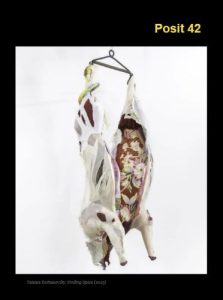
Posit online literary magazine publishes curated poetry, prose, and art, favoring innovative, finely crafted, often experimental work with depth and resonance. The editors invite readers to Issue 42, which features “visual art and literature that integrates innovation with interrelation, challenge with resonance, and discomfort with grace.”
Poetry and prose contributors to this issue include Mike Bagwell, James Butler-Gruett, Valerie Coulton, Elizabeth Dodd, Corwin Ericson, Pearl Kan, David Lehman and David Shapiro, Eléna Rivera, Orchid Tierney, G. C. Waldrep, John Walser, and Evan Williams, plus textiles, sculpture, painting and more by Nancy Cohen, Tamara Kostianovsky, and David Webster.
Cover art: Tamara Kostianovsky, Finding Space (2025)
Happy Friday! It’s been a week of scorching heat and nasty storms out there, hopefully you’re staying cool, hydrated, and safe.
Whatever the weather is doing at your end, NewPages is back with our weekly roundup of submission opportunities. If Mother Nature is still throwing a temper tantrum, this is the perfect excuse to stay inside and put those hours to good use. And if the skies have cleared? Go outside—just don’t leave the house without something to write on. Inspiration has a habit of striking when you least expect it, and a writer should always be prepared.
This week’s prompt explores how we decide what belongs and what doesn’t—and why something can be beautiful, thriving, and still be treated as something to remove.
Submission Opportunities: 110+ Ways to Share Your Work
Looking for places to submit your writing, artwork, or hybrid work? You’re in the right place.
Each week, NewPages curates and updates a comprehensive list of open submission opportunities, including literary magazines, journals, presses, contests, and calls for themed issues. Opportunities span poetry, fiction, nonfiction, cross-genre, visual art, and more, with options for both emerging and established writers.
Paid newsletter subscribers receive early access to many of these calls before they’re posted publicly, along with our monthly eLitPak Newsletter, featuring additional opportunities, events, and industry news.
✏️ Have young writers at home? Don’t miss our Young Writers Guide, which highlights contests and publications open to grades K–12.
🏆 Interested in writing contests, book awards, and literary prizes? Explore our curated list of current contests from literary magazines, independent and university presses, writing organizations, and events.
🔔 What’s new this week? Items marked with a bell icon are newly added to this roundup.
This morning I took the boys out for a walk before the heat and humidity had a chance to settle in, and there at the edge of the driveway, I found them again—pale trumpet-shaped blooms, white with the faintest pinkish tints and deeper-colored markings at the throat. They’ve come back every summer for years now. I have no idea where they came from originally, but they reminded me immediately of the morning glories we used to grow around the old well pump. Google, ever the authority, informs me it’s a weed—though it belongs to the very same family as morning glories. And that got me thinking—who gets to decide?
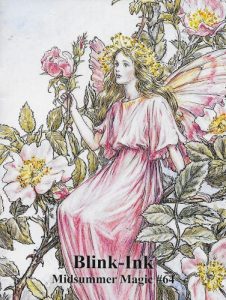
“Midsummer Magic” is the perfectly timed theme for Blink-Ink #64. “Rise with the sun on Midsummer’s Day,” wrote the editors in their call for submissions, “wash your face with dew, fill a bowl from a spring, and you may scry your beloved. At Midsummer, the veil between the worlds is thin and magic is afoot. If you only want to get home without being whisked away to Faerie, carry a bit of iron and hurry past the fairy mounds.” Contributors in this issue include Rachel Friedman, Rachel M. Hollis, Daryl Scroggins, Sally Reno, Marybeth Rua-Larsen, Stephanie M. Wytovich, Scott M. Brents, S.A. Greene, Ruth Heilgeist, Arno Bohlmeijer, K.L. Mill, and many more.
Blink-Ink publishes stories of approximately 50 words in a small-format print quarterly. Blink-Ink #65 is themed “Home” and is open for submissions until July 15. See their website for more information about submissions and subscriptions.
While there is no shortage of the number of literary magazine startups, the distinction with Nerve to Write: A Magazine for Disabled, Chronically Ill, and Neurodivergent Writers is the essential nature of its existence. This isn’t just another lit mag driven by want, but rather Nerve to Write is a magazine our community needs. “Many disabled, chronically ill, and neurodivergent people feel alienated and isolated and are searching for community and connection,” explains Nerve to Write Founder and Editor-in-Chief Sarah Fawn Montgomery. “We hope the literature and art in our magazine can be that community and connection. We hope readers who come across our journal will discover something of themselves reflected in our digital pages, while also learning about other disabled experiences and identities, as we weave together many perspectives into a complex web of acceptance and access.”
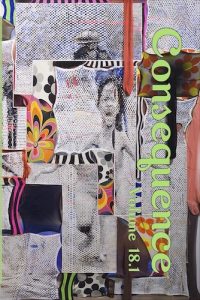
Many of the pieces in Volume 18.1 of Consequence focus on the power of language while addressing the consequences, realities, and experiences of war and geopolitical violence — whether in its written or spoken form. From H.R. Spencer’s poem “The Grammar of War” to Dewaine Farria’s essay “Speaking as a Veteran” to Bänoo Zan’s translation “Silent Language” to Glory Duruem’s short story “Our Unspoken Country,” which emphasizes the potency of things not said.
“As writers ourselves,” Consequence editors comment, “we certainly appreciate pieces that highlight the muscle of words, specifically how they can give shape to an ostensibly indescribable experience or help us discern and engage with convoluted realities. Of the many invaluable capabilities language possesses, its ability to help others glimpse, or even connect to, another person’s elusive experience or tangled world is possibly its greatest. Few other arenas spotlight this ability like those related to the consequences of war and geopolitical violence. . . . language, especially that which is well-crafted, has the ability to help us see the outlines and details of these oversized and often unbelievable realities.”
These details help us become more aware and, ideally, more deeply affected by these experiences. Or as Sayani De writes in “In the Same Tongue”: “Because stories need to be told for the larger collective, for the personal in larger histories, so that they can help to remember, resist, and transform.”
The June 2026 issue of The Lake is now online. This monthly journal of poetry and poetics features new works by Ben Bruges, Clive Donovan, Andy Humphrey, Albert Hwang, Jackson, Paul McDonald, Larry Ollivier, Anya Reeve, Jeff Ryan, and Michael T. Smith.
This issue also includes Charles Rammelkamp’s reviews of Timestamp by David Breskin and every single beat of my heart Pamela Wax and Hannah Stone’s reviews of Lives Outgrown by Susan Darlington and The Professor of Transformation by Elaine Ewart. The Lake’s unique column One Poem Reviews invites poets to share works from recently published collections. This June issue showcases works by J Brooke, Emma Kate Brown, Jasmine Erice Harling, and Richard Stimac.
Happy Friday! We hope you found some time to rest and recharge over the long weekend, and that you were able to pause and honor the memories of those who gave their lives in service.
This marks our final submission roundup for May—and you know what that means… deadlines are stacking up fast. There are plenty of opportunities still within reach, but the window is closing, so don’t wait to get your work out into the world.
Submission Opportunities: 90+ Ways to Share Your Work
Looking for places to submit your writing, artwork, or hybrid work? You’re in the right place.
Each week, NewPages curates and updates a comprehensive list of open submission opportunities, including literary magazines, journals, presses, contests, and calls for themed issues. Opportunities span poetry, fiction, nonfiction, cross-genre, visual art, and more, with options for both emerging and established writers.
Paid newsletter subscribers receive early access to many of these calls before they’re posted publicly, along with our monthly eLitPak Newsletter, featuring additional opportunities, events, and industry news.
✏️ Have young writers at home? Don’t miss our Young Writers Guide, which highlights contests and publications open to grades K–12.
🏆 Interested in writing contests, book awards, and literary prizes? Explore our curated list of current contests from literary magazines, independent and university presses, writing organizations, and events.
🔔 What’s new this week? Items marked with a bell icon are newly added to this roundup.
Being a collector of postcards and discovering a cache of old ones while cleaning out my grandparents’ house sent me straight back to my undergraduate days and it seemed too good not to share.
Founded in February 2022, the centenary month of the publication of Ulysses, L’Esprit Literary Review was born in celebration of the literary revolution of consciousness represented by High Modernism, and seeks to publish work written in the fearless, risk-adept, and revolutionary spirit. The online journal accepts submissions of short fiction, creative non-fiction, novel extracts, literary criticism, book reviews, artwork, and photography.
The April 2026 biannual issue features works by Richard Leise & Lillian Taylor, Jessica Faulkner, Katrin Arefy, Miah Jeffra, Daniel Barbiero, Kent Kosack, Caroline Bock, Chance Freihaut, Maggie Armstrong, Jennifer McMahon, Margaret Dunn, H. L. Onstad, Michal Tallo, Ann Landi, Amanda Michalopoulou, and Andrea Lewis.
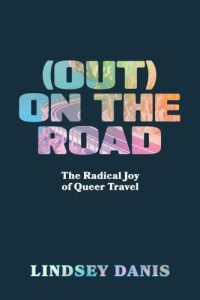
(Out) On the Road: The Radical Joy of Queer Travel by Lindsey Danis Ig Publishing, May 2026
Queer people hold passports at twice the rate of the general population and collectively spend around $100 billion a year on travel—yet remain one of the most underserved groups in the travel industry. A new book aims to change that.
(Out) On the Road by LGBTQ+ travel writer Lindsey Danis is the comprehensive, by-us-for-us guide that queer travelers have been waiting for.
“LGBTQ+ travelers are a growing demographic. They are passionate about travel and willing to spend money on it. Yet time and again, they are ignored or told to stick to a handful of ‘safe’ destinations. This advice fails to build their confidence, validate their identities, or teach them how to advocate for themselves,” says Danis.
(Out) On the Road challenges that conventional wisdom head-on. Drawing on decades of personal travel and eight years as an LGBTQ+ travel writer for publications including AFAR and GayCities, Danis covers everything from navigating safety to funding travel to finding support and connection on the road. Readers will discover how to face their fears, expand their comfort zones, plan affirming adventures — both in the US and internationally — and return home transformed.
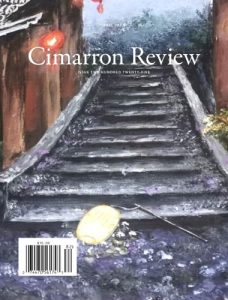
Since 1967, Cimarron Review has published imaginative, truth-driven poetry, fiction, and nonfiction by emerging writers alongside celebrated, award-winning literary voices. The newest issue (225) continues the tradition with poetry by Diana K. Malek, Jenn Blair, Lisa Titus, Sharon Lin, Dorsia Smith Silva, A.E. Stallings, Marisa Lin, Barbara Duffey, Jessica E. Pierce, SM Stubbs, Judith Skillman, Alec Hershman, Ori Fienberg, Danielle Hanson, Luke Hankins, Athena Kildegaard, nonfiction by Andrew Bertaina, Allison Field Bell, and fiction by Nona Caspers, Rebecca Orchard, JP Gritton, and Andrew Malan Milward.
Cimarron Review is a national journal of arts, letters, and opinions, published in the Winter, Spring, Summer, and Fall at Oklahoma State University, Stillwater.
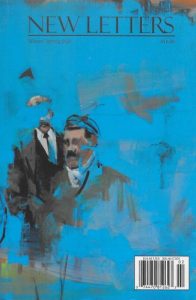
Published by The University of Missouri-Kansas City since 1934, New Letters Winter/Spring 2026 celebrates the New Letters Literary Award winners and Editor’s Choice Award recipients as well as incredible fiction from Andrew Bertaina, Billy O’Callaghan, and Dimitra Rizou — including her graphic story “Let’s Finish Early and Give Everyone 7 Minutes Back” (“Trust us,” the editors say, “you’ll want to spend more than 7 minutes with this one”). This issue also features poetry from David Thoreen, Kelly Gray, and Doug Ramspeck, plus thoughtful essays by Courtney Santo and Elissa E. Minor. A full-color portfolio of artwork by Dean Kube is included inside in addition to the cover image.
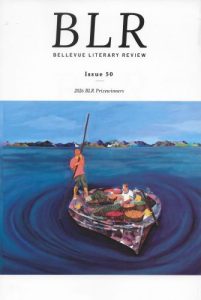
With Issue 50, Bellevue Literary Review celebrates its 25th Anniversary of publication! As Editor-in-Chief Danielle Ofri writes in her foreword, “We certainly weren’t thinking in terms of a silver jubilee back when this all started with a wisp of an idea about creative writing on health, illness, and healing. But these themes are universal, and using the arts to grapple with our shared vulnerabilities turned out to be a prescription that resonates with an ever-growing community.”
Issue 50 includes the winners of the annual BLR Literary Prizes: Shannon Perri for the Goldenberg Prize for Fiction; Won Lee for the Felice Buckvar Prize for Nonfiction; and Dara Laine for the John and Eileen Allman Prize for Poetry. Readers will find a wealth of new fiction, nonfiction, and poetry filling out the issue, with Ofri commenting, “We recognize that BLR writings engage directly with experiences of illness, loss, suicide, and the realities of the body in ways that may be intense or affecting for some readers. We hope you will find meaning and resonance in the stories, essays, and poems contained herein.”
Happy Friday! We hope you found some time to rest and recharge over the long weekend, and that you were able to pause and honor the memories of those who gave their lives in service.
This marks our final submission roundup for May—and you know what that means… deadlines are stacking up fast. There are plenty of opportunities still within reach, but the window is closing, so don’t wait to get your work out into the world.
Submission Opportunities: 134 Ways to Share Your Work
Looking for places to submit your writing, artwork, or hybrid work? You’re in the right place.
Each week, NewPages curates and updates a comprehensive list of open submission opportunities, including literary magazines, journals, presses, contests, and calls for themed issues. Opportunities span poetry, fiction, nonfiction, cross-genre, visual art, and more, with options for both emerging and established writers.
Paid newsletter subscribers receive early access to many of these calls before they’re posted publicly, along with our monthly eLitPak Newsletter, featuring additional opportunities, events, and industry news.
✏️ Have young writers at home? Don’t miss our Young Writers Guide, which highlights contests and publications open to grades K–12.
🏆 Interested in writing contests, book awards, and literary prizes? Explore our curated list of current contests from literary magazines, independent and university presses, writing organizations, and events.
🔔 What’s new this week? Items marked with a bell icon are newly added to this roundup.
“And still, you chose to sleep beside the ghost of me.”
— Ashes of Eden, “Sanctuary of Silence” (2026)
This week’s writing spark explores the architecture of a love that was never spoken aloud.
There are songs that find you in a particular kind of ache, the kind you didn’t know had a name until the music gave it one. Ashes of Eden’s “Sanctuary of Silence” is one of those songs for me. It explores something most love stories skip past entirely: not the dramatic ending, not the confrontation, but the quiet architecture of a love that was never spoken aloud. A devotion that built its own temple in the dark and kept the lights on even after the person it was built for walked away.
The line that won’t let me go: “And still, you chose to sleep beside the ghost of me.”
A note before we begin: I came to this song one way and found it held something else entirely. If you’ve lost someone—recently, or not so recently—this prompt has a room for that too. The sanctuary doesn’t care how the person left. Only that they’re gone, and that something of them still echoes, just like I cannot escape from the echo of my grandfather who would have turned ninety today.
Weekly Creative Prompt
Sanctuary of Silence
“And still, you chose to sleep beside the ghost of me.”
— Ashes of Eden, “Sanctuary of Silence” (2026)
This week’s writing spark explores the architecture of a love that was never spoken aloud.
There are songs that find you in a particular kind of ache, the kind you didn’t know had a name until the music gave it one. Ashes of Eden’s “Sanctuary of Silence” is one of those songs for me. It explores something most love stories skip past entirely: not the dramatic ending, not the confrontation, but the quiet architecture of a love that was never spoken aloud. A devotion that built its own temple in the dark and kept the lights on even after the person it was built for walked away.
The line that won’t let me go: “And still, you chose to sleep beside the ghost of me.”
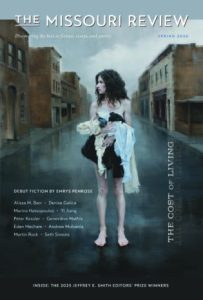
The Missouri Review Issue 49.1 (Spring 2026) is themed “The Cost of Living” and opens with a foreword by Speer Morgan who traces inflation from America’s founding to our contemporary anxieties, reflecting on the roles of scarcity, ambition, literature, and the emotional costs of survival. The issue goes on to highlight The Missouri Reviews 2025 Editors’ Prize winners: Peter Kessler (fiction), Eden Mecham (nonfiction), and Seth Simons (poetry). Readers will also enjoy discovering debut fiction from Emrys Penrose, new fiction from Yi Jiang and Geneviève Mathis, new poetry from Alissa M. Barr and Martin Rock, new nonfiction from Denise Galica and Marina Hatsopoulos, features on Modigliani and Mae West, and a review of three recent poetry collection considered in the context of the legacy of Confessionalism.
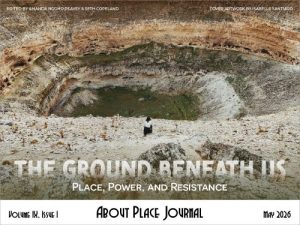
About Place Journal‘s May 2026 issue, The Ground Beneath Us: Place, Power, and Resistance, is a bold and unflinching issue that centers place as a living force shaped by history, marked by power, and sustained through resistance. In a political moment defined by state violence, environmental crisis, and struggles over bodily autonomy, this collection refuses neutrality. Instead, it asks what it means to belong, to remember, and to fight for the ground beneath us.
Bringing together poetry, essays, fiction, hybrid work, and visual art, the issue moves across landscapes both physical and imagined. Here, land is not backdrop but witness: to displacement and diaspora, to gentrification and ecological grief, to sacred memory and communal care. Each piece contributes to a larger tapestry that maps not only geography, but survival, resilience, and transformation.
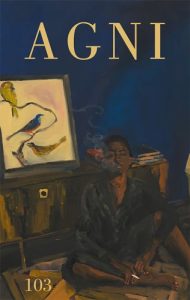
Art takes over in the newest issue of AGNI(103). Paintings by Danielle Mckinney put the thinking self among canvases and books, prefiguring essays by Christie Hodgen, John Cotter, and Mairead Small Staid. In poetry, Victoria Chang and Phillip B. Williams, and in fiction, Jan Carson and Andrew Zornoza speak a self’s truth through art, while poems by Hilda Hilst, (translated by Justin Greene), D. Nurkse, and Hayan Charara counter boggling visitations with the bulwark of language. In this issue’s introductory essay, Senior Editor Shuchi Saraswat resists numbness above all her Editor’s Note, “To Be in a Time Of War.” In nonfiction, May Teng and Ashaki M. Jackson, and in fiction, and Jane Morton and Charu Sinha find an answer in the telling, and the listening.
A full table of contents and several sample works from this print issue are available to read online alongside AGNI‘s unique online-only content, including poetry by Campbell McGrath and Jeff Whitney, “Rewriting the Script of Matrescence Memoir: A Conversation with Erica Stern” by Elizabeth Brogden, “’The Border Moves Through Us’: From Minneapolis, 2026′ blog post by agnimag, and “To Never Have Risked Our Lives: A Portfolio of Central American and Mexican Diaspora Writing” with poetry, fiction, essays, and conversations coedited by Esteban Rodríguez, Jennifer De Leon, and Ben Black.