At the NewPages Blog readers and writers can catch up with their favorite literary and alternative magazines, independent and university presses, creative writing programs, and writing and literary events. Find new books, new issue announcements, contest winners, and so much more!
Consequence Volume 17.1 is full of prose, poetry, and visual art addressing the consequences of war and geopolitical violence. In this issue, a theme emerged of how affecting a difference doesn’t only have to happen on a global scale — it can and should include the more local ones.
This is expressed in “A Trip to Kosovo” where a doctor returns to the war-torn country to navigate its broken bureaucracy in hopes of getting his nephew immediate cancer treatment (a piece that pointedly ends with: If the world can be saved, it will be by small acts of kindness). It appears in “Withdrawal” with the narrator always answering his phone in case it’s a fellow soldier or a refugee in dire need. It’s there in “The Lucky Ones” as a director for an adoption agency in Korea reveals to women the tricks necessary to help their babies find safe homes.
Maybe the most conspicuous example of this theme, though, is in the Translations Feature, which consists of works written in Arabic and centering on the Palestinian experience. Translations Editors Parisa Saranj and Fathima M. frame all ten pieces of the feature by stating, What else can we do but bear witness to the pain of our fellow human beings? Literature has been the first recordkeeper of what humans are capable of doing to and for each other.
Every Monday, our newsletter subscribers receive a curated dose of literary goodness—new issue announcements, book reviews, upcoming releases, literary news, and a fresh writing prompt to spark creativity. If you’ve ever felt stuck staring at a blank page, our weekly prompts are here to help reignite that creative spark.
This week’s newsletter (Issue 183!) took a playful turn with a nod to The Time Warp—but instead of dancing through dimensions, we’re diving into the strange elasticity of time itself.
✍️ Writing Prompt: Warped Relativity
Einstein once explained relativity like this: sit on a hot stove for a minute and it feels like an hour; sit with someone you love for an hour and it feels like a minute. But what about the moments that defy even that logic?
Write about a time when the clock ticked forward, but your experience of it didn’t match. Maybe it was a season of grief that passed in a blur, or a long recovery that dragged on despite no dramatic events. Explore how time can feel warped not just by joy or boredom, but by numbness, uncertainty, or quiet endurance. How does time behave when life is neither thrilling nor tragic—just quietly, stubbornly hard?
Want prompts like this delivered straight to your inbox every Monday? Subscribe to our newsletter and never miss a beat.
💡 Psst… Paid subscribers get early access to submission opportunities, upcoming events, and more behind-the-scenes perks. Just saying.
If I had Said Beauty, Poetry by Tami Haaland Lost Horse Press, March 2025
If I Had Said Beauty, Tami Haaland’s fourth collection of poetry, is dedicated to known and unknown ancestors. It explores the possible narratives and distant origins of what lies behind a sense of self — including recent and ancient DNA, recessive and dominant traits, mitochondrial underpinnings, and an intricate microbiome. Luminous and spare, the poems seek to unravel and speculate, document and lament what happens in a life and what might have been. While probing for definition in the mysteries of deep time, the poems are nevertheless grounded in encounters with wild and domestic life, intimate moments of loss and family connection, all of which intertwine to expand the meaning of “autobiography.” According to poet Connie Voisine, “In these poems, all the spirits are welcome members of [Haaland’s] community, an atom, a spruce, a fly, and the ghosts of her ancestors who are suddenly near, and alive. These poems show me how to remain open to the influx of beings, and how we might allow their various beauties to aid in our survival.”
The newest issue of Southern Humanities Review is introduced by Guest Poetry Editor Jeremy Paden, “On Appalachian Roots,” which opens:
“Who gets to speak for a region? What voices, stories, and accents get to represent a place? And when the place is as vast as Appalachia, one that spans thirteen states and is divided into five subregions? [. . . ] Once J.D. Vance was picked as the vice presidential running mate for the Republican ticket in the summer of 2024, his 2016 book, Hillbilly Elegy, returned to bestseller lists and the national conversation. As a result, I was asked to curate a selection of poems on Appalachia by Appalachians. After all, whatever people think of his memoir, it is not about Appalachia.”
Those poets featured here include Willie Carver, Bernard Clay, Dorian Hairston, Pauletta Hansel, Marc Harshman, Jane Hicks, Silas House, Lisa J. Parker, Randi Ward, William Woolfitt, and Marianne Worthington. The issue also includes nonfiction by Joanna Acevedo and Madeline Jones, and fiction by Sara Levine, Sumita Mukherji, Enyinna Nnabuihe, and Cotton O’Connell. Cover art by Frederic Edwin Church, Storm in the Mountains, 1847, oil on canvas.
Meg Eden Kuyatt is a master of the novel in verse form. Her writing in The Girl in the Walls is elegant, but not finicky; dramatic, but not maudlin. You could teach a workshop on her use of titles alone. Like her protagonist V, Kuyatt is a real artist. She has created a true voice for V, an autistic girl on the cusp of high school, learning her way around her strong feelings and out in the wonderland of the world. V introduces herself in vibrant socks that say, “I am strange and wonderful.” And with that, we are off.
After a rough year, V has been sent to Grandma Jojo’s for the summer. Jojo lives in a clean white house that has been in the family for generations, with plenty of secrets and sludge hidden within the walls. There are supernatural elements here but also some history, stories of how people who act differently have been treated over the years. These are complicated characters. What shines through, though, is empathy. When V has a breakthrough in her perspective of Jojo and the ghost girl, readers are brought to a satisfying resolution.
Of course, as a book of poems, there are metaphors. The pristine parlor displays a collection of perfect porcelain dolls, while Jojo’s granddaughters struggle with masking who they are in social situations. V’s cousin, Cat, creates assemblages, a kind of collage sculpture she describes as taking discarded, broken stuff and turning it into something beautiful.
There are many levels to this book, making it perfect for the target age audience (juvenile fiction, grades 3-7), teachers, and families with neurodivergence. Highly recommend.
The Girl in the Walls by Meg Eden Kuyatt. Scholastic Press, May 2025.
Elizabeth S. Wolf has published five books of poetry, most recently I Am From: Voices from the Mako House in Ghana (2023). Her chapbook Did You Know? was a 2018 Rattle prizewinner. Elizabeth’s poetry appears in multiple journals and anthologies and has received several Pushcart nominations.
In Hesitation Waltz, the 2023 selection in the Foster-Stahl Chapbook Series, Amie Whittemore crafts multimorphic poems that reflect our “ruined and beautiful” world. Through a blend of pastorals, odes, elegies, and epistles, which take form alongside meditations, lullabies, and personae poems, she gives voice to the “vulnerable … narratives” of life; its “riches” and “promise,” “precarity” and “shadow.”
To explore what “is miraculous” and interrogate “Who’s complicit,” Whittemore speaks from “mouths [that] cannot be tamed / and thankfully so.” The various poetic forms mirror her contortionist-like struggle to articulate essential truths and forge connections with her audience, establishing a powerful bond between the poem, the speaker, and the listener.
A hallmark of Whittemore’s poems is their distinct address. Whether the poet is speaking to a student in a science fiction course who complained on an evaluation about being “uncomfortable” with “women befriending / robot spiders,” to a goldfinch adapting to “human activity, / deforestation,” to “a woman who likes dishing about nuns,” to “the half-male, half-female cardinal,” or to her one-year-old nephew, she skillfully balances narrative directness with lyric tenderness.
The chapbook’s title references “The Hesitation Waltz,” a 1950 oil painting by Surrealist René Magritte. This reference suggests the surreal struggles inherent in finding a romantic connection with a hesitant lesbian and comprehending our dependence on fossil fuels. In Hesitation Waltz, Amie Whittemore advocates for “strange thinking” as we seek solutions to the “world’s problems” and celebrates our “myriad existence” in an uncertain yet hopeful dance.
Hesitation Waltz by Amie Whittemore. Midwest Writing Center Press, March 2025.
Reviewer bio: Jami Macarty is the author of The Long Now Conditions Permit, winner of the 2023 Test Site Poetry Series Prize (forthcoming University of Nevada Press), and The Minuses (Center for Literary Publishing, 2020), winner of the 2020 New Mexico/Arizona Book Award – Poetry Arizona. Jami’s four chapbooks include The Whole Catastrophe (Vallum Chapbook Series, 2024) and Mind of Spring (Vallum Chapbook Series, 2017), winner of the 2017 Vallum Chapbook Award. To learn more about Jami’s writing, editing, and teaching practices, visit her author website.
The Spring 2025 issue of Valley Voices is a special issue themed “River and Land: The Mississippi Delta” and is dedicated to Dr. Jerry W. Ward, Jr. (July 31, 1943 — February 8, 2025) “respectful board member, scholar, and friend.”
In celebration of Dr. Jerry W. Ward’s legacy is an interview with Dr. Ward, poetry, literary theorist, editor, professor, and cultural activist, conducted by C Liegh McInnis on July 18, 2007, Charlie Braxton’s poem, “Doc,” and the essay “This is Not a Poem #1 (For Doc Ward)” by McInnis.
Opening the themed content “River and Land: The Mississippi Delta” are “Prim Notes” and “Hurricane Isabel 2003: True Story” by Hermine Pinson and “The Geography of Self: An Interview with Hermine Pinson” by Editor John Zheng. Also featured are poems by Claude Wilkinson, Sterling D. Plumpp, Larry D. Thomas, George Drew, Philip C. Kolin, CT Salazar, C Liegh McInnis, and Michelle McMillan-Holifield; art/photography by Claude Wilkinson (including cover art) and J. Guaner; fiction/nonfiction by Jack Crocker and Dick Daniels.
Criticism pieces include “From Trauma to Triumph: Endesha Ida Mae Holland’s From the Mississippi Delta: A Memoir” by John J. Han, and “Mississippi Masochism: Agentic Pain in Jesmyn Ward’s Where the Line Bleeds and Claude Wilkinson’s World Without End” by Allison Wiltshire.
May is winding down, and the garden is in full swing—along with the critters who think your hard work is their personal salad bar. While NewPages can’t help you fend off deer, rabbits, or rogue field mice, we can supply a fresh dose of writing inspiration and a bounty of submission opportunities to keep your creative goals thriving.
✨ Heads up! June is just around the corner, and that means new deadlines are blooming. Be sure to check out our freshly updated Big List of Writing Contests—to help you plan your next round of submissions.
Writing Prompt: Deerstruction!
It never fails, does it? You sweat and toil—planting, fertilizing, watering, pruning—only to have your efforts thwarted by a gang of majestic, yet maddening, garden invaders: DEER. Or maybe it’s rabbits. Or field mice. Any adorable pest that turns your hard work into a buffet, razing carefully tended flowers, herbs, shrubs, and veggies to the ground… or yanking up plants with what feels like spite, only to spit them out.
Can you channel that frustration into a poem, story, essay, or hybrid piece? Or maybe it’s a metaphor for the writing process itself: you labor over your words, only to have readers or editors tear through your work in unexpected—and sometimes painful—ways, deconstructing your carefully crafted creation.
Use this prompt to spark something new—and then scroll down to explore this week’s submission opportunities.
Anthony Fennell, the narrator of Twist, should remind the reader of Nick Carraway from The Great Gatsby. He’s lost his way in life, unable to write a new novel or play, even unwilling to admit the existence of the son he’s become estranged from since he and his wife went separate ways. He receives an opportunity to write a story about people who work on breaks in underwater cables — which actually carry most of the data from one country to another, a fact most people don’t know — which leads him to meet John Conway.
Like Carraway’s Gatsby, Conway is a mysterious figure who seems to have made himself into somebody else, perhaps for the love of a woman who seems beyond his station in life. Zanele is a South African actress whom Conway lives with when he’s not on the boat repairing cables. Throughout the novel, she becomes more famous while Conway and Fennell are on the ocean, Conway to repair a significant break, Fennell to write about Conway and his crew.
The imagery of breaks in communication runs throughout the novel, as Fennell never understands Conway, and Conway and Zanele seem unable to communicate about what matters in their relationship. However, since the reader only sees that relationship through Fennell’s lens, it’s unclear if that is the case or if there is some other reason for the breakdown in their relationship.
McCann also explores the idea of repair, what one can and can’t mend, in a world that has become more and more digitally connected, but more and more emotionally fractured. Conway seems to reinvent himself, but Fennell also needs to mend himself in some important ways. Twist asks the reader to consider who they are and how they present that self to the world, but also if repair is possible in a world that seems so broken.
Twist by Colum McCann. Random House, March 2025.
Reviewer bio: Kevin Brown has published three books of poetry: Liturgical Calendar: Poems (Wipf and Stock); A Lexicon of Lost Words (winner of the Violet Reed Haas Prize for Poetry, Snake Nation Press); and Exit Lines (Plain View Press). He also has a memoir, Another Way: Finding Faith, Then Finding It Again, and a book of scholarship, They Love to Tell the Stories: Five Contemporary Novelists Take on the Gospels. IG, Threads, and BlueSky: @kevinbrownwrites
Published quarterly at the University of South Dakota through the Department of English and under the sponsorship of the College of Arts and Sciences, this newest issue of South Dakota Review has much to offer readers, beginning with the captivating cover photo by Editor-in-Chief Lee Ann Roripaugh, expressing the disjointedness so many of us are feeling as of late.
In response, the content holds a salve for our weary selves: poetry by Mrityunjay Mohan, Tami Haaland, Grace Bauer, Francine Witte, Ellen June Wright, Isabelle Ylo, Josephine Gawtry, William Trowbridge, Brandon Krieg, Amorak Huey, Kalpita Pathak, Sarah Barber, Carl Watts, Judith Harris, Remi Recchia, and Jim Peterson; short stories by Tina Tocco, Michael Caleb Tasker, Alexandria Peary, Luke Rolfes, nat čermák, and Reuben Sanchez; essays by Gary Finke and Ellie Gomero, with a hybrid excerpt from Sutured Memorī, by Michelle Naka Pierce.
Remember Us to Life: A Graphic Memoir by Joanna Rubin Dranger Ten Speed Graphic, April 2025
Told through a genre-defying blend of illustrations, photography, and found objects, Remember Us to Life chronicles Joanna Rubin Dranger’s investigation into her Jewish family’s history, spanning time, space, and three continents in search of her lost relatives. As discolored photos are retrieved from half-forgotten moth-eaten boxes, Joanna discovers the startling modernity and vibrancy of the lives her family never spoke about — and the devastating violence that led to their senseless murders.
Winner of the Nordic Council Literature Prize, Remember Us to Life recounts Joanna’s family’s immigration from Poland and Russia to Sweden and Israel, where her relatives found work, marriage, and community, blissfully unaware of the horrors to come. Interweaving these anecdotes and stories are historical accounts of the persecution of Jewish people in Germany, Poland, Lithuania, and Russia prior to and during World War II, as well as the antisemitic policies and actions of the supposedly neutral government of Sweden, Joanna’s home country. Joanna’s unflinchingly brave and intimate portrayal of one of history’s greatest tragedies will capture and break readers’ hearts.
[Editor’s Choice posts are not paid promotions. These are selected by NewPages to spotlight titles we want to share with our readers.]
To discover more great books from small, independent, and university presses, visit the NewPages Guide to Publishers as well as our Books Received monthly roundup. Subscribe to our weekly newsletter to stay up to date!
Henrietta Goodman’s Antillia explores innocence, guilt, and the haunting specters of the past. The collection’s title references a mythical island, symbolizing both “the inaccessible” and the elusive nature of truth and self. Goodman’s lyric-narrative poems examine aspects of female identity and maternal grief.
Haunted by her son and various romantic partners, Goodman shares the complexities of these relationships, offering a candid examination of love and regret. She examines the “boys who get stuck, / who die or sleep in a chair in their mother’s / basement” and dissects “all the slapping and deception /…keeping score,” with a voice that is both lamenting and liberating. The collection’s strength lies in the air-clearing confrontations between past and present selves.
Through these portraits of “another me,” Goodman tells us of the loss of her son and allows readers to witness the intertwining of innocence and guilt in her exploration of maternal grief. In the opening poem, “The Puppy and Kitten Channel,” the poet uses a proxy to ask, “Do you ever feel completely ruined?” Through rhetorical inquiry, free association, and tracing the origins of the words “we use / to defend, or forgive” Goodman reveals their capacity for pain and solace.
At the heart of Antillia lies a lake that reflects “Delight,” “Death,” “Time,” and “Hope,” suggesting a dynamic relationship between self-portraiture and memory. Goodman reflects on the impossibility of reclaiming the past while acknowledging the potential for understanding within our memories: “So many years / I’ve wondered what it said, why it seems / so easy and so impossible to put back.”
In Antillia, Henrietta Goodman reminds us of the malleability of memory and how it shapes our present, emphasizing that “there’s no one / back there controlling any of this.” This collection is an eloquent testament to female resilience, maternal love, and grief’s burden — haunting and ultimately liberating.
Antillia by Henrietta Goodman. The Backwaters Press, March 2024.
Reviewer bio: Jami Macarty is the author of The Long Now Conditions Permit, winner of the 2023 Test Site Poetry Series Prize (forthcoming University of Nevada Press), and The Minuses (Center for Literary Publishing, 2020), winner of the 2020 New Mexico/Arizona Book Award – Poetry Arizona. Jami’s four chapbooks include The Whole Catastrophe (Vallum Chapbook Series, 2024) and Mind of Spring (Vallum Chapbook Series, 2017), winner of the 2017 Vallum Chapbook Award. To learn more about Jami’s writing, editing, and teaching practices, visit her author website.
Poppy and Mary Ellen All Fed Up: Book Two of the Frankenmuth Murder Mysteries by Roz Weedman and Susan Todd, Illustrations by Lane Trabalka Mission Point Press, October 2024
In Poppy and Mary Ellen All Fed Up, the punchy writer duo of Roz Weedman and Susan Todd welcome readers back to Frankenmuth, one of Michigan’s most famous and popular tourist towns. With a year-round population of only 5,000 residents, this Bavarian-themed town with its famous chicken dinners and year-round Christmas village draws more than three million visitors each year, making it the perfect setting to slink in and out unnoticed.
Poppy and Mary Ellen earned a reputation for themselves in the first book in the series when they (and a few canine friends) helped the police solve a double homicide, even beating the police to the capture. This time, though, Poppy finds herself topping the suspect list of the murder of a Mah Jongg-playing tourist.
Some familiar characters are back, both canine and human, there’s a titch of romance in the air with its own mystique, and Lane Trabalka’s chapter heading line drawings add to the intrigue and charm. Those who play Mah Jongg and follow conversations about “friendly games” will find themselves laughing out loud as the story centers around planning an upcoming Mah Jongg tournament. Weedman and Todd weave the elements of the game through the story with enough explanation that even non-players may be encouraged to pick up the game.
Although most of the story takes place in the popular and quirky confines of Frankenmuth, readers get to travel all the way to Nairobi in Book Two, but with Weedman and Todd crafting the twists and turns, everyone will need their seatbelts. It’s going to be a bumpy ride.
To discover more great books from small, independent, and university presses, visit the NewPages Guide to Publishers as well as our Books Received monthly roundup. Subscribe to our weekly newsletter to stay up to date!
The unnamed narrator of Bradley’s debut novel, The Ministry of Time, has recently received a promotion within The Ministry, moving from the Languages department to serve as a bridge for a new expat. However, her newly arrived charge is not new to the country, as he was born in England, but new to the time period. The Ministry has discovered a time door, and they’ve used it to bring a handful of people — who were about to die in their lifetimes — into the present to see how they assimilate.
Thus, she spends most of her time with Graham Gore, who should have died in an Arctic expedition in the nineteenth century that went terribly wrong, helping him to adapt to twenty-first century life. They meet up with other bridges and expats at various times, some of whom adjust better than others. The narrator makes it clear early on that readers shouldn’t bother trying to understand the logic of time travel, advice that is always worthwhile when reading any book that involves it.
One of the reasons the narrator has her job is because her mother was a refugee from Cambodia, so leaders in The Ministry think she will work well in such a situation. However, she reveals herself to be rather naïve about the realities of her job. There are other people who are interested in the expats, leading to the narrator’s not knowing whom to trust, as she doesn’t truly understand the situation she has found herself in. She also struggles to understand Graham, and he can’t comprehend her, either, as their class and race divisions complicate their relationship beyond the obvious time differences.
Bradley uses time travel to ask questions about history, but more about history as a narrative that people construct to help provide them with purpose and meaning, as well as to control others or their world. The narrator comes to understand that she has defined others without understanding them, shaping narratives about them and herself that lead her to make a number of poor decisions. The ending leaves the future open, though, as the narrator is learning how to revise the narratives she’s crafted.
The Ministry of Time by Kaliane Bradley. Avid Reader Press, April 2025.
Reviewer bio: Kevin Brown has published three books of poetry: Liturgical Calendar: Poems (Wipf and Stock); A Lexicon of Lost Words (winner of the Violet Reed Haas Prize for Poetry, Snake Nation Press); and Exit Lines (Plain View Press). He also has a memoir, Another Way: Finding Faith, Then Finding It Again, and a book of scholarship, They Love to Tell the Stories: Five Contemporary Novelists Take on the Gospels. IG, Threads, and BlueSky: @kevinbrownwrites
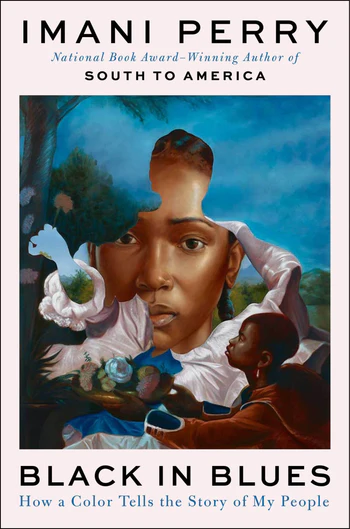
As the title conveys, Imani Perry’s latest book uses the color blue to explore the history of Black Americans. Many of the historical figures and events in the collection of essays are well-known, such as W.E.B. Du Bois, Booker T. Washington, Toni Morrison, Louis Armstrong, George Washington Carver, Zora Neale Hurston, Ralph Ellison, and Nina Simone. However, Perry also draws from the lives and stories of lesser-known artists, musicians, and historical figures to give a fuller view of the story of African Americans.
It’s the use of the color blue, though, that helps her reshape and refashion the histories she tells, digging deeper than the traditional stories even a well-educated reader might know about the famous and less so. For example, she draws on the ninth chapter of Ralph Ellison’s Invisible Man to explore the history of architectural blueprints, which then leads to a meditation on improvisation for when ideas don’t go according to plan, moving to a concluding paragraph on Thelonious Monk’s “In Walked Bud,” which Irving Berlin’s “Blue Skies” inspired. She ends the brief essay by writing, “[Monk] dismantled every blueprint. He showed how it felt to be rescued. The exercise is clear in retrospect: act and build with love — when faced with the prospect of death. That’s how we live.” It is this associative style of writing that gives each essay its power, as Perry ties together seemingly disparate ideas to convey undercurrents throughout Black history.
The culminating effect of the essays is not one of a linear history where one can trace a supposed progress toward more rights or freedom. Instead, Black in Blues reveals how African Americans have moved through and around the dominant white culture, creating their own stories and art and history, a culture that most white people remain ignorant of beyond the names of a select few. She celebrates the life that has thrived within that world, as she writes in the final essay: “Death comes fast, frequent, and unfair. And we’re still here. We know how to breathe underwater. Living after death. It is a universe in blue.” Perry reminds readers of ways in which that universe is simultaneously awful and beautiful.
Black in Blues: How Color Tells the Story of My People by Imani Perry. Ecco, January 2025.
Reviewer bio: Kevin Brown has published three books of poetry: Liturgical Calendar: Poems (Wipf and Stock); A Lexicon of Lost Words (winner of the Violet Reed Haas Prize for Poetry, Snake Nation Press); and Exit Lines (Plain View Press). He also has a memoir, Another Way: Finding Faith, Then Finding It Again, and a book of scholarship, They Love to Tell the Stories: Five Contemporary Novelists Take on the Gospels. IG, Threads, and BlueSky: @kevinbrownwrites
The Midwest Quarterly: A Journal of Contemporary Thought Spring 2025 theme is “Library Issue(s)” with Guest Editor Sara DeCaro and includes the articles “The Options when DEI Initiatives in Libraries are Not Working or Nonexistent” by Casey Phillips, “Digital Commons and Accessibility” by Madison Price, “Mathematical Marvels in a Midwestern Library” by Cynthia Huffman, “The Rise and Fall of Wine Gardens in Kansas City 1880-1920” by Sara DeCaro, “From TV Screen to Family Scene: Bluey and the Art of Invitational Rhetoric” by Blayne Thorton, and “Unreconciled Visions of War: Japan and America in World War II (A Literature Review)” by David F. DiMeo, as well as a selection of new poems.
NewPages is back with our weekly roundup of submission opportunities, plus a dose of creative inspiration to help get your ideas flowing. Kick off the long weekend with fresh prompts and venues to help you hit your writing and publishing goals.
Inspiration: Just Like ABC
Abecedarian poems can be tricky—finding the right rhythm and words for those tough letters like Q, X, and Z is no small feat. But what if you turned that challenge into a song?
Back in elementary school, we learned songs that celebrated Michigan’s history—from voyageurs and logging camps to sailing the Great Lakes. One song stood out: it listed reasons why Michigan was a great place to live, from A to Z.
That got me thinking: what if you created your own alphabetical ode to where you live? Try listing reasons—serious or silly—why your state, city, township, or province is wonderful. Or flip the script and list reasons you don’t love it. Maybe even do both for a fun contrast.
You don’t have to stick to song lyrics or poetry. This could become a children’s story, a young adult piece, a lyric essay, or even an adult picture book. Explore how the quirks and flaws of a place might actually be what makes it feel like home.
Stretch those creative muscles. And if you have kids, get them involved! It’s a great long weekend activity that might just spark something worth submitting.
Speaking of the long weekend—NewPages wishes you a wonderful and safe Memorial Day.
In Upstage, poet Bruce Andrews and photographer Sally Silvers create a vibrant and disorienting urban experience of New Jersey’s Asbury Park. This collaborative work stands out not just for its atmospheric visuals and “boombox” text but also for the way it invites readers to reconsider their relationship with the world around them, especially in the context of the chaotic pandemic era.
As viewers and readers traverse the haunted streets of the pandemic, Silvers’s keen eye for detail provides anatomical structure, while Andrews’s lively text serves as a rhythmic pulse, creating a hypnotic effect that draws us into their shared vision. Through close-ups of patterns within a pattern, Silvers’s photographs orient us, even as they dislocate. Each image evokes a landscape that feels both familiar and alien, urging viewers to look closer and question their perceptions.
Andrews complements this visual storytelling with polyphonic word blocks that invite us to experience the “verbal showdowns” within polymodal signage. Information campaigns, medical incentives, motivational speeches, food advertisements, graffiti tags, and “1-800” numbers “mulch” together in a sort of “handbook of capitalism.” Whether decontextualizing the whole by fragmentation, as Silvers does, or recontextualizing fragments into a new whole, as Andrews does, each artist queries what it means to witness our surroundings.
By playing with abstraction and emphasis, presenting seemingly random configurations that reveal a method within madness, the artists capture the absurd seriousness of our times. In Upstage, Sally Silvers and Bruce Andrews have created a cultural portrait of modern life — a candid reflection on existence during tumultuous times. Their collaboration testifies to the resilience of art and creativity, showing us that even in isolation, meaningful connections can flourish as we navigate the strange beauty of our world together.
Upstage by Bruce Andrews & Sally Silvers. Ugly Duckling Presse, May 2024.
Reviewer bio: Jami Macarty is the author of The Long Now Conditions Permit, winner of the 2023 Test Site Poetry Series Prize (forthcoming University of Nevada Press), and The Minuses (Center for Literary Publishing, 2020), winner of the 2020 New Mexico/Arizona Book Award – Poetry Arizona. Jami’s four chapbooks include The Whole Catastrophe (Vallum Chapbook Series, 2024) and Mind of Spring (Vallum Chapbook Series, 2017), winner of the 2017 Vallum Chapbook Award. To learn more about Jami’s writing, editing, and teaching practices, visit her author website.
The Main Street Rag Spring 2025 issue opens with an interview with Anna Pauscher Morawitz by Jessica K. Hylton, who recently moved Salina, Kansas, and ventured out to a showcase of the arts at a local theatre where the two met. Morawitz is a “triple threat,” a visual artist who works with the Salina Arts and Humanities Department and also plays with the band Enna and the Snapdragons.
This issue also includes ‘Stories & Such’ by David Bradley, Robert Earle, Tim Keppel, Mary Lewis, Robert Page, Joe Taylor, and R. Craig Sautter, as well as loads of new poetry by Bonnie Bishop, Jane Blanchard, Cameron Bushnell, Jim Carpenter, Ricks Carson, Alan Harawitz, Jim Daniels, Rupert Fike, Pamela Brothers Denyes, Alfred Fournier, Rachel Greenberg, Cleo Griffith, Leonore Hildebrandt, PMF Johnson, Jasmine Kumalah, Elizabeth Libbey, Joseph McGreevy, Michael Milburn, Frank C. Modica, Baruch November, Madeline Cohen Oakley, Marjorie Power, Phyllis Price, Patrick T. Reardon, David Sapp, Hannah Ringler, Mary Rohrer-Dun, Cecil Sayre, Susan Shea, Carol Shillibeer, Beate Sigriddaughter, Phillip Sterling, Diane Stone, L. Sweeney, Moira Walsh, Michael Demetria Tsouris, Richard Weaver, Warren Woessner, and Robert Wooten.
If evil is the “absence of empathy,” as defined by G. M. Gilbert, the American psychologist known for his observational commentary during the Nuremberg trials, then Editor Terry L. Kennedy offers an antidote in the Spring 2025 Editor’s Note of The Greensboro Review when he writes that the “magic of literature” is “its ability to dissolve the boundaries that separate us, revealing the common threads of fear, hope, and longing that connects us all.”
This newest issue features much to help us connect, including the Robert Watson Literary Prize winners: Jeni O’Neal’s “Loving a Man and His Kids and His House” in poetry and Emily Harper Ellis’s “The Fairy Swap” in fiction, as well as new work by Miriam Akervall, Megan Blankenship, Alex Bullock, Flora Field, Abigail Ham, Max Kruger-Dull, Seth Leeper, Angela Ma, Elisabeth Murawski, Michael O’Ryan, Leslie Pietrzyk, Caroline Porter, Lindsay Stewart, Zach Swiss, David Thoreen, Amber Train, and Andy Young.
In his poetry and collage hybrid Self Geofferential, Geoffrey Gatza is poetry’s equivalent of chief cook and bottle-washer. He created the book’s art, writing, design, typesetting, and cover. As he writes in the opening poem “Disappointment Apples”: “Under the unity of naming / I hoped to bridge the gap.” Gatza’s multifaceted artistic vision brings “a new light shining” on expansive and inventive possibilities.
That artistic possibility comes alive in the “gallant colorful celebrations” of his mixed media collages and the “strange melting shadows” of familial trauma stories. Gatza addresses the “biggest littlest sadness” of his childhood by rewriting fables such as “Little Red Riding Hood” and “The Tortoise and the Hare.” Reimagining these stories offers Gatza a medium for a do-over where he can stand up to the abusive parents, “hateful” brothers, and “smug” sisters who did him wrong in his early life. By doing so in art, the “broken story is dragged upwards,” and Gatza salvages painful memories “to be made” into something new.
Gatza’s whimsical collages beautifully complement his self-reflective and tender-hearted poems. The poems make room for a “Birthday Girl” who is a “ruthless schemer,” a friend John who “was trouble,” those “wrongfully convicted suffering in jail,” Emily Dickinson, Clarice the cat, and all “Of those who have come before us and serve as markers of who we are / As people on this strange planet wondering what it is that we are all doing / Here.”
One thing Geoffrey Gatza does while here is celebrate “growing” and making. The reader finds him in the garden with primrose, and “in the kitchen cooking / Using up the bruised peaches for a summertime cobbler.”
Self Geofferential is fresh out of Geoffrey Gatza’s imagination. “Looking for the jointure,” between publisher and artist, collage and poetry, the past and present, the fractured and flourishing, Geoffrey Gatza emerges as a “champion of broken art.”
Self Geofferential by Geoffrey Gatza. BlazeVOX [books], December 2024.
Reviewer bio: Jami Macarty is the author of The Long Now Conditions Permit, winner of the 2023 Test Site Poetry Series Prize (forthcoming University of Nevada Press), and The Minuses (Center for Literary Publishing, 2020), winner of the 2020 New Mexico/Arizona Book Award – Poetry Arizona. Jami’s four chapbooks include The Whole Catastrophe (Vallum Chapbook Series, 2024) and Mind of Spring (Vallum Chapbook Series, 2017), winner of the 2017 Vallum Chapbook Award. To learn more about Jami’s writing, editing, and teaching practices, visit her author website.
The Malahat Review 230 features winners of the 2025 Open Season Awards as well as interviews with the authors. Creative Nonfiction Winner: “Singularity Packet” by Tanis MacDonald; Poetry Winner: “Anxiety Attack” by Georgio Russell; Fiction Winner “Bubble Bath and the Ecstasy of Diminishing” by Catherine St. Denis.
Also included in this issue is new poetry by Lucas Crawford, Jannie Stafford Edwards, Jonathan Focht, Michael Goodfellow, Grace, Patrick Grace, Umma Habiba, Danielle Hubbard, PW Jarungpiterah, Barbara Bruhin Kenney, Timothy Liu, Rebecca Lawrence Lynch, Sadie McCarney, Gerald Arthur Moore, Jonathan Moskaluk, Maureen Paxton, Hannah Polinski, Emily Riddle, Jay Ritchie, Spenser Smith, Gordon Taylor, Claudia Yang; fiction by H Felix Chau Bradley, Olga Campofreda, K. S. M.; and creative nonfiction by Alana Friend Lettner, and Sina Queyras.
AGNI 101 is inhabited by gravity and grace in counterpoise, from the cover and art feature by Palestinian painter Malak Mattar to the essays, poems, and stories, the inescapable world finds its match in soaring gestures of imagination. In fiction, the characters of Silja Liv Kelleris, Alp Türkol, and Haytham el-Wardany (trans. Katharine Halls) give terrible circumstances a powerful second shape. Speakers in poems by Kazim Ali, CooXooEii Black, Amy Beeder, Hera Naguib, and Robert Pinsky gaze unflinchingly to counter the sturdiest myths. And in essays, Graison Gill, Brandi Bird, and Angela Pelster — among many others — invite readers into truths more complicated than the surface suggests. Available for purchase in single issue and subscription, AGNI also publishes unique online content readers can access for free.
The Spring 2025 issue of Baltimore Review is now available online for readers to enjoy, with creative nonfiction, fiction, and poetry by Hannah Keziah Agustin, Stephanie J. Andersen, Nicholas Barnes, Merrill Oliver Douglas, Jake Bienvenue, Kimberly Gibson-Tran, Erik Harper Klass, Andrea Lewis, Ron MacLean, Hila Ratzabi, Jemma Leigh Roe, Daniel J. Rortvedt, L. Soviero, Kelly Terwilliger, and Qiwen Xiao.
Published since 1996 as print journal and re-launched as an online, quarterly journal in 2012, work accepted for online publication in Baltimore Review is also collected for annual print issues. The journal features the work of Baltimore-area writers, as well as writers from around the world.
Clarity Press titles have appeared on university course lists, won major human rights awards, been endorsed by high UN and government officials, Pulitzer and Nobel Peace Prize winners, and Hollywood and other activist icons. Over 100 have been translated into 16 different languages. Visit our website to find out more.
Want early access to our eLitPak flyers? Subscribe to our weekly newsletter! You can also support NewPages with a paid subscription and get early access to the majority submission opportunities, upcoming events, and more before they are posted to our site.
Hidden Timber Books publishes stories that speak to historical, and cultural, experiences of past and present. Check out our new releases: books that tap into life in rural Wisconsin, loss and resilience as seen through “candor, humor, and clarity,” and a novel about a family navigating the racism of past and present St. Louis. Visit our website for more information.
Want early access to our eLitPak flyers? Subscribe to our weekly newsletter! You can also support NewPages with a paid subscription and get early access to the majority submission opportunities, upcoming events, and more before they are posted to our site.
Where do you live?, Poetry by Dr. Hanaa Ahmad and Jennifer Jean Arrowsmith Press, May 2025
In Where do you live?, Jennifer Jean and Hanaa Ahmad Jabr follow the great tradition of epistolary poetry. The poets, in different cultural circumstances, inflected over a great planetary arch from Mosul to Massachusetts, speak to each other, and us, about the stories that nurture, and the damage caused by the fantasts of power; of the pincered peril and the anxious peace of empire; of the hoped-for serenity and call to duty of neighborhoods, children and apricot trees; of myths and movies. In Jean’s words, “like love, music is perfectly untranslatable — / it gathers us together.” And in Jabr’s words, since poetry “introduced me to myself,” in these poems readers can be gathered and introduced to their widest selves. A beautiful rumination, with exquisite translations by Wadaq Qais and Tamara Al-Attiya, on soft and hard power, and on what it’s like to live with the yearning for home, whether you’re there or not.
To discover more great books from small, independent, and university presses, visit the NewPages Guide to Publishers as well as our Books Received monthly roundup. Subscribe to our weekly newsletter to stay up to date!
[Editor’s Choice posts are not paid promotions. These are selected by NewPages to spotlight titles we want to share with our readers.]
Those living in the U.S. know Memorial Day, which is approaching soon, is meant to honor and mourn military personnel who died in service. It’s an important day of remembrance—but like many important days, it’s become commercialized as the unofficial start of summer and long weekends. That alone is good fodder for writing, isn’t it? A social loss of something sacred reduced to a day off and a barbecue.
But what is your own personal Memorial Day?
Not the holiday itself, but a day in your year—or a weekend, or a week—that holds deep meaning. Was it the day you finally took the leap and left the place you hated to do what you loved? What era did that mark in your personal history? Was it the best thing to happen to you? Or not quite what you imagined it to be?
Or perhaps it was a profound loss. How do you celebrate what was lost while mourning the fact that it’s gone? How do you honor its place in your life?
Grab your pen and start writing. Let it be sloppy, messy, riddled with mistakes—because all that matters is you are writing. And maybe, just maybe, you can find the strength to talk of things that always felt out of reach.
Time Marches On
Somehow May is half over with—didn’t it just begin? I know, I know, enough with the flying-time jokes, but they never seem to get old. Time always seems to speed up when we want it to slow down and drag when we wish it would fly. It’s Einstein’s Theory of Relativity in action—or at least, that’s how it feels.
While time marches on to the beat of its drum (which never seems steady enough for us), we march on too. Let’s keep submission goals going strong, shall we?
Sarah Ogilvie once worked for the Oxford English Dictionary, so she brings first-hand knowledge to her book. However, the strongest part of this work is her in-depth research — eight years in the making — to find the stories of so many people who contributed to the greatest dictionary in the English language. While some readers will be familiar with Simon Winchester’s book The Professor and the Madman (The Surgeon of Crawthorne in the UK), Ogilvie goes well beyond that to include hundreds of contributors, though there is a chapter on other contributors who spent time in mental institutions.
Ogilvie orders the book alphabetically, with subjects including H for Hopeless Contributors, K for Kleptomaniac; P for Pornographer; and V for Vicars (and Vegetarians). Through this approach, she reveals the breadth of people who shared their time and energy and (sometimes) expertise by collecting words for the OED. The only drawback to the book, in fact, is that these categories are arbitrary, at best, and constraining, at worst. However, that drawback is minor, as Ogilvie clearly needed an organizing principle to contain the multitudes who sent words to the OED, and this structure is as good as any to do so.
The book’s main strength, then, is the breadth of stories that Ogilvie was able to uncover. Using James Murray’s address book as a main source, Ogilvie tracks down the lost stories of people from all classes and all backgrounds, especially those on the margins of society, who helped create this mammoth work. She reminds readers that it was a true work of democracy, though Murray and the other editors were ultimately in charge; the dictionary simply wouldn’t exist without all of the contributors. Also, for word lovers, Ogilvie includes an array of words included in the dictionary that are there only because of the work of one person.
Because of her focus on the everyday people, Ogilvie reminds readers of what a society can accomplish when people come together. That’s a message that goes beyond the OED and one that goes beyond words themselves, especially in a world that’s so deeply divided.
The Dictionary People: The Unsung Heroes Who Created the Oxford English Dictionary by Sarah Ogilvie. Vintage, October 2024.
Reviewer bio: Kevin Brown has published three books of poetry: Liturgical Calendar: Poems (Wipf and Stock); A Lexicon of Lost Words (winner of the Violet Reed Haas Prize for Poetry, Snake Nation Press); and Exit Lines (Plain View Press). He also has a memoir, Another Way: Finding Faith, Then Finding It Again, and a book of scholarship, They Love to Tell the Stories: Five Contemporary Novelists Take on the Gospels. IG, Threads, and BlueSky: @kevinbrownwrites
It All Felt Impossible: 42 Years in 42 Essays by Tom McAllister Rose Metal Press, May 2025
In this meditative and lyrical collection, Tom McAllister challenges himself to write a short essay for every year he’s been alive. With each piece strictly limited to a maximum of 1,500 words, these 42 essays move fluidly through time, taking poetic leaps and ending up in places the reader does not expect. Funny, insightful, and open-hearted, It All Felt Impossible aims to tell the story of McAllister’s life through brief glimpses, anecdotes, and fragments that radiate outward and grapple with his place in the culture at large.
In the span of these essays, McAllister witnesses a monorail crash at a zoo, survives a tornado, plays youth sports for tyrannical coaches, grieves for dead parents, learns how to ride a bike as an adult, works long shifts making cheesesteaks, and more. Each annual offering is a search for meaning and connection, chronicled by an engaging and honest voice.
To discover more great books from small, independent, and university presses, visit the NewPages Guide to Publishers as well as our Books Received monthly roundup. Subscribe to our weekly newsletter to stay up to date!
[Editor’s Choice posts are not paid promotions. These are selected by NewPages to spotlight titles we want to share with our readers.]
The Murmur of Everything Moving: A Memoir, Nonfiction by Maureen Stanton
University of Georgia Press, March 2025
When Maureen Stanton’s boyfriend, Steve, at 29, was diagnosed with cancer, they embarked on an all-out effort to save his life. Meanwhile, Steve’s childhood friend, Joey, a drug addict, sold Steve’s pain medication to pay for Steve’s experimental treatments. This beautiful and aching memoir is an odyssey through the difficult but exquisite terrain of love—romantic, brotherly, spiritual—in the face of mortality.
Winner of the Donald Jordan prize for Literary Excellence, the Sewanee Review nonfiction prize, and featured in New York Times “Modern Love” column, The Murmur of Everything Moving is a riveting memoir of love, loss, and longing. Novelist, Stephen Kiernan, who judged the DLJ contest, called it “beguiling, vivid, rich with loving devotion… a wonder of a book.” Andre Dubus III called it “a love song and tribute, a hymn of praise for each sacred moment given us … heartbreakingly beautiful.”
Publisher’s Weekly Booklife “Editor’s Pick” — “a stunning, true romance … a cinematic, powerful memoir of caregiving.”
Kirkus Reviews — “A poignant, evocative story of love, death, and survival. Stanton is a skilled writer whose prose sparkles with literary panache.”
Maureen Stanton is the author of three award-winning nonfiction books. Recognition for her writing includes the Iowa Review Award, The American Literary Review Award, The Sewanee Review award, Pushcart Prizes, and fellowships from the National Endowment for the Arts and the MacDowell Colony.
Are you having trouble establishing that writing routine you know will help you thrive as a writer? Proliffic can help with that. Designed for writers of all levels, Proliffic helps you get into that consistent writing practice with daily writing prompts and a minimalist interface that keeps you coming back. Not because you have to, but because you want to.
Every day is an invitation to write something, with a fresh prompt to spark your creativity. Engage with the prompt or use it loosely to find a starting point. Write as much or as little as you want. Today you might find the ideas come easily, tomorrow it might be a bit of a grind.
Ultimately, the consistency will pay off in honing your craft, while building a treasure trove of story ideas.
You’ll get to read how others responded to the same prompt; turning writing into a shared, inspiring experience. Proliffic’s built-in calendar makes it easy to track your progress and revisit past pieces. It’s your personal habit tracker, archive, and creative space all in one.
No judgement. Just a simple, sustainable way to write often, write more and write better.
Crunchwrap Truth, Poetry by Kevin J.B. O’Connor Bottlecap Press, May 2025
Crunchwrap Truth by Kevin J.B. O’Connor is a chapbook of absurdist political-food poems, inspired by the regal concoction from which it borrows its title. In existential poetry that probes the meaning of American citizenship in a post-capitalist and post-truth society, O’Connor constructs and conveys a peculiar moment in Western history. Inspired by the New York School and confessional/post-confessional approaches to narrating post-modernity, the author romps through a series of linked verse that is a delightful, page-turning experience to read. The book is available now from Bottlecap Press.
The May 2025 issue of The Lake, journal of poetry and poetics, is now online featuring Aman Alam, Nick Allen, Emma Atkins, Melanie Branton, Marianne Brems, C. B. Crenshaw, Craig Dobson, Kaily Dorfman, Sameen Ejaz, Annette Gagliardi, Judith Taylor, Kim Waters. Readers can also dig into Charles Rammelkamp’s review of Helen Ivory’s new full-length poetry collection, Constructing a Witch, and a review of J. R. Solonche’s Old by David Mark Williams. The Lake also has the unique feature “One Poem Reviews,” in which authors share a poem from a recently published collection. The May 2025 feature spotlights works by Alex Barr, Dennis Maulsby, and M. Kelly Peach.
In January 2020, right before the COVID-19 pandemic shutdowns went into effect, Dr. Melody Glenn took a part-time job at a methadone clinic in Tucson, Arizona. What she found was both appalling and frustrating. First, there was the staff’s condescension toward patients, all of whom were forced to wait in line to get a single dose of a drug that was meant to keep them from using heroin or other opioids. Then there were the periodic tox screenings and the mandatory supervision of patients who resented the constant oversight. Add in the public’s frequently-expressed apprehension about allowing a clinic for people who use drugs to exist in their communities, and it’s easy to see how and why staff burn out and become discouraged.
And it is not just methadone: According to Glenn, a similar reaction surrounds buprenorphine, a less-stringently regulated drug that also helps people reduce opioid dependency. As she began to probe the scorn surrounding these drugs, Glenn learned of Dr. Marie Nyswander, a once-prominent, if always controversial, New York physician who is credited with creating methadone. The unfolding story chronicles Nyswander’s complicated life – she was overtly critical of feminism despite being a pioneer in a largely male world – and reveals the many factors that have made – and continue to make – providing compassionate care to drug users difficult to sustain.
Glenn is a forceful advocate of harm reduction, and Mother of Methadone advocates a range of ways that the medical and social justice worlds can work together to create safe injection sites, distribute clean syringes and fentanyl test strips, and promote the use of Naloxone to reverse overdoses and prevent needless death. What’s more, the book offers a sensitive and progressive vision of medical care and presents a cogent argument against the continued criminalization of drug use.
Mother of Methadone: A Doctor’s Quest, A Forgotten History, and a Modern-Day Crisis by Melody Glenn. Beacon Press, July 2025.
Reviewer bio: Eleanor J. Bader is a Brooklyn, NY-based journalist who writes about books and domestic social issues for Truthout, Rain Taxi, The Progressive, Ms. Magazine, the Los Angeles Review of Books, and The Indypendent.
Editor’s Note: This review was removed at the request of the publisher since final copy of the book was not yet available. Readers can visit the publisher’s website here to read more about the book.
Meditations: The Assorted Prose of Barbara Guest, Edited by Joseph Shafer Wesleyan University Press, May 2025
Meditations gathers together in one volume for the first time an extensive collection of the prose work of Barbara Guest (1920–2006), one of the major voices of twentieth century American literature. Known primarily as a poet, Guest worked in many styles, all represented herein: essays, lectures, art criticism, literary and art reviews, as well as forms of fiction, biography, poetic prose, drama, comics, and other mixed-genre pieces. This collection of the poet’s prose illuminates Guest’s singular genius, highlighting her structural awareness of language and placing her within the vanguard of American poetry. Much of her writing initially appeared in special editions, often through collaborations with visual artists. Lyrical and intellectually soaring, this collection is a treasure of insights into the relationship between language, image, and imagination. Joseph Shafer’s introduction provides a meaningful context for sixty years’ worth of critical and creative prose by one of America’s finest poets.
To discover more great books from small, independent, and university presses, visit the NewPages Guide to Publishers as well as our Books Received monthly roundup. Subscribe to our weekly newsletter to stay up to date!
[Editor’s Choice posts are not paid promotions. These are selected by NewPages to spotlight titles we want to share with our readers.]
Announcing Wordrunner eChapbooks‘ 15th anniversary issue: Disturbances is available to read online or as a downloadable printable PDF. Wordrunner eChapbooks is a hybrid of online literary journal and chapbook collections. Their 2025 anthology and 54th issue issue marks the 15th anniversary of their opening this journal to public submission. Although no theme was announced for this anthology, many of the stories and poems are connected by disturbances small and large — whether endured by troubled adolescents, bereaved mourners, day laborers, boxers or struggling writers (including Mary Shelley).
Wordrunner eChapbook’s Editor’s Choice for this issue is “Minder Root” by Stan Kempton, a haunting tale set in a timeless rural South. Other contributors include fiction by Jim Beane, Ed Davis, Frank Diamond, Stan Kempton, Joseph Kierland and Don J Taylor; nonfiction by Jane Boch, Ann Calandro, David Hawdbawnik and Melanie S. Smith; and poetry by GTimothy Gordon, Peter Grieco, Ted Morrissey and Pamela Wynn.
Last year, Wordrunner eChapbook’s began publishing micro fiction and creative nonfiction. Their Micro Issue 2 went online January 2025. Submissions open again September 2025.
Sky Island Journal’s stunning 31st issue features poetry, flash fiction, and creative nonfiction from contributors around the globe. Accomplished, well-established authors are published — side by side — with fresh, emerging voices. Readers are provided with a powerful, focused literary experience that transports them: one that challenges them intellectually and moves them emotionally. Always free to access, and always free from advertising, discover what over 150,000 readers in 150 countries, and over 1,000 contributors from 54 countries, already know; the finest new writing can be found where the desert meets the mountains.
The MacGuffin April 2025 issue sold out at the 2025 Association of Writers and Writing Programs Conference (!) but is now available again for individual purchase — whew! This hot issue features winners of Poet Hunt 29 with commentary by Judge Michael Meyerhofer as well as a look ahead to this year’s Poet Hunt 30 including a mini-feature of poems by Judge Darrel Alejandro Holnes. The issue rounds out with a quadruplet of short memoirs; fiction selections including Margaret Willey’s family drama — as turbulent as the lake it’s set on, and Angela Townsend’s “Present Lives,” whose main character invites readers to ‘tune in, turn on,’ referencing enhanced spirituality. All of this wrapped neatly within Jennifer Rodrigues’s compelling cover art, “Switch Plate.”
Curated by Sheila-Na-Gig Editions author Simona Carini, Sheila-Na-Gig online’s spring 2025 issue is now available. This volume contains work by Editors’ Choice Award winner Vincent Caseragola along with 44 other new and returning contributors.
Started in 1990, Sheila-Na-Gig continues its mission, “to support the work of both established and emerging writers in a crisp, uncluttered space online and through the publication of individual collections and anthologies from Sheila-Na-Gig Editions.”
Sheila-Na-Gig currently has an open call for submissions until May 31, 2025, for AMPLIFY: An Anthology by Black Poets, Indigenous Poets, and Other Poets of Color to be edited by Sandra Rivers-Gill.
Medieval English historian Dan Jones dramatically delivers with Henry V: The Astonishing Triumph of England’s Greatest Warrior King. After broader books covering the Knights Templar, the three-century Plantagenet dynasty, and the thirty-year Wars of the Roses which led to that dynasty’s end, Jones’s first biography impresses with its depth and research. The narrative draws readers into the life and times of one of the most celebrated Medieval kings.
Though Henry doesn’t become king until around the halfway mark, Jones maintains tension by foreshadowing dramatic events like Henry’s near-death at sixteen from an arrow fired at the Battle of Shrewsbury. Writing in present tense throughout, readers get young Henry’s view of his relative, and godfather, Richard II’s famous tyranny and subsequent deposition by Henry’s father. While carefully undermining certain famous characterizations, Jones recounts Henry’s maturation from the son of a Duke not in line for the throne, to warrior prince and heir, and finally to glorious king and conqueror.
The violence common in medieval histories plays a prominent role in Henry’s military accomplishments. Exploitation of civil war in France allowed Henry’s invasion and subsequent great victories at Agincourt and Harfleur, but also led to civilian horrors. Jones is clear-eyed about the “greatness” of medieval kingship impressing us less today and includes Henry’s many faults according to modern standards. Still, though sensitive readers should pass, lovers of the genre will find it a satisfying addition. Henry V lived a dramatic thirty-five years, dying at the height of his power, and Jones tells the tale with style.
Henry V: The Astonishing Triumph of England’s Greatest Warrior King by Dan Jones. Viking, October 2024.
Aiden Hunt is a writer, editor, and literary critic based in the Philadelphia, PA suburbs. He is the creator, editor, and publisher of the Philly Poetry Chapbook Review, and his reviews have appeared, or are forthcoming, in Fugue, The Rumpus, Jacket2, and The Adroit Journal, among other venues.
The subtitle of A. Kendra Greene’s collection, No Less Strange or Wonderful, is “essays in curiosity,” an apt way to sum up this work. In essays ranging from one to thirty pages, often with illustrations Greene has either drawn or uncovered from books from the past four hundred years or so, Greene lets her curiosity run throughout the natural world.
In one essay, “Megalonyx Jeffersonii,” she writes about dressing up a model of a giant sloth, which leads to reflections on the debate in gender identification of such a species when there’s not enough evidence to determine a clear answer. Though Greene doesn’t make an explicit connection to the current debates about how one determines gender, it’s difficult to read this essay without thinking about that echo.
Greene also explores cultures most of us aren’t aware of, such as balloon twisters, which goes well beyond birthday party clowns. Greene volunteers as a model for Laura, who uses balloons to recreate the iconic Marilyn Monroe dress from The Seven Year Itch. While attending the convention where Laura crafts the dress from balloons, Greene meditates on balloon twisting as a symbolic art — “A balloon sculpture is always, obviously, made of balloons. And yet it is always, obviously, more than that.” — as well as personal space. She points out how willing people were to touch her balloons in ways that are inappropriate otherwise, with one man putting his hand on a balloon representing her breast.
As with all good essays in the tradition of Montaigne, the seeming focus of Greene’s essays is both subject and springboard for meditations on what it means to move through this world, both natural and human-created. Her curiosity leads her to places many writers never arrive.
No Less Strange or Wonderful: Essays in Curiosity by A. Kendra Greene. Tin House, March 2025.
Reviewer bio: Kevin Brown has published three books of poetry: Liturgical Calendar: Poems (Wipf and Stock); A Lexicon of Lost Words (winner of the Violet Reed Haas Prize for Poetry, Snake Nation Press); and Exit Lines (Plain View Press). He also has a memoir, Another Way: Finding Faith, Then Finding It Again, and a book of scholarship, They Love to Tell the Stories: Five Contemporary Novelists Take on the Gospels. IG, Threads, and BlueSky: @kevinbrownwrites
You don’t need running shoes for The Poetry Marathon, an annual, online event focused on generating new work within a set timeline. The challenge is to write 12 poems in 12 hours (a half marathon) or 24 poems in 24 hours (a full marathon) at the rate of one poem per hour.
This free, international event draws hundreds of poets from around the world, and like any endurance challenge, it takes true commitment and perseverance. Do you have what it takes?
This year’s marathon will start at 9AM ET on May 17 and end at either 9PM ET (half) or at 9AM ET on May 18 (full). Half Marathon participants can also choose to start at 9PM ET on May 17 and take the overnight shift until 9AM ET. The organizers post optional prompts on the hour, and participants can post their poems immediately, or, if having all-day online access isn’t feasible, the poems can be written on the hour but posted to the community later.
The event will be hosted in a private, member-only space on Circle, a community platform that allows participants to read and respond to one another’s works.
The Spring 2025 issue of The Missouri Review (Sprint 2025) is themed “Outsiders” and includes the winners of the 2024 Jeffrey E. Smith Editors’ Prize, plus debut fiction by Jeffery Brady, new fiction by Phuong Anh Le, William Torrey, Drew Calvert, and Mark Labowskie. New poetry from Rebe Huntman, Liane Strauss, and Amanda Gunn, and new essays by Sarah Mullens and Justin Thurman. Also, an art feature on James Ensore, and a new “Curio Cabinet” on Theda Bara, and a omnibus review of four novels about becoming a mother by Cynthia Miller Coffel.
This is also the first issue that will be available worldwide on Project MUSE via Open Access here.
In a world that can feel overrun with digital content, print still holds its own and can, in fact, provide some much-needed relief from tech fatigue. This can be especially important for young people, which is where Tween Magazine shines like a beacon in the night. “As parents learn the negative effects of social media and devices, they are returning to more traditional media,” says Founding Editor and Creative Director Mary Flenner. “Tween Magazine offers girls a screen-free chance to engage, learn life skills, build confidence, and find inspiration.”
Tween girls are those in that “in between” stage of life, the preteen years where they are leaving childhood and entering adolescence. “We aim to fill the content void for young girls 8 to 12 who have outgrown children’s magazines but aren’t ready for the mature content in teen magazines,” explains Flenner.
When the famous novelist Mira Wallacz goes missing at the festival devoted to celebrating her work, the attendees assume the worst—and some hope for the worst. Ten years after the festival, Geneva Finch, an ideal reader, sets out to discover the truth about what happened to Mira Wallacz. A twisty literary mystery dealing with duplicity, envy, betrayal, and love between an entertainment agent and a self-deprecating former priest, Wrongful explores the many ways we can get everything wrong, time and again, even after we’re certain we discovered the truth.
In For Today, Carolyn Hembree chronicles the life of a woman navigating the challenges of the sandwich generation — simultaneously caring for her aging father and nurturing her young daughter. Throughout the first quarter of the collection, Hembree draws upon traditional forms such as the sonnet crown, villanelle, and haiku to explore the nature of responsibility and the complex interplay of time. Those poetic structures invite readers to consider how form reflects the weight and nuances of modern life’s emotional “cargo.” The poet poses a compelling question: What form can truly encapsulate the pressures of living amid competing demands? The poet’s answer takes shape in a dynamic, en plein air-style walking poem that maps the tender and evolving relationship between the woman and her daughter, all set against the culturally rich backdrop of their New Orleans neighborhood.
The title poem, spanning sixty-one pages and comprising the collection’s remaining three-quarters, immerses readers in a near real-time narrative detailing the woman’s dynamic internal and external experiences. Here, we witness mother and daughter as they stroll their vibrant neighborhood, play an I-Spy-like game, and delight in the small details of life. The mother’s thoughts also wander to weighty concerns, such as an ill friend, climate disasters, and lockdown drills. Memories of her father merge with reflections on influential poets, like Inger Christensen and Rainer Maria Rilke, prompting her own poetic inquiry and responsiveness.
This expansive poem resists controlling containment and neat endings, instead insisting on a journey that allows tangents and moves “onward.” The poem embraces the totality of existence, affirming that every experience holds significance and deserves recognition. By doing so, the poem “sings exultant,” showing “poetry’s long tongue / licking life’s contours” of love and grief. Hembree’s desire “to touch everything, at once” is an acknowledgment of the intricate beauty of life. For Today reminds us that in the tapestry of life, every thread matters.
For Today by Carolyn Hembree. Louisiana State University Press, January 2024.
Reviewer bio: Jami Macarty is the author of The Long Now Conditions Permit, winner of the 2023 Test Site Poetry Series Prize (forthcoming University of Nevada Press), and The Minuses (Center for Literary Publishing, 2020), winner of the 2020 New Mexico/Arizona Book Award – Poetry Arizona. Jami’s four chapbooks include The Whole Catastrophe (Vallum Chapbook Series, 2024) and Mind of Spring (Vallum Chapbook Series, 2017), winner of the 2017 Vallum Chapbook Award. To learn more about Jami’s writing, editing, and teaching practices, visit her author website.
A name like Silly Goose Press can’t help but attract such comments as “Have you seen that egg?!” or “What a honking good time they are to be around!” which the editors would take as high praise, along with recognition for knowing how to use an Oxford comma. Puns (mostly) aside, Silly Goose Press is a new, online magazine publishing poetry, fiction, creative non-fiction, art, and photography roughly every four months. Readers can enjoy accessing each piece individually online or via PDF which can be downloaded – all for free.
Silly Goose Press was inspired when the editors attended their first AWP conference. “We are best friends who love flocking together,” says Editor-in-Chief Rhiannon Fisher, “just a group of silly geese and always have been. The publication name is an inside joke amongst writing friends that has evolved into something magical.” After the conference, Fisher says, “We challenged ourselves to expand our knowledge of and place in the literary world. We wanted to be a part of something bigger than our individual literary careers, make friends, and build community. Also, now we are legally bound to maintain a friendship.”
In his debut, award-winning collection, Book of Kin, Darius Atefat-Peckham explores the “haunting” intersections of his life as an “only child of grief” with a mother he describes as someone “who will die, many times, over” in life and imagination. Atefat-Peckham’s poems are infused with “[hush] music” that oscillates between “breaking” and “accumulation.” His poem “They Wake Me” poignantly asks, “How many beloveds in me will I survive?” This unveils the dialogue between the poet and the fragments of self that emerge from grief. Both poet and son “want / To see what, at the tongue of a cracked bell, survives.”
Book of Kin has three sections: “The First Sound,” “Book of Kin,” and “The Outer Reaches.” Each section seeks kinship with the mother and brother Atefat-Peckham lost in a car accident, his Iranian heritage and language, his artistic life and “perennial living.”
Atefat-Peckham’s poetry is arresting, self-aware. The narrative and emotion in the poems are intricately tied to formal choices. For example, in the poem “Heathcliffs,” the poet often makes line breaks on words with glottal-stopped consonants, such as “lost,” “meant,” “wait,” “night,” and “want.” This end-word consonance creates a repeated plosive sound, evoking themes of fragility and mortality. Right-justified poems convey the “staggering” loss of family members. Concrete poems shaped like portholes offer an “ethereal lens” to other realms of consciousness. Bracketed words within poems connect to reveal additional meanings and new perspectives.
Each line of Atefat-Peckham’s poetry is wrought with celebration and sorrow, a combination reminiscent of both the poetry of Rumi and Susan Atefat-Peckham, the poet’s mother. Book of Kin serves as both a mourning ritual and a celebratory hymn, “teaching” readers “something about worship” while inviting us into an intimate conversation between spiritual, physical, and artistic realms.
Book of Kin by Darius Atefat-Peckham. Autumn House Press, October 2024. Winner of the 2023 Autumn House Poetry Prize as selected by January Gill O’Neil.
Reviewer bio: Jami Macarty is the author of The Long Now Conditions Permit, winner of the 2023 Test Site Poetry Series Prize (forthcoming University of Nevada Press), and The Minuses (Center for Literary Publishing, 2020), winner of the 2020 New Mexico/Arizona Book Award – Poetry Arizona. Jami’s four chapbooks include The Whole Catastrophe (Vallum Chapbook Series, 2024) and Mind of Spring (Vallum Chapbook Series, 2017), winner of the 2017 Vallum Chapbook Award. To learn more about Jami’s writing, editing, and teaching practices, visit her author website.