
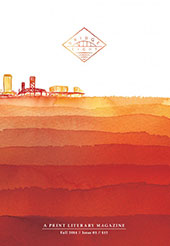
 Based out of Jacksonville, Florida, the biannual print Bridge Eight Literary Magazine publishes literary fiction, poetry and creative non-fiction.
The magazine is published by Bridge Eight, a small independent press that seeks to build the literary culture of Northeast Florida, while publishing work from writers all over the world.
Publisher Jared Rypkema is based in Jacksonville, a city known for its seven bridges. He says, “Bridge Eight provides an ‘eighth bridge’ that will take readers to new imaginative destinations, connecting new voices and new readers, and venturing far beyond the boundaries of the city we call home.” Since its inception, Rypkema notes, Bridge Eight Literary Magazine has been wonderfully received both locally and regionally, earning the support of Jacksonville’s cultural council and arts community. Others working to make the publication happen include Managing Editor Coe Douglas, Senior Fiction Editor Melanie Webb, and Senior Poetry Editor Teri Youmans Grimm.
Bridge Eight started as a community-building organization that sought to connect Jacksonville-based writers and create a movement of literary culture within the city. After a year of hosting workshops and community events, the literary magazine concept was born in order to publish outside influences alongside those grown in Jacksonville, FL. Since there were no other independent literary magazines in Jacksonville, Bridge Eight became the only one of its kind when it published its first issue in November 2014.
Rypkema tells me, “As artists and writers first, publishers second, we carry a commitment to bring our readers the best writing we can, presented in the best way possible. We work with amazing artists for our design and the best printers in the country. For readers, this is a magazine that will not only be a great read, but feel and look amazing as well.”
Recent contributors include Mark Ari, editor of EAT Poems, Editorial Advisor to Fiction Fix, and author of The Shoemaker’s Tale; Teri Youmans Grimm, author of Dirt Eaters and Becoming Lyla Dore (forthcoming); and Lee Matalone, whose writing has recently appeared in the Noctua Review, Verbaleyze’s Young Writers Anthology, the Eunoia Review and the Stoneslide Corrective.
Bridge Eight continues to host workshops for Jacksonville-based writers and presents the semi-regular reading series, Abridged. Rypkema looks to the future of the publication: “As almost all other independent literary magazines, sustainability was key to our foundation. The decisions we’ve made and people we’ve worked with over the past year have set the magazine up for success in the years to come – where we hope to become a go-to for literary publishing in Northeast Florida. Bridge Eight Literary Magazine will always be on the lookout for excellent work that speaks to the very elements of humanity.”
Bridge Eight Literary Magazine accepts submissions on a rolling basis. Submissions received on or before February 15, 2015 will be considered for Issue 2 (Spring 2015).
 While the submissions for this are limited to Vermont poets, the idea is one that could easily be adapted for your own city or college campus!
 There’s still time to submit conference papers, panel or roundtable proposals for the North American Review Bicentennial Creative Writing & Literature Conference, to be held June 11-14 at the University of Northern Iowa, Cedar Falls. Keynotes: Martín Espada, Patricia Hampl, and Steven Schwartz [pictured]. The conference will look back at the NAR’s long and storied past while also looking to the future of the literary world as organizers bring together a wide range of writers, critics, artists, and teachers from around the country to share their work. You are invited to join the celebration! Deadline for proposals: February 22, 2015. For more information, visit the submissions page here.
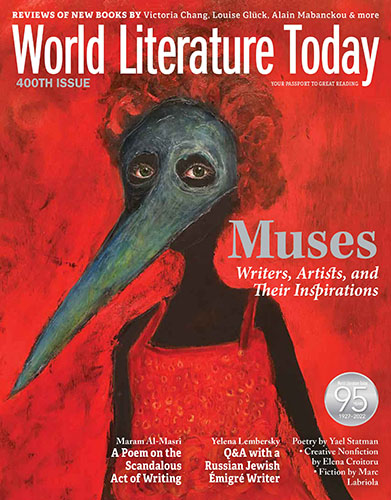 I recommend reading World Literature Today cover-to-cover every issue, but if you need some extra incentive for the January-February 2015, here you go:
 New Letters Editor Robert Stewart asks “Does art do much good?”
 Plan your events now! The Black Caucus of National Council of Teachers of English (NCTE) and NCTE are hosting The National African American Read-In, February 1-28, 2015. There goal is to make literacy a significant part of Black History Month by asking groups and organizations, schools, churches, etc. to host an African American Read-In. Their website has lots of information about how to be recognized as a host, suggested readings and activities, and downloads for giveaways like bookmarks. It’s free to participate.
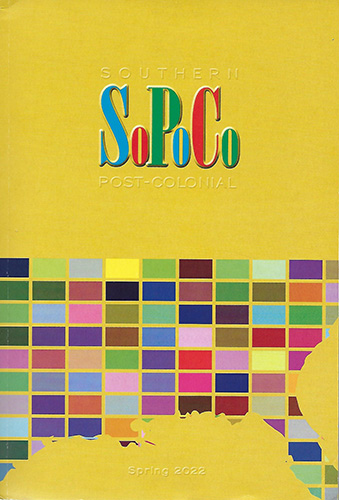 In addition to the cover image, the Winter 2014 issue of The Georgia Review features what Editor Stephen Corey rightly refers to as “the striking art portfolio by Mequitta Ahuja” and notes this is the publication’s “second-ever multi-panel foldout.” This is both a generous and gorgeous dedication to artwork for journal readers to enjoy. Corey also footnotes the artwork introduction with this: “Mequitta Ahuja’s Automythography marks The Georgia Review‘s first collaborative project with the University of Georgia’s Lamar Dodd School of Art Galleries. Sponsored by the Willson Center for Humanities and Arts, Ahuja will be in residence at the school from late January to early February 2015, and an exhibit of her work will be on display at the Dodd Galleries.”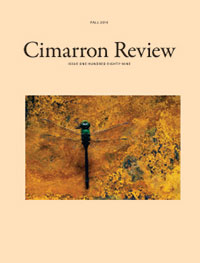
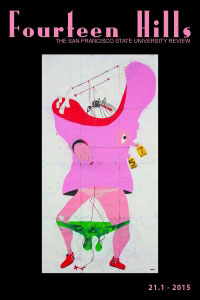 Because this cover made me look twice and then keep looking to really get the full sense of the image, Fourteen Hills 20.1-2015 makes the post. “Don Pepe” by Camilo Restrepo from the series Los Caprichos (2014) is ink, water-soluble wax pastel, tape, glue, newspaper clippings and saliva on paper. Yup. Saliva.
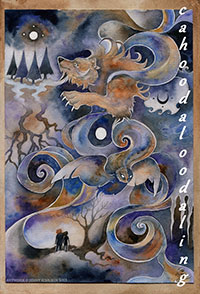 From the online magazine, Cahoodaloodaling: “Our cover artist, Jenny Schukin, is a 20-year-old artist, born in Moscow, Russia, and currently residing in Israel. Mainly inspired by nature, mythology, and folk-tales, Jenny enjoys surreal, fantasy and animal themed artwork. Her preferred media is traditional and her tools of choice are watercolors, inks, and pencils. Jenny’s plans for the near future include attending an art academy in the field of illustration.” In a word: Gorgeous. More of her work is featured in the online issue.
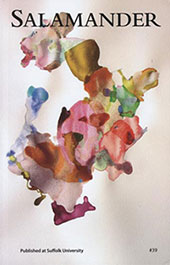 Salamander #39 features the 2014 fiction prize winner judged by Jennifer Haigh: “Dimension” by Barrett Warner. Of his work, Haigh says it is a “coming-of-age tale turned inside out, the hit-and-run love story of an unlikely couple on the skids. Their ill-fated affair is sketched with marvelous economy, style , and verve. Wise, playful, startling in its insight, this is a story made of remarkable sentences laid end to end.’
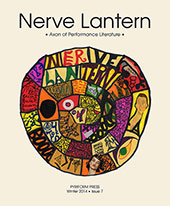 Nerve Lantern: Axon of Performance Literature is a truly unique publication. Published by Pyriform Press and edited by Ellen Redbird, Nerve Lantern is “a journal of experimental performance texts and texts about performance, supporting a range of forms, including poets’ theatre and page-as-stage.” Some examples from Winter 2014 Issue 7: “Un/Conventional Chorus: A Spoken Choral Work for Ten Voices” by Mary Burger & Yedda Morrison; “A Song about the Moon in the Middle of the Night” by Hannah Rodabaugh; “Xylene Radiator Anxiety Mask: Experimental Sonnet Map for Five Voices” by Gary Sloboda; “Pig of Angels of the Americlypse: An anti-masque for four players” by Rodrigo Toscano.
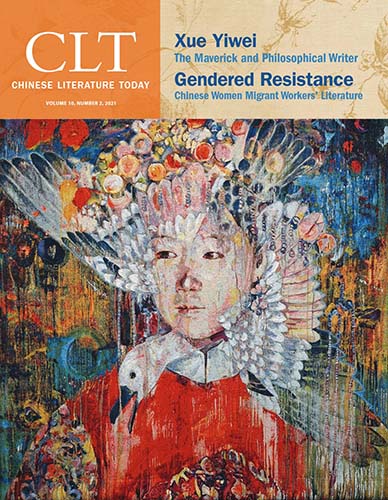 Modern short fiction highlights the newest issue of Chinese Literature Today (v4 n2). Four award-winning authors were selected to exemplify what editors note is a revival of the short form in Chinese literature: Ai Wei, Fan Xiaoqing, Dong Xi, and Li Shijiang. “Our selection covers different generations of contemporary Chinese writers, both male and female writers, and a wide spectrum of literary styles. The selected stories are some of the most representative pieces that showcase short fiction’s efficacy in re-narrating history and memory, capturing immediate social changes, and aestheticizing fragmented individual experiences.”
 Mediterraneans is the subject of The Massachusetts Review special issue for Winter 2014. In their introduction, Editors Anna Botta and Michel Moushabeck write of history of the area, of the many cultures that crisscrossed this busy commerce route, and of the language developed to be shared among them, called lingua franca.
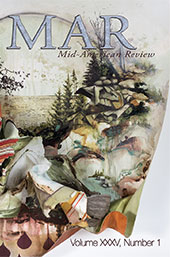 The newest issue of Mid-American Review has much to celebrate. For its 35th Anniversary, Editor-in-Chief Abigail Cloud wanted to recognize the publication’s annual Fineline Competition, unique because it focuses on the short form in poetry and prose, and also because the magazine’s staff cross-read genres to choose the winners. This issue of MAR features 26 works from past Fineline winners in addition to the 2014 Fineline Competition selections: Allison Adair, Winner; Becky Hegenston, Runner-Up; Cherie Hunter Day and Nancy Hewitt, Editor’s Choices. A great issue for those looking to read winning works as well those who may want to enter future Fineline Competitions.
 Writer Beware: The Blog is sponsored by Science Fiction and Fantasy Writers of America, with additional support from several other organizations. With author Victoria Strauss [pictured] at the helm, their effort is “Shining a bright light into the dark corners of the shadow-world of literary scams, schemes, and pitfalls. Also providing advice for writers, industry news and commentary, and a focus on the weird and wacky things that happen at the fringes of the publishing world.”
 Natural Bridge Fall 2014 (#32) includes a special selection of veterans-themed poetry and fiction. Guest Editor John Dalton writes that though the wars in Iraq and Afghanistan are said to be ending, “These wars, it turns out, have their own afterlife. Perhaps no one understand this better than the men and women who’ve returned to us as veterans.”
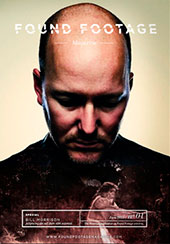 Found Footage Magazine is a double-blind peer review publication of theoretical, analytical and informative contents to Found Footage filmmaking. This independent semi-annual publication will be distributed worldwide and printed both in English and Spanish.
 Skin is the special focus of The Chattahoochee Review Fall/Winter 2014 double issue. Editor Anna Schachner writes that the call for submissions encouraged “literal and figurative explorations of the theme,” and that “the editorial staff couldn’t have predicted the original and varied responses” they would receive.
 Ruminate Magazine Winter 2014-15 features poetry by the winners of the 2014 Janet B. McCabe Poetry Prize judged by Jeanne Murray Walker: First Place Emily Rose Cole; Second Place Charity Gingerich; Honorable Mention J. Scott Brownlee (whose poem “Pasture Ode” can be read here on Ruminate). Also featured are visual works in full color by the winners of the 2014 Kalos Visual Art Prize judged by Mary McCleary: First Place Hilary White, whose work is featured on the cover in addition to a portfolio within; Second Place Aaron Lee Benson; Honorable Mention Lisa Discepoli Line.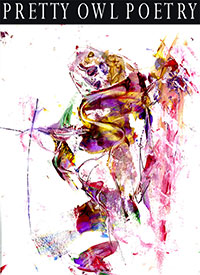
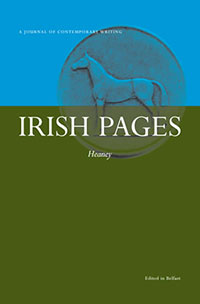 Edited by Chris Agee and Cathal Ó Searcaigh, the newest issue of Irish Pages (v8 n 2) is a tribute in memory of Seamus Heaney. The journal includes: four poems by Heaney; Sven Birkerts and Helen Vendler on the man and the poet; a suite of obituaries and global reminiscences by leading poets and writers in Ireland, Britain and the United States; new poems by Kerry Hardie, Michael Coady, Paddy Bushe, Kathleen Jamie, Katie Donovan, Seán Lysaght, Damian Smyth, Ignatius McGovern, John F. Deane, Franics Harvey, Michael Longley, Alan Gillis, Moya Cannon and Harry Clifton; President Michael D. Higgins on John Hewitt & Richard Murphy on poetry and terror; new writing in Irish from Nuala Ní Dhomhnaill, Cathal O Searcaigh and others; and Seamus Justin Heaney 1939-2013 a unique photographic portfolio by Bobbie Hanvey.
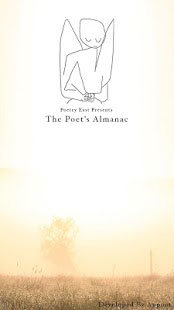 Poetry East has introcuded its new app, The Poet’s Almanac, available for free download on iOS and Android devices. This unique app analyzes the weather report and couples it with Poetry East’s customized archive to create a new way for users to discover and engage with poetry every day. Matthew Murrey heralds a rainy day with a piece, and an afternoon of San Francisco fog invites the reader to enjoy Sally Fisher. All of the poems have been handpicked by the staff at Poetry East and graduate students, as well as faculty, at DePaul University have attributed to each a temperature and weather type.
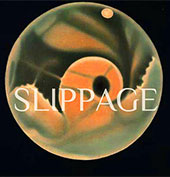 While science, technology, engineering and mathematics – STEM – is the recent focus in education, I am pleased to find pockets where the value of arts is retained: STEAM. The online literary/arts journal [Slippage] is “dedicated to the discovery and publication of unique, creative pieces fusing art with science . . . to bridge the gap between the two worlds of art and science by inspiring artists to think about science and encouraging scientists to transcend rote reductionism.”
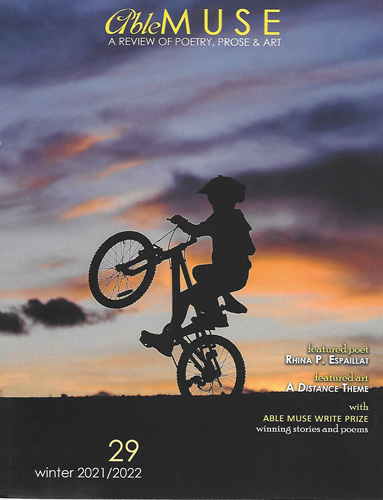 Able Muse Winter 2014 features poetry from Scott M. Miller, winner of the 2014 Write Prize for Poetry, as well as by finalists Eric Berlin, Marilyn L. Taylor, and Catherine Chandler. Winning work of the 2014 Write Prize for Fiction, J. Preston Witt, is featured as well.
 The Broadsided Editorial Team is once again planning their Haiku Year-In-Review (HYIR). Writers are asked to “render the events of the previous year in short poems.” These poems will then be matched with seasonal images for a broadside that can be downloaded for posting. “When you write out your resolutions,” the editors suggest, “look back and write a haiku (and send it to us!)”
 Textual Overtures is a new online academic journal created by graduate students for graduate students in an effort to create an intellectual relationship between the studies of rhetoric & composition and literature. The mission statement of Textual Overtures focuses on the publication’s dedication to “creating a space in which rhetoric, composition, and literature can coexist, and further, create a harmony of textual explorations.”
 First place: Eva Lomski [pictured], of Melbourne, Australia, wins $1500 for “The Things We Build.” Her story will be published in Issue 96 of Glimmer Train Stories.
 $50 knees
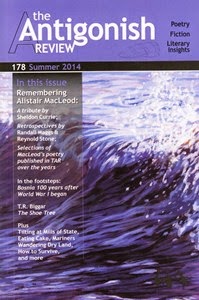 The newest issue of The Antigonish Review features winning works for two of the publication’s 2014 contests:
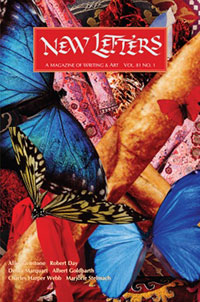
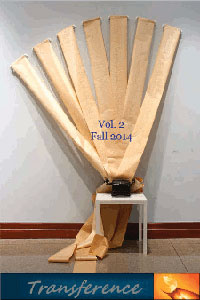
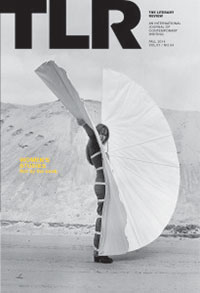
 I’ve noticed lately that print literary journals take a variety of approaches to how they use the back cover of their publication. Their backsides might be completely blank, carry over the cover art from the front, feature a separate artwork, be a money-making ad spot for anything from creative writing programs to publishing to chocolates, list contributors – and perhaps even include a tag line for the works inside.