At the NewPages Blog readers and writers can catch up with their favorite literary and alternative magazines, independent and university presses, creative writing programs, and writing and literary events. Find new books, new issue announcements, contest winners, and so much more!
Imagine finding a prestigious publishing platform that respects authors, pays them well, and treats them like we would want to be treated. According to Founder and Editor Josh Boldt. “Brown Hound Press is well on our way to that goal.” Brown Hound Press favors offbeat mystery, dark humor, southern gothic, and literary fiction, publishing one story every Thursday for readers to enjoy open access online with free subscriptions for email delivery to look forward to each week.
“We’re new,” Boldt says, “but our weekly stories already reach thousands of readers, including best-selling and award-winning authors, editors, publishers, and literary agents.”
The Shore Issue 29 has emerged just in time for spring! It is bursting with poems navigating life’s tangles and finding beauty in the weeds. The issue is popping with new poems from Amorak Huey, Avriel Mejrah, Kelly Grace Thomas, Jacqueline Berger, Thia Bian, Elena Zhang, Bridget Brush, Jenny Chu, Cayla Garman, Patrick Meeds, Brian Czyzyk, Ronda Piszk Broatch, Lea Marshall, Fiona Jin, Catherine Weiss, Morgan Matchuny, Jessica Zhao, Meggie Royer, Janice Northerns, Fez Avery, Aaron Tyler Hand, Morgan Moriarty, Oladejo Abdullah Feranmi, H G Dierdorff, Heidi Seaborn, Becki Hawkes, Tara Ballard, H R Webster, Gareth Adams,Chris Cocca, Nathan Fako, Bridget Kriner, Finaly Worrallo, Özge Lena, Mary Buchinger, Lisa Raatikainen, Nathaniel Julien Brame, Kaitlin Tan, Katie Kemple, Nancy Mitchell, Dennis Hirichsen, Elinor Ann Walker, Daniel Elias Bliss and Nora Sun. It also features an explosion of art by Adam Benedict.
The National Association of Black Bookstores (NAB2) officially declared April 7 as National Black Bookstore Day (NBBD), a first-of-its-kind national observance honoring the cultural, economic, and community impact of Black-owned bookstores across the United States. The day also celebrates the enduring legacy of Georgia “Mother Rose” Peat West, a pioneering figure in Black literary history.
“My mother, Mother Rose, founded and ran Underground Books in Oak Park. This day is deeply personal to my brother and me, it’s a way to honor her legacy and ensure that the stories, voices, and spaces she cherished continue to thrive. National Black Bookstore Day is about more than commerce. It is a declaration that Black bookstores are essential, that they are worth celebrating, and that they are here to stay,” said Kevin Johnson, Founder, National Association of Black Bookstores.
Founded in 1967 at Auburn University, Southern Humanities Review publishes fiction, poetry, essays, earning recognition and consideration for major literary awards. The newest issue (59.1) features nonfiction by Sarah Gorham and Annelise Richardson, fiction by Fernanda Coutinho Teixeira, Reyumeh Ejue, Imogen Osborne, and Don Zancanella, and poetry by Emma Aylor, Zanice Bond, Elizabeth Rose Bruce, Grant Clauser, Cara Dees, Regan Green, Diane K. Martin, Josh Martin, Lana Reeves, Mk Smith Despres, Jayasri Sridhar, Mehrnoosh Torbatnejad, Adam Vines, and Angelica Whitehorne. The cover art is Bird’s Nest and Ferns by Fidelia Bridges (1834-1923).
Happy Friday! April is upon us already. If you celebrate Easter, we hope you have a safe and happy time with your family. In our neck of the woods, we’re looking at cold temperatures and rain this weekend—so much for the kiddos’ egg hunt. But that also means it’s prime time to stay indoors, tucked into a cozy little office, your favorite sweater on, tea close at hand, and submission goals on the agenda.
We’re back with our weekly roundup to keep you inspired and, hopefully, help you find a home for your work.
Explore teatime as more than ceremony in this week's creative writing prompt. Write into ritual, restraint, inheritance, and the ordinary objects that carry everything we can't say aloud.
Subscribe to the NewPages newsletter and get fresh ideas, submission calls, and literary news delivered to your inbox every week.
Submission Opportunities: 134 Ways to Share Your Work
Looking for places to submit your writing, artwork, or hybrid work? You’re in the right place.
Each week, NewPages curates and updates a comprehensive list of open submission opportunities, including literary magazines, journals, presses, contests, and calls for themed issues. Opportunities span poetry, fiction, nonfiction, cross-genre, visual art, and more, with options for both emerging and established writers.
Paid newsletter subscribers receive early access to many of these calls before they’re posted publicly, along with our monthly eLitPak Newsletter, featuring additional opportunities, events, and industry news.
👉 Consider subscribing or upgrading to stay ahead of deadlines.
✏️ Have young writers at home? Don’t miss our Young Writers Guide, which highlights contests and publications open to grades K–12.
🏆 Interested in writing contests, book awards, and literary prizes? Explore our curated list of current contests from literary magazines, independent and university presses, writing organizations, and events.
🔔 What’s new this week? Items marked with a bell icon are newly added to this roundup.
Since learning at the ripe old age of forty that I have GERD, LPR, and issues with fermentable sugars known as FODMAPs, navigating life, and food, has been an education in paying attention.
What came out of all that stress, anxiety, and the constant work of keeping things simple without losing the joy of them was something I didn’t expect: a ritual. A deliberate pause in the middle of the day. Homemade sourdough buns I’ve come to call Sakura Cloud Buns, soft and pillowy and made with care. The right tea chosen to echo whatever flavor the bun is carrying that week. Slow sips. A ceramic tea ware set my father brought back from Japan—delicate, hand-painted with sakura blossoms—pulled out and handled with intention instead of saved for some occasion that never comes.
Learning to be slow. Learning to be deliberate. Learning that a ritual doesn’t have to be inherited or traditional or performed for anyone else to matter.
This is what a tea-time ritual gave me, and it’s also what this week’s prompt is really asking you to explore—because this kind of ritual isn’t about tea. It’s about the pause we carve out when everything else is too much, and the ordinary objects we reach for when we need to remember that we’re still here.
It doesn’t have to be tea. It just has to be yours.
Weekly Creative Prompt
What the Heck is a Crumpet Anyways?!
“In nothing more is the English genius for domesticity more nobly expressed than in the institution of the tea-time ritual.”
— George Gissing, The Private Papers of Henry Ryecroft
There’s a reason the Boston Tea Party still haunts us—Americans have never quite forgiven themselves for what they threw overboard. We lost the kettle. We lost the ceremony. We lost the quiet, deliberate pause in the middle of the day when something as small as a cup could hold all of a relationship’s weight.
Teatime is not really about tea. It’s about what gathers around the table with it: restraint, inheritance, class, longing, the small economies of kindness. A crumpet is just bread—until it isn’t.
This Week’s Challenge
Write into a tea-time ritual.
Your narrator might encounter it for the first time, bewildered and curious — What the heck is a crumpet?! — or they might move through a ritual so ingrained it has become a private language, a thing passed between people the way only shared ceremony can. Let the ritual reveal something: about power or hospitality, longing or resistance, inheritance or the refusal of it.
Consider what happens when the ritual is interrupted. Refused. Misunderstood. Or weaponized.
Your piece might be fiction, nonfiction, poetry, scene fragments, dialogue, visual art, or hybrid work. You might work with teatime literally or metaphorically. But somewhere in the piece, let an ordinary object—a cup, a kettle, a small plate, a spoon—become charged with meaning. Let the ritual carry more than itself.
Ways In
Not sure where to begin? Choose the entry point that feels right for you.
A character raised without ritual enters someone else’s home at tea time and doesn’t know what to do with their hands.
Two people who have shared tea every day for years sit down together for the last time—or the first time without speaking of something that happened.
Tea time as inheritance: a grandmother’s set, passed down with unspoken instructions.
A character uses the ritual as control—hosting as a form of power, or refusing the cup as an act of defiance.
Tea time in a country or context where it doesn’t belong: a diner, a war zone, a hospital waiting room. The wrong tea, the wrong cup, the wrong time—and everything it reveals.
Helpful Tips
On ritual and meaning: Rituals accumulate significance through repetition. The reader doesn’t need to be told the tea means something, they need to feel the weight of the familiar gesture. Let the detail do that work.
On the outsider lens: The narrator who doesn’t know the ritual is a tremendous narrative gift—confusion is a kind of revelation. What does “not knowing” allow them to see that the initiated can’t?
On restraint: What is not said over tea is often more important than what is. Silence, hesitation, the avoidance of a topic—these belong in the scene as much as dialogue.
Try This:
Before writing, spend five minutes with this question: What is the ritual actually protecting? Name it as specifically as you can—not “grief” but this specific grief, not “power” but whose power over whom. Let your answer live just beneath the surface of the piece, never stated, always felt.
Craft Lessons
If you’d like to go deeper—into craft, structure, and how ritual works on the page or in visual composition—the reflections below offer a few focused lenses.
The Object as Threshold
For Writers: In fiction and nonfiction alike, physical objects gain meaning through the weight we place on them in prose—through the way characters handle them, avoid them, misuse them, or inherit them. A cup of tea is just a cup until the narration slows down and notices how the character holds it. Think of the objects in your piece not as props, but as thresholds: things characters move through on their way to or from something else. Choose one object in your piece and write the scene around it—not the emotion, not the theme, but the object. Let the meaning arise from the handling.
For Visual Artists: Still life has always been more than arrangement—it is argument. What a painter or photographer chooses to include on the table (and what they leave out, or push to the edge) tells a story about value, abundance, absence, and care. Consider a composition centered on a tea service or a single cup: what is the table communicating? Who is expected? Who has already left? Work with placement, light, and omission to let the arrangement carry emotional weight without text.
Ritual and the Disruption That Reveals
For Writers: Ritual in narrative functions like music—the reader registers the pattern, and then the moment it breaks becomes charged with meaning. This is why the interrupted ritual is such a powerful scene: the deviation reveals what the repetition was protecting. In your piece, establish the ritual clearly enough for the reader to feel its shape, then introduce the break. The disruption doesn’t have to be dramatic. Someone sets the cup down wrong. The biscuits aren’t there. Someone doesn’t wait to be poured for. These small moments, in the right hands, can hold enormous pressure.
For Visual Artists: Consider the interrupted still life—the arrangement after something has happened. A knocked-over cup, a chair pulled back from the table, the absence where a place setting was. Disruption in visual work functions the same way it does in prose: the eye reads the break in pattern and understands that something has shifted. Use the imperfect, the unfinished, the displaced to suggest narrative without telling it.
Class, Culture, and the Hospitality Bargain
For Writers: Teatime is never purely personal—it carries the weight of its social history. Hospitality is never entirely benign: it is also a form of gatekeeping, an assertion of norms, a test. Who gets to offer? Who is expected to receive graciously? Who doesn’t know the rules? Writing that engages with ritual often finds its real subject in the power structures hiding inside familiar ceremony. You don’t have to announce the class dynamics or cultural tension—situate your characters clearly and let their actions and discomforts do the work.
For Visual Artists: Consider whose table this is, and whose it isn’t. Hospitality imagery in art has long coded belonging and exclusion through objects—the fine china versus the chipped mug, the abundance of the formal tea versus the sparse table of the working household. You might work with contrast, scale, or material to suggest the social stakes embedded in a single domestic scene.
irl: poems by Danielle McMahon Stanchion, March 2026
irl is a chapbook cast in amber, a series of poems with a nostalgic bent, framed by clips of AOL Instant Messenger conversations. It is a love story and it is also not. It’s about kinship, communication, coming of age, and finding the right person at the right time. The poems of irl are tender without ever being sentimental and capture the agony and ecstasy of being seen as a young person.
“At turns visually striking and intimately conversational, irl is a fascinating poetic exploration.”
— Audrey T. Carroll, author of The Gaia Hypothesis
“irl is what cuts through the radio static when the dead zone ends on a winding midnight drive through the middle of nowhere. It is the neon pulse of the lovesick heart and the shards of a glittering eternity. McMahon sings of the age when the small town last felt like the universe: of desolate landscapes crackling with life, and of the electricity of opening oneself to the possibility of everything.”
— Amy Jannotti, author of Angels & Insects are Creatures with Wings and editor-in-chief of Bleating Thing Magazine
There’s a reason “Let there be light” is how so many stories begin. Light doesn’t just illuminate—it creates. What we can see, we can name. What we can name, we can reckon with.
But light in fiction and poetry is never just light. It’s the angle of late afternoon sun that makes a kitchen feel like childhood. It’s the way a flashlight in the woods turns trees into something else entirely. It’s seasonal, emotional, spiritual, physical—and endlessly useful to a writer who knows how to work with it.
Weekly Newsletter Prompt
Let There Be Light
Every art form speaks in light and shadow first. The rest is detail.
Light is how we see. It bounces off everything around us, bends through water, disappears at dusk. It makes plants reach and moods shift. It’s the first thing called into existence in the oldest stories we have—and the last thing a character notices before everything changes.
This Week’s Challenge
Writing lives in the same creative family as every other art form—and light is the language they all share. Painters chase the golden hour. Photographers frame shadow as carefully as subject. Collagists layer translucence and opacity to build meaning. Even graphic novelists know that a single unlit panel can stop a reader cold.
This week, let that cross-art awareness into your writing practice.
For writers: Write a scene, poem, or flash piece in which light, or the absence of it, is doing more than one kind of work at once. Maybe the afternoon light in a room signals the end of something. Maybe a character is afraid of brightness. Maybe darkness is the only honest space left. Let the light (or its lack) carry both physical and emotional weight.
For visual artists & multimedia makers: Create a piece—drawing, photograph, collage, mixed media—in which light or shadow is the primary subject, not just the backdrop. Then write a short artist’s statement (3–5 sentences) describing one deliberate choice you made about light and what you wanted it to do.
For everyone: If you work across forms, try both. See what one teaches the other.
Ways In
Not sure where to start? Try one of these entry points:
A room you know well — describe it in two different kinds of light. Morning vs. 2 a.m. Summer vs. January.
A memory attached to light — a particular porch, a hospital hallway, a car ride at dusk. Let the light be the doorway in.
Start with the science — light bounces, bends, scatters, fades. What if your character understood this literally? What if they thought about it too much?
Write the darkness — begin the moment the lights go out, metaphorically or literally, and follow what emerges.
A threshold moment — someone stepping into or out of light. What are they moving toward? What are they leaving?
💡 Tips Before You Begin
Resist the obvious. “She stepped into the light and felt hopeful” is a starting point, not a destination. Push past the first meaning your light carries.
Be specific about the quality. Fluorescent, golden, blue-gray, filtered, blinding, absent—the type of light tells us where and when and who.
Let shadow do work too. What light falls on matters. What it doesn’t fall on matters just as much.
Mood follows light — in real life and on the page. If your scene feels flat, check what time of day it is and whether your light matches (or purposefully contradicts) the emotional register.
📚 Three Craft Lessons in Light
Painters study light for years. Photographers build entire practices around it. Writers often treat it as an afterthought—set dressing rather than structure. These three lessons are an invitation to change that.
Light as Emotional Weather
Skilled writers and artists use light the way filmmakers use it—not just to show us a scene, but to tell us how to feel about it before the feeling is ever named. This is sometimes called “objective correlative”: the external world reflecting interior states.
Notice how a writer or artist might give us a character sitting under a single bare bulb in a kitchen at 3 a.m.—we already know something is wrong before a word of interiority appears. Or how golden late-afternoon light in a childhood scene might do the work of nostalgia without ever naming it. Or how a photographer’s single shaft of light cutting across a cluttered room tells us everything about the life lived there.
The exercise: Write the same scene twice—once in harsh overhead light, once in soft lamplight. Same characters, same dialogue, same action. Notice how much changes without changing a word of what anyone says or does.
Specificity and the Physics of Light
Vague light is wasted light—in any medium. “The sun was bright” tells us almost nothing on the page, just as a flat, evenly lit photograph tells us almost nothing about mood or intention. The moment you get specific, everything sharpens.
Light has real properties: it slants, it filters, it reflects, it creates glare, it fades in gradients. Writers who understand this write better scenes. Photographers and visual artists who understand this make deliberate compositional choices rather than accidental ones. A collagist layering translucent tissue paper over a dark image is making the same kind of decision a novelist makes when they choose late afternoon over high noon.
Consider the specific worlds different light sources carry with them: fluorescent light hums and flattens—it’s institutional, exposing, relentless. Candlelight pools and trembles—it’s intimate, unstable, ancient. The light through hospital blinds creates a particular striped shadow that no other setting produces. Golden hour turns the ordinary luminous, which is exactly why it’s been painted, photographed, and described ten thousand times—and why it still works when handled with care.
The exercise: Pick three spaces—one intimate, one institutional, one natural. Writers: write one sentence of light for each, aiming for a level of specificity that makes the space and the mood inseparable. Visual artists: sketch, photograph, or collage the same three spaces using only light and shadow as your compositional tools—no color, no subject detail. See what the light alone communicates.
Structural Light — Beginning, Turning, Ending in Illumination
Some of the most powerful uses of light in writing and art are structural—light doesn’t just appear, it changes. And that change is the work’s emotional arc.
Think about how this plays out across forms. A short story might begin in darkness and move toward light, or vice versa, and that movement carries the reader’s feeling through the whole piece. A photographer might shoot a sequence in which the light shifts from harsh to soft, and the subject seems to transform without moving. A collagist might build layered opacity toward a single point of brightness that becomes the visual and emotional destination of the entire piece. The medium changes. The structural logic doesn’t.
The cliché version of this is the “dawning realization,” the moment a character finally sees. The craft version earns that dawn. It plants the darkness early, lets it mean something, and only then allows the light to arrive—or withholds it entirely, which can be just as powerful.
The exercise: Create a piece, in whatever medium is yours, in which the light changes once, and that single change marks the emotional turning point of the entire work. The change can be literal (the power goes out, the sun finally sets, the flash fires) or figurative—but try to make it both at once. Writers: let the light shift carry a scene from one emotional register to another without stating the shift outright. Visual artists: build a piece with two distinct light zones, before and after, and let the threshold between them be where the meaning lives.
Ready to write? Share your piece by tagging us on social or submit to one of the literary journals listed on NewPages—light-themed or otherwise. We’d love to see what you illuminate.
Enjoy prompts like this?
Get fresh inspiration delivered to your inbox every Monday by subscribing to our weekly newsletter. You’ll also find new issues of great lit mags, new and forthcoming titles, recommended readings, bookstore updates, and submission opportunities.
Bennington Review Issue 15 is themed “The Secret History” issue and invites readers in with the startling, unsettling cover photograph by Jonathan Kline, and goes on to include work by seventy-one poets, seven fiction writers, and eleven nonfiction writers, as well as a conversation poet Camille Guthrie conducts with the poet and translator Donna Stonecipher.
On the theme of “The Secret History,” the editors in their introductory note write that this issue’s, “various poems, short stories, flash fictions, and essays are interested in public and private histories, shared and individual traumas that consume us as we try to bury them, the intersections between the personal and the global, ancient violence and the well-worn path from Babylon and the Old Kingdom of Egypt . . . to the 20th and 21st century Ages of Exhaust and Exhaustion.”
Contributors to this issue include Stephanie Ellis Schlaifer, Chris Stroffolino, Rob Schlegel, Adam Clay, Matthew Gellman, Katharine Whitcomb, Mary Jo Salter, H. M. Cotton, Bob Hicok, Madilyne Igleheart, Elizabeth Robinson, Genevieve Kaplan, Nicholas Montemarano, Gilad Jaffe, John Gallaher, Orlando Ricardo Menes, James Kelly Quigley, Mark Nowak, Jehanne Dubrow, Nikola Champlin, Margaret Yapp, Malachi Black, Michael Chang, Elise Thi Tran, Sean Thomas Dougherty, Donna Stonecipher, Laura Bandy, Julie Hanson, Allan Peterson, Dana Isokawa, Sara Rose Nordgren, Kami Enzie, Stella Wong, Lynn Pedersen, Daniel Bouchard, Phillip B. Williams, Aimee Bender, Amelia Gray, Keith Pilapil Lesmeister, Jin Zhao, Laura Eve Engel, Philip Metres, Germain Lee, Tiffany Troy, Su-Yee Lin, and Carrie Cogan among many more.
Blink-Ink #63 asked writers to send their best stories of approximately 50 words on the topic of “Lost Civilizations / The Silurian Hypothesis.” The editors set the stage: “Extreme geological forces of nature make our Earth something like a gigantic trash compactor. Physical evidence of anything at all doesn’t last long. This and the great age of the planet might imply that civilizations as advanced or even more advanced than our own have come and gone. Civilizations that are completely lost to us today. Or are they?”
Contributors include Alisa Golden, David Galef, Merle Mayes, Scott M. Brents, He.E. Ross, Caryl Scroggins, Janel Cameau, Marla Krauss, Eileen Tynion, and many more, with cover art by IrinaTall Navikova.
Happy Friday! I am sitting here huddled under a blanket wishing that spring would stay sprung, but we can’t get that lucky yet. If you are also stuck with some cold and gloomy weather, NewPages is back with our weekly roundup of submission opportunities and a delicious contemplative morsel to help jumpstart your writing.
Explore the bruise as paradox: deep purple proof of pain, sickly yellow promise of healing. A writing prompt with three craft lessons for poets and essayists.
Submission Opportunities: 147 Ways to Share Your Work
Looking for places to submit your writing, artwork, or hybrid work? You’re in the right place.
Each week, NewPages curates and updates a comprehensive list of open submission opportunities, including literary magazines, journals, presses, contests, and calls for themed issues. Opportunities span poetry, fiction, nonfiction, cross-genre, visual art, and more, with options for both emerging and established writers.
Paid newsletter subscribers receive early access to many of these calls before they’re posted publicly, along with our monthly eLitPak Newsletter, featuring additional opportunities, events, and industry news.
✏️ Have young writers at home? Don’t miss our Young Writers Guide, which highlights contests and publications open to grades K–12.
🏆 Interested in writing contests, book awards, and literary prizes? Explore our curated list of current contests from literary magazines, independent and university presses, writing organizations, and events.
🔔 What’s new this week? Items marked with a bell icon are newly added to this roundup.
There’s a particular kind of beauty in a bruise at its worst—that deep, impossible purple, the color of something that has been through something. Then a few days later, the yellow. Sickly, almost strange. Easy to miss if you’re not paying attention. Some days you skip the purple. You find the bruise already fading, with no memory of the hurt that made it. And sometimes that’s not just the body—sometimes it’s the only way we survive certain things, noticing only when we’re already on the other side.
But that yellow means healing is already underway. The body has started the long, unspectacular work of reabsorbing what went wrong.
Weekly Creative Prompt
Bruises as Hurt and Healing
A writing prompt about bruises, survival, and the slow work of healing
Writers have always been drawn to the body as a record-keeper—skin that holds evidence, flesh that marks time. The bruise is one of the most honest images available to us: it doesn’t let you pretend nothing happened, but it also doesn’t let you stay stuck. It moves through its colors whether you want it to or not.
This week’s prompt asks you to sit with that image—the full arc of it, from the dark bloom of initial injury to the faded reminder of what your body quietly survived.
This Week’s Challenge
Write a piece, in any form, in which a bruise is the central image. Not just the wound, but the whole arc of it: the deep purple at its worst, the sickly yellow as it fades. Consider the bruise as paradox—proof that something hurt you, and proof that your body is already working to heal.
What does that color tell us about pain, survival, and the strange beauty of slowly becoming whole again?
You don’t have to have witnessed the wound at its worst. Some of the most honest writing begins with the yellow—with looking back and recognizing, only in the fading, that something must have happened.
Craft Lessons
The Paradox Image
A bruise is two things at once, and that doubleness is what makes it such powerful material for writers. It is evidence of damage, you can see exactly where something went wrong, and it is simultaneously a map of recovery in progress. The body did not ask for your consent before it began healing. That tension, between the hurt that happened and the healing that insists on happening, is where the richest writing lives.
This is the paradox image: a single object or detail that holds contradictory truths without resolving them. Think of Seamus Heaney’s bogs preserving bodies for centuries—death as a kind of keeping. Or James Baldwin’s use of light and fire as both destruction and illumination. The image doesn’t choose between its meanings. It holds both.
When you draft this prompt, resist the urge to explain the paradox. Let the image carry it. Trust the reader to feel the purple and the yellow without a narrator explaining what they mean.
Color as Emotional Time
The bruise moves through colors: red-black, deep purple, blue-green, the sickly yellow-brown of late healing. Each stage is not just a visual fact but an emotional one. Writers who understand this use color not as decoration but as a kind of clock—a way of marking where we are in a feeling.
In lyric poetry and personal essay especially, color can carry enormous weight when it’s anchored to specific, sensory observation rather than abstraction. “Sorrow” is abstract. “The yellow at the edge of the bruise, where it was almost done” is specific, and in its specificity it opens outward.
Notice how the yellow in a bruise is not a happy color, not a spring color. It’s the yellow of illness, of old paper, of something that has been through darkness and come out the other side looking strange. Give your piece permission to use the colors honestly—neither prettified nor sensationalized.
The Body’s Unapologetic Wisdom
One of the most striking things about the bruise as a subject is how indifferent the body is to what you want. It heals on its schedule. It announces your injury publicly, on the surface of you, whether you’re ready for that visibility or not. And it resolves without asking how you feel about it.
This is the body’s particular kind of wisdom: it is not interested in narrative, in meaning-making, in waiting for you to be ready. It simply proceeds. In writing about the body—injury, illness, recovery, change—one of the most radical moves a writer can make is to honor that indifference without either resenting it or sentimentalizing it.
There’s another kind of body wisdom worth considering: the bruise you didn’t notice at the time. The body sometimes withholds the full picture until you’re ready—or until enough time has passed that the wound is no longer dangerous to look at. Writers who work with trauma, grief, or long-held pain often describe this: you don’t write about the thing while it’s happening. You write about it from the yellow.
Consider writing from the perspective of the body itself, or in a voice that is close to the physical rather than the interpretive. What does the bruise know that the mind doesn’t?
A Way In
Think of something in your own life—a loss, a relationship, a period of time—that was both damaging and, in retrospect, something your body or self survived and integrated. You don’t have to write about the bruise itself. The bruise can be a lens.
Try This
Before you write, spend five minutes describing a bruise you remember—or imagine one—in only color terms, with no narrative. What stage is it? What does each color make you feel before you’ve thought about what it means? Use those raw responses as material.
A Way In
Try writing a short piece entirely in the present tense, anchored in the body’s sensory experience rather than the mind’s reflection on it. Stay as close to the physical facts as you can. See where the meaning comes from when you’re not reaching for it.
Enjoy prompts like this?
Get fresh inspiration delivered to your inbox every Monday by subscribing to our weekly newsletter. You’ll also find new issues of great lit mags, new and forthcoming titles, recommended readings, bookstore updates, and submission opportunities.
The Courtship of Windsonline literary journal’s Winter 2026 issue opens with Editor William Ray’s commentary, which welcome readers to a wide range of content subject and themes: “the tension in individuals’ quests to find a spiritual home, inside or outside the mainstream church; reflections on the conflict between corporate and social values; the nuances and challenges of personal relationships; the damage brought by war; poetic pictures of natural landscapes and of quiet moments; and writing that takes writing and art as subjects.”
Readers can enjoy reading poetry by George Freek, Austin Allen James, Erren Geraud Kelly, Anne Whitehouse, Petra Francesca Bagnardi, Ace Boggess, William Miller, Clyde Kessler, Paul Connolly, Jeffery Allen Tobin, Douglas G. Campbell, Doug Tanoury, Jean Howard, Paul Rabinowitz, Mark J. Mitchell, Allison Carroll, Holly Day, Richard Granvold, Tamar Brooks, Annie Przypyszny, Caroline Maun, Glenn Wright, Frederick Pollack, James Croal Jackson, JS Choi, M. M. Adjarian, Lucien R. Starchild; essays by Gary DeCoker, David Sapp; fiction byTITOXZ, Emma Kohut, Guerguan Tsenov, Angela Tang, Debra Lee; drama by Sarah Daly, and artwork by Nuala McEvoy.
Sometimes, for seemingly no reason at all, nursery rhymes still crawl into your adult brain and linger. What seems innocent enough in youth can take a turn when you realize the undercurrents may not be as innocent as you thought.
Mary Had a Little Lamb. Ring‑around‑the‑Rosie. London Bridge. We grow up singing these without thinking much about them—simple melodies, easy to memorize, handed to us before we even remember learning them.
But many nursery rhymes carry shadows: plague histories, ruined cities, forgotten tragedies. Others simply feel eerie, even without a confirmed backstory, as though something older and heavier is woven into the tune.
This week, choose a children’s song or rhyme—whether it’s one whose proposed dark origins you know, or one you’ve never questioned—and create from the feeling it stirs in you now.
What lives under the melody? What memory, fear, tenderness, or myth does it unlock when you listen as an adult rather than as a child?
This Week’s Challenge
Let the rhyme be a doorway, not a subject.
Write, draw, collage, compose, choreograph, design, or otherwise craft a piece that responds to the emotional undercurrent of a nursery rhyme. Don’t retell the rhyme itself—follow the atmosphere it conjures. The sweetness, the dread, the nostalgia, the uncanny, the grief, the comfort.
A Way In
Not sure where to start?
Close your eyes and hum a nursery rhyme you knew as a child—one that surfaced without effort. Don’t choose; just notice which one appeared. Then sit with it for a moment before you look anything up. What does it feel like in your body? What image comes? What age do you become? That instinctive, pre-analytical response is your material. Start there.
Craft Lessons
The best use of the prompt is to not overexplain the perceived meaning behind the nursery rhymes, but to open up their hoods and see what you can find underneath.
Atmosphere is an Argument
The best responses to this prompt won’t explain what the rhyme “means”—they’ll make the reader feel something the rhyme already knows. Think of atmosphere not as decoration but as structure. Every sensory detail, every choice of pacing, is doing persuasive work. Ask yourself: what is the emotional claim I’m making, and is every line earning it?
The Familiar Made Strange (defamiliarization)
Nursery rhymes work because they’re already defamiliarized—adult experience compressed into child-sized language. Your job is a second defamiliarization: take the thing you know by heart and make it strange again. Try shifting scale (enormous, microscopic), time period, point of view, or medium. Strangeness creates attention, and attention creates meaning.
Restraint as Resonance
Resist the urge to explain the darkness. The most haunting pieces in this tradition—Into the Woods, Grimm originals, Angela Carter’s retellings—earn their power through what they withhold. Name the feeling; don’t narrate it. Trust the reader to feel what you felt. One unexplained detail, held with confidence, will do more than a paragraph of analysis.
Helpful Tip
On research and instinct: The proposed “dark origins” of many nursery rhymes—plague, beheadings, political satire—are often folklore themselves, not verified history. That’s not a problem; it’s a gift. You don’t need the backstory to be true for it to be emotionally true. If you want to research, go ahead—but don’t let the research become a substitute for your own felt response. The most powerful work here will come from what the rhyme does to you, not from what historians say it meant.
Try This:
Before you write, draw a line down a page. On the left, list everything you know about the rhyme—words, characters, any backstory. On the right, list everything you feel—images, body sensations, memories, associations. Then write from the right column only.
Enjoy prompts like this?
Get fresh inspiration delivered to your inbox every Monday by subscribing to our weekly newsletter. You’ll also find new issues of great lit mags, new and forthcoming titles, recommended readings, bookstore updates, and submission opportunities.
Publishing poetry, prose, and art online, Chestnut Review pledges respect for artists through ethical financial policies, selecting outstanding work and promoting it widely, as well as celebrating contributors’ achievements. Chestnut Review acknowledges that artists must show a stubborn resilience. Just like the chestnut tree, surviving blight by sending out new shoots, artists persistently create despite rejection, hardship, and life’s demands, sustained by stubborn belief in their work.
Those stubborn artists contributing to the Winter 2026 issue include Daniel Abukuri, Hajer Requiq, Jen Feroze, Lauren Saxon, Marvellous Igwe, Michael Okafor, Sam Aureli, Shei Sanchez, Sodïq Oyèkànmí, Chelsea Lebron, Chris Negri, Claudia Owusu, Nicholas Hilbourn, Nora Wagner, Ellen McMahill, Jack Bordnick, Jeff Mann, Joyce Melander, and Lisa Rigge.
New England Review Issue 47.1 offers readers contemporary poetry, fiction, and nonfiction alongside translations translations from the German and Spanish, and “rediscoveries” of previously published work.
Contributors to this newest issue explore themes of grief, identity, technology, family, failure, and memory through poetry by Catherine Goldhammer, Alissa M. Barr, Sandra Lim, Ama Codjoe, Chelsea Christine Hill, Lauren Eggert-Crowe, Randall Mann, Traci Brimhall, Patricia Lockwood, Abdulkareem Abdulkareem, Oscar Oswald; fiction by Emily Lyons Flamm, Lauren Acampora, Kyle Francis Williams, Elizabeth Lee Ayce, David Hansen, José Orduña; nonfiction by Lindsay Starck, Hasanthika Sirisena, Robin Hemley, Ranbir Sidhu, David Staudt.
Translations include work by Mely Kiyak translated by William Pierce, by Liliana Ponce translated by Michael Martin Shea, and by Clementina Suárez translated by J. P. Allen. “Rediscoveries” brings back work by Edmund Burke, “From Thoughts on the Cause of the Present Discontents.”
Eternidades / Eternities (1916-1917) by Juan Ramón Jiménez Translated with an Introduction and Notes by A. F. Moritz The Bitter Oleander Press, March 2026
“Written in 1916 and 1917 and published in 1918 by Nobel Prize winner Juan Ramón Jiménez, Eternities is one of the foundational books of modern Spanish literature and of the modernist period. A.F. Moritz presents a masterful translation of Jiménez’s landmark collection.
“Juan Ramón’s first trip to America (1916) and his interest in English-language poetry, especially Emily Dickinson, profoundly marked his work during the period in which he wrote Eternidades (1918). . . a milestone work in Juan Ramón’s journey from what was called ‘pure poetry’ to what he later termed, in the famous poem 5 of Eternidades, ‘naked poetry’.”
The Colorado Authors League (CAL) supports and promotes its community of published writers while connecting with and adding value to the reading world. Formed in 1931, authors become members to: keep up with changes in the craft of writing, publishing, and marketing, gain greater visibility for their writing, join a group of like-minded people who love writing. View our flyer to see new releases by members and learn more at our website.
Want early access to our eLitPak flyers? Subscribe to our weekly newsletter! You can also support NewPages with a paid subscription and get early access to the majority submission opportunities, upcoming events, and more before they are posted to our site.
Still Point Arts Quarterly is a visually striking literary and arts journal published four times a yea with each themed issue featuring historical and contemporary art, fiction, nonfiction, and poetry. The Spring 2026 issue is themed “Crafting a Life” and opens with Editor Christine Brooks Cote’s commentary exploring art, craft, and industry, closely examining the distinction between craft and industry.
“There is nothing certain about life. Every moment of every day involves risk — not knowing how to proceed, trying something to see if it will work, sometimes having to undo past efforts and try another way, hoping it all works out in the end — and possibly suffering the consequences of our actions. By accepting and living with the risks, we craft our lives. […] Just as we improve and progress in our craft as we do it, we learn how to live a better life as we do it, and often the lessons learned are interchangeable: patience, perseverance, problem-solving, a sense of curiosity, the importance of mental and physical stimulation, and so many more. Crafting a well-lived life is not without risk and uncertainty, but if we seek certainty, we miss the point.”‘
Contributing poets and artists who offer readers the opportunity to enjoy their craft include Christopher Wiley-Smith, Gloria Heffernan, Renee Dionne Mies, Sheri Reda, Lilace Mellin Guignard, Fendy Tulodo, Elise Chadwick, Gail Tyson, David Anson Lee, Joyce Lewis-Andrews, Lisa Timpf, Mary E. Berg, Robin Michel, Kathryn DeZur, Katherine Simmons, David M. Stern, Kimberly Beckham, and Sarah Kilch Gaffney.
Happy Friday! If you missed it on Wednesday, our March eLitPak went out with plenty of writing opportunities and book recommendations to keep you busy. And if you’ve already powered through everything—good for you!
NewPages is back with this week’s roundup of submission opportunities to help you keep your goals on track, plus a little spark of inspiration if you’re feeling stuck in a creative rut.
Submission Opportunities: 150+ Ways to Share Your Work
Looking for places to submit your writing, artwork, or hybrid work? You’re in the right place.
Each week, NewPages curates and updates a comprehensive list of open submission opportunities, including literary magazines, journals, presses, contests, and calls for themed issues. Opportunities span poetry, fiction, nonfiction, cross-genre, visual art, and more, with options for both emerging and established writers.
Paid newsletter subscribers receive early access to many of these calls before they’re posted publicly, along with our monthly eLitPak Newsletter, featuring additional opportunities, events, and industry news.
✏️ Have young writers at home? Don’t miss our Young Writers Guide, which highlights contests and publications open to grades K–12.
🏆 Interested in writing contests, book awards, and literary prizes? Explore our curated list of current contests from literary magazines, independent and university presses, writing organizations, and events.
🔔 What’s new this week? Items marked with a bell icon are newly added to this roundup.
When my grandfather started using a wheelchair, we discovered fast that 1960s doorframes weren’t built with that in mind. The solution was straightforward: take the doors off their hinges. Problem solved—technically. But practical? Comfortable? Dignified? That’s a different question.
It shows up everywhere once you start looking. A strip mall might have two handicap access points and still leave someone stranded at a heavy door with no free hands and no automatic opener. My own GERD diagnosis taught me that standard kitchen design—counters at a certain height, the need to bend and lift—doesn’t account for bodies managing reflux every single day.
Accessibility often looks like a checkbox. Lived experience tells a different story.
Weekly Creative Prompt
Practical and Accessible Aren’t the Same Thing
A door taken off its hinges is still a door. It just asks more of you. That asking—the space between what was designed and what is lived—is where the story begins.
The Tension
Think about a space, system, or solution that technically met the definition of “accessible”—and still created unexpected barriers, workarounds, or moments of quiet adaptation. That gap between intention and reality is rich creative territory. It holds frustration, ingenuity, grief, humor, and resilience all at once.
This prompt isn’t only about disability or illness. It applies anywhere a designed solution falls short of a lived need—a school system built for one kind of learner, a workplace that accommodates but doesn’t include, a home that technically fits but never quite feels like it does.
A Way In
Not sure where to begin? Start small and specific.
A doorframe. A ramp. A counter. A form that doesn’t have a field for your situation. The most powerful entry point is usually a single physical detail that carries the weight of something larger. Ask yourself: Where did the workaround live? That’s often where the story does too.
Craft Ideas
Not a writer? Not only a writer? These entry points are for you.
Writing
Write a scene in which a character navigates a space that was designed with good intentions but fails them in a specific, concrete way. Resist the urge to editorialize—let the physical details carry the emotional weight. The character’s adaptation says more than any internal monologue could.
Visual Art & Photography
Create a piece that documents or imagines the workaround rather than the barrier. What does it look like when someone has made a system work for them despite its design? Consider negative space, threshold imagery, or the aesthetics of improvised solutions.
Mixed Media & Collage
Layer “official” accessibility language—signage, checklists, building code excerpts, medical guidelines—against imagery or text that reflects the lived reality. Let the tension between those two registers become the work itself.
This Week’s Challenge
Avoid abstraction. Be specific.
The real challenge here is avoiding abstraction. It’s easy to write about inaccessibility as a concept. It’s harder—and more powerful—to put a reader inside a specific body, in a specific space, in a specific moment, and let them feel the gap firsthand. The goal isn’t to make a point. It’s to make the reader understand something they may have never had to think about before.
Wherever this prompt takes you—a first draft, a finished piece, a photograph, a collage, a single sentence that finally says what you’ve been trying to say—that’s enough. The gap between design and lived experience has always been full of stories. Yours is one of them.
What becomes of a literary magazine once it ceases publication? One long-standing option has been the University of Wisconsin’s Little Magazine Collection, a non-circulating collection of print publications, along with their Introduction to Little Magazines Learning Module, their work is integral to the preservation of this aspect of literary history.
Another, perhaps more accessible option, is the new and growing Zine Alive Archive at The Fool’s World. Zine Alive Archive is open to house literary works from magazines and blogzines that have ceased publication, for whatever reason.
For those publications, Zine Alive Archive is here to house the published works that are now offline. In this space, Zine Alive shares active links as well as highlights or full issues of those magazines for free.
The Sunlight Press is a nonprofit digital literary journal publishing new and established voices in creative nonfiction, fiction, poetry, reviews, photography, and craft reflections. Focused on light, hope, and human resilience, The Sunlight Press explores moments of insight found in everyday and extraordinary experiences. New work appears Mondays and Wednesdays, with occasional additional features and announcements.
Recent featured works include photography by Russell Nichols, poetry by Thehara S.U. and Claire Lynch, essays by Lee Bernstein, Yiyao Li, and Ron Clinton Smith, and fiction by Kathryn Silver-Hajo.
Currently closed to fiction and poetry, submissions are open for personal essays, reviews, “Artists on Craft Series” (interviews/reflections by artists on their process of the art of choice) and photography.
What if before there was anything, there wasn’t darkness—not the deep, cinematic black of space—but a gray static, like a television tuned to nothing with the volume muted? And what if somewhere in all that silence, a whisper gathered itself and exploded into everything?
Creation is a question humans keep returning to. This week, we’re asking you to step inside that moment—the one before the first thing had a name.
This Week’s Newsletter Creative Prompt
Out of the Gray Silence
A writing prompt on emergence, creation, and the first impossible moment.
This week’s writing spark explores emergence, creation, and the first impossible moment.
Every act of creation starts the same way—with nothing. A blank page. A held breath. A gray void waiting.
This week’s prompt asks you to reach into that void and pull something out. Not just anything—something that could only come from you.
This Week’s Challenge
Before anything had a name, there was only gray silence—lightless, soundless, waiting like a blank canvas. Then a whisper gathered force until it became a world-shaping boom that cracked open the nothingness.
What emerges in that first impossible moment?
Create what arrives with that sound: a world, a creature, a memory, a myth, a color, a mistake, a miracle. Write it, draw it, photograph it, collage it, or push two forms together into something new. Let the boom give birth to something only you could make.
Craft Lessons
Sometimes something abstract can seem tough to tackle. This prompt invites you to shake off the notion of abstraction to create something meaningful.
The Power of Sensory Grounding in Abstract Subjects
Creation mythology—the void, the boom, the emergence—is about as abstract as subject matter gets. The craft challenge is to make it felt rather than explained. The writer who tells us “and then the world began” loses us. The writer who tells us the first thing to exist was the smell of rain on concrete nobody had laid yet—that writer holds us.
Practice: For every abstract concept in your draft (silence, creation, nothingness), find one physical detail that embodies it. Not a metaphor—a thing. Concrete nouns are the anchor of all great lyric writing.
Scale as a Craft Tool
This prompt operates at cosmic scale—the birth of something from nothing. One of the most powerful moves a writer can make is to suddenly shift that scale: zoom from the universe to a single detail so small it shouldn’t matter.
Think of Annie Dillard watching a moth burn. Or Marilynne Robinson’s Gilead, which holds the entire weight of mortality in a description of light on a kitchen table. The cosmos-to-crumb move is a signature of the most memorable literary writing.
Practice: Write your piece at the grandest scale you can manage—and then, in the final paragraph or image, land on something impossibly small. One hair. One syllable. One mote of dust that didn’t know it had just become dust.
Form as Content—When Structure Tells the Story
The prompt explicitly invites hybrid and experimental forms—and this is intentional. When your subject is the birth of something new, your form can enact that birth. A piece that begins as prose and then fractures into white space and fragments. A visual piece that starts in gray and ends in color. A list that begins as noise and gradually becomes music.
Form is not just a container for content. Form is an argument. When you choose to write a field guide entry about the first creature that ever felt lonely, the bureaucratic structure of that form is saying something about how we catalogue and domesticate experience. Let that layer do some of the heavy lifting.
Practice: Before you draft, ask yourself: what form would this content be embarrassed to be put in? Then consider whether that tension could be exactly the point.
Three Ways to Enter the Void
Not sure where to begin? Choose the entry point that feels right for you:
The Witness. Write in first person as someone—or something—that was present when the boom happened. Not God, not a narrator. A piece of gravel. A future word that didn’t exist yet. The color blue, before it was blue.
The Artifact. Create something that exists because of the boom—a mythology fragment, a field guide entry for the first creature, a medical chart for the first wound, a recipe for the first meal. Let form carry meaning.
The Visual. Draw, collage, or photograph the moment of emergence. Capture the gray just before and the something just after. You don’t have to be an artist—a torn magazine, a smudge of graphite, a double-exposed photo all count.
Helpful Tip
It’s tempting to jump straight to what emerges—the creature, the world, the image. But the most powerful responses to this prompt often start by dwelling in the sound itself.
Before you write a single noun, close your eyes and listen. What does this boom feel like? Is it low and geological, like tectonic plates grinding into existence? Is it sharp and electric, like a synapse firing for the first time? Is it somehow musical—or is it the very moment before music was invented?
That sonic quality will carry your piece. A boom that sounds like a cello breaking will birth something different than a boom that sounds like a word mispronounced in the dark. Let the sound lead, and the emergence will follow naturally.
Try this:
Set a timer for 3 minutes. Write only about the sound—its texture, temperature, weight, direction. Don’t describe what it creates yet. Just the sound. Then stop and read what you wrote. The shape of your piece is already there.
📬 Get Inspiration Delivered Weekly
Subscribe to the NewPages newsletter and never miss a spark. Each week you’ll receive:
✦ New issues of literary magazines ✦ New book releases worth your time ✦ Bookstore news and updates ✦ Recommended reading ✦ Submission opportunities and calls for work ✦ Weekly writing prompts like this one
Join thousands of readers and writers keeping the literary world close.
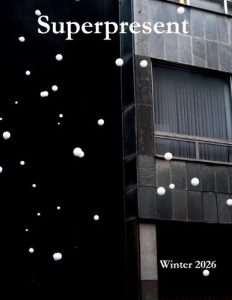
Themed “echo,” the Winter 2026 issue of Superpresentopens with the editors commentary, “This go-round, Superpresent asked contributors to think of echo in their own ways. We didn’t receive the photo of a bat promised by one 14 year old niece when told the theme (‘echo location,’ she smugly nodded). We did, however, receive work that reminded us of Emerson’s letter to Whitman on first reading Leaves of Grass: ‘I greet you at the beginning of a great career, which yet must have had a long foreground somewhere, for such a start.’ Some of the contributors this issue are gifted beginners while others are seasoned (weathered?) makers.”
Publishing quarterly since 2020, Superpresent was created with a few simple goals: to present striking visual art and writing without favoring one over the other; to be available both online and in print; to be free (free to download or view online and free to submit work to); and to produce an affordable, high quality print version for those who still like touching paper and ink.
Formerly known as Crazyhorse, swamp pink publishes fiction, poetry, and nonfiction online twice a month. The journal is dedicated to showcasing exceptional work by writers at all stages of their careers, with a particular interest in voices from writers of color and other marginalized or underrepresented communities. The February 2026 issue (no. 24) features fiction by Brian Ma, Skyler Melnick, Abeje Zora Schnake; poetry by Elisa Luna Ady, Ben Cooper, Sam Dickerson, Leila Farjami, Mckendy Fils-Aimé, John T. Howard, L. S. Klatt, Yunkyo Moon-Kim, samodH Porawagamage, February Spikener, Mary Zhou, Flash Fiction, KJ Nakazawa-Kern, Sarah Therio; and nonfiction by Philip Metres and Amber Flora Thomas.
Cholla Needles is a nonprofit supported by private donations that publishes a monthly literary magazine and books by desert-inspired writers. Cholla Needles hosts literary events, offers mentoring and workshops for writers of all ages, provides free access to its poetry, prose, and art library by appointment, and partners with community organizations to promote the arts.
Their monthly print publication focuses on the work of ten poets as well as accompanying photography and/or artwork. Contributors to the newest issue (111) include James Marvelle, Bonnie Bostrom, Rick Adang, Sarah Marie, Duane Anderson, Arvilla Fee, Patty Prewitt, Francene Kaplan, Barry Kritzberg, and J. Malcolm Garcia, with cover and inside photos by Kim Martin.
Established in 2014, Brilliant Flash Fiction is a nonprofit literary journal dedicated to sharing striking short fiction from writers around the globe. Each story appears alongside vivid photography, creating a visually engaging reading experience. The journal also hosts writing contests and shares craft advice through social media, all without charging any fees. Committed to showcasing distinctive international voices, Brilliant Flash Fiction invites submissions from writers at every stage of their careers. Recent contributors include Dirk Kortz, Alethea Paul, Hannah Wyatt, Tracy Royce, David L. Updike, Samuel Cromwell, Jonathan Worlde, Bethany Bruno, Benjamin Brindise, Pravy Jha, and Mandira Pattnaik.
Terrain.org is a pioneering place-based online journal publishing high-quality literature, art, science, and activism addressing social and environmental issues. Featuring renowned writers like Wendell Berry and Joy Harjo alongside emerging voices, Terrain.org offers multimedia work, interviews, podcasts, and community case studies while fostering an inclusive, advertisement-free literary community. Recent articles include “Built on Dry Ground: The Water Reckoning in the West” by Joe Whitworth, “Why We Tell Stories” by Rob Carney, “Learning Resilience: Writing Washington State Lands” by Lis McLoughlin, “From Birds to Whales to Birthdays” by Rob Carney, “Letter to America: What do we tell the water now?” by Lisbeth White, “Satellites Show, Stories Tell” by Elise Arellano-Thompson, “Also, the Universe Purrs” by Rob Carney, as well as recent episodes in their podcast series, “In the Circle of Ancient Trees” and “The Gift of Animals. Terrain.org also publishes poetry, fiction, interviews, reviews, and visual features “ARTerrain” and “Upsprawl.”
Happy Friday! …and happy winter 2.0. This weekend, winds are rising and temperatures are set to plummet, with up to 7 inches of snow headed for the NewPages neck of the woods. So if your roof‑maintenance quotes are also getting waylaid by the weather, we’ve got you covered: plenty of submission opportunities to keep you busy indoors, plus a little inspiration to jump‑start your “bored of winter” creativity.
This week’s creative prompt explores the tension between lineage and construction, asking what happens when the boundary between the “begotten” and the “made” begins to blur.
Submission Opportunities: 140+ Ways to Share Your Work
Looking for places to submit your writing, artwork, or hybrid work? You’re in the right place.
Each week, NewPages curates and updates a comprehensive list of open submission opportunities, including literary magazines, journals, presses, contests, and calls for themed issues. Opportunities span poetry, fiction, nonfiction, cross-genre, visual art, and more, with options for both emerging and established writers.
Paid newsletter subscribers receive early access to many of these calls before they’re posted publicly, along with our monthly eLitPak Newsletter, featuring additional opportunities, events, and industry news.
✏️ Have young writers at home? Don’t miss our Young Writers Guide, which highlights contests and publications open to grades K–12.
🏆 Interested in writing contests, book awards, and literary prizes? Explore our curated list of current contests from literary magazines, independent and university presses, writing organizations, and events.
🔔 What’s new this week? Items marked with a bell icon are newly added to this roundup.
Being born Lutheran in a farming family in the Midwest meant that every Saturday night we got cleaned up and went to church. Over the years the language shifted a bit. “Quick and the dead” became “the living and the dead,” and many of the thys and thees softened into more modern speech.
But one phrase never really changed.
“Begotten, not made.”
And brains being what they are, you start to wonder what that phrase might mean outside its theological context. What does it really imply about lineage, identity, and authenticity? What happens when we take that ancient distinction and apply it to the world we live in now? And once you start thinking about it, the distinction between what is begotten and what is made begins to show up everywhere.
Weekly Creative Prompt
Begotten, Not Made
“begotten, not made, being of one substance with the Father, by whom all things were made”
— Nicene Creed
This week’s creative prompt explores the tension between lineage and construction, asking what happens when the boundary between the “begotten” and the “made” begins to blur.
The distinction between begotten and made appears throughout theology and philosophy. To be begotten is to come from a direct lineage, sharing the essence of one’s progenitor. To be made is to be constructed, crafted, or engineered.
Even beyond religion, echoes of this belief run through society. The natural-born versus the manufactured. The organic versus the artificial. People formed through science, objects produced by hand or factory, and increasingly sophisticated technologies all challenge the idea that origin determines worth.
Now imagine a world where this divide is not subtle, but structural.
Those who are begotten inherit rights, privilege, and status. Those who are made receive none.
But boundaries rarely stay fixed.
What happens when something made begins to resemble something begotten? Or when the begotten rely on the made in ways that complicate the hierarchy?
Where does essence come from? Who decides what counts as authentic? What happens when those categories begin to collapse?
Write, draw, collage, sketch, or create your way into the space between what is begotten and what is made.
💡 Core Idea: Look for the Seam
Instead of examining the two categories separately, look at the place where they meet.
Where is the interface between the begotten and the made?
It might appear as:
a surgical scar
a serial number etched into bone
a legal document defining personhood
a memory that cannot be proven natural or artificial
an heirloom whose origin is uncertain
The most compelling stories and artworks often live at the seam—the moment something made tries to pass as begotten, or something begotten begins to realize it has been shaped, modified, or constructed.
This Week’s Challenge
Explore the tension between begotten and made through any creative form—writing, drawing, collage, comics, photography, or multimedia work.
You might begin with one of these entry points:
The Heirloom An object treated as sacred within a family is revealed to have been mass-produced.
The Body A character begins to lose track of which parts of themselves were inherited and which were engineered.
The Ritual A culture develops a ceremony to determine who is truly “begotten.”
The Artifact Something manufactured slowly gains emotional or cultural meaning until it is treated like a living legacy.
The Discovery A person believed to be naturally born learns their origin was constructed—or vice versa.
Follow the tension wherever it leads.
Craft Practices to Deepen Your Work
Linguistic Coding
Language itself can reinforce hierarchy.
The Begotten might speak in organic, ancestral terms—bloodlines, roots, inheritance.
The Made might be described using mechanical or industrial language—assembly, calibration, circuitry.
Try reversing this expectation. What happens when the made begin to reclaim their origins through language?
The Ship of Theseus Question
A classic philosophical puzzle asks: if every plank of a ship is replaced, is it still the same ship?
Apply this idea to a character, object, or identity.
If a person gradually replaces parts of themselves with engineered components, at what point do they stop being begotten?
Or do they?
Structural Irony
Consider a society where the Made secretly maintain the world of the Begotten.
Perhaps the culture, history, or traditions that define the Begotten are actually preserved or manufactured by those who were never meant to belong.
If the Begotten depend on the Made to maintain their sense of authenticity, the hierarchy may already be collapsing.
Perhaps the real question is not whether something is begotten or made…
…but whether the difference still matters once both begin to resemble each other.
Try It As
This prompt may resonate with creators working in:
speculative fiction
poetry
collage and mixed media
visual art exploring authenticity and replication
hybrid or experimental work about identity, origin, and artificial creation
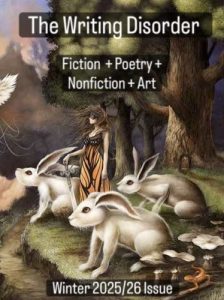
The Writing Disorder is a quarterly Los Angeles–based journal publishing fiction, poetry, nonfiction, art, interviews, and reviews, showcasing emerging and established voices while celebrating storytelling and experimentation. The Winter 2025/26 issue features “The Fantastic Art of Dan May,” each image of which will take viewers on a fantastical imaginary journey. Readers will also enjoy fiction by James Joaquin Brewer, Adrienne Clarke, Danyl A. Doyle, Joceline Eickert, Adrianna Procida, Plamen Vasilev, Bill Vernon; poetry Suzette Bishop, Richard Dinges, Jr., Peycho Kanev, Jennifer Lagier, Jim Murdoch, Michael Penny, Tammy Smith; nonfiction by Kevin Brown, Caitlin Garvey; and an interview with author Diana Josefowicz by Geri Lipschultz as well as a book review by Hugh Blanton of Crush by Ada Calhoun.
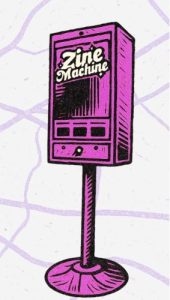
If you hear someone say, “I love when you can just tell that everyone involved is having fun,” chances are pretty good they’re talking about Zine Machine, the magazine named after the original concept: a literal vending machine for zines – but it is also so much more!
Zine Machine is a quarterly publication of writing and visual art formatted as a mini zine which is compatible with its vending machines. (Exact specifications and an example template are available at zinemachine.com/submissions.) New issues are published on the first of January, April, July, and October, and in keeping with the name, these quarterly issues can be purchased via vending machine through partnering retailers. (More information about these locations can be found at zinemachine.com/pop-ups.) These zines are also free to read as digital flipbooks online while individual zines and full issues are available to purchase on the Zine Machine website.
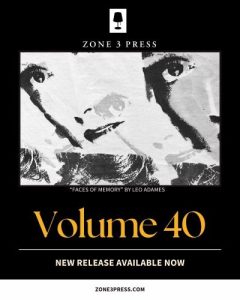
Founded in 1986, Zone 3 is the annual online literary journal of Austin Peay State University’s Center of Excellence for the Creative Arts (CECA, “seek-ah”), publishing poetry, fiction, and creative nonfiction from emerging and established writers in a wide range of aesthetics.
Issue 40.1 has just been released and features Nonfiction by Zehra Habib, Francesca Leader, Matthew Pitt; Poetry by Claire Cella, Dario Cvencek, Aminata Gueye, Don Farrell, Rachel Fan, Kelle Groom, Alana Craib, Jim Daniels, D. Dina Friedman, Shana Graham, Tom Laughlin, Glen Mazis, Michael Montlack, John A. Nieves, Hayden Park, Abigail Xiao, Nicole Yurcaba, Hanyi Zhou, Jane Zwart, Nicole Yurcaba; and Fiction by Barbara Krasner and Jacob Vaus.
Two unrelated phrases collided in my brain this week: “your body is a wonderland” and “a house with a room of its own.” They have no business being in the same thought — but once they were, I couldn’t shake the question underneath them: what happens when a home becomes a person, or a person becomes a house?
Weekly Creative Prompt
This House is Alive
On writing the body as architecture — and what it means to live inside yourself.
This week’s writing spark explores what happens when a house becomes a body, a self becomes a structure, and memory finds a room to inhabit.
What if a house is not haunted, but breathing?
We spend so much time writing the interior life as though it were weather—storms of feeling, seasons of grief, fog at the edges of memory. But what if we tried a different architecture? What if the self had rooms, load-bearing walls, a foundation poured in childhood that still holds the whole structure up?
This week’s prompt asks you to think of a house as a body—and a body as a house. The roof is hair. The attic is the brain. The windows are eyes. The front door is a mouth. And from there, the metaphor opens into something stranger and more truthful than it first appears.
Whether you’re a poet, a memoirist, a fiction writer, or someone who just reached for a notebook during a difficult week—there’s an entry point here for you.
This Week’s Challenge
Select one option below to explore in writing, art, or collage. Or, if you’re feeling adventurous, try all four and see where they take you.
Option 1: Renovation
Your house-body needs repair. When the wallpaper-skin is peeled back, what forgotten history is revealed? What memory rises when the attic-brain is opened for light? Write or create from the moment something is exposed—or refused to be repaired.
Option 2: The Architect Arrives
A visitor appears claiming to be the architect of your house-body—your past self, future self, or a stranger with impossible knowledge. They walk room to room explaining their choices and pointing out one flaw they regret. What happens next?
Option 3: Structural Integrity Report
Your house-body is being inspected by an unexpected entity: a doctor, a ghost, an emotion, or a loved one. What do they find in the wiring, the foundation, the crawlspace? What truth does their report force you to confront?
Option 4: Guests
Your house-body fills with guests—memories, habits, ancestors, characters, or intrusive thoughts. Where do they stay? Who rearranges the furniture? Who leaves without saying goodbye? Create from the tension or tenderness of guesthood.
3 Craft Practices to Deepen Your Work
Not sure where to begin or how to go deeper once you’ve started? These three practices work especially well with extended metaphor prompts like this one.
Make the Metaphor Literal—Then Break It
Extended metaphors are strongest when they’re willing to test themselves. Start by committing fully to the conceit: if the windows are eyes, what does it mean when the glass fogs? What happens when one is broken and never replaced? Let yourself follow the logic wherever it goes. Then, deliberately find the moment the metaphor strains or fails, and write toward that edge. The crack in the analogy is often where the poem or essay truly lives. Don’t paper over the flaw, build the whole room around it.
Write the Mundane Detail First
When a prompt asks you to explore something vast—the self, the body, inherited memory—it’s tempting to start with large, resonant language. Resist that. Instead, anchor yourself in a single specific, even boring, detail: the particular squeak of a floorboard, a smudge on a baseboard, a draft from a window that was never quite sealed. Specificity does the work that abstraction can’t. The mundane detail creates trust between the writer and the reader, and it gives the larger emotional or thematic movement somewhere solid to push off from.
Let the Form Echo the Content
Houses have structure: rooms, thresholds, rooms within rooms. As you draft, consider how the shape of your piece might mirror the architecture you’re exploring. A piece about compartmentalization might use tight, separate sections. A piece about a house that’s falling apart might let the sentences fragment or the white space widen. A poem about a foundation might hold its form rigidly. The decisions you make about line breaks, paragraph length, and white space are structural decisions too. Don’t make them by default, make them deliberately, as if you’re the architect.
Get Fresh Inspiration, Every Week
If this prompt sparked something—a first line, a memory, an urge to rearrange your own furniture—imagine what a year of these could do.
Our newsletter is a weekly gathering place for writers and readers who want to stay close to the work. When you subscribe, you’ll receive:
A new writing or creative prompt every week, like this one
Literary magazine updates—new issues, themed calls, and editorial news from journals we love
Recommended reading—essays, poems, stories, and interviews worth your time
New book releases—debuts, collections, and titles from independent and small presses
Bookstore updates—store openings, store closings, and new locations
Submission opportunities—open calls, contests, and residencies for writers at every stage
We keep it warm, curated, and low-noise—no spam, no filler, just the kind of content that makes you want to sit down and write.
Whether you’ve been writing for decades or you’re just beginning to discover what you have to say, there’s a place for you here. Subscribe below and we’ll see you in your inbox—same time next week, with something new to make the house feel alive.
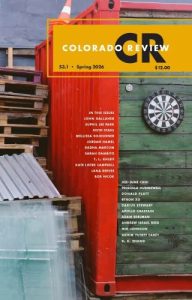
Editor in Chief Stephanie G’Schwind opens the Spring 2026 issue of Colorado Review: “It’s mid-December, as we wrap up production on this issue, and the news cycle, often grim anyway, feels particularly so at the moment, creating an unfortunately familiar sense of disconnect: Adjacent to so much tragedy and sorrow, there is inevitably still joy. Perhaps unsurprisingly, the stories and essays in these pages echo this peculiar crux of our human experience.”
Contributors to this issue include Priscilla Hunnewell, R. X. Zhang, Kate Lister Campbell, Mellissa Sojourner, Darius Stewart, Keith Stahl, T. L. Khleif, Jordan Hamel, John Gallaher, Lana Reeves, Donald Platt, Byron Xu, Radha Marcum, Sarah Gambito, Apollo Chastain, Suphil Lee Park, Adam Edelman, Hee-June Choi, Akhim Yuseff Cabey, Bob Hicok, Andrew Israel Reed, and Mik Johnson.
G’Schwind closes the Editor’s Page: “We hope, of course, that you come to this issue from a space of joy rather than grief, but if you find yourself in that other territory, perhaps Darius Stewart’s experience offers something of a balm: ‘I was trying to write from there, not around it but through it.'”
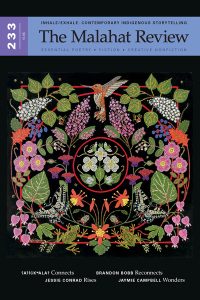
The Malahat Review Issue 233 is a special issue themed “Inhale/Exhale: Contemporary Indigenous Storytelling.” Guest Editor Richard Van Camp welcomes readers to this issue: “When we write, our sprits dance. When we read, our spirits are welcomed into that dance. You’ll feel pretty quick that in ‘Inhale/Exhale’ some of us are already two-steppin’; some of us are jigging; others have joined hands in a round dance. Welcome. Get on in here and join us.”
Van Camp also includes a special acknowledgement: “I’d like to dedicate this special edition of The Malahat Review to the memory and legacy of Dr. Greg Younging, whose 2018 book on editing Indigenous writing, Elements of Indigenous Style, guided all of us in making these selections.”
The selections inlcude Art by Jenn Ashton, Crystal Behn, Kristi Bridgeman, Samantha Erron Gibbon, giiwedinongkwe, Hali Heavy Shield, Michael J. Leeb, Autumn Moosehunter, Heather Rampanen, Syndel Thomas Kozar; Poetry by ʕAʔíCKʷALAʔ, Jennifer Adese, Michelle Poirier Brown, Cathi Charles Wherry, Henry Heavyshield, Mika Lafond, Samantha Martin-Bird, Victor Hugo Mendevil, Autumn Moosehunter, Shantell Powell, Athena Serbourne, Raymond Sewell, Syndel Thomas Kozar, Jenna Timmons-Oikawa, Jayli Wolf; Fiction by Brandon Bobb, Jessie Conrad, Francine Cunningham, Annie MacKillican, Mason Mantla, Jason Pearce, Daly Quintal, Kieran Kalls Rice, Stacie VanEvery; Creative Nonfiction by Lareina Abbott, Odette Auger, Dayne Brelyn, Joely BigEagle-Kequahtooway, Jaymie Campbell, Marion Erickson, and Marshall Hill.
Happy Friday! Warm weather and sunshine visited us this week. It was so welcome! Now we are in a gloomy period with the potential for thunderstorms and potential highs hitting the 70s…in March…the Midwest. When if feels as if the whole world is going crazy, weather might as well follow suit, right?
If rainy days are also raining on your warmer weather parade, NewPages has plenty to keep you occupied with our weekly roundup of submission opportunities and a little spark to jumpstart your writing.
Submission Opportunities: 130+ Ways to Share Your Work
Looking for places to submit your writing, artwork, or hybrid work? You’re in the right place.
Each week, NewPages curates and updates a comprehensive list of open submission opportunities, including literary magazines, journals, presses, contests, and calls for themed issues. Opportunities span poetry, fiction, nonfiction, cross-genre, visual art, and more, with options for both emerging and established writers.
Paid newsletter subscribers receive early access to many of these calls before they’re posted publicly, along with our monthly eLitPak Newsletter, featuring additional opportunities, events, and industry news.
✏️ Have young writers at home? Don’t miss our Young Writers Guide, which highlights contests and publications open to grades K–12.
🏆 Interested in writing contests, book awards, and literary prizes? Explore our curated list of current contests from literary magazines, independent and university presses, writing organizations, and events.
🔔 What’s new this week? Items marked with a bell icon are newly added to this roundup.
“Verily, this vichyssoise of verbiage veers most verbose, so let me simply add that it’s my very good honor to meet you and you may call me V.”
— V for Vendetta, 2005
This week’s writing spark explores how sound shapes meaning—using alliteration, rhythm, and repetition to turn language into something almost musical
There is something ancient and almost physical about sound in language. Before the page, there was the mouth. Before the eye, there was the ear. When a writer repeats a sound — at the start of a word, buried in the middle, humming through the vowels — they are not merely decorating. They are building rhythm, momentum, and texture into the very bones of their work.
Hugo Weaving’s legendary “V” monologue is a masterclass in this: one repeated consonant transforms a speech into something incantatory, almost hypnotic. The technique is available to every writer, in every form — and when wielded with intention, it makes language demand to be spoken aloud.
Alliteration
Repeated initial consonant sounds—the oldest trick in the sonic arsenal
Consonance
Repeated consonant sounds anywhere within words—the murmur beneath the surface
Assonance
Repeated vowel sounds—the open throat of a line, its emotional color
This Week’s Challenge
Choose a single sound: a consonant, a vowel, a breath. Let it haunt your piece. Don’t just place it at the front of words; let it echo in the middle, slide between syllables, surface and submerge. Write something where the sound itself carries meaning, where the way it feels in the mouth mirrors what it says to the mind.
The March 2026 special folio of Broadsided is themed “Signs of Life: Artists and Writers Respond to AI.” Broadsided asked four artists to provide images from their notebooks, then provided four AI-adjacent prompts for writers: What role does AI play in your creative life? Your pragmatic life? How do you, as a human, reckon fully with its presence personally? Ecologically? Ethically?
This final folio offers readers a way to reckon with humanity and inhumanity around us and features collaborations between writer S.D. Dillon and artist Janice Redman, writer Hilish Patel and artist Kevin Morrow, writing by Jacqueline Lyons and art by Amy Meissner, writer Beth Feldman Brandt and artist Antonia Contro, and writer Angie Vorhies and artist Antonia Contro.
Each collaboration is available as a free PDF download that can be printed and posted.
Broadsided Press occasionally offers a special folio of work responding to a current moment. It started in 2011, when Broadsided artist Yuko Adachi reached out about creating work in response to (and raising funds for) the Fukushima disaster. Since then, Broadsided has created responses to Superstorm Sandy, the Ebola crisis, in support of the Water Protectors of the Dakota Access Pipeline, and more.
What Hollywood’s Best Adaptations Can Teach Us About Reimagining the Classics — Plus Creative Prompts to Try Yourself
I’ve always been an unabashed lover of novels, and an equally unabashed consumer of movie and miniseries adaptations. Some I adore (Colin Firth’s Pride and Prejudice supremacy forever), and some I’ll politely pretend never happened (looking at you, 2005). But what fascinates me most isn’t the faithful adaptations we debate endlessly; it’s the ones we never realized were adaptations at all.
There’s something delightful about discovering that a film you grew up quoting wasn’t just a clever screenplay, but a classic story in disguise. A story reshaped, modernized, re-dressed in contemporary anxieties and aesthetics… yet still unmistakably rooted in the original.
That little shock of recognition—Oh, wait… that’s Emma? That’s Shakespeare? That’s Les Liaisons Dangereuses?—is exactly what inspired this week’s prompt.
Inspiration Prompt: I Watched the Movie, Does That Count?
What do Clueless, 10 Things I Hate About You, and Cruel Intentions have in common? At first glance, it doesn’t feel like they really should have anything. One’s a pastel-drenched comedy about a Beverly Hills fashionista. One’s a high school rom-com with Heath Ledger at his most swoon-worthy. And one is… well, deliciously scandalous in a very 1990s way. And yet, these three iconic films are all modern retellings of classic literature—and the casual viewer probably had absolutely no idea.
Clueless translates Jane Austen’s Emma into the sunlit world of 1990s Los Angeles, where a pure-hearted but totally oblivious valley girl slowly grows into herself and, eventually, love. 10 Things I Hate About You lifts its entire plot from Shakespeare’s The Taming of the Shrew—trading Elizabethan suitors and arranged marriages for high school hallways and a brooding Patrick Verona. And Cruel Intentions? It’s Les Liaisons Dangereuses relocated from French aristocracy to Manhattan prep school culture, where manipulation and status games are just as ruthless, if slightly less corseted.
Were you already aware these were adaptations? Does knowing that change how you see them or how you feel about the originals?
The March 2026 issue of The Lake, a contemporary poetry webzine, is now online featuring new poetry by Naned Bajevic, Daniel Cartwright-Chaoui, Holly Day, David Anson Lee, Beth Mcdonough, Gordon Scapens, Hannah Stone, J. S. Watts, Jan Wiezorek, Kate Young. The Lake also offers reviews of recently published collections, and this month Charles Rammelkamp reviews Tony Gloeggler’s Here on Earth and Hannah Stone reviews Tomas Venclova’s The Grove of the Eumenides.The Lake has the unique feature, ‘One Poem Reviews’ in which authors can submit a sample poem from a recently published book, this month spotlighting works from Ruth Holzer, Xi Nan, Alan Perry, and Bethany Pope.
If you are a poet with a book/chapbook, One Page Reviews invites you to share a poem with The Lake readers from a collection published in the last twelve months or forthcoming. This is a great way to get more exposure for your book, make some sales, and connect with other poet. Visit The Lake for more details.
Happy Friday! As we head into the final weekend of February, here’s hoping March eases in gently rather than roaring to life. Mother Nature is a fickle one, of course—so we’ll see what she has in mind.
Whether you’re feeling early spring energy or full-on cabin fever, NewPages is here to help you channel it into your writing and submitting. March brings a fresh wave of opportunities, and several deadlines are closing soon. Don’t miss your window.
Inspiration Prompt: Precious Children
We weren’t called precious because we were adorable and utterly lovable.
We were called precious because of what we looked like.
One child came with golden locks and golden eyes, skin kissed warm by some unseen sun—a living echo of the most coveted metal on earth. Another arrived silver-haired and metallic-eyed, with a cool bluish-grey undertone that made him look like something poured and set, something that belonged behind glass. The third had copper hair, coppery brown eyes, a warmth in her skin that glowed like something freshly forged.
Three children who reminded people of precious metals. Three children who had done nothing to earn that resemblance and nothing to deserve what came with it.
Here is what you get to decide: what does come with it?
Are they coveted, sought after, collected, kept close by people who want to own beautiful things? Are they feared, because what looks rare is also fragile, and fragile things make people nervous? Are they worshipped in ways that hollow a person out over time? Or are they cursed by a world that can’t see past the surface of them, that has decided their worth before they’ve spoken a single word?
Write the life of one, or all three. Write the moment someone first looked at them and wanted something. Write the moment they understood what they were to other people. Write the moment they decided whether to use it or fight it or flee it.
Precious is only a word until someone decides what it means. You be the one who decides.
Souvenirs from Another Life, the first full-length collection of short fiction by Leah Browning, features an abundant selection of stories. By turns sharp and tender, these stories delve into the reality and surreality of love, companionship, and family.
In “Caught,” a man finds his Tinder date surrounded by vaguely threatening birds. Toward the beginning of “The Surrogate Wife,” a woman returns after a long journey to discover that her husband’s new housekeeper has taken over her home. And in “The Costume Wedding,” a doctor and her boyfriend travel to Albuquerque to attend a ceremony where they’ve been instructed to dress up.
The collection — which is available as a print paperback, e-book, and unabridged audiobook — includes full-length literary fiction, flash, and linked stories about the pleasures and absurdities of everyday life.
Fiction by Leah Browning has appeared in Four Way Review, Harpur Palate, Valparaiso Fiction Review, The Threepenny Review, Necessary Fiction, Contrary Magazine, and elsewhere. Her stories have been nominated for the Pushcart Prize anthology, Best of the Net, Best Microfiction, and the Wigleaf Top 50 Very Short Fictions.
Visit www.leahbrowninglit.com/souvenirs for more information about Souvenirs from Another Life including product details, an excerpt, and a printable discussion guide for readers.
“Dear reader,” writes Esther Vincent Xueming in the Editorial to open The Tiger Moth Review online, “it is my hope that Issue 15 will inspire you in new ways to do your part for our earth. It is my wish that the poems and stories in this issue will speak to you and stay with you, that the words and images from our wonderful contributors will germinate in your hearts and sprout into beautiful saplings, changing the world one mindful breath at a time, one mindful action at a time.”
Those wonderful contributors and their place on the globe include Clarence Eng (Singapore), Brooke Hoppstock-Mattson (Vancouver, Canada), Mary Ann Lim (Singapore), Aryan Kaganof (Gordons Bay, South Africa), Natalie Foo Mei-Yi (Singapore), Vinita Agrawal (Indore, India), L.Y. Rinn (Penang, Malaysia), Deepa Onkar (Chennai, India), Sambhu Ramachandran (Kerala, India), ML Strijdom (Johannesburg, South Africa), Maziar Karim (Tehran, Iran), Akumbu Uche (Nigeria), Gabriella Contratto (Los Angeles, California, USA), Salvador Francis Isaiah Deapera (Metro Manila, The Philippines), Sofia Mariah Ma (Singapore), Ashwani Kumar (Mumbai, India), Maria Fedorova (Fontainebleau, France), Jordan Prochnow (Washington, USA), and Isaiah Alexander (Texas, USA).
A writing prompt about last requests, the people who carry us, and the stories that find us before we’re ready for them.
Some songs find you at exactly the wrong moment — and stay forever.
James Blunt’s Carry You Home became that song for me while caring for the grandparents who raised me. It’s still capable of bringing me to my knees, carrying with it the weight of my grandmother’s passing and the particular ache of watching someone you love leave slowly. That line — “I’m watching you breathing for the last time” — hits different when you’ve lived it.
But the phrase that lodged itself deepest was the simplest one: I’ll carry you home.
Four words. A promise. A burden. A act of love that could mean so many different things depending on who’s asking and who’s being asked.
This week, let that phrase be your compass.
Maybe your character knows they’re dying. Maybe they don’t. Maybe the request comes out of nowhere — a sudden illness, an accident, a war that ends too quickly in all the wrong ways. They reach out to one specific person and ask them to carry them back to where their roots are, to where the family is, to wherever home still means something.
Or flip it. Write from the perspective of the person being asked. Do they even know this person well? Does the request feel like an honor or a burden — or both at once? Is there old betrayal tangled up in it? Do they go anyway?
And what does home even mean at the end? A place. A person. A moment of forgiveness. A family made whole again before it’s too late.
Create from wherever this lands for you. A short story or flash fiction. Dueling poems — one voice from each side of the request. A photo essay about the objects and places we carry people back to. A comic strip, a collage, a sketch. If you journal, write the conversation itself: the asking, the silence after, the answer.
The only rule is this: let it be real. The best work tends to come from the places that still make us cry.
Going Deeper: Three Writing Tips for “I’ll Carry You Home”
1. Anchor the Emotional Weight in a Single Object or Detail The reason a line like “I’m watching you breathing for the last time” hits so hard is that it’s specific. When you write your piece, resist the urge to describe grief in the abstract. Instead, find the one detail that carries everything — a worn quilt, a particular smell, the sound of a name spoken in a certain way. That concrete anchor will do more emotional work than paragraphs of feeling ever could. Ask yourself: what is the one thing this character would notice that no one else would?
2. Let the Silence Speak The most powerful moment in any “last request” story isn’t the asking — it’s the pause before the answer. Practice writing what your character doesn’t say. What do they swallow back? What do their hands do? Subtext is the difference between a scene that tells us someone is overwhelmed and one that makes the reader feel it. Try writing the scene twice: once with every emotion stated outright, then again with all of it removed and replaced only with action and dialogue. The truth usually lives somewhere between the two drafts.
3. Complicate the Person Being Asked The richest version of this story lives in moral ambiguity. If the person being asked to “carry them home” feels purely duty-bound and willing, the story has only one note. But what if they have reason not to go? An old wound, a life they’ve built far away, a complicated history with the family waiting back home? Obligation and love and resentment can all occupy the same heart at the same time — and that tension is where your most honest writing will come from. Give your character a reason to say no, and then show us why they say yes anyway.
Enjoyed this? Our newsletter goes deeper every week — creative prompts, new lit mag issues, book releases, recommended reading, and bookstore updates. Subscribe below and join the conversation.
Vita Poetica Journal is an online quarterly publication of creative work explored through a spiritual lens. In the editorial letter to readers opening their Winter 2026 issue, Co-Editor Caroline Langston writes “‘Immobility’ might seem to be a pretty salient concept for many of us right now – amid what is now seemingly everpresent authoritarian political oppression and cultural struggle, we can feel as frozen in our moral senses and in our abilities to act. [. . . ] In a multiplicity of ways, the works of art in this issue show that we are not, in fact, powerless. In so many instances, the narrators and governing souls that guide our selections explode out of their immobilities.”
Contributors to this issue include poetry by Richard Jackson, Dion O’Reilly, Bern Mulvey, Trevor Cunnington, Johanna Caton, O.S.B.; Kelly Sawin, Evan Leslie, Mary B. Moore, Ali Beheler, Temima Weissmann, Daril Bentley, James B. Nicola, Liza Moore; nonfiction by Chris Weigel, K. D. Battle; visual art by Jocelyn Mathewes, Alison Kysia, and Ernest Williamson III. Readers will also enjoy an interview with Poet Jon Bishop, reviews, and “Contemplative Practices.”
Vita Poetica Journal is also available in an audio version with standalone pieces recorded by the contributors, as well as in a podcast format to hear a little behind-the-scenes inspiration from the creators as they introduce their work.
Cover art: Alison Kysia. Al Fatiha: The Opening, 2023. Ceramic. 60 L x 60 W x 5 H inches.
The Fiddlehead Issue 306 (Winter 2026) features poetry, fiction, creative nonfiction, and reviews written by some of the best new and established writers. This issue includes new work from Carl Phillips, José Teodoro, Susan Robertson, and Ariadne Asho, winner of The Fiddlehead 35th annual Fiction Contest as selected by Anuja Varghese, an interview with Mary Dalton, and much more! Visit The Fiddlehead website to see a full list of contributors, read excerpts from selected works, and order your copy of Issue 306. Cover art: Silent Night, 2023, Digital Photography by Kirsten Stackhouse.
Happy Friday! Somehow we’re already staring down the last week of the month. The February eLitPak newsletter is out, and here in Michigan the warmer weather has arrived with its usual mix of rain and fog—but at least we’re getting a break from snow and ice.
With another major storm rolling across the country, I hope you’re staying safe and finding time to write. Here’s this week’s roundup of submission opportunities, plus a little spark to keep your creativity going.
Inspiration Prompt: Reading Between the Lines
Mark Twain once said, “A successful book is not made of what is in it, but what is left out of it.” He was talking about editing — but there’s a deeper implication worth sitting with. Omission isn’t just a tool for clarity. It’s where a story’s interior life lives.
Every piece of writing has an on-screen existence — the words the reader follows, the scenes they witness, the dialogue they hear. But surrounding that visible story is a larger, quieter one: the character history that never surfaces, the worldbuilding detail you wrote only for yourself, the emotional beat implied in a pause rather than stated in a speech, the off-screen choice that explains everything without ever being named.
The most resonant writing doesn’t fill in those gaps. It trusts them. It lets the unseen world press against the edges of the page — present, shaping, felt.
Posit online journal of literature and art Issue 41 opens with this commentary from the Editor’s Note: “In times like these, when innocent people are terrorized and even murdered in the streets by government goons, collective protections are eviscerated, disinformation is forced down our throats, and social contributions in science, education, and journalism are censored and censured, art-making is another act of resistance.”
“Brought to you with love and defiance for times like these,” this issue features “new works of resistance and reflection” by Charles Bernstein, Susan Bee, Joanna Doxey, Heikki Huotari, Bai Juyi, trans. Jaime Robles, Caroline Kanner, Genevieve Kaplan, Elina Kumra, Julia Kunin, Hank Lazer, Alice Letowt, rob mclennan, linn meyers, Laura Mullen, Alexandria Peary, and Anne Waldman.