Home » Newpages Blog » Poetry » Page 14

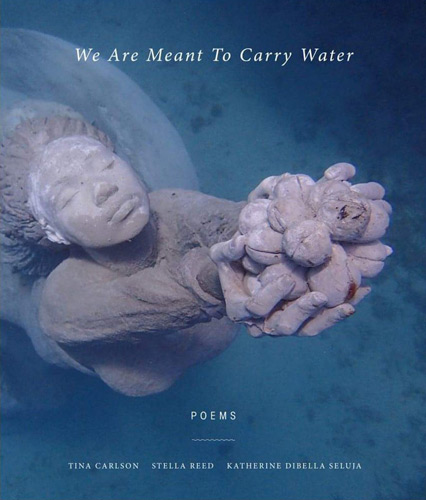
‘We Are Meant to Carry Water’ by Carlson, Reed, and Dibella Seluja

We Are Meant to Carry Water

Guest Post by Kimberly Ann Priest

“Are we only bone, skin, and urge?” asks the speaker in The Great Square That Has No Corners. I am beginning to wonder if the answer to that question is affirmative. Yes. As I write this, I am sitting in my living room on a Tuesday afternoon in October, mid-way through another semester teaching, and realizing that, this autumn, I have over-committed myself . . . again.

As projects begin to pile up and my network grows, while responsibilities increase and my own poetry demands that I give it more of my attention, I have to let some things go. After four years reading and writing about new works by various authors and publishers, this will be my last review for NewPages. It’s time, once again, to listen to my body and check my urges. And, how fitting that I should end my review history with a review of a collaborative manuscript by three clearly very talented women who have written an elegant collection of poems on assaulted womanhood—a topic that continually shows up in my own work. Drawing from mythology, Tina Carlson, Stella Reed, and Katherine Dibella Seluja have woven a modern (though not modernized) conversation between Helen, Leda, and Lilith, and they have done so with such precision, such tastefulness, such raw beauty. Continue reading “‘We Are Meant to Carry Water’ by Carlson, Reed, and Dibella Seluja”
‘Night Sky with Exit Wounds’ by Ocean Vuong

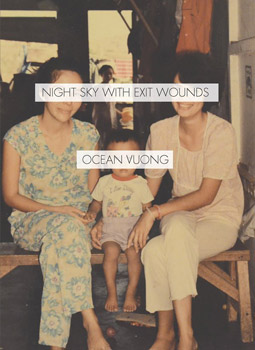
Night Sky with Exit Wounds by Ocean VuongGuest Post by Andrew Romriell

Ocean Vuong’s collection of poetry, Night Sky with Exit Wounds, is a masterpiece that illustrates the most vital and sincere hardships of humanity in astonishingly few words. Leaping from free-verse to prose poetry, from stringent format to broken syntax, Vuong fashions here a collection of inclusion.

We open on “Threshold,” a poem where Vuong introduces his themes of body, parenthood, sexuality, and history. He warns us from the very beginning that “the cost of entering a song—was to lose your way back.” Vuong asks us to enter into his words and lose ourselves there. And we do, poem after poem, until we close on Vuong’s book with the penultimate piece, “Someday I’ll Love Ocean Vuong.” In this poem, we read an assumed message from Vuong to Vuong where he tells himself “don’t be afraid,” and to “get up,” and that the most beautiful part of his body “is where it’s headed.” Before this, we’ve read pages of poetry full of pain, fear, and shattering, but here, Vuong embraces himself—and us alongside him.

“Someday I’ll Love Ocean Vuong,” like all the poems in Night Sky with Exit Wounds, rings with pain, wonder, regret, and history. Yet, there is also hope here, and I would say this is the theme of Vuong’s work: hope, inclusion, and change. Vuong takes us through a journey, shatters our expectations, holds our hearts, tells us to get up, and that, like him, we can survive the voyage.


Night Sky with Exit Wounds by Ocean Vuong. Copper Canyon Press, April 2016.

About the reviewer: Andrew Romriell is a creative writing student at Utah State University.

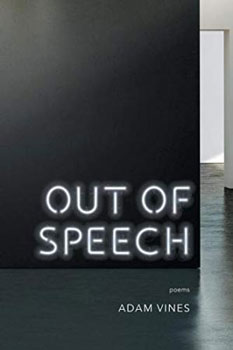
‘Out of Speech’ by Adam Vines

Out of Speech by Adam VinesGuest Post by Adrian Thomson

Adam Vines’s Out of Speech, a poetry collection comprised of ekphrastic poetry based upon famous paintings as well as personal experience, draws on Vines’s travels from southernmost Argentina to the Louvre. Each poem begins by naming the art piece it takes as a subject, then moves toward unpacking their visual elements often through fascinating uses of enjambment.

More than just describing the artwork, Vines peels away surfaces to encounter shavings of shocking humanity lying beneath. In “My View From Here,” a poem responding to Yves Tanguy’s Les Vues, Vines sees an abstract red vista of segmented alien pillars the cancer polyps hidden in a barstool acquaintance he meets by chance outside the gallery. “Holes and Folds,” based on the group portrait The Swing by Jean Honoré Fragonard, finds a narrator focused on the most innocent of the lounging young men in order to question his objectives as a hand slides up a woman’s dress.

Vines’s visual inspection of minutiae leaves his reader questioning the subjects presented in the paintings. Will the awoken businessman in Hopper’s Excursion Into Philosophy leave before his lover stirs? What has made his countenance so dour? What of the open book forgotten on the bed? Is his shoe slipping into, or out of the light? The reader feels unsure even after turning away, and Vines leaves them contemplating in silence.


Out of Speech by Adam Vines. LSU Press, March 2018.

About the reviewer: Adrian Thomson is a creative writing student at Utah State University.

Ekphrastic Work in Valley Voices

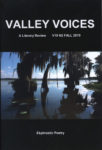
Valley Voices brings readers a special edition on ekphrastic poetry with the Fall 2019 issue. Fifty-seven poems by forty-two poets follow the theme, and John J. Han pens the essay: “A Verbal Response to Visual Art: The popularity, Types, and Composition of Ekphrastic Poetry.”

Opening the issue is a sort of call and response between husband and wife duo Leo Touchet and Elizabeth Burk in “Louisiana: A Duet of Photographs and Poems.” Touchet’s photographs serve as inspiration for Burk’s poetry. After the selection, the two speak with Editor John Zheng about their work, both as individuals and as a creative pair.

Zheng introduces the issue with, “[ . . . ] ekphrastic expressions are not simple interpretations; they are, instead, reinterpretations that experiment with imagination, language, and synesthesia in the creative process of writing poetry.” Check out the creative experimentations in the Fall 2019 issue and let it inspire you to experiment with your own ekphrastic work.

Plume Publishes 100th Issue

Plume lit mag

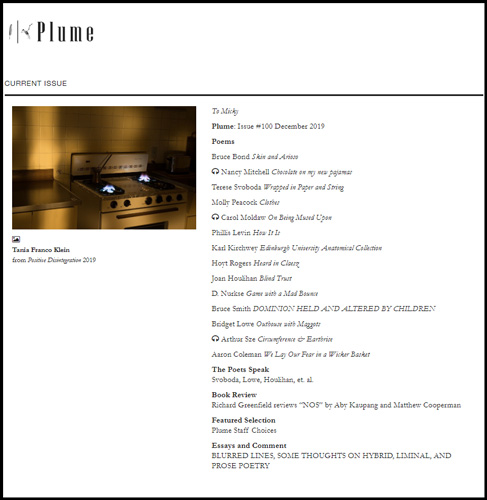
Plume has hit quite a milestone this month. Their December 2019 issue is their 100th publication. As usual, they bring readers a fine selection of poems (some with audio recordings), a smattering of book reviews, and one essay. However, they stray from their usual format with their featured selection. While readers will normally find one poet interviewed with a selection of their poetry in this section, this month the staff has chosen to feature favorites selected from the past 100 issues.

These selections include: Rasha Abdulhadi (Issue 88), Angie Estes (Issue 46), Stephen Dobyns (Plume Anthology Number 7), Amy Beeder (Issue 67), Tom Sleigh (Issue 17), Justyna Bargielska translated from Polish by Benjamin Paloff (Issue 77), and Stephen Dunn (Issue 2).

If readers are feeling especially ambitious, they can find their own favorite poem among the full archive of all these past issues.