Home » NewPages Blog » Page 256

NewPages Blog

At the NewPages Blog readers and writers can catch up with their favorite literary and alternative magazines, independent and university presses, creative writing programs, and writing and literary events. Find new books, new issue announcements, contest winners, and so much more!

Poem :: Jacob Scheier

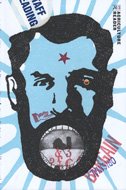
Dear Office of Homeland Security
Jacob Scheier

It’s my duty to inform you I saw a flag waving suspiciously
outside Grand Central Station.

I held my hands to my ears and opened my mouth
and stood on one leg,
trying to signal the authorities
just like the website told me to,
but was only given quarters by a street mime.

So I bought beer nuts from a guy standing next to a guy selling
watches, because you can’t buy sugar coated nuts on the streets
in Canada and I wanted to know what it meant to be an American.

Read the rest on Geist.

Awards :: Perugia Press Prize

Perugia Press Prize: A prize of $1000 and publication by Perugia Press is given annually for a first or second unpublished poetry collection by a woman. Winner of the 2009 Perugia Press Prize:

How to Live on Bread and Music
by Jennifer K. Sweeney

“Life-affirming but without illusions, How To Live on Bread and Music showcases poet Jennifer K. Sweeney’s mature consciousness and circumspect intelligence. This collection, made up of poems that stand firmly on their own, takes us on a physical and spiritual trip, symbolized often in the recurring image of the train. Exploring broad themes such as identity formation, nostalgia, and impermanence, the poet passes through risk to find refuge in the sensory world. What is most remarkable is Sweeney’s ability to confide without burdening, her gift for arranging enough silence between words for us to locate the pulse of meaning.”

Jennifer K. Sweeney lives in Kalamazoo, Michigan. Her first book, Salt Memory, was winner of the Main Street Rag Poetry Book Award in 2006. How To Live on Bread and Music is due to be released in September 2009. To order this book and other titles, visit Perugia Press.

SEMI-FINALISTS: Shannon Amidon, Emma Bolden, Amy Benson Brown, Peg Davis, Joanne Diaz, Rachel Contreni Flynn, Elizabeth Frost, Kate Lynn Hibbard, Vera Kroms, Charlotte Pence, Alexandra Teague, Melissa Tuckey, Leslie Williams, Dede Wilson, Abe Louise Young.

New Lit on the Block :: Gigantic

Gigantic is a forthcoming print magazine of short prose and art (arriving in April) founded about a year ago by four former Columbia MFA students: Ann DeWitt, Rozalia Jovanovic, Lincoln Michel (who was a former reviewer at NewPages – Hi Lincoln!), and James Yeh.

In addition to publishing short and innovative fiction from such writers as Ed Park (founding editor of The Believer and author of Personal Days) and Justin Taylor (who has edited for McSweeney’s), they have several interviews either completed or lined up with: Malcolm Gladwell, Gary Shteyngart, Sam Lipsyte, Tao Lin, as well as a conversation between Joe Wenderoth and Deb Olin Unferth.

Already on their website are “preview teasers” including a Prose preview, an Art preview, and most recently an Interview preview with excerpts from each of the aforementioned interviews – more than enough to pique a reader’s curiosity!

Gigantic is open for submissions, and includes a list of “a few of our favorite things” to give writers an idea of the type of aesthetic they would be interested in seeing.

Jobs :: Various

English, Assistant Professor of English/Children’s Literature U of Nebraska-Kearney. OUF

Literary House Director for The Rose O’Neill Literary House. March 16

The Creative Writing Program at the Lewis Center for the Arts, Princeton University is seeking distinguished writers for openings in fiction, poetry, translation, autobiography/biography.

Sunday Fun :: Book Recommendation Contest

The Quarterly Conversation asks readers, in 200 words or less, to tell about the best book they’ve never heard of but need to read. “Make sure it’s something we’ve never seen, and make sure you make us understand why we need to track down a copy.” The winner will receive books and store credit at the online store of Chicago’s Seminary Co-op Bookstore. Prizes for runners-up as well. Details in Issue 15.

NewPages Update :: Lit Mag Reviews

Visit NewPages Literary Magazine Reviews to read thoughtful commentaries on the following print publications – Agni :: Alimentum :: Basalt :: Bateau :: Cave Wall :: Freshwater :: High Desert Journal :: Indiana Review :: The Literary Bird Journal :: POOL :: Reed :: Santa Monica Review :: Southern Humanities Review.

For information on having your publication considered for review, please visit the NewPages FAQ page.

Love Your Writing, Hate Your Beliefs


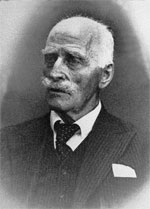
Revered author still hated for his Nazi stand
New Zeland Herald
Saturday Feb 28, 2009

Hamsun was celebrated and loved by Norwegian readers until the war. Some 15 years ago, sculptor Skule Waksvik started work on a statue of 1920 Nobel Literature Prize winner Knut Hamsun, a Norwegian admired by his countrymen for his writing – and despised for supporting the Nazis during World War II…[read the rest]

Buck’s Good Earth Goes Home

PERKASIE, Pa. (AP) — The long-lost handwritten manuscript of Pearl S. Buck’s classic novel “The Good Earth” is set to go on display next month at the late author’s home outside Philadelphia.

The Pearl S. Buck House, in Hilltown Township, will display the 400 hand-edited pages for six months, beginning March 3.

It will be the first time since May 1930 that the manuscript will be reunited with the desk, chair and typewriter that Buck used when she wrote the novel, said Donna Rhodes, a curator at Buck’s home.

The manuscript had been missing for about 40 years when it was found in June 2007. The daughter of Buck’s longtime secretary said she found the pages in a suitcase in her basement and took them to a Philadelphia auction house, which called the FBI.

The manuscript has spawned a legal fight involving Buck’s heirs and foundations with links to her. A lawyer representing Buck’s birthplace in Hillsboro, W.Va., also staked a claim for ownership based on a notarized “bill of sale” that Buck signed in 1970, three years before she died.

Janet Mintzer, president of Pearl S. Buck International, said a will filed in Vermont, where the author died, gave the Buck family estate rights to her literary works, but that the family didn’t want to lend out the manuscript until the matter was settled.

The Buck family trust has formed an agreement with Pearl S. Buck International to display the manuscript for six months. The foundation maintains Buck’s home and manages its international adoptions program.

“We’ve been waiting literally a year and a half for it,” Mintzer said. “We’re very excited. It’s a great piece of history.”

“The Good Earth,” Buck’s most famous book, follows the life of a peasant farmer in pre-Revolutionary China as he marries, accumulates wealth and experiences both success and heartache. Buck, the daughter of Presbyterian missionaries, lived mostly in China from infancy through age 40.

The novel won the Pulitzer Price in 1932 and helped earn Buck the Nobel Prize for Literature in 1938.

NewPages Book Reviews :: March 2009

Swing by the NewPages Book Review page to read great reviews on the following small/indie press books:

Secret of Breath
Poetry by Isabelle Baladine Howald
Translated from French by Elena Rivera
Burning Deck Press, October 2008
Review by Joseph P. Wood

Irresponsibility
Poetry by Chris Vitiello
Ahsahta Press, February 2008
Review by Karyna McGlynn

A Fixed, Formal Arrangement
Prose by Allison Carter
Les Figues Press, November 2008
Review by Sarah Sala

Big World
Stories by Mary Miller
Short Flight/Long Drive Books, February 2009
Review by Ryan Call

Circulation
Novella by Tim Horvath
sunnyoutside, March 2009
Reviewed by Jason Hinkley

The Islands of Divine Music
Novel by John Addiego
Unbridled Books, October 2008
Review by Laura Di Giovine

The White Space Between
Novel by Ami Sands Brodoff
Second Story Press, October 2008
Review by Christina Hall

Family Secret
Poetry by Rich Murphy
Finishing Line Press, 2008
Review by Roy Wang

Tomorrowland
Flash Fiction by Howie Good
Paper Hero Press, Achilles Chapbook Series,
December 2008
Review by Ryan Call

When You Come Home
Novel by Nora Eisenberg
Curbstone Press, November 2008
Review by Jessica Powers

Job :: Dzanc Development Director

Dzanc Books is looking for an individual to provide strategic direction and coordination for all fundraising efforts. The candidate will be an experienced person able to help create fundraising strategies that increase donations to Dzanc from individuals, corporations, agencies and foundations. Position will develop / implement a major gifts fundraising program, and solicitation strategies. Experience with grant writing a plus but not necessary. Send resume to [email protected] For further information about Dzanc, check their website.

Feminism: The Icelandic Perspective

Feminism, a Dirty Word
Nanna Árnadóttir
From Iceland Review

Feminism has become something of a taboo I’ve noticed. It’s beginning to annoy me a little actually.

It’s like some dirty word now. Feminist. Like saying you’re a feminist equates you with standing on the steps of City Hall and setting your bra on fire. I cherish my bra, anything that can support these puppies is alright in my book, and I still call myself a feminist…Now some might argue that feminism has always been taboo because any attempt by women to create equality is taboo, but I’m not of that opinion. I think feminism in the Nordic countries (Iceland included) has become taboo because most women think they evened the playing field already…And yet women in countries like Iceland are being abused by stuff that—if feminism were more integrated into people’s lives—might not actually be happening…[read the rest]

Feminism: The Icelandic Perspective

Feminism, a Dirty Word
Nanna Árnadóttir
From Iceland Review

Feminism has become something of a taboo I’ve noticed. It’s beginning to annoy me a little actually.

It’s like some dirty word now. Feminist. Like saying you’re a feminist equates you with standing on the steps of City Hall and setting your bra on fire. I cherish my bra, anything that can support these puppies is alright in my book, and I still call myself a feminist…Now some might argue that feminism has always been taboo because any attempt by women to create equality is taboo, but I’m not of that opinion. I think feminism in the Nordic countries (Iceland included) has become taboo because most women think they evened the playing field already…And yet women in countries like Iceland are being abused by stuff that—if feminism were more integrated into people’s lives—might not actually be happening…[read the rest]

Red Mars, Green Earth: Science Fiction and Ecological Futurity

Read Gerry Canavan’s recap of his above titled presentation, which includes the following major points:

1) Science fiction should be understood as an ecological literature
2) I use the distinction between Coruscant and Trantor to draw a line between science fiction (SF) and science fantasy
3) How the current environmental crisis demands not just this sort of methodological ecology but a politically environmentalist consciousness
4) Taxonomy

Publishing :: Found in Translation

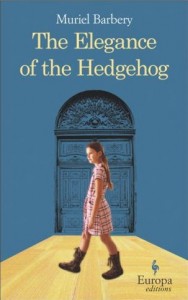
Europa Editions finds success in translations
By Motoko Rich
International Herald Tribune
February 26, 2009

It does not sound like a recipe for publishing success: a roster of translated literary novels written mainly by Europeans, relying heavily on independent-bookstore sales, without an e-book or vampire in sight.

But that is the formula that has fueled Europa Editions, a small publisher founded by a husband-and-wife team from Italy in 2005…[read the rest]

Yet Another Protest :: Orestimba High School

District took Bless Me, Ultima off sophomore reading list
By Danielle Gaines
[email protected]
February 24, 2009

Two teachers from Orestimba High School, upset that a book has been removed from their class reading lists, met with UC Merced students on Monday night.

The educators — Catherine Quittmeyer, chairwoman of the English department, and Andre Powell, English teacher — spoke to about a dozen Chicano literature students and future teachers on the university’s campus.

“This was an event for the students; a lot of them want to become teachers,” Quittmeyer said. “This is something I wish I was able to ask questions about when I was becoming a teacher.” [read the rest]

Contest Winners :: Indy Poetry 2009

The Independent Weekly has announced their selection of picks for their 2009 Poetry Issue. Preliminary judges Brian Howe and Jaimee Hills passed along their selections to kathryn l. pringle who selected the following:

First Place: Christopher Salerno
Second Place: Alisha Gard
Third Place: James A. Hawley
Honorable Mention: C.P. Mangel

All have MP3s for your listening pleasure along with their poems to read.

New Lit on the Block :: nanomajority revived

From editors Mark Stricker and Jolynne Roorda: “nanomajority ia back from an unplanned hiatus, excited to reset the clock for our upcoming issues and planning to unveil some new projects in the near future. Thanks to our contributors for being so patient! From an editorial standpoint, nanomajority is interested in the various ways in which artists, writers, and critics intersect (or don’t); there is no single stylistic container or grouping from which we select projects to highlight. There is no overarching manifesto to guide us. We simply publish what interests us.”

nanomajority does not accept submissions in general, but if you have a project in mind – and after reviewing their site, you’ll see how broad a mind they have – you can contact them with a proposal.

In the most current issue: Lizzie Hughes, Myron Michael, e.t. and Michael Bolsinga.

Internship :: US Holocaust Memorial Museum

United States Holocaust Memorial Museum Center for Advanced Holocaust Studies
Summer Research Assistantships for Graduate Students

The Center is now accepting applications for graduate student summer research assistants. Recipients will have the opportunity to participate with the Center’s staff scholars in cutting-edge research and publication projects relating to key areas of Holocaust scholarship. Sample projects may include writing and editing for the Museum’s /Encyclopedia of Camps and Ghettos, 1933-1945; /research and translating for the Center’s archival source series on /Documenting Life and Destruction/; and preparing in-depth studies and reports about the archival collections of the International Tracing Service (ITS), among others.

Applicants must be enrolled in or admitted to a graduate program at a North American university. The Center is unable to provide visa assistance for non-U.S. citizens. Applicants must have basic knowledge of the Holocaust, experience in conducting archival or library research and the ability to work as part of a team. In addition to English, fluency in one or more of the following languages is desired: German, Russian, Polish, Romanian Hebrew, Yiddish, French, Dutch, Hungarian, Slovak, and/or Croatian. Each assistantship will last for up to three months during the May-August time frame. Awardees will receive a stipend of $2,500/month. The Center will also provide funds for one roundtrip airline ticket to and from Washington, D.C. for travel within North America.

Application Procedure:

Applicants should submit a resume, a personal statement of no more than two pages in length, and one letter of recommendation from a faculty member or dean at his/her institution that speaks to the applicant’s qualifications. The personal statement must explain the significance of the assistantship to the applicant’s professional and/or academic goals, and the contributions the applicant’s skills and interests could make to the Center’s research and publication projects. Application materials must be received by March 31, 2009. All applicants will be notified of selection results by early April 2009.

Application materials should be sent to: Dr. Lisa Yavnai, Director, Visiting Scholar Programs, Center for Advanced Holocaust Studies, United States Holocaust Memorial Museum, 100 Raoul Wallenberg Place, SW, Washington, DC 20024. Inquiries may be addressed to [email protected] or via telephone at 202-314-7829.

In Memoriam :: Scott Symons

“Controversial gay writer Scott Symons, whose scandalous life and 1967 novel “Place d’Armes” rocked Canada’s literary world, has died at age 75. The Toronto-born author passed away at a Toronto nursing home on Monday after several years of poor health, his lawyer Marian Hebb said WednesdayShe remembered Symons as a bold personality who never shied away from strong views on politics, love and literature, at times to the detriment of his personal relationships.”

Writers Retreat :: AROHO

A Room of Her Own
2009 Writers’ Retreat
Ghost Ranch, Abiquiu, New Mexico
“My Country is the Whole World”—Virginia Woolf
August 10-16, 2009

Includes: Meredith Hall on crafting memoir; Dana Levin on Sylvia Plath and the creation of “self”; Pamela Painter on double endings; Ellen McLaughlin on lies, secrets, and subtext; A special seminar with Pulitzer Prize winning poet Rita Dove, and more.

Limited scholarships available; deadline midnight, March 15th, 2009. General Applications accepted on a rolling basis until June 1st, with notifications of acceptance beginning in early April and occurring roughly every two weeks until all slots are filled.

Conference :: Conversations and Connections

The third annual Conversations and Connections conference will be held in downtown DC on April 11, with Amy Hempel as the featured speaker. Registration includes the full day conference, one ticket for “Speed Dating with Editors,” a book, and a literary magazine subscription. Breakout sessions are geared to appeal to new and experienced writers of fiction, poetry, and nonfiction, and include topics like Fighting Writer’s Block with Play and Experimental Prompts, Sentence Power, Creative Nonfiction: Where are the boundaries? Do they exist?, The Digital Literary Landscape, Writing Sex Scenes, Grants for Writers: Where’s the money and how do you get it?, and more.

Art :: Prick of the Spindle

Galleries from AmateurArtwork.com are now in their new home at Prick of the Spindle, along with 12 new artists. View art from Jesse Lindsay, David Scott Tenorio, Amy Bernays, Pam Ross, Dave Mullins, Christy Call, and many more. Look for new artists to be added on a weekly or semi-weekly basis.

Also check out the graphic short, The Dragoon, written by Lane Kareska and illustrated by Cynthia Reeser.

Prick of the Spindle is open to submissions year-round.

New Lit on the Block :: Twelve Stories

Twelve Stories is an online literary journal dedicated to publishing quality short fictions of up to 1,500 words each. Editors are Molly Gaudry and Blythe Winslow, whose credentials are as follows: “One of us is a writing professor; the other works in a head shop. One of us is outspoken; the other is passive aggressive. Neither can sing.” Fair enough!

As the publication cycle is whenever Gaudry and Winslow receive “twelve stellar stories,” submissions are open, and sim/subs welcome.

The first issue features stories by Steve Almond, J.R. Angelella, Rusty Barnes, Matt Bell, Jimmy Chen, Timothy Gager, Richard Garcia, Kathryn Good-Schiff, Jim Hanas, Jeff Landon, Jennifer Levin, and Dan Moreau.

Secret of Breath

In one of the early poems of Isabella Baladine Howald’s haunting new collection, Secret of Breath, the poet writes, “What I love is not seeing, but the effort of seeing.” This untitled poem’s opening line could easily serve as the book’s Ars Poetica: Howald relentlessly self-interrogates as she scrutinizes the philosophical meaning behind her lover’s/husband’s death (it’s never quite specified who exactly died) – and, by extension, life. Continue reading “Secret of Breath”

Irresponsibility

Here is an austere and well-made collection which brings to mind a spitfire of phrases, like “German ingenuity” and “high modernism” and the “plasir” of the “illisable texte.” The book shifts its glasses and a-hems a bit before engaging me in a conversation which is charmingly incomprehensible. And despite its attempts to be cordial and funny and warm (okay, maybe not quite warm), I can't quite shake that feeling I used to have when I met my physicist boyfriend for beers after work and he'd start talking about trapping ions with lasers: it was sexy as hell but my eyes glazed over almost immediately – not because it was boring, but because I wasn't smart enough. I admit it: this book raises the presumed-dead spectre of my math fear. It feels clean and masculine and well-groomed and logical and intimidating in a way that made me put off writing this review for months. This isn't easy-going for me, but then, I don't think it's supposed to be. Continue reading “Irresponsibility”

A Fixed, Formal Arrangement

Allison Carter’s book of experimental prose isn’t, as Danielle Dutton suggests in the introduction to the slender volume, “a kind of writing that gets called ‘cross-genre’ because it pulls all the best aspects from poetry and all the best aspects from fiction.” A Fixed, Formal Arrangement is far beyond that in its originality of thought and image as to feel like a new genre altogether; something like a planet and a star colliding, fusing a third heavenly body in the process. No longer a star and a planet, they orbit away – a wondrously altered thing. Continue reading “A Fixed, Formal Arrangement”

Big World

Mary Miller’s Big World, the second release from the mini-books division of Hobart: Another Literary Journal, is physically reminiscent of the 1950s-era pulp paperbacks you see stacked around used book stores. If I were older, I imagine that David Kramer’s bright front and back illustrations, the colored edges of the book’s pages, and the book’s small size would remind me of the good old days when I could buy naughty books for ten cents apiece and hide them in my back pocket. Continue reading “Big World”

Circulation

In his introspective novella Circulation, Tim Horvath devotes special attention to examining the grey areas of modern life where reality and fantasy often meet and the distance between life and death dwindles. In what would best be described as character self-development, Horvath brings the reader face to face with the narrator Jay's dual preoccupations of family connection and recorded knowledge. The self examining nature of Circulation presents the reader with a sympathetic look at these twin pillars of the protagonist's identity, even as Jay begins to slowly tear them down. Continue reading “Circulation”

The Islandsof Divine Music

Like most families, the Verbicaros are anything but ordinary. Following five generations of a close knit Southern Italian family over the span of a century, The Islands of Divine Music by John Addiego follows the Verbicaros’ journey from Italy’s boot to San Francisco to the Yucatán Peninsula. Along the way, they encounter traces of the sacred and the profane, discovering themselves in the process. Continue reading “The Islandsof Divine Music”

The White Space Between

You could say this is a novel about the Holocaust. You could say this is a story about secrets and the past, control and acceptance, love and emptiness. And The White Space Between is all these things, but, above all else, Ami Sands Brodoff has crafted a tale of ancestry and the familial bond. Continue reading “The White Space Between”

Tomorrowland

A vague, unnamable danger drives much of the language throughout Howie Good’s Tomorrowland. The narrator speaks of a land in which “bodies in the early stages of decay hang like gray rags from the trees” and authorized personnel instruct evacuees “to wait for the destroying angels to tire and the broken buildings to stop burning.” It seems that the characters of this world cannot escape no matter how carefully they plot: secret police and paid snitches abound, and the whirring ceiling cameras never cease. Continue reading “Tomorrowland”

When You Come Home

Nora Eisenberg tackles a touchy topic in When You Come Home – specifically, she writes about the mysterious Gulf War illness that afflicted a quarter of returning soldiers from the Gulf War, but, more generally, she explores the damage that soldiers sustain physically and emotionally during wartime. Continue reading “When You Come Home”

Festival :: Get Lit!

Get Lit!
April 10-19, 2009
Spokane, WA

The Northwest’s best festival for readers and writers features author presentations and readings, writing workshops and panels, author visits to schools throughout eastern Washington and into northern Idaho, youth poetry slams, and more. Many events are free to the public. The festival, now celebrating its 11th year, is produced by Eastern Washington University Press.

This year’s authors include: Simon Armitage, Charles Baxter, Margaret Lippert, Paul Roberts, Jane Smiley, David Suzuki, Ellen Wittlinger, Pamela Aidan, Zan Agzigian, Glenda Burgess, Patrick Carman, Sarah Conover, Chris Crutcher, Claire Davis, William Dietrich, Kathy Fagan, Deby Fredericks, Sam Green, Adina Hoffman, Christopher Howell, Sandra Hosking, Sherry Jones, John Keeble, Jim Kershner, Melissa Kwasny, Laurie Lamon, Ken Letko, Phillis Levin, Buddy Levy, Samuel Ligon, Tod Marshall, Brenda Miller, Kelly Milner Halls, Kenn Nesbit, Laurie Notaro, Oliver de la Paz, Midge Raymond, Claire Rudolf Murphy, Brandon Schrand, Martha Silano, Gregory Spatz, Mark Steilen, Rachel Toor, Manny Trembley and Eric Anderson, Kathryn Trueblood, Jeanette Weaskus

Conference :: Gettysburg Review

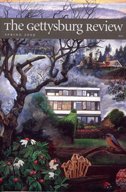
3rd Annual Gettysburg Review Conference for Writers
Gettysburg College, PA
June 3-8, 2009

The Gettysburg Review invites you to join them in creating a community of writers in a bucolic, convivial, and historic setting. Small workshops (maximum ten people per workshop) will be led by award-winning writers who have dedicated their lives to the teaching of poetry and prose. Limited scholarship support available.

Faculty include: Lee K. Abbott (fiction); Rebecca McClanahan (nonfiction); Dean Young (poetry)

Application Deadlines: Applications must be received by May 22, 2009. Scholarship applications must be postmarked by April 27, 2009.

PEN Translation Feature

PEN 2009 Translation Feature
Speaking across geographies, styles, and literary conventions, this month’s Online Feature showcases some of the most interesting voices—old and new—in translation. Find recent translations of fiction and poetry from around the world, doing the work that Susan Sontag calls “the circulatory system of the world’s literatures.”

How to Write About Africa

From the latest issue of Granta comes this essay, How to Write About Africa, by Binyavanga Wainaina. Should be required reading on at least a dozen lists I can think of: “Broad brushstrokes throughout are good. Avoid having the African characters laugh, or struggle to educate their kids, or just make do in mundane circumstances. Have them illuminate something about Europe or America in Africa. African characters should be colourful, exotic, larger than life — but empty inside, with no dialogue, no conflicts or resolutions in their stories, no depth or quirks to confuse the cause…”

Tucson Festival of Books

Tucson Festival of Books
March 14-15, 2009
University of Arizona

Featured authors include Jimmy Santiago Baca, Josh Bazell, Jennifer Lee Carrell, Billy Collins, David Eagleman, Diana Gabaldon, Brent Ghelfi, Temple Grandin, J.A. (Judith) Jance, Elmore “Dutch” Leonard. and Richard Shelton. Separate events for children and teens.

Paradise Finally Lost?

According to this article on Reutgers, Poet Laureate Andrew Motion believes students can’t “get past ‘go'” in such classics as Milton’s Paradise Lost without having basic knowledge of the Bible. Other classics that suffer in their loss of students understanding their full meaning also include Shakespeare, with something as simple as the title “Measure for Measure” (which comes from the Bible) being a lost reference for students.

Interestingly enough, Professor John Mullan comments that this lack of Biblical background may come from universities “accepting young people from much broader social backgrounds, with less frequent immersion in classical literature, than they had in the past.” Or perhaps more specifically, less exposure to the Bible and Christianity? (Though they do argue religious adherence is not a requirement.)

I’m sure it is a lament of every generation, but will there come a time when Milton and Shakespeare are no longer the “classics” to be studied? Will their references, regardless of how “archetypal” be so without point of grounding in student understanding that they become irrelevant? Me thinks it is only a matter of time…

New Lit on the Block :: Agricultural Reader

Technically not *new* Agricultural Reader is an arts annual founded in 2006 by Jeremy Schmall who currently edits the publication with Justin Taylor. However, the most recent issue (No. 3) is making its national debut via X-ing Books.

Agriculture Reader is interested in fiction, poetry, criticism, and “anything we haven’t seen before or even thought of yet.” They ask contributors to send a query letter rather than a submission: “Tell us about yourself, what you liked about our previous issues, and feel free to include a brief, representative sample of your work. We read queries year-round and respond, in the fullness of time, to all of our mail.”

The first issue includes works by Shimon Adaf, Christian Barter, Heather Christle Joshua Cohen, Julia Cohen, Dennis Cooper, Mark Edmund Doten, Will Edmiston, Elaine Equi, Christian Hawkey, Robert Hershon, Jen Hyde, Noelle Kocot, Justin Marks, Anthony McCann, Mike McDonough, Sharon Mesmer, Eileen Myles, Peter Orner, Joey Parlett, Stephen Priest, Ariana Reines, Jerome Sala, Tony Towle, Diane Williams, Rebecca Wolff, Matvei Yankelevich, and Matthew Zapruder.

You can get a sneak peek and some of the content and format on their website.

Student Suspension is “Gross Abuse”

NYU’s Violation of Student Rights
Tuesday, February 24, 2009

From John K. Wilson’s post on College Freedom, “I was not a fan of the student occupation of a New York University cafeteria. I didn’t like the incoherent list of bizarre demands, and I don’t like the use of occupation as a tactic in general. But the response of NYU in suspending 18 students, who were arrested when the occupation was ended, is a gross abuse of due process.” Read the rest.

How’s Your News?

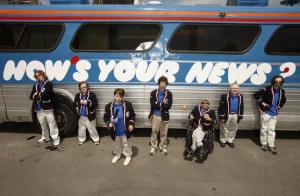
MTV’s latest series How’s Your News first began over ten years ago at a summer camp for adults with disabilities in Massachusetts. The current series grew out of the 1999 documentary directed by author Arthur Bradford (Dogwalker) and produced by South Park’s Trey Parker and Matt Stone. In the How’s Your News? film, Harrington, Bird, Perry, Costello, and Ronnie Simonsen (who’s currently battling leukemia) — all of whom attend Camp Jabberwocky, a Martha’s Vineyard camp for the disabled where Bradford is a counselor — pile into a tour bus and head west.

Along the way from New Hampshire to California, the group conduct a string of man-on-the-street interviews, and their conversations offer a funny and revealing look at how the disabled perceive and are perceived. The TV show follows the same general pattern, but it ups the star quotient somewhat, filming the HYN reporters as they interact with celebs like Sarah Silverman, Ben Affleck, and Amy Sedaris. (The Boston Phoenix)

Episodes from the series can be viewed in full on MTV’s website.

Erica J has her own to say on Disability Nation: Why I Really Didn’t Like “How’s Your News?”

Press 53 Announces New Poetry Editor

Tom Lombardo is now Poetry Editor at Press 53. Last year (2008), Tom edited and published After Shocks: The Poetry of Recovery for Life-Shattering Events (Sante Lucia Books), which features 152 poems by 115 poets from 15 countries. Tom is a widely published and respected poet and is a graduate of the MFA program at Queens University in Charlotte, NC. His mission is to bring 4-6 poetry collections to Press 53 each year and to be the preliminary judge for Poetry in the Press 53 Open Awards.

New Lit on the Block :: Specs

Specs is an annual journal of contemporary culture and arts at Rollins College that “aims to create sympathetic interfaces between artistic and critical practices.” Spec accepts fiction, non-fiction, cultural criticism, artwork, poetry, and pieces that blur genre boundaries.

The editors are particularly interested in works that examine contemporary culture and/or cross the critical/creative divide while riffing on the theme of “Faux Histories” in multiple ways.

Issue One contributors include: Douglas Barbour, Molly Bendall, Jeffrey L. Bohn, Christophe Cassamassima, D.P. Clark, Robert E. Clark, Glenn Deutsch, Denise Duhamel, Eliza Fernbach, Vernon Frazer, Jeanne Genis, Janis Butler Holm, Rosalie Morales Kearns, Amy Letter, Michael David Madonick, Kate Middleton, Sheila Murphy, T.A. Noonan, Melissa Parks, Chad Reynolds, Micah Riecker, Sarah Rosenblatt, Sankar Roy, Craig Saper, Jeff Solomon, Rodrigo Toscano, Lyzette Wanzer, Nina Zammit-Zorn, Slavoj Žižek