The Andrew Wyeth Chronicles by Janée J. Baugher Tupelo Press, February 2026
Winner of the Dorset Prize for Poetry, selected by Shane McCrae, The Andrew Wyeth Chronicles by Janée J. Baugher presents an imaginative narrative of the painter’s creative life, rife with both losses and pleasures. Baugher employs the footnote form to write a book-length narrative of ekphrastic poetry in which the character of Andrew Wyeth chronicles his internal musings. The sixty-three Wyeth paintings that influenced these poems (dated 1938 through 2008) are the ones in which Baugher delighted in how the quotidian is made tender, like a white sheet drying outside on the line or sunflowers’ shadows against a house. Studying the work of this particular artist was a decades-long meditative practice of deep-looking, a method by which the author detaches from her ego. Wyeth’s paintings, drawings, and watercolors became portals through which she could imagine worlds beyond her immediate awareness and in which she could explore linguistic possibilities.
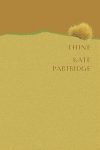
In Thine, Kate Partridge’s meditative lyrics generously allow poetic perspectives physical and cognitive, situated in landscape and observation, located in “the city, the body” and “the peopled land the landed people.” Whether “the burn crouching through the valley” or “a gauntlet of yellow flowers” the poet “let[s] things gather around” her.
Simultaneously the poet reckons with her positionality; “one’s position is fault.” Whether “at the precipice,” “on a dock,” “above the playa,” or “standing on the bike path,” the poet wishes for the “presence / / and vision” of others—intimates, artists, and writers. The writers range from Jorie Graham to Marianne Moore to C. D. Wright; six poems “erase… one reserved letter from Willa Cather to her partner Edith.” Joining epistles, homages, and erasures, ekphrastic poems engage Dorothea “Lange’s photos of women in deserts,” Agnes Martin’s grid paintings, and Walter de Maria’s land art, among others.
The poet’s multiple poetic perspectives, conversations, and forms offer readers an artist’s “many ways to give, / thought to the other.” For the poet, engagement with artists, art, land, and self seems to offer her heart means to “expanding in all / sorts of ways” and to “gird” for the necessary wait for the “pockmarked future.”
Dear Reader, “if at any time / you have need of a beginning, look” to Kate Partridge’s “evident truths.” There among “the rising proof of grass” she will meet thee and these poems will be Thine.
Thine by Kate Partridge. Tupelo Press, September 2023.
Reviewer bio: Jami Macarty is the author of The Long Now Conditions Permit, winner of the 2023 Test Site Poetry Series Prize, forthcoming fall 2024, and The Minuses (Center for Literary Publishing, 2020), winner of the 2020 New Mexico/Arizona Book Award – Poetry Arizona. Jami’s four chapbooks include The Whole Catastrophe, forthcoming summer 2024 from the Vallum Chapbook Series, and Mind of Spring (Vallum, 2017), winner of the 2017 Vallum Chapbook Award. To learn more about Jami’s writing, editing, and teaching practices visit her author website.
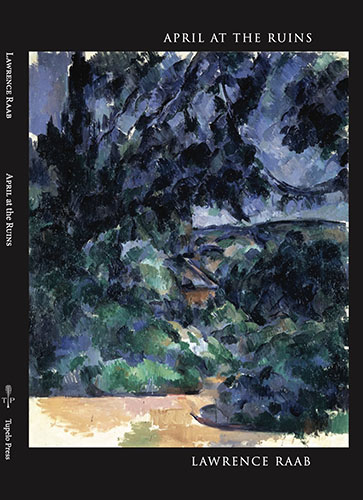
Depending on the reader, the title of Lawrence Raab’s tenth poetry collection, April at the Ruins, might evoke “the cruelest month” of Eliot’s The Waste Land or a postcard from a Henry James character on The Grand Tour. There are glimmers of each here — mixtures of memory and desire as well as travels both real and metaphorical. But more often we find Raab meditating on love and loss (and much besides) with his characteristic sense of gratitude, entire lives suggested by a precise detail or turn of phrase:
… and as they crossed the street she took his hand, just as if everything they hadn’t told each other had never happened. (“One of the Ways We Talk to Each Other”)
In “Little Ritual,” stones collected and then forgotten beside a lake become metaphysical emblems, the “zigzags of blue” in a “shiver of quartz” reminding the speaker “that some day everything / I love must be set aside, / or given away, or lost.” Amid the ruin we’ve made or witnessed of this world, Raab nonetheless celebrates an April of the spirit. “Nothing is beyond repair,” he writes. “How can there be a beautiful ending / without many beautiful mistakes?”
April at the Ruins by Lawrence Raab. Tupelo Press, 2022.
Reviewre bio: James Scruton is the author of two full collections and five chapbooks of poetry, most recently The Rules (Green Linden Press, 2019). He has received the Frederick Bock Prize from Poetry magazine, among other honors.
Jeffrey Levine and Kristina Marie Darling invite you to join Tupelo Press’ expertly-designed online poetry manuscript conference. We will meet in small, intimate groups. You will be guided through the craft of transforming your manuscript into a book that coheres and sings! At the end, you’ll have a readied manuscript, a publication plan, and a community of fellow poets. Rolling registration.
View the full NewPages August 2021 eLitPak newsletter.
All authors want to get their books into the hands of as many readers as possible. Though it is a publisher’s role to aid and assist authors in marketing and publicity for every book, the role of any publisher necessarily takes a back seat to your all-important efforts. Nobody else can do this essential work as effectively as you can.
View the full NewPages August 2021 eLitPak newsletter.
Tupelo Press presents two recent releases, Shahr-e-jaanaan: The City of the Beloved by Adeeba Shahid Talukder, and our latest printing of Maggie Smith’s “Good Bones” onto broadsides. Also be sure to check out the Tupelo Press BOGO sale going on at tupelopress.org. View the entire April eLitPak Newsletter here.
Winner of the Tupelo Press / Crazyhorse Award The Forest of Sure Things by Megan Snyder-Camp is now available for purchase.
The 12th Annual Tupelo Press Award for a First or Second Book of Poetry is an open competition with a $3,000 prize. Submissions are accepted from anyone writing in the English language, whether living in the United States or abroad (translations are not eligible for this prize). Final judges will be the editors of Tupelo Press and the journal Crazyhorse. All entries must be postmarked or uploaded to the online Submission Manager between January 1 and April 15, 2011.