Opiummagazine.com has taken its “literary humor for the deliriously captivated” into the print world. No.1, with an Eggersly subtitle, “A Whopping Collection of Fanatical Literary Brilliance,” retains the clever wit and sly characterizations of its daddy on-line journal, including estimated reading times. Continue reading “Opium – 2005/2006”

NewPages Blog :: Magazine Reviews
Find literary magazine reviews on the NewPages Blog. These reviews include single literary pieces and an issue of a literary magazine as a whole.
Nimrod International Journal – Fall/Winter 2005
Of the 49 contributors in this issue of Nimrod, 36 are finalists and semifinalists of its 27th annual award issue, which is based on Ovid’s Metamorphoses. Four are for the Katherine Anne Porter Prize for Fiction; 32 for the Pablo Neruda Prize for Poetry. Numbers may not be the best introduction for their venerated prize issue, yet it suggests the bloom of the varied, evocative and penetrating contents: this is a journal to be slowly ingested and savored. Continue reading “Nimrod International Journal – Fall/Winter 2005”
Me Three – Fall 2005
Me Three delivers prose in all its bountiful forms: fiction, personal essays, criticism, and even “unclassifiables.” Continue reading “Me Three – Fall 2005”
Lorraine and James – 2005
The auspicious debut issue of Lorraine and James compliments its diverse fiction with personal essays, some poetry, one interview and a contributor’s page that offers a brief explanation of the story’s inspiration and/or development. Continue reading “Lorraine and James – 2005”
Epoch – 2005 Series
Self-described as having a “shrewd eye for talent,” the editors at Epoch, Cornell University’s literary journal, have again published an exceptional issue. Largely filled with short stories, this issue includes characters that are ordinary and empathetic, complex and endearing—believable, if difficult to understand. Continue reading “Epoch – 2005 Series”
Conjunctions – 2005
There is something sinister about children (a fact every Hollywood horror movie knows), with their made-up languages, their hidden play spots and their games of Hangman. The work in Conjunctions 45 makes good use of this, offering up a thick portion of eeriness in their “Secret Lives of Children” issue. Continue reading “Conjunctions – 2005”
Carousel – Fall/Winter 2005-6
In bookstores, the quirky and curious Carousel is filed under Literary or Visual Art. This international journal offers poems, cartoons, drawings, cartoon-like drawings, a few ads, mixed media, boobs, prose poems, a naked woman embracing a polar bear, charcoal watercolors, macabre big-faced drawings on graph paper, a list of phobias and more. Continue reading “Carousel – Fall/Winter 2005-6”
Four-Hundred Words – 2005
Four-Hundred Words is a CD sized lit journal filled with 66 different 400-word autobiographies on the theme of…life. Though the editor, Katherine Sharpe, claims the first issue grew out of “that weird time right after college, the time of looking around and wondering how the world works and how people find, and understand, their place in it,” the array of contributors ranges in age from a 72-year-old physicist to a 15-year-old Taiwanese woman who expresses herself in exclamations, “She’s so URGH!!” Continue reading “Four-Hundred Words – 2005”
The Fiddlehead – Summer 2005
The Fiddlehead may very well be the single best in-door for those with a mind to explore the finest of Canadian creative writing. This “Summer Fiction” issue is a wellspring particularly for anybody seeking the multifarious pleasures that original and adventurous short stories can provide. Published out of Fredericton, New Brunswick, The Fiddlehead, as the brief editor’s note asserts, celebrates its 60th anniversary this year, “which makes The Paris Review at fifty seem a veritable pup.” Continue reading “The Fiddlehead – Summer 2005”
Fairy Tale Review – 2005
Charming and adventurous, this new annual journal displays impressive wit and eclecticism. Right away you know Fairy Tale Review will be a different sort of literary magazine from its multiple visual references to Andrew Lang’s Fairy Book Collection, (a series of books listed by color, the Red Fairy Book, the Olive Fairy Book, etc.) Continue reading “Fairy Tale Review – 2005”
Crate – Spring 2005
Southern California is a nexus of geography and culture, a place where perspectives about the world get reflected through the iridescent sheen of difference. Continue reading “Crate – Spring 2005”
Controlled Burn – Winter 2005
I am occasionally awed and inspired to be reminded of the number of excellent literary journals produced by this country’s community colleges. Controlled Burn comes to us out of Kirtland Community College of Roscommon Michigan, but in design, content, and skillful editorial vision, this publication is easily on a par with our nation’s more celebrated, ivy-league journals. Continue reading “Controlled Burn – Winter 2005”
Buffalo Carp – 2004
Many of the works in Buffalo Carp, “a hybrid, an amalgam” of two species native to the Quad City Mississippi River area, also celebrate the natural world. Dennis Saleh’s terse yet lyrical poem, “The Delta Songs of the Harper,” evokes Ra, the Sun God from Egyptian mythology. Continue reading “Buffalo Carp – 2004”
Beloit Fiction Journal – Spring 2005
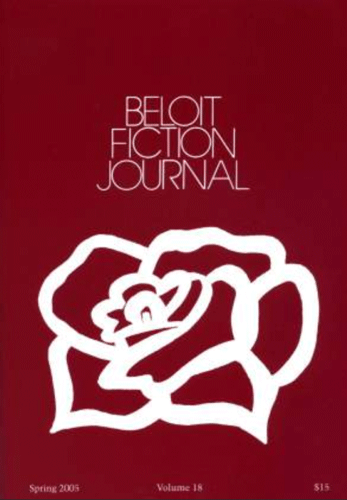
In Keith R. Denny’s short, remarkable dream-sequence of a story, “Ulrika,” the reader is swiftly trammeled up in the twisty mind of a would-be fiction writer for whom “the possibility of narrative is machine-gunned down in the street like a mad dog.” Lucky for us, the narrator’s self-effacing assertion does not hold true for “Ulrika” nor any of the other stories in the wonderfully narrative-packed Beloit Fiction Journal.
Continue reading “Beloit Fiction Journal – Spring 2005”Barrow Street – Summer 2005
Don’t be deceived by the unassuming cover. Or should I say: be deceived, be very deceived, on account of the delicious merit of surprise. Such is the case with every issue of Barrow Street, and I have to say, I like it that way. Inside the summer issue are 72 poems, 6 poems-in-progress, and 3 reviews. Not bad for 127 pages, even better for $8 an issue. Barrow Street is perfect bound, the heft of a paperback novel, copious, a literary variety show. It seems more discerning than other journals, but by no means to a fault. While Barrow Street is known for publishing established writers bearing lists of publications, most of its contributors are past or present professors, making the journal no more or less academic for it. A cursory curiosity, though worth noting. Continue reading “Barrow Street – Summer 2005”
Good Foot – 2005
Quick summary of the use of the term “experimentalism”: Some people impose the label on themselves as a license to do anything, while others get the label applied to them for lack of any better term. Good Foot poetry journal, where it is experimental, sits on the edge of the second camp. Continue reading “Good Foot – 2005”
The Georgia Review – Summer 2005
The summer edition of The Georgia Review is dedicated to “the art of the rant,” an idea that is, without exception, brilliantly explored in this outstanding issue. The topic is broadly interpreted, from frenetically paced poetry to a father’s tense conversation with his disturbed daughter to Robert Cohen’s essay that discusses the necessity of “going to the extreme limit.” Continue reading “The Georgia Review – Summer 2005”
Feminist Studies – 2005
Feminist Studies, a glossy, intellectual journal that balances its essays on research and theory with literary fiction, poetry, and art, manages again to spark interest in its intelligent, clearly written essays—this time, my favorite essays were on a post-post structuralist approach to feminism in Simone de Beauvoir’s writings by Sonia Kruks and a study of beauty pageants relations to college life by Karen W. Tice. Continue reading “Feminist Studies – 2005”
Columbia Poetry Review – Spring 2004
This handsome perfect-bound journal out of Chicago with its heavy matte cover first drew me in with its impressive and diverse list of contributor’s names on the back: Nick Carbó, Karen Volkman, Wanda Coleman. From lyric narratives to post-avant experimental work, the poems have in common a certain hipness, an investment in emotion and image, and a conversational directness that draws the reader in. Continue reading “Columbia Poetry Review – Spring 2004”
The Chattahoochee Review – Summer 2004
“Everything that once made him rage is now reason to smile,” says the narrator in Judith Oritz Cofer’s “Tio’s Nostalgia” of her uncle, though she could just as easily be describing the contents of the latest Chattahoochee Review. This issue couples celebration and darkness; Cofer’s piece is at once a story of homecoming and of the desire to leave. Continue reading “The Chattahoochee Review – Summer 2004”
Carve Magazine – 2005
Among hundreds of saddle-stitched paper magazines, the Ithaca-based CARVE begs but one comment from this reviewer: I hope it continues its bold showcasing of unknown talent. Through the course of these three issues, CARVE has stuck to its formula, featuring as many as five poems or poem excerpts from each of five or six poets. The contributor demographics, though largely concentrated in New England, have diversified to include New Zealand and the U.K. And the poems are next to impossible to publish just about anywhere, but you’ll find them rewarding if you keep pace with them. Issue 5 includes a small biography of late British poet Ric Caddel, whose self-described style summarizes much of CARVE: “Part of the poetic process which is going on, is precisely that of jamming diverse elements together to see how they work, associating dissociated things.” In issue 6, we see how diverse such elements can be. Bill Marsh toys around with his wordplay meter on high in five excerpts from his magnetic Songs of Nanosense: Continue reading “Carve Magazine – 2005”
Beloit Poetry Journal – Fall 2005
Beloit Poetry Journal threw me for a loop with this issue, by including not one, or two, but seven poems by Mary Molinary at the beginning of the journal—and in a slim journal such as this one (48 pages total) this makes quite an impact. The upside of having so many poems by a single artist is that you get a good solid idea of that artist’s work. Molinary’s seven poems are seven lyric, existential takes on the time 8:38—in a style more post-avant-garde/experimental than you might expect from this journal. Does this signal a shift in editorial preference? I await the next issue to find out. Continue reading “Beloit Poetry Journal – Fall 2005”
Swivel – 2005
The second issue of Swivel is a wry collection of fiction, essays, poetry, and yes, even the occasional comic strip, all written by women. “This time,” says editor Brangien Davis, “the zeitgeist is littered with beasts,” meaning that thematically, this issue seems inexplicably connected by animals — including giraffes. Continue reading “Swivel – 2005”
South Dakota Review – Winter 2004
Published by the University of South Dakota since 1963, this issue of South Dakota Review contains many fine stories including James Jay Egan’s “The Hand of God,” in which things go terribly wrong, Robert J. Nelson’s graceful memoir “The Music Teacher,” Katherine L. Holmes lyrical “Eggs in a Basket,” and Christine Sneed’s “Furious Weather.” Continue reading “South Dakota Review – Winter 2004”
Smartish Pace – 2005
Eric Pankey and Jim Daniels, John Kinsella and Denise Duhamel — there’s no formula here, no template — the breadth of poems in Smartish Pace is one of its key attractions. Forty-two poets as different from each other as forty-two poets can be. There is a pleasing balance here, too, of stars (Bob Hicock and Lola Haskins, not to mention Rimbaud, Italian poet Giovanii Pascoli, and Polish poet Jerzy Kronhold, in addition to the aforementioned) and newcomers. I am sure I would have found Darren Jackson’s poem, “Pain Rents a Room Off Bourbon Street,” one of his first to be published, powerful had I read it last week or last year, but from here forward, of course, it becomes an entirely new experience: Continue reading “Smartish Pace – 2005”
River Styx – 2005
An impressive 30th anniversary issue featuring many prolific and well established writers, including Dorianne Laux, Lucia Perillo, Sharon Olds, William Gass, Molly Peacock, Louis Simpson, Richard Burgin, and Robert Finch, among others, as well as many accomplished, but lesser known talents, including Alison Pelegrin, Marcela Sulak, Allen C. Fischer, and Jacbo M. Appel. Continue reading “River Styx – 2005”
The Reader – Summer 2005
Penelope Shuttle admits that she is a bookworm while she talks (writes) about the importance of reading aloud, a common activity of the past, less common in the present. She attends author readings, the most memorable of which she describes. “It was Pablo Neruda who made the very deepest impression on me. Continue reading “The Reader – Summer 2005”
Rattle – Summer 2005
Do lawyers write poetry? Well, if a tribute to lawyers who write appears in the summer 2005 issue of Rattle, the answer is a resounding yes: lawyers do write poetry. Lawyer poems can often be just as sad, angry, or serious as non-lawyer poems. They can even be humorous, like these lines taken from ‘“What Is Your Idle Job?’” by Ace Bogess: “Then it’s back to the office for coffee / tasting like gasoline, maybe a doughnut on the sly” he writes. “If my boss pops over, checking my progress, / I greet him with a good-natured pat on the back / to wipe the sticky glaze from my fingertips.” Continue reading “Rattle – Summer 2005”
Pilgrimage – 2005
I have never been disappointed by an issue of Pilgrimage. In a world that is exceedingly desperate, both on and off the page, this exquisite little journal never fails to soothe and stimulate in equal measure, with intelligence, grace, and authenticity. This issue’s theme is “borderlands.” Continue reading “Pilgrimage – 2005”
Other Voices – Spring/Summer 2005
Art “lives on long after wars have ended and townspeople have mended their ravaged homes and gone on with their lives…” says the editor of Other Voices. Each of the 16 stories in the spring/summer issue contains the suggestion of crossing a boundary, whether psychological, physical, social or national. Continue reading “Other Voices – Spring/Summer 2005”
Open Minds Quarterly – Summer 2005
“What reader,” says Maureen D. Mack, “does not search for a happy ending at the end of a love story? How many of us yearn for a better ending to a human conflict or loss that we have suffered in our lives?” Continue reading “Open Minds Quarterly – Summer 2005”
Ninth Letter – Spring/Summer 2005
There are literary magazines that you read and enjoy, but end up piled in your closet amongst back issues of other magazines. Then there are literary magazines that are so lovingly put together and carefully designed that they demand prominent placement on your bookshelf or coffee table. Ninth Letter is one of the latter. This University of Illinois based publication seeks to reinvent the literary magazine by infusing it with design and art. Continue reading “Ninth Letter – Spring/Summer 2005”
The New Quarterly – Summer 2005
Montreal-based poet Robyn Sarah served as guest editor for what is called a “small anthology” of poems featured in this issue. Sarah also contributes an essay on poetics in which she defines a good poem: “it should transcend its own particulars; it should be built to bear weight; it should have lift.” The nearly four dozen poets she’s selected offer up work Sarah finds “attentive to language, memorable, ponderable, convincing.” Sarah clearly favors plain diction, narrative impulses, strong, authentic voices, and emotional integrity. Continue reading “The New Quarterly – Summer 2005”
MAKE – 2005
Though the editors of Make magazine cite Chicago literary patriarch Nelsen Algren as their inspiration, you don’t have to be a Chicagoan to be in Make’s debut issue. Continue reading “MAKE – 2005”
Main Street Rag – Summer 2005
The preference in Main Street Rag is for transparency, work with plain, strong language and a clear point of view — Scott C. Holstad’s “I Want It All,” for example (“Fuck the sweats, / I want the world. / No rhyming for me, / no structured / bullshit, I want / to spread out, / feel the bullets / whistle past.”); or Nicole Lynskey’s “Talker at the Café” (“The extrovert-talker / could be a pit-bull on a cell-phone / for all that her dark-haired friend / is allowed to speak, / in her ‘this-funny-anecdote’, / ‘that-divorced-couple’ conversation…”); or Glen Chestnut’s “The Pickup” (“Sometime in the 1950’s / A construction site / somewhere in the jungles of Colombia. / Work had stopped for the day. / The mountains to the west / had swallowed up the last rays of sun.”) Continue reading “Main Street Rag – Summer 2005”
Indiana Review – Summer 2005
There is even a collaborative review of a collaborative book in this fascinating issue of work conceived and produced in collaboration (Mary Austin Speaker and Sara Jane Stoner review Phoebe 2002. Continue reading “Indiana Review – Summer 2005”
Gulf Coast – Winter/Spring 2005
Usually, I take a week to read a good literary magazine, parceling out the pieces over long evenings sitting on my porch or during my thrice-weekly ride on the stationary bike. It’s a sign of respect that I don’t read it all in one sitting. Now I have a new magazine to add to my weekly ritual: Gulf Coast. Continue reading “Gulf Coast – Winter/Spring 2005”
Gihon River Review – Spring 2005
The Gihon River Review’s spring 2005 issue offers a bountiful selection of stories and poems. Allan Peterson’s poem “Slight of Hands” I appreciate for his use of detail and personification, and fresh way in which Peterson reveals a sense of frustration: “The clock is holding its head in its hands,” he writes in the third stanza. Introducing the fourth, in which that sense of frustration seems to have ended when a “gnat burns itself crazy on the bulb.” Continue reading “Gihon River Review – Spring 2005”
American Tanka – 2005
A concentration of metaphors, word play, and unconventional thinking binds together the five line poems in American Tanka. From the world of subtle nuances and concrete images, I constantly had the sense of reliving a moment that had never before belonged to me. Yet through my communion with each poem, the shared joy, sadness, different perspective, that Aha feeling, I was assured that the moment was in part my own. Several authors are memorable, out of which only a few can be mentioned here. Cindy Tebo’s “old lime kiln,” the first line in her poem, is haunting. The sudden image of the kiln suggests travel, perhaps an old country road. Merely driving by, the traveler pauses in a chance meeting of past and present. The kiln “in the shadows / of a cold afternoon” emphasizes the passing, of the kiln? the traveler? Like Leonard D. Moore’s powerful seven stanza sequence “To Find My Way Home,” Tebo adds additional layers to her poem through careful word choice, placement of lines, absence of punctuation, and juxtaposition. Tim W. Younce’s repetition of the line “folds and unfolds” creates the feeling of nervousness from the perspective of a soldier “at the airport / camo clad,” holding his “boarding pass.” For a moment this soldier can stop time, fold it in his palms. We are all three connected, author, soldier, reader — through a shared awareness of both our power and powerlessness. These poems are for readers who do not want to be told what to think, for those who enjoy connecting the threads. We must compare images and/or ideas and draw conclusions using hints the author provides and our own resources. Because of the relationship we establish in the process, the poems have the potential to live on. [American Tanka, P.O. Box 120-024, Staten Island, NY 10312. Email: [email protected]. Single issue $12 www.americantanka.com] —Donna Everhart Continue reading “American Tanka – 2005”
Alligator Juniper – 2005
This issue is dedicated to the theme, “Scars,” as evidenced from the dramatic black and white cover photograph of a man whose chest becomes a screen on which is projected several black birds in flight, their wings like the feathery reminders of what the body endures. While a theme dedicated to the visceral remnant of physical and emotional wounds could have solicited writing that was affected, tedious, or even cliché, this issue illustrates anything but. Instead, we read of the subtleties of pain, the nuances of grief, the faint reminders of loss or dejection, though many of these authors left me feeling hopeful — that glimmer of possibility that encircles our aches like a silvery light. Continue reading “Alligator Juniper – 2005”
West Branch – Spring/Summer 2005
The poets of West Branch have something to say, and though the imagery may be beautiful and the lines carefully crafted, there is nothing excessive, artsy, or difficult for difficulty’s sake. This observation hit me as I read Yona Harvey’s wonderful “Turquoise,” in which the poet bluntly tells a young female student that “wearing turquoise jewelry & Frida Kahlo skirts / doesn’t make women artists.“ Continue reading “West Branch – Spring/Summer 2005”
THEMA – Summer 2005
If you don’t already know, Thema is a journal whose every issue is based on a different premise, upon which the poetry, fiction, and photography reflect. This issue’s theme is “Hey, Watch This!” Continue reading “THEMA – Summer 2005”
Southern Humanities Review – Spring 2005
Southern Humanities Review has respect for the questions of moral fabric that challenge a classical, essentialist universe, but it is not strictly a religious journal. Continue reading “Southern Humanities Review – Spring 2005”
The Sewanee Review – Winter 2005
Officially this country’s most time-tested literary quarterly (it was founded in 1892), The Sewanee Review is one in that very small number of old-school American journals that just can’t be messed with, the kind of publication that can successfully sport an antiquated, unembellished cardstock cover without seeming quaint or stodgy. A reviewer feels, while reading a publication whose founding date stands more than a century back, that any inspired high praise will seem inordinately past its deadline. Continue reading “The Sewanee Review – Winter 2005”
Sentence – 2004
If it has ever occurred to you to wonder where exactly one might draw the line between poetry and prose, you’ll undoubtedly find yourself engrossed by Sentence, amongst whose litany of stated objectives you’ll find: “to explore the gray areas around the prose poem,” and to “publish work that extends our perception of what the ‘prose poem’ is or can be.” And even if it’s never occurred to you to worry about “the distinction between the prose poem and poetic prose,” you’ll still find yourself engrossed—I can practically promise. Continue reading “Sentence – 2004”
Red Hills Review – Spring 2005
The limestone formations rise up out of the bay like… How a dragon legend was ever connected with them, I can easily understand. They inspire, thanks to Stephen Buel, who provided the image on the cover of Red Hills Review, a drop of the mouth reaction, similar to the one a dragon might inspire (I have to say might because I’ve not yet seen a dragon). Safely past the red paperback cover, drop of the mouth is also fitting when discussing more than thirty days of reading material, poetry, fiction, memoir, and essay. I have to admit, though, that my main attraction before receiving the journal was Light on the Northern Shore: Homage to Noam Chomsky, a theorist whose work I’ve only partially understood. I wanted a deeper understanding of the theorist, and I came to one with the assistance of David Baker. Continue reading “Red Hills Review – Spring 2005”
Pearl – Spring/Summer 2005
I always enjoy uncovering a journal with a history that I had never known existed before. Pearl has a history (34 volumes now) that includes an impressive devotion to special issues. This all-fiction issue marks the eighth time Pearl has committed itself to the genre, and it doesn’t disappoint. Of the 19 stories included, most are under 1,500 words and immediately accessible; they can be tried on by all sizes to see which fit the best. Continue reading “Pearl – Spring/Summer 2005”
The Midwest Quarterly – Spring 2005
Rare is the poem that combines senses, emotions, and intellect, that contains ability to ease in and out of natural worlds, both internal and external. Continue reading “The Midwest Quarterly – Spring 2005”
The Massachusetts Review – Summer 2005
The Massachusetts Review is the perfect antidote to beach reading, a cultural exploration that enriches us and at the same time reminds us that we are all connected to and responsible for the world we inhabit. Continue reading “The Massachusetts Review – Summer 2005”
The Manhattan Review – Winter/Spring 2005
A good publication to consult for fine contemporary poetry, The Manhattan Review here offers a special double issue for the 2005 Winter/Spring volume. Continue reading “The Manhattan Review – Winter/Spring 2005”