Florida is a wildly unique collage of environments, from the gritty urban core of Miami to dense crocodile infested swamps; from the upscale shops of tropical Longboat Key to the historic architecture of Jacksonville, where the nights are distinctly northern with their chilly edges. This journal reflects this rich diversity from the edgy, tongue-in-cheek poetry of “spotlighted” poet Denise Duhamel, to the arch intelligence of prose stylist Janet Burroway (an interview and a story)—I have always admired them both. Continue reading “Saw Palm – Spring 2010”

NewPages Blog :: Magazines
Find the latest news from literary and alternative magazines including new issues, editorial openings, and much more.
32 Poems – Fall 2010
I have always loved the organizing principle of this little journal: thirty-two ways to write (or read) a poem: Continue reading “32 Poems – Fall 2010”
Anamesa – Spring 2010
A snarling wolf graces the front cover of this issue. This jolting art, titled “The Queen/Bitch,” by Jennifer Murray provides an intriguing introduction to the central themes of the issue: loneliness and isolation. Continue reading “Anamesa – Spring 2010”
The Aurorean – Fall/Winter 2010-2011
This fifteenth anniversary issue of The Aurorean, published in Farmington, Maine, celebrates the fall/winter seasons in New England. This issue features poets Jim Brosnan and Martha Christina, and includes a special section of Haiku and “related poetry.” Continue reading “The Aurorean – Fall/Winter 2010-2011”
Big Muddy – 2010
This journal reads like a road trip. Its rich landscape left me with a lingering sense of journey as I found characters and imagery replaying in my mind like saturated photographs. Continue reading “Big Muddy – 2010”
Dislocate – 2010
Unaware of any necessary precautions in the handling of “The Contaminated Issue,” I consciously folded back the front cover and crossed my fingers in hoping its pages were not infected with some sort of incurable disease. But it was already too late; the truth is that I was already contaminated; we all are. Continue reading “Dislocate – 2010”
Elder Mountain – Fall 2010
Marideth Sisco’s essay “You’re Not from Here, Are You?” gives this issue of Elder Mountain its integral sense of place, a right-away taste of the people, culture and world of the Ozarks. Sisco remembers “lying on the porch on summer nights or curled up by the woodstove in winter,” listening to her relatives tell stories. Indeed stories and the people who tell them are the heart of Sisco’s writing and all the varied pieces that follow in this volume. Continue reading “Elder Mountain – Fall 2010”
Florida English – 2009
For this issue, the overall theme can be summed up in T. Allen Culpepper’s poem “My Life Is Not a Very Good Poem,” which starts, “My life seldom rhymes / (or reasons either, for that matter).” The genres in this issue are nicely mixed up in the ordering, and the result is an elegant, ever-changing reading experience. Continue reading “Florida English – 2009”
FRiGG – Fall 2010
This lit mag is classier than its somewhat obscene name. The writing generally is clear and of high quality, the website is well laid out, and each story or poem is accompanied by engagingly colorful artwork. There is a certain in-your-face irreverence to many of the stories, but they are also entertaining as a whole. Frigg often presents two or three pieces of flash fiction by the same author – unusual in the universe of online literature today. Continue reading “FRiGG – Fall 2010”
The Healing Muse – Fall 2010
This tenth anniversary issue of this journal, dedicated to creative explorations of health and healing, includes more than 120 pages of poetry; nonfiction contributions by 14 essayists; five short stories; and more than a dozen pages of appealing and memorable artwork. Continue reading “The Healing Muse – Fall 2010”
Lake Effect – Spring 2010
Examining the inside of Lake Effect’s back cover will inform the reader of the journal’s standards. It “publishes [fiction] that emerges from character and language as much as from plot.” Always a fan of the character-driven piece, I was delighted to discover that this standard was adhered to carefully. Continue reading “Lake Effect – Spring 2010”
The Literary Review – Fall 2010
The theme for this is “Refrigerator Mothers: ‘Just happening to defrost enough to produce a child’…and other things we said that we wish we could take back,” and I would recommend it to any writer who is a mother or expecting mother. The issue includes short stories and poems from the perspective of mothers and some from the perspective of the writer thinking back on their mother. “A Good Day,” an essay by Jessie van Eerden, is a moving, detailed look at the seemingly ordinary, everyday aspects of her mother that defined her. Continue reading “The Literary Review – Fall 2010”
The Louisville Review – Fall 2010
Guest editors Philip F. Deaver (fiction), Nancy McCabe (nonfiction), and Kelly Moffett (poetry) join drama editor, Charlie Schulman, and Louisville Review editor Sena Jeter Naslund to offer up yet another notable issue. From accomplished poets Eleanor Wilner, Stephen Dunn, and Frederick Smock—among many others—to the surprising accomplishments of poems in the “Children’s Corner,” featuring work more polished and successful than one expects from high school students, this is a particularly appealing issue. Continue reading “The Louisville Review – Fall 2010”
Monkeybicycle – 2010
Monkeybicycle’s cover for this issue seduced me with its sleek matte finish of an image of red smoke over a white background. It was a pleasure to just hold the journal, and I couldn’t wait to see under the covers. The interior layout is conventional but easy to read, and I’m very thankful the editors didn’t try to do something fancy with the table of contents; they keep it simple and clean. The real beauty of this issue isn’t the cover or the layout, though. It’s in the stories and poems. Continue reading “Monkeybicycle – 2010”
New Letters – 2010
“Flight in Word and Deed” is the theme to this issue—transcendence, explains editor Robert Stewart. His introduction is, nonetheless, a defense of the grounded nature of the literary journal as an object, something “weighty” we can hold in our hands. (“As America gets fatter, it seems to want its art to become weightless,” he writes of e-books and cyber publications). He doesn’t need to convince me that the printed page, the bound volume, the variation in texture from the uncoated paper of the pages containing stories and poems to the glossy coated stock of the extraordinary reproductions of paintings by Fabian Debora are worth their weight in pixels, providing a kind of pleasure hard to replicate in digital spheres. Continue reading “New Letters – 2010”
Rattle – Winter 2010
Rattle‘s winter issue features a special section of poetry entitled “Tribute to Mental Health Workers,” which includes poetry on a variety of issues in the field, from Alzheimer’s to therapists to hospital workers. While some poems delve into the grief and sadness of these illnesses, others approach them with hope. Gwenn A. Nusbaum’s poem “Hospital, Spring,” is one such poem, describing a man waiting during his wife’s surgery, while “babies are being born.” This section also includes an interesting article by Maryhelen Snyder, “The Art of Waiting: The Parallels of Poetry and Therapy.” Continue reading “Rattle – Winter 2010”
Sleeping Fish – 2010
The cover explains the selections within very well: things are going to get weird. The publication is filled with more questions than answers; each story leaves you in a new locale, and while rereading may make things more understandable, true clarity is never given. The biggest mistake one can make entering these works is assuming that a solution, a character, or a situation will be made explicit. Often one is simply forced to fight imagination with imagination. Continue reading “Sleeping Fish – 2010”
Washington Square – 2010
The cover art of this issue is from Dan Hillier’s collection of altered engravings, four which appear inside the magazine. Hillier’s pictures are odd, collaging the real with the imagined. Many of his engraving show humans with animal features. For example, the engraving on the cover depicts a woman in Victorian dress whose skirts branch out into octopus tentacles. This weirdness seems intentional and thematic for the issue as a whole. Continue reading “Washington Square – 2010”
Western Humanities Review – Summer 2010
When I read for pleasure I want to be transported to another place: another world, another time, another headspace. But it is a particular treat when I am able to get a fresh perspective on the art of writing and storytelling itself. Continue reading “Western Humanities Review – Summer 2010”
Wild Apples – Spring/Summer 2010
“Animals take center stage in this fifth issue of Wild Apples,” writes Linda Hoffman, the founding editor of the journal. Humans are a part of this issue too, but more precisely the pieces are about how we fit into the animal world—and even how the animal world fits into us. (In some cases, literally; in “The Animals Within Us,” Greg Lowenberg discloses that four hundred species of parasites live in and on us, including our intestinal tracts.) Thus, the interconnection between humans and other creatures becomes the thematic thread that strings together all the pieces in this issue. Continue reading “Wild Apples – Spring/Summer 2010”
ZYZZYVA – Fall 2010
ZYZZYVA, besides having name difficult to pronounce, is a triannual publication out of San Francisco and features only West Coast writers. The name itself refers to tropical American weevils and is the last word in most dictionaries. Continue reading “ZYZZYVA – Fall 2010”
Salamander Fiction Contest Winners
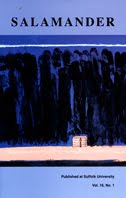 The newest issue of Salamander (v16 n2) includes the winners of the magazines first-ever fiction contest with Jill McCorkle as final judge. The first prize winner is Timothy Mullaney (“Green Glass Doors”) and runner up is Susan Magee (“The Mother”). The judge for Salamander’s 2011 fiction contest will be Jim Shepard. Entry period is April 15 – May 15 (postmark deadline).
Crazyhorse 50th Anniversary Issue
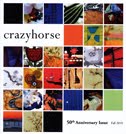 In celebration of its 50th year of continuous publication, Crazyhorse offers readers a “sort of” Editors’ Picks Bonus Anniversary Issue. It includes works from issues edited at College of Charleston in hopes that it will stand as a show of appreciation for all the writers and editors who have come before as well as (“with any luck”) those who will continue the come to the publication.
ABRAXAS – 2010
ABRAXAS describes itself as an “irregular, independent poetry magazine” from Wisconsin and introduces readers to contemporary writers of lyrical poetry. Continue reading “ABRAXAS – 2010”
AMERARCANA – 2010
As child I remember singing, “This land is your land, this land is my land. From California to the New York Island […] This land was made for you and me.” Like Woody Guthrie’s famous song, the Amerarcana brilliantly encompasses a broad spectrum of voices that represents the collective identity of American poets from coast to coast. The Amerarcana is a rich steaming stew of folklore, language, and cultural identity. Piping hot and savory too! Each poem is a tantalizing slice of western spirit. Continue reading “AMERARCANA – 2010”
Amoskeag – Spring 2010
From the unknown writer expecting a rejection letter, rather than a publication, to authors well-known to the New York Times—all meet together in Amoskeag. This collection of voices focuses on what Editor Michael J. Brien expresses as, “recollections and reconstructions of hazy, distant memories, and memories so fresh they scream to be captured before they begin to […] lose breath.” Continue reading “Amoskeag – Spring 2010”
Crab Creek Review – 2010
After winning a year’s subscription during last year’s National Poetry Day, I discovered the joy of the Crab Creek Review. What had drawn me into past issues was the range of voices, both from experienced writers and fresh, emerging writers. There has always been a certain charm to the pieces selected, whether their tone leans towards the more serious or whimsical, and this issue is no exception. Continue reading “Crab Creek Review – 2010”
Feile-Festa – Spring 2010
Feile and festa mean “festival” in Irish and Italian, and indeed there are many pieces in this journal from the Mediterranean Celtic Cultural Association worth celebrating. Much of the work explores the effects of Irish and Italian diaspora in the United States, particularly New York City. Continue reading “Feile-Festa – Spring 2010”
Field – Fall 2010
Bruce Weigl, Annie Finch, Steve and Stuart Friebert, David Young, Beckian Fritz Goldberg, Carole Simmons Oles, and Stephen Tapscott contribute to “A Symposium” on poet Richard Wilbur, in anticipation of his 90th birthday, with essays responding to particular Wilbur poems, reprinted here. These thoughtful essays of close reading, and Wilbur’s “consistently brilliant” poetry (as aptly categorized in the editors’ introduction), are well accompanied by new work from David Dodd Lee, David Wagoner, Elton Glaser, Jon Loomis, Kimiko Hahn, and Sandra McPherson, among others. Continue reading “Field – Fall 2010”
Jubilat – 2010
Uljana Wolf’s work, translated by Susan Bernofsky, excerpts from DICTHionary. A German-English Dictionary of False Friends, True Cognates, and Other Cousins, is like the best of the work jubilat always gives us, inventive, unusual, confusing, smart, and full of itself—always in the best sense. Here, dictionary letters and their representative words are followed by prose poems that play out the letters in clever streams of connected and disconnected images and opinions. Continue reading “Jubilat – 2010”
Knockout Literary Magazine – Spring 2010
Simply put, the collection of poems in Knockout Literary Magazine is breathtaking. This edition includes a wide variety of topics such as suicide, oppression against homosexuality, and love (straight and queer). In its third volume, the heavy-hitting journal presents forty astounding poets, who make their way to the page bringing dark imagery, fearless honesty, and fresh voices, including Jeff Mann, Robert Walker, Joseph Massey, Jim Tolan and Ronald H. Bayes. Knockout also features translations from Dag T. Straumsvag, Yannis Ritsos, Harry Martinson, Jesus Encinar, and Olav H. Hauge. Continue reading “Knockout Literary Magazine – Spring 2010”
Poet Lore – Fall/Winter 2010
The cover of Poet Lore is wondrous, a photograph of ice skaters posing for the camera on Mirror Lake in Yosemite in 1911. The Editor’s Page describes the photo as an appropriate introduction to the issue’s work with its—unanticipated—focus on winter as metaphor. The photo’s technical and artistic qualities are, to my mind, the finest metaphor for poetry, or, perhaps, an apt metaphor for fine poetry—making the real seem both more and less real than seemed possible, drawing what is far-off into close view and moving what is right in front of us into the background. The photo is clear in its misty-ness and misty in its clarity, like much of the poetry in this issue. Continue reading “Poet Lore – Fall/Winter 2010”
Slipstream – 2010
This issue is a beautifully composed collection of poetry and black-and-white photography commemorating the thirtieth anniversary of Slipstream Magazine. Elegant, hauntingly surreal images by David Thompson and Lauren Simonutti, interspersed among the poetry, compliment perfectly the magazine’s tone. Poems contributed by authors from walks of life ranging from the academic to the janitorial present a similarly diverse range of perspectives, yet the poems feel like they were meant to be published together. The collection flows seamlessly from beginning to end in a way that makes reading it in its entirety not only easy to do, but extraordinarily rewarding as well. Continue reading “Slipstream – 2010”
The Tusculum Review – 2010
The Tusculum Review plunges into an odyssey of self-reflection, confession, and recollection. The review calls itself, “an annual venue for new voices,” and each voice within its pages is entirely unique from its counterparts. The sampling highlights a fusion of character voices within the short stories, drama, poetry, and illustrations; each piece retains a beautifully rendered resonance to its own statement. Continue reading “The Tusculum Review – 2010”
World Literature Today – November-December 2010
Every glorious issue of World Literature Today is an argument for print! There is simply no way to duplicate the experience as cyber reading. This is not to say that you might not want to try “Zinio,” the virtual magazine-reading option for WLT. But, for my money (and it’s only $4.95 on the newsstand!) there is no way it could duplicate the feel of the glossy paper, the vibrancy of the large and small format color and black and white photos, the clarity of the illustrations (maps), or the smartly designed pages. This issue’s special section is on India, and the gorgeous, beautifully reproduced full-color, full-bleed photograph that opens the section, “Girl in Red Slippers by the Blue Door,” the work of guest editor and poet Sudeep Sen of New Dehli, is hard to picture on a small screen.
Continue reading “World Literature Today – November-December 2010”
6×6 – Fall 2010
How is it that there have been 20 issues before the one I’m holding—die cut corner, rubber band binding, and all—in amazement of this charming and worthwhile little journal and I had not heard of it or seen it anywhere? Published by Ugly Duckling Presse, 6×6 features the work of just 6 (of course!) writers (in this issue: Julie Carr, Marosa di Giorgio, Farid Matuk, Amanda Nadelberg, Sara Wintz, and Michael Barron) in an innovative, but low-key design that is original, clever, but unassuming. The poetry is paramount. And it deserves the attention the design enables. Continue reading “6×6 – Fall 2010”
Annalemma – 2010 No 7
The “Endurance” issue of Annalemma should be abysmally depressing, as all of the stories and essays in it are sad. The great care put into its design, however, gives one answer to the editor’s question of “what gives a person forward momentum when every sign around them says give up.” Editor/publisher Chris Heavener says that “to endure means having a purpose.” His publication shows that one can find purpose though literature and art.
Arcadia – 2010
Arcadia is an annual produced by students at the University of Central Oklahoma. The inaugural issue features fiction, poetry, drama, an essay, and several black and white photographs. A brief bio page precedes each writer’s piece. This issue includes work by writers from around the country widely published, for the most part, in a variety of literary journals and by a number of independent presses. Continue reading “Arcadia – 2010”
The Bitter Oleander – Autumn 2010
This issue features a marvelous interview with and series of poems by Ana Minga, a young journalist and poet from Ecuador, whose work is translated here by Alexis Levitin. Having grown up in a religious community where her father worked, Minga says her childhood ended at age six; she suffered dreadful insomnia by age 11; and by her teens she was writing and publishing award-winning poetry. Her best friends, she claims, are her dogs; investigative journalism provides the adrenalin “rush” she needs to thrive. Her work reflects these realities: Continue reading “The Bitter Oleander – Autumn 2010”
Chtenia – Fall 2010
“A themed journal of fiction, non-fiction, poetry, photography and miscellany,” this issue is a “Chekhov Bilingual” comprised of an introductory essay by editor Tamara Eidelman; excerpts from “Notebooks” by Ivan Bunin (1870-1953), one of Chekhov’s contemporaries; a poem by Sasha Chyorny (1880-1932) “Why Did Chekhov Quit this Earth So Soon?”; and 8 stories and play excerpts by the great master, some newly translated. It is fantastic, even for those of us who do not read Russian, to have the originals and the translations side by side, and I wish more journals would follow suit and publish the originals as an integral component of presenting non-English work. I was delighted, too, to learn in the publisher’s note, that 1,000 copies of the journal were given to Russian language students at several hundred high schools and universities around the US, thanks to a grant to the magazine from The Ruskkiy Mir Foundation. Continue reading “Chtenia – Fall 2010”
Main Street Rag – Fall 2010
Known for its colloquial writing, The Main Street Rag, in its latest issue, features an interview with Steve Roberts, author of the Main Street Rag poetry book Another Word for Home; six fiction entries (though one is also, perplexingly, labeled as “Commentary”); over 100 pages devoted to poetry, including writers such as Lyn Lyfshin; five book reviews, and a page of feedback from readers. Continue reading “Main Street Rag – Fall 2010”
Mississippi Review – Spring 2010
This issue of the Mississippi Review somehow evokes a European tone, though the journal is firmly rooted in the Deep South. Editor Frederick Barthelme’s selections for the Review’s fiction and poetry prizes are united by the narrative risks taken by the authors. These gambles pay off for the most part, resulting in work that grabs more attention than conventional work while still fulfilling the reader’s craving for the standard story elements, including plot, character and setting. Continue reading “Mississippi Review – Spring 2010”
The New York Quarterly – 2010
In the latest issue of the New York Quarterly, we are reminded why it has survived for over 40 years while so many other literary journals of import both large and small are now defunct. The diversity of poetry in this journal makes it extremely inviting as if many disparate voices are having an energetic conversation so stimulating there is no need of a proper segue. Continue reading “The New York Quarterly – 2010”
The Paris Review – Fall 2010
Those who wish to participate in the latest literary world gossip should read The Paris Review. Articles have been written about its new editor, Lorin Stein, for months. Moreintelligentlife.com reports that the 37 year old former Farrar, Straus and Giroux editor is looking for “the best of the best, period—except I don’t really believe in The Best.” According to New York Magazine, Stein’s publishers told him they were looking for “boldness.” The Financial Times reports that “the magazine’s relationship with reportage has ended.” Poets are lamenting the choice of Stein and new poetry editor Robyn Creswell to reject all of the poems previously accepted and slated for future publication. (Many of the rejected poems can be found at The Equalizer.) Continue reading “The Paris Review – Fall 2010”
The Pedestrian – August 2010
The Pedestrian is curious. In the best sense. A compilation of essays written by long-dead writers and today’s up-and-comers, The Pedestrian is dedicated to immortalizing what some may view as a dying art, the essay. With the rise of creative nonfiction, the essay has been sorely missing from many modern journals. The existence of this magazine is promising, and, like any good essay, ripe with curiosity, wonder, and philosophy. Continue reading “The Pedestrian – August 2010”
Roanoke Review – 2010
This volume of the Roanoke Review features the work of 8 fiction writers, including the journal’s three fiction prize-winners, 24 poets, and an interview with poet and novelist Lee Upton. Contributors’ notes include the writers’ statements about the genesis of their pieces and/or their writing process. Poetry and fiction are characterized by affable, accessible voices, and moving stories. Continue reading “Roanoke Review – 2010”
Silk Road – Spring 2010
Published by Pacific University in Oregon, Silk Road includes fiction, poetry, and nonfiction. As diverse as these three genres are, so is the work presented within each. Continue reading “Silk Road – Spring 2010”
Telephone – Fall 2010
This is a tiny little journal, literally, despite its large ambitions—“this journal is designed as an opportunity to bask in the general shiftiness of translation…serves as a home to foreign poetry, as a tool for developing new work, and as an experiment in translation,” the editors tell us—Telephone fits snugly in one palm. This inaugural issue features the work of Berlin poet Uljana Wolf whose original five poems serve as a “jumping-off point” for more than a dozen poets writing in English, including Mary Jo Bang, Matthea Harvey, Robert Fitterman, Erin Moure, and Craig Santos Perez, among others. Continue reading “Telephone – Fall 2010”
Trachodon – Summer/Fall 2010
The editor of the first issue of Trachodon, named after a dinosaur that never existed, writes in his editor’s note, “I want TRACHODON the magazine…to be this weird, sort of impossible thing. Something that’s up for debate because it’s always leaning a little toward the unreasonable. And, maybe, to be something that’s never quite finished.” Continue reading “Trachodon – Summer/Fall 2010”
Vallum – 2010
This issue’s theme is “renegades,” perfectly apt for the journal as a publication of “new international poetics.” New poems from the prolific and ever-renegade-ish Tomaz Salumun, translated from the Slovenian by Michael Thomas Taren and the author, serve as a fitting start: “The relation between you can and you cannot / is art, / therefore the line is art.” The “you can” is poetry from two and a half dozen poets, reviews, and provocative visual art from Tanya Cooper and the journal’s marvelous—appropriately curious and disturbing—cover by Mathieu Bories. The “you cannot” is ignore Vallum as a poetic force to be reckoned with. Continue reading “Vallum – 2010”