Within its first year, The Blue Bell Review has earned widespread trust within the literary community, leading to numerous collaborations with organizations and youth-led initiatives. Recent partnerships include a Young Writers’ Ekphrastic Contest with Phosphorescent Lit, creative arts and writing workshops for rural students in Hosapete with the Sakhi Trust, and ongoing projects with the Sama Foundation and Beyond the Lines. The platform attracts contributors at all levels, from emerging writers seeking certificates to established authors participating in in-depth interviews. Its international reach is reflected in submissions from India, the United States, Canada, Indonesia, Luxembourg, and South Korea.
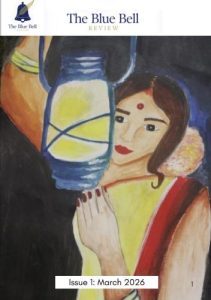
The Blue Bell Review publishes quarterly issues with occasional special issues as well as regularly updated content on their website, accepting a wide range of submissions in writing (poetry, prose, essays, reviews, op-eds, travelogues, and articles), art (drawings, paintings, collages, 3D art, digital art, Best-Out-Of-Waste, etc.), and multimedia (animations, audio, video, apps, and music). Each issue is published as an HTML Flipbook, PDF, free download, and open online access.
Childhood Influences
The Blue Bell Review Founder and Editor-in-Chief Elaine Elizabeth Jinto explains the publication’s name comes from the home where she was born. “It was there that I first began telling stories, exploring, and creating,” she shares, “which is why the place holds such deep meaning for me. I have always loved the color blue, and I especially cherished the gentle wind chimes that once hung in a quiet corner of my old home.”
Jinto credits her growing up as the inspiration for The Blue Bell Review, “I still remember the day I presented my parents with a folder of ten poems and stories painstakingly written out in my best handwriting — a big deal when one is nine years old. I told my parents that I wanted to get published, and to my surprise, they agreed. My mom grabbed her phone and searched for a place where students could submit writing, and the first thing she saw was Stone Soup. That is where my journey began. It was an amazing community: warm, friendly, and teeming with creativity.
“I am a writer like any other. I rejoice over the rare acceptance, collect rejection emails with false bravado, and write at the most inconvenient times. But Stone Soup has been a constant in my life since that evening — a source of inspiration, motivation, and entertainment. I wanted to create a platform like that myself for students all around the world. One thing I have always been disappointed about is the fact that there are virtually no prestigious platforms based in India for creative children. I wanted to remedy that, and here we are!”
Experienced Masthead
Jinto was formerly the Editor-in-Chief of her school magazine, and her work has appeared or is forthcoming in Stone Soup, Skipping Stones, Bookosmia, STEM Chronicles, Wildfire Weekly, Kingfisher Quarterly, and elsewhere. Jinto serves as a member of the Inklings Members Advisory Team at the Society of Young Inklings. She is also an editor at Phosphorescent Lit and In The Margins, and has been recognized at the GetLit Poetry Fest and the Metaphoria Contest.
Joining her on the masthead is Prose Editor Kyle Chinchio. A few years ago, he had the opportunity to write for The Week Junior, where his piece was published in their magazine after several weeks of revising, refining, and interviewing. Chinchio also regularly participates in Stone Soup’s monthly writing prompts and has been honored to place in the Top 10 multiple times.
Blog Editor Aanyaa Tekwani has worked on a variety of creative writing projects, including short stories and poetry submissions for youth literary platforms such as Stone Soup. Her writing primarily focuses on emotion-driven storytelling, often exploring reflective themes and meaningful personal perspectives.
Editor M. Havish Reddy has had the opportunity to review art submissions along with pieces written in Kannada (the state language of Karnataka, where the magazine originated). Reddy has secured the State First Rank in the Kannada Olympiad for two consecutive years and loves drawing, pencil shading, and working with watercolors and oil pastels.
Additionally, while The Blue Bell Review is youth run, there is an Adult Advisory Board consisting of esteemed professionals who offer their advice.
Helping Creators Grow
Submissions are accepted from youths aged 6–16 on a rolling basis and are read blind by The Blue Bell Review editors with Jinto taking the first look. She explains, “If it is something I know we are going to reject immediately — content that doesn’t match our guidelines, submission guidelines not followed, too many grammar errors — I don’t send it to the editors. If it looks promising, I send it to the appropriate editor, who reviews it and gets back to me. They also write feedback for the piece, which we then send to the submitter. If we are unable to make a decision — such as when we had to choose a winner for our Young Writers’ Ekphrastic Contest hosted in collaboration with Phosphorescent Lit — the entire editorial board votes, and we choose based on the majority.”
The publication does not accept AI-generated writing, Jinto says, “Pieces that are generated by AI are rejected immediately. We don’t provide feedback because we don’t see how it will help the creator grow. We have read so many AI-generated pieces that we can often identify them on the spot; however, to double-check, we put them through multiple AI detectors before making a final decision.”
Response time is generally within a month.
Thoughtful Curation
In addition to art and writing from differently abled, neurodivergent, and non-English speaking students, The Blue Bell Review readers will find honest and thoughtfully curated content by young writers across the globe, along with cool prompts, book recommendations, and advice from established writers, editors, and former contributors.
For readers looking for great writing, and for creators looking for submission insight, the editors offer some commentary on pieces in their first issue:
Jinto’s recommendation: “I simply loved Sanvi Devanshi’s poem, ‘Litany for a Cold Moon’. The moment I finished reading it for the first time, I knew we had to publish it. I deeply appreciated the poem’s unique comparisons, such as loving the moon through ‘calculation, vigil, and ruin,’ which gave the piece a thoughtful, almost spiritual quality. One particular line — ‘At her fullness, the world grew dangerous. / Even stone remembered water.’ — was especially moving. For potential submitters who want to understand the kind of writing we are looking for, Sanvi’s piece is a stellar example.”
Chinchio’s recommendation: “I really enjoyed Shravya Kadekar’s piece, ‘This Time Will Be Different’. It had a deeply interesting concept and skillfully played with the reader’s emotions throughout. The writing was clean, engaging, and easy to read, making the story all the more impactful. One line that particularly stood out to me was: ‘I turned and saw my younger sister, Naomi, standing beside my older brother, Leo. Naomi clutched the box with both hands, her fingers white with nerves. Her messy braids hung loose around her face, and her oversized sweater nearly swallowed her whole.’”
Tekwani’s recommendation: “Selah Cross’ poem, ‘Single Drop’, was magnificent. I really admired how the poem used a single raindrop to symbolize the small actions that often go unnoticed yet still carry the power to create meaningful change. The imagery throughout the piece felt both calm and vivid, particularly in its beautiful descriptions of rain and nature. The line that caught my attention the most was, ‘And yet the earth is made more fair / For its having fallen there.’ It beautifully captures the idea that even small, often unnoticed things can still hold meaning and leave a lasting impact.
Reddy’s recommendation: “My favorite artwork was Harshitha’s drawing from the workshop in Hosapete. I especially admired it because, despite being only in 6th grade and having very limited resources while living in a village, she was still able to create something truly impressive. Her work was a wonderful example of talent, creativity, and determination shining through regardless of circumstance.”
Jinto reflects on the start-up learning curve, sharing, “The most surprising and disappointing thing was the number of AI-generated pieces we get. We want to feature youth voices with all their imperfections and errors, but sometimes people don’t seem to get that. It’s sad when we have to reject a piece because it was AI-generated.” At the same time, Jinto sees the value in using AI in the writing process, “We are building an AI Creative Assistant to support neurodivergent, differently-abled, and non-English speakers in their creative process.”
Future Collaborations
From this strong start, Jinto has plans for the future of The Blue Bell Review, “We hope to become a registered organization, which will allow us to expand our vision in meaningful ways. One of our major goals is to begin releasing print-on-demand issues, making our publication more accessible to readers in physical form. Of course, we also dream of being able to pay our contributors for their incredible work, as we deeply value the time, creativity, and effort they put into their writing and art. Looking further ahead, one of our biggest aspirations is to publish full-length books by young contributors, giving emerging voices an even larger platform to share their stories with the world. We are also looking into collaborating with schools to create anthologies.”
Jinto expands on their ideal collaboration, “We would be honored to collaborate with more organizations that work with neurodivergent, differently-abled, and non-English speaking students. We provide tailored art and writing workshops to suit the students’ needs, teach them how to use our AI assistant, and guide them hand-in-hand to create a piece. These pieces will then be published in a Special Issue, compiling all the work created during the session.”
For a sample, you can view a Special Issue from their workshops with the Sakhi Trust here: https://thebluebellreview.info/archive/issue/special-issue
Note: The editors can only conduct offline workshops in Bangalore, India for now, but they are completely open to hosting online workshops. Visit the The Blue Bell Review website for more details and contact information.