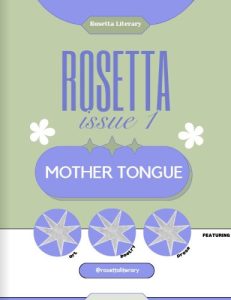
Rosetta Literary is a new online international literary magazine promoting diverse global voices that favors exploring the intersection of culture and language to challenge stigma and bias. This authentic, original, and creative publication connects writers and artists worldwide through inclusive storytelling and especially welcomes submissions from first-generation and low-income creators with a special focus on youth 14-25.
The name of the publication, the editors share, is “inspired by the Rosetta Stone and its global symbolism of diversity, multilingualism, and ‘deciphering’ the inner human spirit. Just like the Stone, we seek to be a beacon of culture through artistic expression.”
Creating Opportunities for Others
Co-Founders and Co-Editors-in-Chief Jenny Chu and Audrey Han discuss their motivation for taking on a literary magazine, “We wanted to get an ‘in’ into the publishing world and try building a magazine ourselves start to finish. We wanted to publish amazing works and meet even more amazing collaborators and contributors in the process and provide resources our younger selves didn’t have.”
While Rosetta Literary is a learning space, the editors themselves are not new to writing and publishing. A high school student from Dallas, Texas, Jenny Chu’s work has been recognized by YoungArts, Scholastic Art & Writing Awards, Guernsey Literary Festival, Texas Cultural Trust, Texas Commission on the Arts, Poetry Society of New York, NSPA, and NCTE, among others. She has studied at Iowa Young Writers’ Studio, Adroit Journal Summer Mentorship, and Sewanee Young Writers’ Conference. Her work appears in journals such as Pithead Chapel, The Shore, and Gone Lawn, among others.
Audrey Han is a senior in high school with a passion for any kind of prose and sometimes poetry. She has been recognized multiple times by Alliance for Young Artists and Writers and also placed second at University Interscholastic League State. She also attended Iowa Young Writers’ Studio.
Rounding out the masthead are Poetry Executive Editor Gracie Jones, Art Executive Editor Zixin Song, Poetry Editor Jiyoo Kim-Jung, and Poetry Editor Sonia Kamnitzer – full profiles can be read on the Rosetta Literary website.
Supportive Sub Process
For writers looking to submit works, there are no submission fees and response time is 3-4 months. Rosetta Literary staff each reads a certain number of submissions after the EICs distribute them, the EICs look over each submission decision again. For a certain number of early submissions from contributors ages 14-25, they will provide a page of personalized feedback for contributors who request it.
Rosetta Literary publishes two-three issues per year and welcomes any type of poetry, shorter fiction, nonfiction, prose (up to 10 pages), any type of art. The publication may also include other forms of writing if they are collaborating with another organization, as well as offering educational workshops with no participation fees.
Representative Reading
Readers of Rosetta Literary can expect to find diverse, intensely human and personal art and writing from young writers from across the world. “We want to show stories and underrepresented cultures that aren’t meaningful just in narrative, but also craft. We are also passionate about graphic design, so works will be beautifully arranged in our signature colors of green and blue.”
Some early contributors include Michelle Li, Fiona Jin, Suchita Senthil Kumar, Betty Stanton, Leviathan A. Solivagant, Thomas Acquistapace, Sarah Watkins, Gail, Grycel, Morgan Boyer, Annette Gagliardi, Marisela Davi Torres and Jyair David. Issue 3 (released June 20) features winners and shortlisted works from their Cipher Contest.
Encouraging Future
The best advice Rosetta Literary editors can offer to others considering starting a literary magazine: “Just do it! Sometimes you just have to figure it out as you go; even if there’s ups and downs, you have to stay faithful to your values and dive in headfirst.”
After such a strong start, Rosetta Literary is not slowing a bit. The editors continue to build collaborations to increase their outreach and encouragement for young creatives. The editors look forward to continued growth, “We want to expand interdisciplinary youth programs of accessibility beyond our magazine, and we also want to continue hosting contests and perhaps publish digital chapbooks.”
Encouragement is tantamount to Rosetta Literary’s mission, as the editors offer this final word to young writers and artists, “Stay resilient. Trust your voice, submit to places like Rosetta, take both rejections and acceptances in stride. Your work’s already worth the world.”