For this week’s newsletter prompt, I opted not to dive into music, movies, dramas, or literature (in the fullest sense), but instead wanted to explore something I have experienced more often than I would like to admit: auditory illusions. Whether from caretaker trauma, the memory of a voice calling my name in the middle of the night, or those moments in crowded places when I swear someone has spoken to me—only to find no one nearby.
That got me thinking about a poem I loved in my college creative writing class, Naomi Shihab Nye’s ‘The Words Under the Words.’ I also found myself thinking about Jane Arden’s classic song ‘Insensitive,’ which explores a different—but related—kind of echo.
Inspiration Prompt: Auditory Illusions
Have you ever heard your name called in an empty house? Or listened to a cat cry and, for a split second, felt your body insist it sounded like a human infant? These uncanny moments aren’t just tricks of the ear—they’re invitations to listen for what else might be speaking.
Naomi Shihab Nye asks whether we can hear “the words under the words.” Auditory illusions—those misheard fragments, phantom echoes, or emotional reverberations—often point toward that deeper layer. They reveal the private logic of the mind, the meanings we continue to translate even when nothing external is making a sound.
And then there’s the kind of auditory haunting Jane Arden names in “Insensitive”: the voice you can’t stop hearing long after the relationship has ended. It lingers not because you want it back, but because your nervous system memorized it. The cadence remains long after the conversation is over. That too is an illusion of sorts—memory performing its own echo chamber—another version of “the words under the words,” the layer we continue to interpret long after the speaker has gone.
This week’s prompt asks you to explore that deeper space: the gap between what is heard and what is felt, between the literal sound and the emotional frequency beneath it. Writing into those gaps is an act of faith—faith that the surface layer isn’t the whole story, faith that something underneath is asking to be recognized.
Why We Hear What Isn’t There
Auditory illusions emerge where perception and emotion collide. We mishear because of:
Longing or Grief
The mind reaches for a familiar frequency—a lost loved one’s voice, a phrase that once meant safety.
Trauma
The world sharpens, and every sound becomes coded with urgency or threat.
Desire
We hear the “yes” in the static because part of us needs it to be there.
These “mis-hearings” aren’t errors; they’re insights. They reveal a character’s internal landscape more clearly than any literal description could.
3 Tips for Writing Sound, Silence, and the Unheard
1. Write the Subtext Literally
If your scene has two layers—a polite, surface-level exchange and a charged emotional undercurrent—try writing both. Put the spoken words on the page, and let the internal monologue or sensory interpretation run beneath it. The friction becomes the drama.
2. Use Onomatopoeia Sparingly—But Write the Physicality of Sound
Avoid the easy “Bang!” or “Clack!” Instead, describe how the sound lands in the body. Does it thud like a heartbeat? Buzz like anxiety? Vibrate in the teeth? The physical response is often more revealing than the noise itself.
3. Lean Into the Uncanny
The most compelling auditory illusions are almost right—but not quite. A voice that sounds like a familiar friend but lacks their usual warmth. Footsteps that mimic someone’s gait but drag just a little too long. Let your reader feel the uncanniness.
Listening for What’s Beneath
Each week, through prompts like this, we explore how perception—especially misperception—can reveal the deeper story. Whether you’re writing about phantom calls, remembered voices, or conversations with two layers, the goal remains the same:
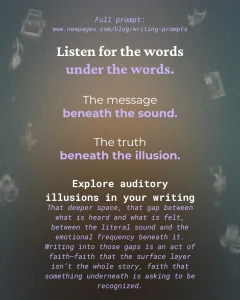
Listen for the words under the words.
The message beneath the sound.
The truth beneath the illusion.
If you want prompts like this delivered each week—along with news about book releases, new lit mag issues, bookstore updates, and a carefully curated list of submission opportunities—consider subscribing to our weekly newsletter!