Uncle Frank’s Diary
Number Five
The Night I Prayed
for Castro, and What Happened Then:
A Meditation Prompted by a Current Controversy
Librarians who pay attention to such things may recall–from the recesses of their World Trade Center-preoccupied noggins–seeing recent coverage of the “independent library” question in Cuba.
The story of anti-Castro libraries, or “libraries,” cropping up in Cuba in defiance of state sanctions has appeared in places ranging from American Libraries to theWashington Post, as well as in some hot on-line exchanges about the matter. According to an article by David Gonzalez in the June 6, 2001 New York Times, there are approximately 60 such libraries in Cuba.
As most things do for the ever-solipsistic Uncle Frank, the controversy awakens sleeping memory banks. Let us go back, back into the dim recesses of a more innocent time…
Back when I was a kid, when everything was still in black and white, I regularly watched the Ed Sullivan Show on Sunday evening. This was well before the Beatles, in the days of Eisenhower and U-2 flights over Russia and anxiety about a possible nuclear “exchange” over a couple of islands–Quemoy and Matsu–that you’ve probably never heard of unless you’re of a certain age. I recall praying, as an eight-year-old, I believe, that we would not blow up the world over those two islands. As you’ll soon see, I was just a prayin’ fool in those days.
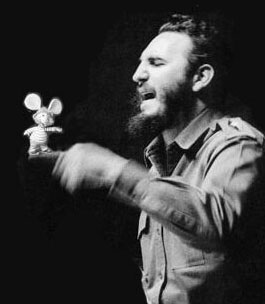
Sometimes Big Ed featured some pretty good material, not the least of which was a pre-bloated Elvis. Sometimes he put on some hopelessly lame acts, most notably “the Italian Mouse,” Topo Gigio. I hated that stupid puppet–and Ed had him on all the damned time! The circus acts were also a complete waste of my family’s 17-inch Admiral TV’s screen, but it was a variety show, so nothing lasted very long. The worst swill in show biz (viz., Topo Gigio) might give way to something wonderful.
Fidel Meets Big Ed
From time to time Ed went a little off the wall, by 1950s American television standards. One night in 1959, he ran a filmed interview with Fidel Castro and his fellow revolutionaries as they hunkered down in the Cuban hills, before their upcoming push to kick dictator Fulgencio Batista and his goons off the island. (Imagine the bizarritude: It’s the height of the Cold War, and here’s Fidel Castro on the Ed Sullivan Show! Holy moley, what next? Beaver and Wally quoting Trotsky?)
At the time, my chief reading (aside from what I had to do for 7th grade, which wasn’t much, and much of that I didn’t do with any enthusiasm) consisted of Madmagazine (nearly at the apex of its goodness–nothing like the poor thing it has declined to in the present day), the Sporting News, and science fiction. Somehow, though, I had come across some disturbing coverage of Batista and his reign, possibly in the Reader’s Digest. (If it’s in print, I’ll read it. What the hell, eh?) When Big Ed ran the interview with Fidel and the boys, my ears perked up and my eyes widened.
“Wow,” I thought, or something like that. Here are these bearded guys up in the mountains, and they’re out to free the Cuban people from a rotten dictator! Cool! The Sullivan coverage was very positive. The audience applauded when the interview was over; the Sullivan audience always applauded the film clips.
“Imagine the bizarritude:
It’s the height of the Cold War,
and here’s Fidel Castro on the
Ed Sullivan Show!
Holy moley, what next?
Beaver and Wally quoting Trotsky?”
Oh Dear God, Have a Cigar: My Hero Just Had a Revolution
I was knocked out. I went to bed that night, my heart astir with revolutionary fervor. I couldn’t sleep, thinking about the brave Fidel and his men in their struggle against the loathsome Batista. So carried away was I that, by God, I prayed for the success of the revolutionaries! I lay right there in my bed, a touching testament to the efficacy of Sunday school, and sent my best wishes for their triumph Heavenward.
God answered my prayer. I admit before you now that I, a pre-adolescent idealist romantic acting on the life-long exhortations of my patriotic, Christian tutors, am (as far as I know) singularly responsible for facilitating the Cuban Revolution through my invocation of Divine Will. Yes, you can petition the Lord with prayer!
As we all know, the U.S. did not respond with good grace to Castro’s ascension. Something about the new Cuban government nationalizing corporate properties didn’t sit well with freedom-loving Americans. When our hostility to this sort of thing led Cuba to lean on the Ruskies for support, we went berserk. JFK and the best and the brightest nearly got us all killed at the high point of our pique over the Cuban-Soviet dealing. If you weren’t there, or weren’t old enough to pay attention, in that run of dark days in October of ’62, you can’t imagine. We were getting ready to kiss our buns good-bye. General anticipation held that they would soon be toasted, fried, poached, and barbecued.
Some clever diplomatic correspondence kept us out of the fire, but ever since that point, U.S. policy toward Cuba has shown a complete absence of enlightened self-interest, to say nothing of basic humane consideration for the Cuban people. By seeking to isolate Cuba, and indulging in a breathtakingly stupid, vindictive obsession, the U.S. government has helped provoke the worst in the Cuban government, and has, almost without a doubt, helped insure that the point at which Cuba enjoys true democratic life will continually recede with the horizon, at least until some vague day after Fidel shuffles off to his eternal reward–which will probably have him sharing hot seats with fellow people’s giants Mao and Stalin.
The Revolutionary Good Life
Fidel is a tyrant, and has been most of his career. He can’t stand criticism. He’s a control freak with an extensive enforcement network to help him maintain rigid authority. Bad things happen to those who publicly question him or his policies. The Committee to Protect Journalists, a nonpartisan, nonprofit org founded in 1981 (http://www.cpj.org/index.html), this May included Fidel for the seventh time as one of the ten worst enemies of the press in the world. He joins such insults to basic notions of journalistic freedom as Iran’s Ayatolla Khamenei, Liberia’s Charles Taylor, Zimbabwe’s Robert Mugabe, and Russia’s Vladimir Putin.
Fine company, indeed. Here is some of the CPJ’s take on Fidel:
“Fidel Castro’s government continues its scorched-earth assault on independent Cuban journalists by interrogating and detaining reporters, monitoring and interrupting their telephone calls, restricting their travel, and routinely putting them under house arrest to prevent coverage of certain events…. Cuba is the only country in the Western Hemisphere that currently holds a journalist in jail for his work. Bernardo Arevalo Padron continues to serve a six year sentence for reporting critical of Castro and the Communist Party.”
Trying to recruit followers in opposition to the Cuban government is a sure ticket to trouble. Amnesty International’s 2001 report on Cuba notes that Fidel’s functionaries keep hundreds of people imprisoned for political reasons. Cuba conducts kangaroo-court trials of its political enemies, employs the death penalty with vigor (maybe the Cuban officials could contact George W. for some pointers), and, when in the mood, subjects prisoners to cruel and inhuman treatment.
Any government that tries to control what its citizens read is evil.
There is but one legal political party in Cuba, Fidel’s. According to Amnesty International, in the period covered by its report, “Individuals and groups peacefully exercising their rights to freedom of expression, association and assembly continued to face repression.” There was “serious escalation in repression during the closing months of 2000.” Living the good life under Fidel, those who attempt to organize meetings, express views or form organizations opposing government policy are subject to short-term detention, interrogation, threats, intimidation, eviction, loss of employment, restrictions on travel, house searches, house arrests, phone bugging and physical and verbal acts of aggression carried out by government supporters.
Authoritarian governments never have a problem finding sociopaths eager to help carry out “support” for official policies. It’s nice to know that gainful employment is available to those who would otherwise find it difficult to make ends meet.
Independent Libraries, or Outlets for U.S. Propaganda?
Curiously, authoritarian governments also don’t have a hard time finding sympathetic observers abroad. A good bit of the verbiage on the “independent libraries” is sympathetic to the official Cuban position: These libraries and the people who run them, or attempt to run them, are enemies of revolutionary enlightenment. The major point of concern for a number of U.S. librarians who support official Cuban libraries seems to be whether the “independent library” movement is truly independent, or whether it is simply one more arm of the counter-revolutionary octopus encouraged by U.S. policy.
The chief point of those who support the independent libraries is that Cuba’s official libraries are not free; they cannot offer the reading public all points of view, particularly those of a political stripe. Official Cuban libraries are, on one level, tools the dictatorship employs to help control the reading, hence the thinking and political behavior, of the Cuban people.
Are They, or Aren’t They?
Some critics of the independent libraries attack them because they are not “real” libraries run by “real” librarians; those assembling collections of forbidden literature are not positively sanctioned and certified by the authorities. Well, honestly: Uncle Frank is shocked.
There is something a little disingenuous about arguing that only “real” librarians can assemble “real” libraries in an authoritarian state, or anywhere else, for that matter. Countless private dwellings and other facilities on the planet contain what over the centuries people have called “libraries.” Some have been very impressive libraries. Some, little dinky libraries. Although the great majority of these libraries were not, and are not, built by professional librarians, it strains reason to suggest that they do not deserve to be called libraries.
One fears that only a self-conscious professional snootiness (a quality, alas, not unknown in libraryland) would permit a librarian to sight down his or her uplifted nose and declare a collection of literature “not a library” because it does not occupy an officially-approved library building, or because no professional librarian had a hand in its creation, or because it is not impressively large.
Perfectly Clear and Precious
The U.S. government (or at least some of its leading advocates of retro-think) is eager to provide financial support to the independent libraries. With U.S. money at their disposal, these facilities would more easily spread their message.
So what? If the ideas thus advanced did not reflect the values of the Cuban people, they would fall on dry ground and quickly wither. Can it be that after four decades of Fidel, the virtues of the revolutionary government are not perfectly clear and precious to those who enjoy them daily? What, then, do Cuban officials fear from these pitiful “independent libraries”–run by people who are not even (gasp!) real librarians–and why do their U.S. critics worry about the sources of their funding? Is it possible that the Cuban government and its U.S. friends do not enjoy complete confidence that the Cuban people share their faith in the fruits of the revolution? That Cubans might want to try other possibilities in the political orchard?
That is terribly hard to imagine, unless one reflects on the observations on Cuban political and intellectual life put forward by such groups as Amnesty International and the Committee to Protect Journalists.
Sometimes I suspect that the romantic notions of noble rebellion that I entertained the night I saw Fidel and the boys on the Ed Sullivan Show are much the same as those animating today’s defenders and admirers of the Cuban regime, regardless of the subtopic (libraries, health care, literacy, whatever). I will not apologize for having been naïve at the age of 12, or for having prayed for Fidel’s success. Batista was a thug, and deserved to go down. What is Fidel today?
“Don’t follow leaders; watch the parking meters.”
Bob Dylan said that. (He didn’t say that Fidel’s time has expired.)
Any government that tries to control what its citizens read is evil.
Uncle Frank said that.
###
Graphics by Karen McGinnis