Uncle Frank’s Diary
Number Ten
Who Needs Librarians?
Let’s Get Some Trained Monkeys!
The matter, as is usually the case, devolves to money. It costs a lot less to exploit a clerk than it does to exploit a librarian. An OCL reference clerk earns about $22K a year. A librarian starts at $31K. Presumably savings in fringe benefits augment the $9K difference when the system sheds a librarian.
What a week.
My car is laid up in the shop with a shot intake manifold gasket. Judging by the speed at which things are happening, they’re manufacturing a new gasket from recycled asbestos siding at a sweatshop in Guatemala. It’s due in, oh, some day. I’m driving a borrowed car (my son’s) to work.
He’s really happy about that. Or maybe he doesn’t care: The back brakes are out of whack, so that when I step on them at low speeds they lock up, and the car bounces up and down like a lowrider from one of Uncle Frank’s bad dreams. I can lay a patch in the driveway at three miles an hour.
But that’s better than falling off my bike, which feat I accomplished the other night. I hit a spot of loose gravel just as I began to turn. The bike went one way; I went the other, into the asphalt pavement. I laid several patches of hide on the road. The right side of my body looks as though someone has been practicing on it with a power sander. My wife took one look and insisted that I start wearing a helmet.
A helmet? Real librarians don’t wear helmets.
But she insisted, so I bought the baddest looking black helmet I could find, took it home, and modeled it for my wife.
“You look like a Dutch policeman,” she said.
All right. So I’ll wear the shades with it. Maybe that will help.
Forward, into the Future!
Maybe Uncle Frank will wear them when he busts into the Orange County Library in Orlando, Fla., to take names and kick sand.
Real librarians have apparently been taking it on the chin at the OCL, and not by pitching over their handlebars and doing face melds with the roadway. Library management is reportedly replacing them with clerical workers. Staff writer James Miller notes in his Aug. 16 Orlando Sentinel piece (“Library accused of using clerks as librarians”) that since August of 1999, the number of OCL librarians assigned to work with the public has dropped from 73 to 64. In the same period, the non-librarian staff grew from 203 to 214.
Miller says that system Director Mary Anne Hodel sees the staff transformation as “leading the library toward the future.”
Well, sure. Everything leads toward the future, one way or another. According to Director Hodel, who has been on the job since this past January, “It doesn’t take a librarian to show someone how to use the Internet. What matters is service—whoever provides it.”
Hmm. If she feels that way about it, maybe she could enlist the help of some of OCL’s constant patrons. Every library with public Web access has them: the folks who arrive shortly after the library opens in the morning, cement themselves to a chair, and stay at a computer as long as they’re allowed to fool around in their chat rooms, email, Neopet pages, and what-not. Some of these individuals really know their way around the Web, or a part of it, and would probably be glad to help others for nothing. Then the library could get rid of a whole bunch of regular staff.
It’s Not About Service; It’s About Money
The matter, as is usually the case, devolves to money. It costs a lot less to exploit a clerk than it does to exploit a librarian. An OCL reference clerk earns about $22K a year. A librarian starts at $31K. Presumably savings in fringe benefits augment the $9K difference when the system sheds a librarian.
(Now you know who’s standing in line to buy those obscene SUVs that Detroit cranks out: reference librarians with large wads of dough—of the Bureau of Engraving and Printing variety—hanging from their pockets. Most of them aren’t like me, driving an ’87 Buick Century to work out of ersatz identification with the working class.)
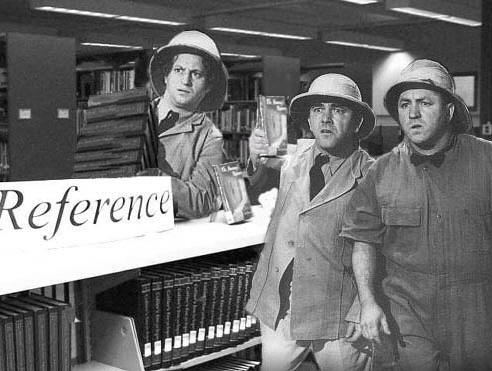
There’s nothing new or unusual about this tactic. At a local library system I used to visit, clerical staff were habitually referred to as “librarians,” while no degreed librarians were in sight. Libraries in general would be in big trouble without their clerical workers, but calling a clerk a librarian is like calling a hospital orderly a doctor. Assigning a clerk to perform traditional librarian services—reference work, original cataloging, collection development—is like handing an orderly a kit bag full of operating tools and sending her into the OR to perform surgery.
At that same local library system, by the way, I occasionally found the “librarian” clerk’s pre-adolescent daughter on “duty” at the information desk while her mother tended something else. Is this service, or what?
It’s “Women’s Work,” Anyhow, Right?
At the root of this crummy business lies the traditional under valuation of “women’s work.” Professions that have been dominated in numbers by female practitioners—teaching, librarianship, nursing—have always been grossly underpaid in relation to the education required to master them, and the skill and judgment their members have been expected to exercise.
Through history, women have come cheap (through no fault of their own), and the libraries of the world have not hesitated to take advantage of the fact. If they can take advantage by paying highly-educated practitioners humble wages, all to the good of the institutional economy; if they can persuade their clientele that they don’t really need these well-trained practitioners, that a clerk with a high school diploma and a year’s experience can do “just as well,” then why keep those “expensive” librarians on the job? Dump ‘em, and fill their places with even-worse-paid clerks expected to function at levels of responsibility far beyond their training and education.
Hell, let ‘em put their 12-year-old kids at the reference desk, the way they did in my old neighborhood. A trained chimp could check out a book, right? And be glad to work for peanuts. Or bananas.
And many library patrons would think it “cute.”
Such a deal for the budget keepers!
How Do You Know What’s Good if You Don’t Know What’s What?
Ronald Harbert, president of the OCL board of trustees, has asked patrons to alert him to “shortages of service” occasioned by the library’s staffing plan. How do library patrons know when they’re receiving inadequate service, beyond egregious examples? People who are not expert library users can easily mistake earnest but uninformed and inadequate service as passing muster, just as someone who knows little or nothing about medical procedures can assume that a careless doctor’s diagnosis and treatment are on the ball.
It’s the same all over: As expenses rise and municipal budgets erode, managers struggle to fill the holes while papering over the resulting shoddy public service with happy talk. The selfless heroes in the Michigan legislature not long ago saw to it that they received pay raises of almost 40 percent. These same ascetic public servants, annoyed over tuition hikes, are busy telling the state’s public colleges and universities—which they have been underfunding for years—to “tighten their belts, like everyone else.”
Uh-huh. Like everyone else.
Like libraries that send amateurs to do professional work. Go ahead and use those libraries, but leave your helmet on when you enter. That way, it won’t hurt so much when you swat your forehead in frustration over the inept service that results from trying to do things on the cheap.
###
Graphics by Karen McGinnis